IEFE 2013 Workshop
Designing a Curriculum
Evaluation
Dr. Dorothy Harnish
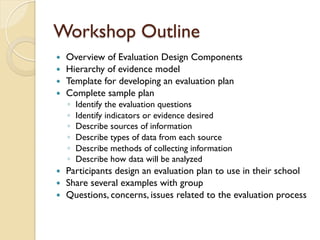
Workshop Outline
—  Overview of Evaluation Design Components
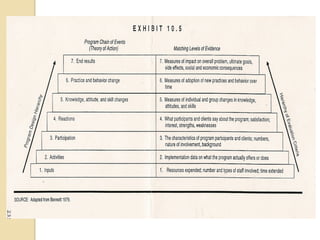
—  Hierarchy of evidence model
—  Template for developing an evaluation plan
—  Complete sample plan
◦  Identify the evaluation questions
◦  Identify indicators or evidence desired
◦  Describe sources of information
◦  Describe types of data from each source
◦  Describe methods of collecting information
◦  Describe how data will be analyzed
—  Participants design an evaluation plan to use in their school
—  Share several examples with group
—  Questions, concerns, issues related to the evaluation process
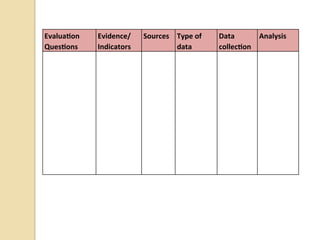
Evalua&on	
  
Ques&ons	
  
Evidence/	
  
Indicators	
  
Sources	
   Type	
  of	
  
data	
  	
  
Data	
  
collec&on	
  
Analysis	
  
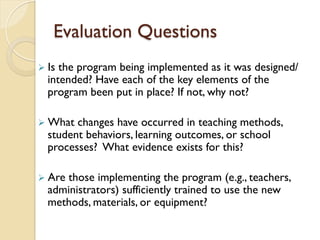
Evaluation Questions
Ø Is the program being implemented as it was designed/
intended? Have each of the key elements of the
program been put in place? If not, why not?
Ø What changes have occurred in teaching methods,
student behaviors, learning outcomes, or school
processes? What evidence exists for this?
Ø Are those implementing the program (e.g., teachers,
administrators) sufficiently trained to use the new
methods, materials, or equipment?
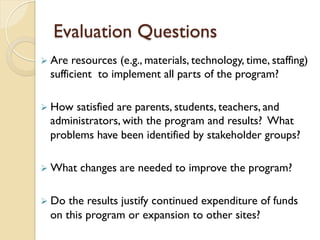
Evaluation Questions
Ø Are resources (e.g., materials, technology, time, staffing)
sufficient to implement all parts of the program?
Ø How satisfied are parents, students, teachers, and
administrators, with the program and results? What
problems have been identified by stakeholder groups?
Ø What changes are needed to improve the program?
Ø Do the results justify continued expenditure of funds
on this program or expansion to other sites?
Information Sources
—  People
—  Products
—  Processes
—  Documents/Materials
—  Importance of “triangulation” through
multiple sources of information
Data Collection
Ø Methods determined by evaluation purpose
and questions
Ø Qualitative and quantitative methods
§ on-site field observations
§ individual interviews
§ focus groups
§ questionnaires
§ document or program materials review
§ student test or performance data
Data Analysis & Reporting
—  Experimental, quasi-experimental,
longitudinal, and qualitative analyses
—  Pre-post analyses to assess growth and
impact
—  Comparison groups
—  Randomization to control extraneous
variables
—  Generalization of findings
—  Difficulty of cause-effect conclusions
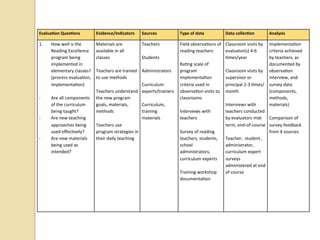
Evalua&on	
  Ques&ons	
   Evidence/Indicators	
   Sources	
   Type	
  of	
  data	
  	
   Data	
  collec&on	
   Analysis	
  
1.  How	
  well	
  is	
  the	
  
Reading	
  Excellence	
  
program	
  being	
  
implemented	
  in	
  
elementary	
  classes?	
  
(process	
  evalua>on,	
  
implementa>on)	


-­‐  Are	
  all	
  components	
  
of	
  the	
  curriculum	
  
being	
  taught?	
  
-­‐  Are	
  new	
  teaching	
  
approaches	
  being	
  
used	
  effec>vely?	
  
-­‐  Are	
  new	
  materials	
  
being	
  used	
  as	
  
intended?	
  
Materials	
  are	
  
available	
  in	
  all	
  
classes	


Teachers	
  are	
  trained	
  
to	
  use	
  methods	


Teachers	
  understand	
  
the	
  new	
  program	
  
goals,	
  materials,	
  
methods	


Teachers	
  use	
  
program	
  strategies	
  in	
  
their	
  daily	
  teaching	
  
Teachers	


Students	


Administrators	


Curriculum	
  
experts/trainers	


Curriculum,	
  
training	
  	
  
materials	
  
Field	
  observa>ons	
  of	
  
reading	
  teachers	


Ra>ng	
  scale	
  of	
  
program	
  
implementa>on	
  
criteria	
  used	
  in	
  
observa>on	
  visits	
  to	
  
classrooms	


Interviews	
  with	
  
teachers	


Survey	
  of	
  reading	
  
teachers,	
  students,	
  
school	
  
administrators,	
  
curriculum	
  experts	


Training	
  workshop	
  
documenta>on	
  
Classroom	
  visits	
  by	
  
evaluator(s)	
  4-­‐6	
  
>mes/year	


Classroom	
  visits	
  by	
  
supervisor	
  or	
  
principal	
  2-­‐3	
  >mes/
month	


Interviews	
  with	
  
teachers	
  conducted	
  
by	
  evaluators	
  mid-­‐
term,	
  end-­‐of-­‐course	


Teacher,	
  	
  student	
  ,	
  
administrator,	
  
curriculum	
  expert	
  
surveys	
  
administered	
  at	
  end	
  
of	
  course	
  
Implementa>on	
  
criteria	
  achieved	
  
by	
  teachers,	
  as	
  
documented	
  by	
  
observa>on	
  
interview,	
  and	
  
survey	
  data	
  
(components,	
  
methods,	
  
materials)	


Comparison	
  of	
  
survey	
  feedback	
  
from	
  4	
  sources	
  
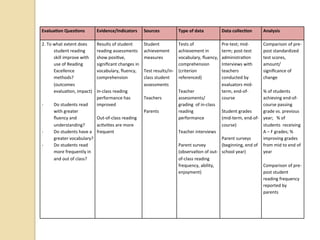
Evalua&on	
  Ques&ons	
   Evidence/Indicators	
   Sources	
   Type	
  of	
  data	
  	
   Data	
  collec&on	
   Analysis	
  
2.	
  To	
  what	
  extent	
  does	
  
student	
  reading	
  
skill	
  improve	
  with	
  
use	
  of	
  Reading	
  
Excellence	
  
methods?	
  
(outcomes	
  
evalua>on,	
  impact)	


-­‐  Do	
  students	
  read	
  
with	
  greater	
  
fluency	
  and	
  
understanding?	
  
-­‐  Do	
  students	
  have	
  a	
  
greater	
  vocabulary?	
  
-­‐  Do	
  students	
  read	
  
more	
  frequently	
  in	
  
and	
  out	
  of	
  class?	
  
Results	
  of	
  student	
  
reading	
  assessments	
  
show	
  posi>ve,	
  
significant	
  changes	
  in	
  	
  
vocabulary,	
  fluency,	
  
comprehension	


In-­‐class	
  reading	
  
performance	
  has	
  
improved	


Out-­‐of-­‐class	
  reading	
  
ac>vi>es	
  are	
  more	
  
frequent	
  
Student	
  
achievement	
  
measures	


Test	
  results/in-­‐
class	
  student	
  
assessments	


Teachers	


Parents	


Tests	
  of	
  
achievement	
  in	
  
vocabulary,	
  fluency,	
  
comprehension	
  
(criterion	
  
referenced)	


Teacher	
  
assessments/	
  
grading	
  	
  of	
  in-­‐class	
  
reading	
  
performance	


Teacher	
  interviews	


Parent	
  survey	
  
(observa>on	
  of	
  out-­‐
of-­‐class	
  reading	
  
frequency,	
  ability,	
  
enjoyment)	
  
Pre-­‐test;	
  mid-­‐
term;	
  post-­‐test	
  
administra>on	
  	
  
Interviews	
  with	
  
teachers	
  
conducted	
  by	
  
evaluators	
  mid-­‐
term,	
  end-­‐of-­‐
course	


Student	
  grades	
  
(mid-­‐term,	
  end-­‐of-­‐
course)	


Parent	
  surveys	
  
(beginning,	
  end	
  of	
  
school	
  year)	
  
Comparison	
  of	
  pre-­‐
post	
  standardized	
  
test	
  scores,	
  
amount/	
  
significance	
  of	
  
change	


%	
  of	
  students	
  
achieving	
  end-­‐of-­‐
course	
  passing	
  
grade	
  vs.	
  previous	
  
year;	
  	
  	
  %	
  of	
  
students	
  	
  receiving	
  
A	
  –	
  F	
  grades;	
  %	
  
improving	
  grades	
  
from	
  mid	
  to	
  end	
  of	
  
year	


Comparison	
  of	
  pre-­‐
post	
  student	
  
reading	
  frequency	
  
reported	
  by	
  
parents	
  

تصميم عمليات تقويم المناهج

  • 1.
    IEFE 2013 Workshop Designinga Curriculum Evaluation Dr. Dorothy Harnish
  • 2.
    Workshop Outline —  Overviewof Evaluation Design Components —  Hierarchy of evidence model —  Template for developing an evaluation plan —  Complete sample plan ◦  Identify the evaluation questions ◦  Identify indicators or evidence desired ◦  Describe sources of information ◦  Describe types of data from each source ◦  Describe methods of collecting information ◦  Describe how data will be analyzed —  Participants design an evaluation plan to use in their school —  Share several examples with group —  Questions, concerns, issues related to the evaluation process
  • 3.
    Evalua&on   Ques&ons   Evidence/   Indicators   Sources   Type  of   data     Data   collec&on   Analysis  
  • 4.
    Evaluation Questions Ø Is theprogram being implemented as it was designed/ intended? Have each of the key elements of the program been put in place? If not, why not? Ø What changes have occurred in teaching methods, student behaviors, learning outcomes, or school processes? What evidence exists for this? Ø Are those implementing the program (e.g., teachers, administrators) sufficiently trained to use the new methods, materials, or equipment?
  • 5.
    Evaluation Questions Ø Are resources(e.g., materials, technology, time, staffing) sufficient to implement all parts of the program? Ø How satisfied are parents, students, teachers, and administrators, with the program and results? What problems have been identified by stakeholder groups? Ø What changes are needed to improve the program? Ø Do the results justify continued expenditure of funds on this program or expansion to other sites?
  • 6.
    Information Sources —  People — Products —  Processes —  Documents/Materials —  Importance of “triangulation” through multiple sources of information
  • 7.
    Data Collection Ø Methods determinedby evaluation purpose and questions Ø Qualitative and quantitative methods § on-site field observations § individual interviews § focus groups § questionnaires § document or program materials review § student test or performance data
  • 8.
    Data Analysis &Reporting —  Experimental, quasi-experimental, longitudinal, and qualitative analyses —  Pre-post analyses to assess growth and impact —  Comparison groups —  Randomization to control extraneous variables —  Generalization of findings —  Difficulty of cause-effect conclusions
  • 10.
    Evalua&on  Ques&ons  Evidence/Indicators   Sources   Type  of  data     Data  collec&on   Analysis   1.  How  well  is  the   Reading  Excellence   program  being   implemented  in   elementary  classes?   (process  evalua>on,   implementa>on)     -­‐  Are  all  components   of  the  curriculum   being  taught?   -­‐  Are  new  teaching   approaches  being   used  effec>vely?   -­‐  Are  new  materials   being  used  as   intended?   Materials  are   available  in  all   classes     Teachers  are  trained   to  use  methods     Teachers  understand   the  new  program   goals,  materials,   methods     Teachers  use   program  strategies  in   their  daily  teaching   Teachers     Students     Administrators     Curriculum   experts/trainers       Curriculum,   training     materials   Field  observa>ons  of   reading  teachers       Ra>ng  scale  of   program   implementa>on   criteria  used  in   observa>on  visits  to   classrooms     Interviews  with   teachers       Survey  of  reading   teachers,  students,   school   administrators,   curriculum  experts     Training  workshop   documenta>on   Classroom  visits  by   evaluator(s)  4-­‐6   >mes/year     Classroom  visits  by   supervisor  or   principal  2-­‐3  >mes/ month     Interviews  with   teachers  conducted   by  evaluators  mid-­‐ term,  end-­‐of-­‐course     Teacher,    student  ,   administrator,   curriculum  expert   surveys   administered  at  end   of  course   Implementa>on   criteria  achieved   by  teachers,  as   documented  by   observa>on   interview,  and   survey  data   (components,   methods,   materials)     Comparison  of   survey  feedback   from  4  sources  
  • 11.
    Evalua&on  Ques&ons  Evidence/Indicators   Sources   Type  of  data     Data  collec&on   Analysis   2.  To  what  extent  does   student  reading   skill  improve  with   use  of  Reading   Excellence   methods?   (outcomes   evalua>on,  impact)     -­‐  Do  students  read   with  greater   fluency  and   understanding?   -­‐  Do  students  have  a   greater  vocabulary?   -­‐  Do  students  read   more  frequently  in   and  out  of  class?   Results  of  student   reading  assessments   show  posi>ve,   significant  changes  in     vocabulary,  fluency,   comprehension     In-­‐class  reading   performance  has   improved     Out-­‐of-­‐class  reading   ac>vi>es  are  more   frequent   Student   achievement   measures     Test  results/in-­‐ class  student   assessments     Teachers     Parents     Tests  of   achievement  in   vocabulary,  fluency,   comprehension   (criterion   referenced)     Teacher   assessments/   grading    of  in-­‐class   reading   performance         Teacher  interviews     Parent  survey   (observa>on  of  out-­‐ of-­‐class  reading   frequency,  ability,   enjoyment)   Pre-­‐test;  mid-­‐ term;  post-­‐test   administra>on     Interviews  with   teachers   conducted  by   evaluators  mid-­‐ term,  end-­‐of-­‐ course     Student  grades   (mid-­‐term,  end-­‐of-­‐ course)     Parent  surveys   (beginning,  end  of   school  year)   Comparison  of  pre-­‐ post  standardized   test  scores,   amount/   significance  of   change       %  of  students   achieving  end-­‐of-­‐ course  passing   grade  vs.  previous   year;      %  of   students    receiving   A  –  F  grades;  %   improving  grades   from  mid  to  end  of   year     Comparison  of  pre-­‐ post  student   reading  frequency   reported  by   parents