Evaluation in Swaziland
schools: types of evaluation,
challenges faced by teachers
and means of dealing with the
challenges
BY

MOSES G. MABUZA
128529
Introduction
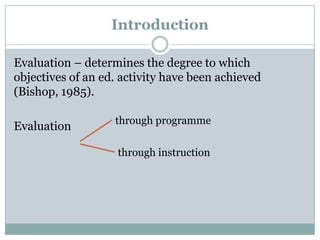
Evaluation – determines the degree to which
objectives of an ed. activity have been achieved
(Bishop, 1985).
Evaluation

through programme
through instruction
Intro. continues
Purpose of evaluation
 Facilitate st. learning
 Improve instruction
 Report progress of students
 Decision making
Evaluation types
 Formative
 Summative
 diagnostic
Background
Evaluation is:
 Hottest issue in recent ed. developments (Kotze,
2003)
 Important process in curr. dvlpt (Bishop, 1985)
 Ensures curr, educator and institution
accountability.
Statement of the problem
Decline in SGCSE pass rate over past 4 years (ECOS
reports)
Research objectives
Determine practically the types of evaln used in
Swaziland schools.
2. Ascertain the challenges faced by teachers during
evaluation.
3. Find ways of tackling the challenges
1.
Significance of study
 Provide knowledge of the types of evaln.
 How to deal with evaluation challenges.
Conceptual framework
Certain assessment concepts need clarification to
distinguish btn ed. activities (Kotze, 2003)
Measurement – assign numbers
Testing – determine level of achivement
Assessmemnt – gather information
Evaluation – weigh ass. information
Formative assessment
Summative assessment
Literature review
Methodology
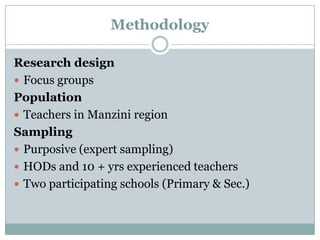
Research design
 Focus groups
Population
 Teachers in Manzini region
Sampling
 Purposive (expert sampling)
 HODs and 10 + yrs experienced teachers
 Two participating schools (Primary & Sec.)
Methodology cont.
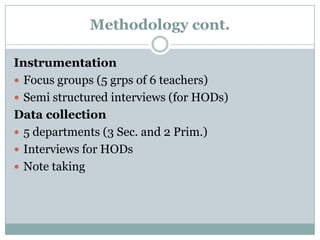
Instrumentation
 Focus groups (5 grps of 6 teachers)
 Semi structured interviews (for HODs)
Data collection
 5 departments (3 Sec. and 2 Prim.)
 Interviews for HODs
 Note taking
Data analysis
 Concurrent with data collection
 Content analysis
 Narration
Findings
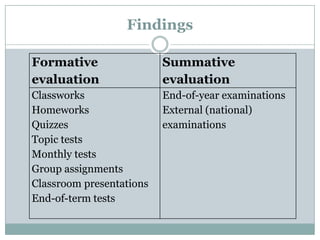
Formative
evaluation

Summative
evaluation

Classworks
Homeworks
Quizzes
Topic tests
Monthly tests
Group assignments
Classroom presentations
End-of-term tests

End-of-year examinations
External (national)
examinations
Findings cont.
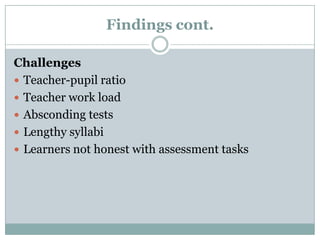
Challenges
 Teacher-pupil ratio
 Teacher work load
 Absconding tests
 Lengthy syllabi
 Learners not honest with assessment tasks
Findings cont.
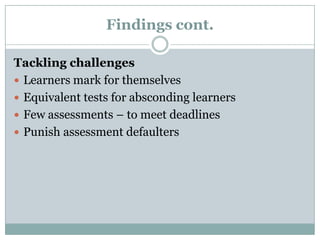
Tackling challenges
 Learners mark for themselves
 Equivalent tests for absconding learners
 Few assessments – to meet deadlines
 Punish assessment defaulters
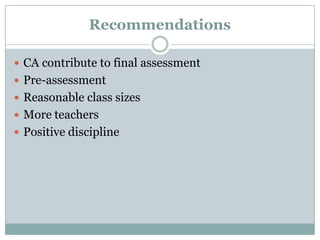
Recommendations
 CA contribute to final assessment
 Pre-assessment
 Reasonable class sizes
 More teachers
 Positive discipline

Evaluation in swaziland schools