AGENDA
What is SQL


WHAT is SQL injection


SQL Injection Attack Types


Prevention of SQL Injection Attack


                                      2
WHAT IS SQL?
SQL is a special-purpose programming
 language designed for managing data held in
 a relational database management systems (RDBMS).

The scope of SQL includes data insert, query, update
 and delete, schema creation and modification, and
 data access control.


                                                        3
What is SQL injection?
A class of code-injection attacks, in which data provided by the
 user is included in an SQL query in such a way that part of the
 user’s input is treated as SQL code
SQL injection is a technique to maliciously exploit applications
 that use client-supplied data in SQL statements. Attackers trick
 the SQL engine into executing unintended commands by
 supplying specially crafted string input, thereby gaining
 unauthorized access to a database in order to view or
 manipulate restricted data.
 SQL injection techniques may differ, but they all exploit a
 single vulnerability in the application:
  Incorrectly validated or non validated string literals are
 concatenated into a dynamic SQL statement, and
 interpreted as code by the SQL engine.

                                                                    4
Example of SQL injection


                           5
TYPES OF SQL ATTACKS
1)First Order Attack:-The attacker can simply enter a
 malicious string and cause the modified code to be
 executed immediately.
2)Second Order Attack:-The attacker injects into
 persistent storage (such as a table row) which is deemed
 as a trusted source. An attack is subsequently executed by
 another activity.
3)Lateral Injection:-The attacker can manipulate the
 implicit functionTo_Char() by changing the values of the
 environment
 variables, NLS_Date_Format orNLS_Numeric_Characters.
                                                              6
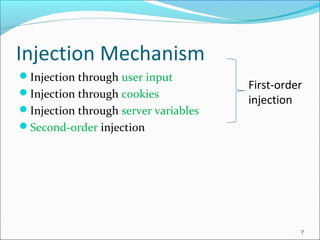
Injection Mechanism
Injection through user input
                                      First-order
Injection through cookies
                                      injection
Injection through server variables
Second-order injection


                                                7
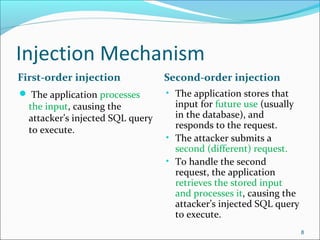
Injection Mechanism
First-order injection             Second-order injection
 The application processes       • The application stores that
  the input, causing the            input for future use (usually
  attacker’s injected SQL query     in the database), and
  to execute.                       responds to the request.
                                  • The attacker submits a
                                    second (different) request.
                                  • To handle the second
                                    request, the application
                                    retrieves the stored input
                                    and processes it, causing the
                                    attacker’s injected SQL query
                                    to execute.
                                                                    8
Attack Intent
Determining database schema
Extracting data
Adding or modifying data
Bypassing authentication


                               9
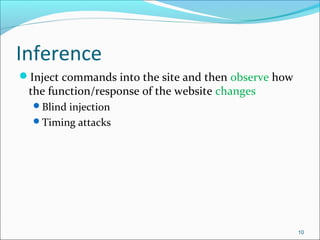
Inference
Inject commands into the site and then observe how
 the function/response of the website changes
  Blind injection
  Timing attacks


                                                      10
Blind SQL injection
The information must be inferred from the behavior
 of the page by asking the server true/false questions


                                                         11
Timing Attacks
Gain information by observing timing delays in the
 response of the database


                                                      12
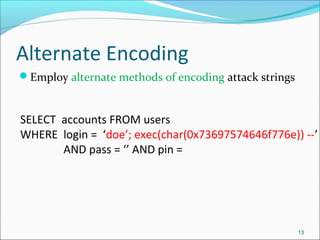
Alternate Encoding
Employ alternate methods of encoding attack strings


SELECT accounts FROM users
WHERE login = ‘doe’; exec(char(0x73697574646f776e)) --’
       AND pass = ‘’ AND pin =


                                                       13
Prevention of SQLIAs
The root cause of SQL injection vulnerabilities is
 insufficient input validation

Solution:
  Defensive coding practices
  Detection & Prevention techniques


                                                      14
REFERENCES
www.wikipedia.com
www.google.com
download.oracle.com
QUERIES

Sql injection

  • 2.
    AGENDA What is SQL WHATis SQL injection SQL Injection Attack Types Prevention of SQL Injection Attack 2
  • 3.
    WHAT IS SQL? SQLis a special-purpose programming language designed for managing data held in a relational database management systems (RDBMS). The scope of SQL includes data insert, query, update and delete, schema creation and modification, and data access control. 3
  • 4.
    What is SQLinjection? A class of code-injection attacks, in which data provided by the user is included in an SQL query in such a way that part of the user’s input is treated as SQL code SQL injection is a technique to maliciously exploit applications that use client-supplied data in SQL statements. Attackers trick the SQL engine into executing unintended commands by supplying specially crafted string input, thereby gaining unauthorized access to a database in order to view or manipulate restricted data.  SQL injection techniques may differ, but they all exploit a single vulnerability in the application: Incorrectly validated or non validated string literals are concatenated into a dynamic SQL statement, and interpreted as code by the SQL engine. 4
  • 5.
    Example of SQLinjection 5
  • 6.
    TYPES OF SQLATTACKS 1)First Order Attack:-The attacker can simply enter a malicious string and cause the modified code to be executed immediately. 2)Second Order Attack:-The attacker injects into persistent storage (such as a table row) which is deemed as a trusted source. An attack is subsequently executed by another activity. 3)Lateral Injection:-The attacker can manipulate the implicit functionTo_Char() by changing the values of the environment variables, NLS_Date_Format orNLS_Numeric_Characters. 6
  • 7.
    Injection Mechanism Injection throughuser input First-order Injection through cookies injection Injection through server variables Second-order injection 7
  • 8.
    Injection Mechanism First-order injection Second-order injection  The application processes • The application stores that the input, causing the input for future use (usually attacker’s injected SQL query in the database), and to execute. responds to the request. • The attacker submits a second (different) request. • To handle the second request, the application retrieves the stored input and processes it, causing the attacker’s injected SQL query to execute. 8
  • 9.
    Attack Intent Determining databaseschema Extracting data Adding or modifying data Bypassing authentication 9
  • 10.
    Inference Inject commands intothe site and then observe how the function/response of the website changes Blind injection Timing attacks 10
  • 11.
    Blind SQL injection Theinformation must be inferred from the behavior of the page by asking the server true/false questions 11
  • 12.
    Timing Attacks Gain informationby observing timing delays in the response of the database 12
  • 13.
    Alternate Encoding Employ alternatemethods of encoding attack strings SELECT accounts FROM users WHERE login = ‘doe’; exec(char(0x73697574646f776e)) --’ AND pass = ‘’ AND pin = 13
  • 14.
    Prevention of SQLIAs Theroot cause of SQL injection vulnerabilities is insufficient input validation Solution: Defensive coding practices Detection & Prevention techniques 14
  • 15.
  • 16.

Editor's Notes

  • #5 -Code-injection attacks: LDAP injection for LDAP directory and XPath injection for XML documents, ASP, PHP, HTML injection
  • #8 -User input typically comes from form submissions that are sent to Web application via HTTP GET or POST requests. -Cookies are stored on the client machine. If a Web application uses the cookie’s contents to build SQL queries, an attacker could easily submit an attack by embedding it in the cookie -Server variables are the collection of variables that contain HTTP, network headers, & environmental variables. Web applications use these server variables in variety of ways, such as logging usage statistics & identifying browsing trends => attackers can forge these values
  • #14 -Avoid detection by defensive coding practices & also many automated prevention techniques -Attackers have employed alternate methods of encoding their attack strings. Common scanning & detection techniques do not try to evaluate all specially encoded strings, thus allowing these attacks to go undetected -Different layers in an application have different ways of handling alternate encodings -An effective code-based defense against alternate encodings is difficult to implement in practice
  • #15 -Defensive coding practices: straightforward solution for eliminating these vulnerabilities -Detection & prevention techniques: assist developer & compensate for the shortcomings in the application of defensive coding