
10+ Testing Pitfalls
Looking at some of the main common testing mistakes
and the ways to avoid them
With: Joel Montvelisky - Chief Solution Architect
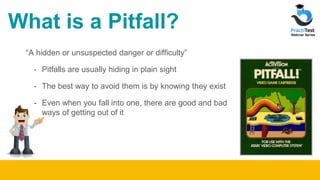
What is a Pitfall?
“A hidden or unsuspected danger or difficulty”
- Pitfalls are usually hiding in plain sight
- The best way to avoid them is by knowing they exist
- Even when you fall into one, there are good and bad
ways of getting out of it
Who should care
about Pitfalls?
- New Testers
- Team Leaders
- Experienced Test Managers
- Even I myself ;-)
Everyone!
Who am I?
Professions :
(last 20 years)
- Tester
- QA Manager
- Blogger
- Speaker
- Solution Architect
PractiTest:
- Chief Solution Architect
- QA Manager
About
✓ SaaS ALM Solution
✓ Simple & Intuitive – yet – Professional & Flexible
✓ Integrates with Jira, Selenium, Jenkins, Pivotal Tracker, QTP,
Bugzilla, Ranorex, SoapUI, etc…
✓ Best Darn Support in the Business ☺
My Mindmap about Testing Pitfalls
www.mindmup.com
Classification of Our Pitfalls
Planning
Personal
Project
Planning Pitfalls
Planning Pitfalls
Your Test Plan is only the basis for managing and executing your work.
This plan should have the information that will
allow you to quickly make:
- Assessments
- Decisions
- Changes
Image source: https://www.dreamstime.com
1. Bad or No Prioritization
Do you prioritize your test plan based on importance?
Down the line you will need to make changes and even sacrifices,
but some Test Plans lack prioritization altogether…
Idea!
Simple Prioritization:
P1 - What needs to be Fully Tested
P2 - What needs High Level Regression
P3 - What can be Sanitized Only
Planning Pitfalls
2. Under-planning
Your plan doesn’t account for important things like
Resources, Delivery Schedules, Training, Materials, etc.
Don’t reinvent the wheel!!
You can look for a template!
For example: http://qablog.practitest.com/master-test-plan-testing-strategic-side/
You can also brainstorm with your team on what do they think
is important to plan ahead - make sure to bring examples.
Planning Pitfalls
3. Over-planning
For example: Your Gantt chart includes every person in your team,
on a half-a-day resolution for the next 6 months
Things will go wrong and even more things will change along the way.
Over-planning will make you inflexible.
Don’t overplan!
Define High Level plans for the whole project, and Low Level plans
only for the week or two weeks ahead. Or work Agile :-)
Planning Pitfalls
4. Not Adapting to Changes
Your project will change, and not adapting to them will leave you
out of sync, and probably out of a job…
How about…?
- Expect Change & Be Flexible.
- Update your High Level plans at least once a week.
- When changes happen, communicate the repercussions right away.
- Be a team player (and not a party pooper!)
Planning Pitfalls
Project Pitfalls
Project Pitfalls
Let’s define Project as:
Everything happening as part of the actual operations, and around the
interactions between the players.
Stuff <=> Work <=> People
5. Bad Communication Culture
Two main concrete issues:
- Disruption of the Information Flow
and
- Blame-Game Culture.
What can you do??
Be the Responsible Grown-Up in the team and bring the issue up.
Explain the benefits of transparency and good communications.
Project Pitfalls
6. Ignoring the Needs of the Testing Team
Failing to accommodate for testing constraints, schedule bottlenecks,
testability (specially around automation), and more...
Speak Up!
It is not selfishness or being spoiled. Let the rest of the team
understand what are the repercussions (with enough time) so
that they can make the corrective actions.
Project Pitfalls
7. Unrealistic Timelines and “SMALL” Changes
“You are not a teamplayer!”
“How can it take you twice as long as Development to test it?!?!”
“C’mon! You cannot bring this up every time we need to change something!”
You are a Tester, not a Magician!
Be consistent but not grumpy.
You are not the gatekeeper, you should only provide visibility.
Explain the alternatives (what you will not test!) and let the team be part
of the decision process.
Project Pitfalls
8. Lack of Resources and Skills
- You need a Load Tester to do Load Testing
- You need a Developer to do Automation
- You need access to devices to test Mobile
It takes time and money to have all the resources you need for a project!
Solution:
Plan this as part of your Test Plan. Bring these points up as soon as possible
(before you make your low level plans!) - secure budgets as soon as you can.
Project Pitfalls
Personal Pitfalls
Personal (& Personality) Pitfalls
Many of the most important pitfalls are the ones
that come from within ourselves and limit our
interactions with the rest of the team players
Personal Pitfalls
9. The Friendly Team Player Conundrum
https://www.youtube.com/watch?v=3WHSkbM9zAU
10. Emotional Testing
Our mood and approach influences everything we do, including the tests we run.
- Developers are not your enemies!
- Feedback, comments and rejections should never be personal!
Solution:
Ignore who wrote a feature or who are reporting the bug to. You cannot be soft to
some and strict to others, this means you need to be strict with all of them.
You need to do your job so that others can do theirs, but remember to smile while
you are at it.
Personal Pitfalls
11. Personal Bad Communication
Some of us are bad at any or both of these:
- Inwards communication - learning more what we need to do
- Outwards communication - explaining what we found
Solution:
Communication is one of the most complex topics in testing (you can see our
previous webinar).
This is something you need to MASTER if you want to be a good tester.
Personal Pitfalls
12. Lack of Realism
Avoid any of the 2 extremes:
- Optimism: everything will sort out by itself, no need to worry about things
- Pessimism: no matter what we do this project will fail, no need to worry about
things
Solution:
Keep your cool. When you lose perspective walk it off until you can
approach the issue from the right and realistic angle.
Be the person who comes up with the solutions, not only the problems
Personal Pitfalls
13. Shyness
Sometimes we feel like the most junior member of the project, assuming anything
we see was already seen and dismissed by the “more experienced” guys.
Solution:
If you see or feel something is not right make sure to bring this up. If it is
just a feeling look for a person who may help you to concretize this to
something tangible.
Many times it takes fresh eyes to see the Elephant in the Room.
Personal Pitfalls
The Pitfalls - in one view
1. Bad or No Prioritization
2. Under-planning
3. Over-planning
4. Not Adapting to Changes
5. Bad Communication Culture
6. Ignoring Testing Needs
7. “Small” Changes & Unreal timelines
8. Lack of Resources & Skills
9. Friendly Team Player Conundrum
10. Emotional Testing
11. Bad Communication
12. Lack of realism
(optimism vs pessimism)
13. Shyness
Conclusion
Many times we are our own worst
enemies…
The best way to fight testing pitfalls is
to be aware of them, and to have
peers to helps us visualize them as
they happen.
Q&A
Thank you
joel@practitest.com
http://qablog.practitest.com/

10+ Testing Pitfalls and How to Avoid them

  • 1.
    10+ Testing Pitfalls Lookingat some of the main common testing mistakes and the ways to avoid them With: Joel Montvelisky - Chief Solution Architect
  • 2.
    What is aPitfall? “A hidden or unsuspected danger or difficulty” - Pitfalls are usually hiding in plain sight - The best way to avoid them is by knowing they exist - Even when you fall into one, there are good and bad ways of getting out of it
  • 3.
    Who should care aboutPitfalls? - New Testers - Team Leaders - Experienced Test Managers - Even I myself ;-) Everyone!
  • 4.
    Who am I? Professions: (last 20 years) - Tester - QA Manager - Blogger - Speaker - Solution Architect PractiTest: - Chief Solution Architect - QA Manager
  • 5.
    About ✓ SaaS ALMSolution ✓ Simple & Intuitive – yet – Professional & Flexible ✓ Integrates with Jira, Selenium, Jenkins, Pivotal Tracker, QTP, Bugzilla, Ranorex, SoapUI, etc… ✓ Best Darn Support in the Business ☺
  • 6.
    My Mindmap aboutTesting Pitfalls www.mindmup.com
  • 7.
    Classification of OurPitfalls Planning Personal Project
  • 8.
  • 9.
    Planning Pitfalls Your TestPlan is only the basis for managing and executing your work. This plan should have the information that will allow you to quickly make: - Assessments - Decisions - Changes Image source: https://www.dreamstime.com
  • 10.
    1. Bad orNo Prioritization Do you prioritize your test plan based on importance? Down the line you will need to make changes and even sacrifices, but some Test Plans lack prioritization altogether… Idea! Simple Prioritization: P1 - What needs to be Fully Tested P2 - What needs High Level Regression P3 - What can be Sanitized Only Planning Pitfalls
  • 11.
    2. Under-planning Your plandoesn’t account for important things like Resources, Delivery Schedules, Training, Materials, etc. Don’t reinvent the wheel!! You can look for a template! For example: http://qablog.practitest.com/master-test-plan-testing-strategic-side/ You can also brainstorm with your team on what do they think is important to plan ahead - make sure to bring examples. Planning Pitfalls
  • 12.
    3. Over-planning For example:Your Gantt chart includes every person in your team, on a half-a-day resolution for the next 6 months Things will go wrong and even more things will change along the way. Over-planning will make you inflexible. Don’t overplan! Define High Level plans for the whole project, and Low Level plans only for the week or two weeks ahead. Or work Agile :-) Planning Pitfalls
  • 13.
    4. Not Adaptingto Changes Your project will change, and not adapting to them will leave you out of sync, and probably out of a job… How about…? - Expect Change & Be Flexible. - Update your High Level plans at least once a week. - When changes happen, communicate the repercussions right away. - Be a team player (and not a party pooper!) Planning Pitfalls
  • 14.
  • 15.
    Project Pitfalls Let’s defineProject as: Everything happening as part of the actual operations, and around the interactions between the players. Stuff <=> Work <=> People
  • 16.
    5. Bad CommunicationCulture Two main concrete issues: - Disruption of the Information Flow and - Blame-Game Culture. What can you do?? Be the Responsible Grown-Up in the team and bring the issue up. Explain the benefits of transparency and good communications. Project Pitfalls
  • 17.
    6. Ignoring theNeeds of the Testing Team Failing to accommodate for testing constraints, schedule bottlenecks, testability (specially around automation), and more... Speak Up! It is not selfishness or being spoiled. Let the rest of the team understand what are the repercussions (with enough time) so that they can make the corrective actions. Project Pitfalls
  • 18.
    7. Unrealistic Timelinesand “SMALL” Changes “You are not a teamplayer!” “How can it take you twice as long as Development to test it?!?!” “C’mon! You cannot bring this up every time we need to change something!” You are a Tester, not a Magician! Be consistent but not grumpy. You are not the gatekeeper, you should only provide visibility. Explain the alternatives (what you will not test!) and let the team be part of the decision process. Project Pitfalls
  • 19.
    8. Lack ofResources and Skills - You need a Load Tester to do Load Testing - You need a Developer to do Automation - You need access to devices to test Mobile It takes time and money to have all the resources you need for a project! Solution: Plan this as part of your Test Plan. Bring these points up as soon as possible (before you make your low level plans!) - secure budgets as soon as you can. Project Pitfalls
  • 20.
  • 21.
    Personal (& Personality)Pitfalls Many of the most important pitfalls are the ones that come from within ourselves and limit our interactions with the rest of the team players
  • 22.
    Personal Pitfalls 9. TheFriendly Team Player Conundrum https://www.youtube.com/watch?v=3WHSkbM9zAU
  • 23.
    10. Emotional Testing Ourmood and approach influences everything we do, including the tests we run. - Developers are not your enemies! - Feedback, comments and rejections should never be personal! Solution: Ignore who wrote a feature or who are reporting the bug to. You cannot be soft to some and strict to others, this means you need to be strict with all of them. You need to do your job so that others can do theirs, but remember to smile while you are at it. Personal Pitfalls
  • 24.
    11. Personal BadCommunication Some of us are bad at any or both of these: - Inwards communication - learning more what we need to do - Outwards communication - explaining what we found Solution: Communication is one of the most complex topics in testing (you can see our previous webinar). This is something you need to MASTER if you want to be a good tester. Personal Pitfalls
  • 25.
    12. Lack ofRealism Avoid any of the 2 extremes: - Optimism: everything will sort out by itself, no need to worry about things - Pessimism: no matter what we do this project will fail, no need to worry about things Solution: Keep your cool. When you lose perspective walk it off until you can approach the issue from the right and realistic angle. Be the person who comes up with the solutions, not only the problems Personal Pitfalls
  • 26.
    13. Shyness Sometimes wefeel like the most junior member of the project, assuming anything we see was already seen and dismissed by the “more experienced” guys. Solution: If you see or feel something is not right make sure to bring this up. If it is just a feeling look for a person who may help you to concretize this to something tangible. Many times it takes fresh eyes to see the Elephant in the Room. Personal Pitfalls
  • 27.
    The Pitfalls -in one view 1. Bad or No Prioritization 2. Under-planning 3. Over-planning 4. Not Adapting to Changes 5. Bad Communication Culture 6. Ignoring Testing Needs 7. “Small” Changes & Unreal timelines 8. Lack of Resources & Skills 9. Friendly Team Player Conundrum 10. Emotional Testing 11. Bad Communication 12. Lack of realism (optimism vs pessimism) 13. Shyness
  • 28.
    Conclusion Many times weare our own worst enemies… The best way to fight testing pitfalls is to be aware of them, and to have peers to helps us visualize them as they happen.
  • 29.
  • 30.