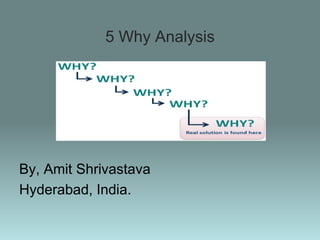
5 Why Analysis
By, Amit Shrivastava
Hyderabad, India.
Why 5 Why ?
To find the…….
When to Use 5 Why
 Complaint from the Client
 Observation from the Client
 Recurring Errors
 First Time Quality
 Internal Quality Issue
 Quality System Audit Non-conformances
5 Why Analysis
 A cross-functional team should be used to
solve the problem
 Don’t jump to conclusions or assume the
answer is obvious
 Don’t be bias
 Be absolutely objective
General Guidelines
 Ask “Why” until the root cause is
uncovered
 It may be more or less than 5 Whys
 If words like “because” or “due to” are
coming in the answer, move to the next
Why
 If you don’t ask enough “Whys”, you may
end up with a “symptom” and not “root
cause”
General Guidelines (Contd…..)
 Corrective action for a symptom is not
effective in eliminating the cause
– Corrective action for a symptom is usually
“detective”
– Corrective action for a root cause can be
“preventive”
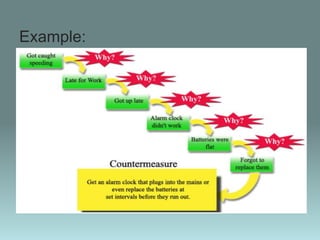
Example:
Criticism of 5 Why:
 We generally stop at symptoms rather
than going on to lower-level root causes
 Lack of support to help the investigator
ask the right "why" questions
 Getting right answer for the "why"
 Different people using 5 Whys, come up
with different causes for the same problem
Criticism of 5 Why (Contd…..)
 Tendency to isolate a single root cause,
whereas each question could elicit many
different root causes
Solution:
Verify the answer to the current "why"
question before proceeding to the next.
5 why analysis

5 why analysis

  • 1.
    5 Why Analysis By,Amit Shrivastava Hyderabad, India.
  • 2.
    Why 5 Why? To find the…….
  • 3.
    When to Use5 Why  Complaint from the Client  Observation from the Client  Recurring Errors  First Time Quality  Internal Quality Issue  Quality System Audit Non-conformances
  • 4.
    5 Why Analysis A cross-functional team should be used to solve the problem  Don’t jump to conclusions or assume the answer is obvious  Don’t be bias  Be absolutely objective
  • 5.
    General Guidelines  Ask“Why” until the root cause is uncovered  It may be more or less than 5 Whys  If words like “because” or “due to” are coming in the answer, move to the next Why  If you don’t ask enough “Whys”, you may end up with a “symptom” and not “root cause”
  • 6.
    General Guidelines (Contd…..) Corrective action for a symptom is not effective in eliminating the cause – Corrective action for a symptom is usually “detective” – Corrective action for a root cause can be “preventive”
  • 7.
  • 8.
    Criticism of 5Why:  We generally stop at symptoms rather than going on to lower-level root causes  Lack of support to help the investigator ask the right "why" questions  Getting right answer for the "why"  Different people using 5 Whys, come up with different causes for the same problem
  • 9.
    Criticism of 5Why (Contd…..)  Tendency to isolate a single root cause, whereas each question could elicit many different root causes
  • 10.
    Solution: Verify the answerto the current "why" question before proceeding to the next.