Extend the Five- Whys to Eight- Whys! Why?Ali Anani
BeforeA previous publication of mine on “Consultative Selling and Customers’ Needs Identification” triggered quite some interest.  A subsequent presentation on “Emotions in Action” gave further support to the first presentation. Out of no where a question jumped into my head.
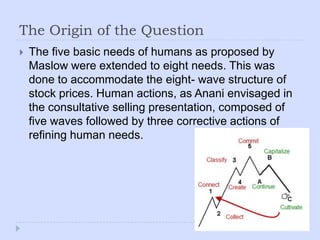
The Origin of the QuestionThe five basic needs of humans as proposed by Maslow were extended to eight needs. This was done to accommodate the eight- wave structure of stock prices. Human actions, as Anani envisaged in the consultative selling presentation, composed of five waves followed by three corrective actions of refining human needs.
The Probing QuestionWhy not then extend the five- why questions to an eight- structured why questions? This will allow greater consistency of standardizing human behavior (if it is!) Five questions and not eight?
The Probing Question- 2Is there any problem with asking only five questions?Five questions Problems
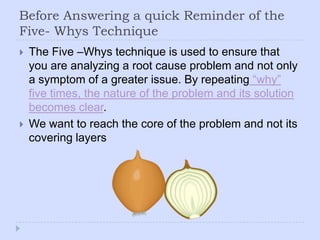
Before Answering a quick Reminder of the Five- Whys TechniqueThe Five –Whys technique is used to ensure that you are analyzing a root cause problem and not only a symptom of a greater issue. By repeating “why” five times, the nature of the problem and its solution becomes clear. We want to reach the core of the problem and not its covering layers
Problems with the Five- Whys TechniqueFirst, using 5 Whys doesn’t always lead to root cause identification when the cause is unknownThe success of 5 Whys is to some degree contingent upon the skill with which the method is appliedThe method isn’t necessarily repeatableFor an excellent reference see Stewart Anderson on the “Root Cause Analysis: Addressing Some Limitations of the 5 Whys”
But There is another Factor Missing?
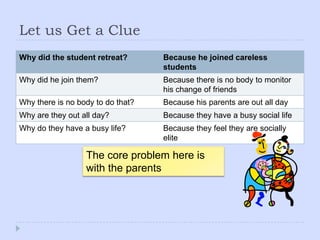
Let us Get a ClueThe core problem here is with the parents
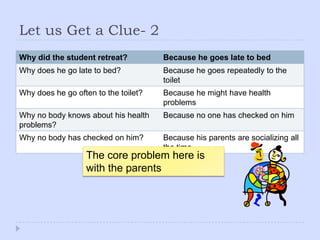
Let us Get a Clue- 2The core problem here is with the parents
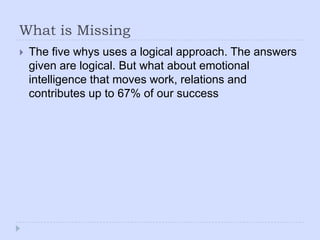
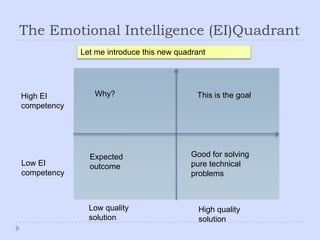
What is MissingThe five whys uses a logical approach. The answers given are logical. But what about emotional intelligence that moves work, relations and contributes up to 67% of our success
The Emotional Intelligence (EI)QuadrantLet me introduce this new quadrantWhy?This is the goalHigh EI competencyGood for solving pure technical problemsExpected outcomeLow EI competencyLow quality solutionHigh quality solution
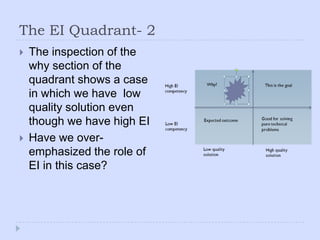
The EI Quadrant- 2The inspection of the why section of the quadrant shows a case in which we have  low quality solution even though we have high EIHave we over-emphasized the role of EI in this case?
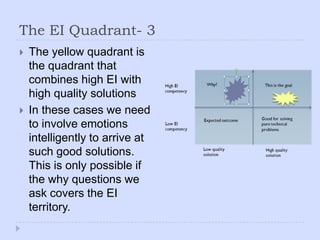
The EI Quadrant- 3The yellow quadrant is the quadrant that combines high EI with high quality solutionsIn these cases we need to involve emotions intelligently to arrive at such good solutions. This is only possible if the why questions we ask covers the EI territory.
The ConclusionWe may need to expand the five- Whys to Eight- Whys to correct for missing the emotional factors.This is analogous to extending the five basic human needs into eight, as I proposed before.

Extend the five whys to eight- whys! why

  • 1.
    Extend the Five-Whys to Eight- Whys! Why?Ali Anani
  • 2.
    BeforeA previous publicationof mine on “Consultative Selling and Customers’ Needs Identification” triggered quite some interest. A subsequent presentation on “Emotions in Action” gave further support to the first presentation. Out of no where a question jumped into my head.
  • 3.
    The Origin ofthe QuestionThe five basic needs of humans as proposed by Maslow were extended to eight needs. This was done to accommodate the eight- wave structure of stock prices. Human actions, as Anani envisaged in the consultative selling presentation, composed of five waves followed by three corrective actions of refining human needs.
  • 4.
    The Probing QuestionWhynot then extend the five- why questions to an eight- structured why questions? This will allow greater consistency of standardizing human behavior (if it is!) Five questions and not eight?
  • 5.
    The Probing Question-2Is there any problem with asking only five questions?Five questions Problems
  • 6.
    Before Answering aquick Reminder of the Five- Whys TechniqueThe Five –Whys technique is used to ensure that you are analyzing a root cause problem and not only a symptom of a greater issue. By repeating “why” five times, the nature of the problem and its solution becomes clear. We want to reach the core of the problem and not its covering layers
  • 7.
    Problems with theFive- Whys TechniqueFirst, using 5 Whys doesn’t always lead to root cause identification when the cause is unknownThe success of 5 Whys is to some degree contingent upon the skill with which the method is appliedThe method isn’t necessarily repeatableFor an excellent reference see Stewart Anderson on the “Root Cause Analysis: Addressing Some Limitations of the 5 Whys”
  • 8.
    But There isanother Factor Missing?
  • 9.
    Let us Geta ClueThe core problem here is with the parents
  • 10.
    Let us Geta Clue- 2The core problem here is with the parents
  • 11.
    What is MissingThefive whys uses a logical approach. The answers given are logical. But what about emotional intelligence that moves work, relations and contributes up to 67% of our success
  • 12.
    The Emotional Intelligence(EI)QuadrantLet me introduce this new quadrantWhy?This is the goalHigh EI competencyGood for solving pure technical problemsExpected outcomeLow EI competencyLow quality solutionHigh quality solution
  • 13.
    The EI Quadrant-2The inspection of the why section of the quadrant shows a case in which we have low quality solution even though we have high EIHave we over-emphasized the role of EI in this case?
  • 14.
    The EI Quadrant-3The yellow quadrant is the quadrant that combines high EI with high quality solutionsIn these cases we need to involve emotions intelligently to arrive at such good solutions. This is only possible if the why questions we ask covers the EI territory.
  • 15.
    The ConclusionWe mayneed to expand the five- Whys to Eight- Whys to correct for missing the emotional factors.This is analogous to extending the five basic human needs into eight, as I proposed before.