Spring steel springs
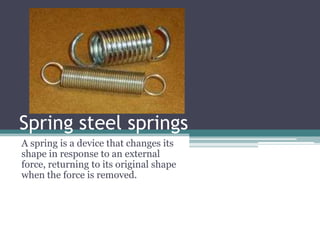
A spring is a device that changes its
shape in response to an external
force, returning to its original shape
when the force is removed.
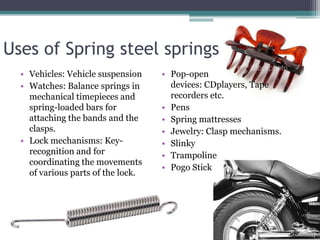
Uses of Spring steel springs
• Vehicles: Vehicle suspension
• Watches: Balance springs in
mechanical timepieces and
spring-loaded bars for
attaching the bands and the
clasps.
• Lock mechanisms: Key-
recognition and for
coordinating the movements
of various parts of the lock.
• Pop-open
devices: CDplayers, Tape
recorders etc.
• Pens
• Spring mattresses
• Jewelry: Clasp mechanisms.
• Slinky
• Trampoline
• Pogo Stick
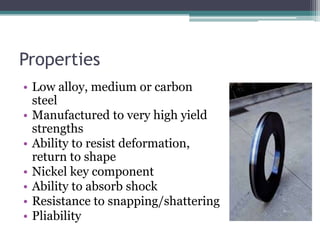
Properties
• Low alloy, medium or carbon
steel
• Manufactured to very high yield
strengths
• Ability to resist deformation,
return to shape
• Nickel key component
• Ability to absorb shock
• Resistance to snapping/shattering
• Pliability
Coiling
Cold winding. Wire up to 0.75 in (18 mm) at room
temperature using one of two basic techniques. One
consists of winding the wire around a shaft called an
arbor or mandrel. This may be done on a dedicated
spring-winding machine, a lathe, an electric hand drill
with the mandrel secured in the chuck, or a winding
machine operated by hand cranking. A guiding
mechanism, such as the lead screw on a lathe, must be
used to align the wire into the desired pitch (distance
between successive coils) as it wraps around the
mandrel.
• Alternatively, the wire may be coiled without a mandrel.
This is generally done with a central navigation
computer (CNC) machine.
Spring steel and Tempering
http://www.youtube.com/watch?v=3CnwUQZ6q7
8
To be kept in mind
When tempering, hardness need to be kept along
the edge and bevel, soft along spine , tensile
strength on middle, soft on knife.
Gas blow torch – BLUE colour. Can be fooled by
the first blue that comes around 580 degrees, the
blue after straw colour. Not good because stays
brittle.
Need darker blue evenly across the steel.
Cold Rolling
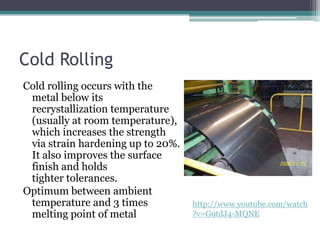
Cold rolling occurs with the
metal below its
recrystallization temperature
(usually at room temperature),
which increases the strength
via strain hardening up to 20%.
It also improves the surface
finish and holds
tighter tolerances.
Optimum between ambient
temperature and 3 times
melting point of metal
http://www.youtube.com/watch
?v=G9tdJ4-MQNE
Stainless 1.4310 spring steel
Grade 1.4310 can be supplied with a tensile strength of up
to 1800 MPa in strip and wire forms, to produce tempers
in the range of 1/16 Hard to Full Hard. The controlled
analysis enables it to retain sufficient ductility in
conditions up to ½ Hard conditions to be roll or brake
formed into components. In simple design forms ¾ to
Full Hard tempers should be used.
Applications:
• Automotive wheel covers and wiper blade holders and
clips
• Toaster springs and stove element clips
• Screen frames and curtain walls
• Highway trailer components
Alternate products
• Piano wire
• Spring clamps
• Antennas
• Metal swords
• Knives
• Fabrication of lockpicks
• Smaller aircrafts landing gear

Spring steel springs

  • 1.
    Spring steel springs Aspring is a device that changes its shape in response to an external force, returning to its original shape when the force is removed.
  • 2.
    Uses of Springsteel springs • Vehicles: Vehicle suspension • Watches: Balance springs in mechanical timepieces and spring-loaded bars for attaching the bands and the clasps. • Lock mechanisms: Key- recognition and for coordinating the movements of various parts of the lock. • Pop-open devices: CDplayers, Tape recorders etc. • Pens • Spring mattresses • Jewelry: Clasp mechanisms. • Slinky • Trampoline • Pogo Stick
  • 3.
    Properties • Low alloy,medium or carbon steel • Manufactured to very high yield strengths • Ability to resist deformation, return to shape • Nickel key component • Ability to absorb shock • Resistance to snapping/shattering • Pliability
  • 4.
    Coiling Cold winding. Wireup to 0.75 in (18 mm) at room temperature using one of two basic techniques. One consists of winding the wire around a shaft called an arbor or mandrel. This may be done on a dedicated spring-winding machine, a lathe, an electric hand drill with the mandrel secured in the chuck, or a winding machine operated by hand cranking. A guiding mechanism, such as the lead screw on a lathe, must be used to align the wire into the desired pitch (distance between successive coils) as it wraps around the mandrel. • Alternatively, the wire may be coiled without a mandrel. This is generally done with a central navigation computer (CNC) machine.
  • 5.
    Spring steel andTempering http://www.youtube.com/watch?v=3CnwUQZ6q7 8
  • 6.
    To be keptin mind When tempering, hardness need to be kept along the edge and bevel, soft along spine , tensile strength on middle, soft on knife. Gas blow torch – BLUE colour. Can be fooled by the first blue that comes around 580 degrees, the blue after straw colour. Not good because stays brittle. Need darker blue evenly across the steel.
  • 7.
    Cold Rolling Cold rollingoccurs with the metal below its recrystallization temperature (usually at room temperature), which increases the strength via strain hardening up to 20%. It also improves the surface finish and holds tighter tolerances. Optimum between ambient temperature and 3 times melting point of metal http://www.youtube.com/watch ?v=G9tdJ4-MQNE
  • 8.
    Stainless 1.4310 springsteel Grade 1.4310 can be supplied with a tensile strength of up to 1800 MPa in strip and wire forms, to produce tempers in the range of 1/16 Hard to Full Hard. The controlled analysis enables it to retain sufficient ductility in conditions up to ½ Hard conditions to be roll or brake formed into components. In simple design forms ¾ to Full Hard tempers should be used. Applications: • Automotive wheel covers and wiper blade holders and clips • Toaster springs and stove element clips • Screen frames and curtain walls • Highway trailer components
  • 9.
    Alternate products • Pianowire • Spring clamps • Antennas • Metal swords • Knives • Fabrication of lockpicks • Smaller aircrafts landing gear