Types of
Springs
Understanding Their Uses and
Manufacturing Process
Procurement & Transport
Anup Howlader
Overview
Introduction
Hooke's Law
Types of springs
Helical Springs
Leaf Springs
Disk Springs
Functions of Springs
Materials Used in Making Springs
Common Manufacturing Process
Conclusion
Introduction
Springs are mechanical components used in many products such as watches,
automobiles, and cellphones. There are many types of springs, each with
unique features making choosing difficult.
Therefore, there is a need to know about them. This article discusses the
common spring types, their applications, materials and what causes a
mechanical spring failure so that you can select the right one.
Spring is a mechanical component that, when compressed by a load,
stores the energy, and releases it when the load is removed. This is
the normal way all springs function irrespective of their types, as
expressed by Hooke’s law.
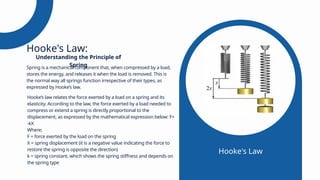
Hooke's Law:
Hooke’s law relates the force exerted by a load on a spring and its
elasticity. According to the law, the force exerted by a load needed to
compress or extend a spring is directly proportional to the
displacement, as expressed by the mathematical expression below: F=
-kX
Where;
F = force exerted by the load on the spring
X = spring displacement (it is a negative value indicating the force to
restore the spring is opposite the direction)
k = spring constant, which shows the spring stiffness and depends on
the spring type
Understanding the Principle of
Spring
Hooke's Law
Types of springs and Their Uses
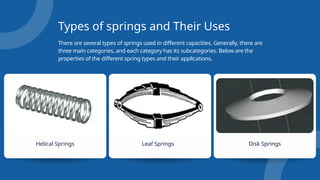
Helical Springs Leaf Springs Disk Springs
There are several types of springs used in different capacities. Generally, there are
three main categories, and each category has its subcategories. Below are the
properties of the different spring types and their applications.
Types of springs and Their Uses
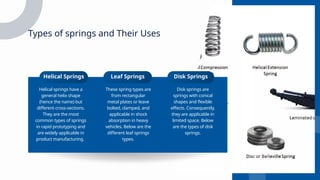
Helical Springs Leaf Springs Disk Springs
Helical springs have a
general helix shape
(hence the name) but
different cross-sections.
They are the most
common types of springs
in rapid prototyping and
are widely applicable in
product manufacturing.
These spring types are
from rectangular
metal plates or leave
bolted, clamped, and
applicable in shock
absorption in heavy
vehicles. Below are the
different leaf springs
types.
Disk springs are
springs with conical
shapes and flexible
effects. Consequently,
they are applicable in
limited space. Below
are the types of disk
springs.
Spiral Springs
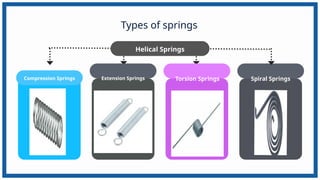
Types of springs
Helical Springs
Compression Springs Extension Springs Torsion Springs
Helical Springs
Helical springs have a general helix shape
(hence the name) but different cross-
sections. They are the most common types
of springs in rapid prototyping and are
widely applicable in product manufacturing.
Below are the different types of helical
springs.
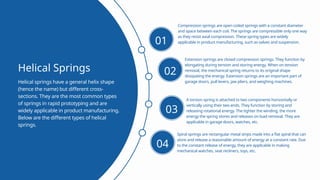
Compression springs are open coiled springs with a constant diameter
and space between each coil. The springs are compressible only one way
as they resist axial compression. These spring types are widely
applicable in product manufacturing, such as valves and suspension.
01
Extension springs are closed compression springs. They function by
elongating during tension and storing energy. When on tension
removal, the mechanical spring returns to its original shape
dissipating the energy. Extension springs are an important part of
garage doors, pull levers, jaw pliers, and weighing machines.
02
A torsion spring is attached to two components horizontally or
vertically using their two ends. They function by storing and
releasing rotational energy. The tighter the winding, the more
energy the spring stores and releases on load removal. They are
applicable in garage doors, watches, etc.
03
Spiral springs are rectangular metal strips made into a flat spiral that can
store and release a reasonable amount of energy at a constant rate. Due
to the constant release of energy, they are applicable in making
mechanical watches, seat recliners, toys, etc.
04
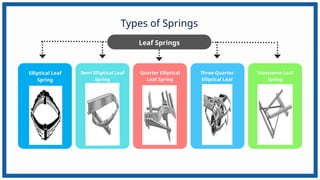
Elliptical Leaf
Spring
Semi Elliptical Leaf
Spring
Types of Springs
Quarter Elliptical
Leaf Spring
Three-Quarter
Elliptical Leaf
Spring
Transverse Leaf
Spring
Leaf Springs
Types of Leaf Springs
01
03
02
04
05
Elliptical leaf spring comprises two stacked, bolted, and clamped leaves with semi-elliptical shapes connected in
opposite directions. Although they have opposite directions, there is no need for spring shackles due to the leaf’s
subjection to the same amount of elongation on compression. These springs were important in old cars where car
manufacturers attached them to the axle and frame. However, they are not much important nowadays.
Like the elliptical leaf spring, the quarter elliptical leaf spring is olden. Also known as the cantilever type of
leaf spring, it has one end fixed on the frame side member using a U-clamp or I-bolt and the other freely
connected to the axle. Therefore, when the front axle beams experience shocks, the leaves can easily
straighten and absorb the shock.
Semi elliptical leaf spring comes from steel leaves having the same width and thickness but different lengths. The
longest/uppermost leave is the master leaf. They are the most popular leaf spring in automobiles as they require less
maintenance and have a long life.
Semi elliptical leaf springs have an end fixed rigidly to the automobile frame and the other to the shackles. Therefore,
the length varies when driving in rough terrains, aiding in shock absorption.
This leaf spring is a combination of the quarter elliptical spring and semi-elliptical spring. On the one
hand, the semi-elliptical ends are attached to the vehicle frame and the quarter elliptical spring. On the
other hand, the free end of the quarter elliptical spring is then attached to the vehicle frame using an I-
bolt.
These are semi-elliptical leaf springs mounted transversely along a vehicle width. In this arrangement,
the longest leaf is at the bottom while the mid-portion is fixed to the frame using a U-bolt. Transverse leaf
springs lead to rolling. Therefore, they have limited use in the automobile industry.
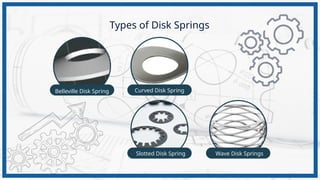
Types of Disk Springs
Belleville Disk Spring Curved Disk Spring
Slotted Disk Spring Wave Disk Springs
Types of Disk Springs
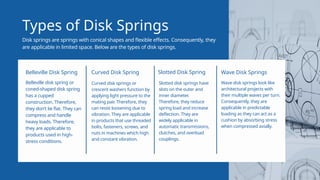
Disk springs are springs with conical shapes and flexible effects. Consequently, they
are applicable in limited space. Below are the types of disk springs.
Belleville disk spring or
coned-shaped disk spring
has a cupped
construction. Therefore,
they don’t lie flat. They can
compress and handle
heavy loads. Therefore,
they are applicable to
products used in high-
stress conditions.
Belleville Disk Spring
Curved disk springs or
crescent washers function by
applying light pressure to the
mating pair. Therefore, they
can resist loosening due to
vibration. They are applicable
in products that use threaded
bolts, fasteners, screws, and
nuts in machines which high
and constant vibration.
Curved Disk Spring
Wave disk springs look like
architectural projects with
their multiple waves per turn.
Consequently, they are
applicable in predictable
loading as they can act as a
cushion by absorbing stress
when compressed axially.
Wave Disk Springs
Slotted disk springs have
slots on the outer and
inner diameter.
Therefore, they reduce
spring load and increase
deflection. They are
widely applicable in
automatic transmissions,
clutches, and overload
couplings.
Slotted Disk Spring
Functions of Springs
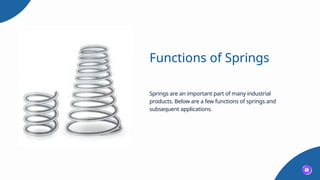
Springs are an important part of many industrial
products. Below are a few functions of springs and
subsequent applications.
Shock Absorbing Properties
Control the Movement of the Mechanism
Storage and Output Energy
Vibration Damping
FUNCTIONS OF SPRINGS
Springs can compress and extend due to applied load/force.
Therefore, they have good shock absorbing capability. This use
of springs is very important in the automobile industry as when
a vehicle experiences a shock, the spring compresses to absorb
the shock. It then releases the energy constantly.
Springs can control the movement of some components.
Consequently, they are widely applicable in garages,
doors, weighing machines, internal combustion engine
valve springs, and control springs in clutches.
Springs can store mechanical energy and release it
constantly. Therefore, they can serve as an alternative to
batteries in some devices. An important example is a
mechanical watch and gun bolt.
Springs also help in buffering or damping vibration.
Therefore, they are important in making stable products
in vibrating environments. Application of mechanical
springs for vibration damping include cars and train cars.
Types of Materials Used in
Making Springs
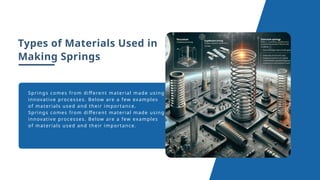
Springs comes from different material made using
innovative processes. Below are a few examples
of materials used and their importance.
Springs comes from different material made using
innovative processes. Below are a few examples
of materials used and their importance.
USED IN
MATERIALS
M A K I N G
S P R I N G S
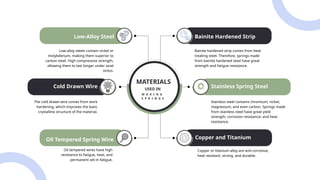
Low-Alloy Steel
Low-alloy steels contain nickel or
molybdenum, making them superior to
carbon steel. High compressive strength,
allowing them to last longer under axial
stress.
Bainite hardened strip comes from heat
treating steel. Therefore, springs made
from bainite hardened steel have great
strength and fatigue resistance.
The cold drawn wire comes from work
hardening, which improves the basic
crystalline structure of the material.
Oil tempered wires have high
resistance to fatigue, heat, and
permanent set-in fatigue.
Stainless steel contains chromium, nickel,
magnesium, and even carbon. Springs made
from stainless steel have great yield
strength, corrosion resistance, and heat
resistance.
Copper or titanium alloy are anti-corrosive,
heat resistant, strong, and durable.
Oil Tempered Spring Wire
Cold Drawn Wire
Bainite Hardened Strip
Copper and Titanium
Stainless Spring Steel
Common Manufacturing
Process of Springs
Springs are made using a process of
winding, heat treating, grinding, coating,
and finishing option. The process is
straightforward, although there are few
variations depending on the types of
springs.
Winding
Grinding
Heat Treating
Coating and Finishing
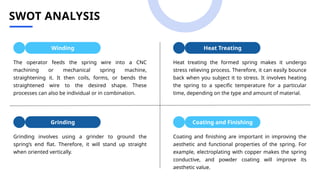
SWOT ANALYSIS
The operator feeds the spring wire into a CNC
machining or mechanical spring machine,
straightening it. It then coils, forms, or bends the
straightened wire to the desired shape. These
processes can also be individual or in combination.
Grinding involves using a grinder to ground the
spring’s end flat. Therefore, it will stand up straight
when oriented vertically.
Heat treating the formed spring makes it undergo
stress relieving process. Therefore, it can easily bounce
back when you subject it to stress. It involves heating
the spring to a specific temperature for a particular
time, depending on the type and amount of material.
Coating and finishing are important in improving the
aesthetic and functional properties of the spring. For
example, electroplating with copper makes the spring
conductive, and powder coating will improve its
aesthetic value.
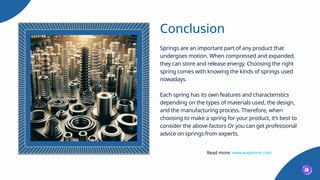
Conclusion
Springs are an important part of any product that
undergoes motion. When compressed and expanded,
they can store and release energy. Choosing the right
spring comes with knowing the kinds of springs used
nowadays.
Each spring has its own features and characteristics
depending on the types of materials used, the design,
and the manufacturing process. Therefore, when
choosing to make a spring for your product, it’s best to
consider the above factors Or you can get professional
advice on springs from experts.
www.waykenrm.com
Read more:
THANK YOU

Springs Materials Uses and Manufacturing Process

  • 1.
    Types of Springs Understanding TheirUses and Manufacturing Process Procurement & Transport Anup Howlader
  • 2.
    Overview Introduction Hooke's Law Types ofsprings Helical Springs Leaf Springs Disk Springs Functions of Springs Materials Used in Making Springs Common Manufacturing Process Conclusion
  • 3.
    Introduction Springs are mechanicalcomponents used in many products such as watches, automobiles, and cellphones. There are many types of springs, each with unique features making choosing difficult. Therefore, there is a need to know about them. This article discusses the common spring types, their applications, materials and what causes a mechanical spring failure so that you can select the right one.
  • 4.
    Spring is amechanical component that, when compressed by a load, stores the energy, and releases it when the load is removed. This is the normal way all springs function irrespective of their types, as expressed by Hooke’s law. Hooke's Law: Hooke’s law relates the force exerted by a load on a spring and its elasticity. According to the law, the force exerted by a load needed to compress or extend a spring is directly proportional to the displacement, as expressed by the mathematical expression below: F= -kX Where; F = force exerted by the load on the spring X = spring displacement (it is a negative value indicating the force to restore the spring is opposite the direction) k = spring constant, which shows the spring stiffness and depends on the spring type Understanding the Principle of Spring Hooke's Law
  • 5.
    Types of springsand Their Uses Helical Springs Leaf Springs Disk Springs There are several types of springs used in different capacities. Generally, there are three main categories, and each category has its subcategories. Below are the properties of the different spring types and their applications.
  • 6.
    Types of springsand Their Uses Helical Springs Leaf Springs Disk Springs Helical springs have a general helix shape (hence the name) but different cross-sections. They are the most common types of springs in rapid prototyping and are widely applicable in product manufacturing. These spring types are from rectangular metal plates or leave bolted, clamped, and applicable in shock absorption in heavy vehicles. Below are the different leaf springs types. Disk springs are springs with conical shapes and flexible effects. Consequently, they are applicable in limited space. Below are the types of disk springs.
  • 7.
    Spiral Springs Types ofsprings Helical Springs Compression Springs Extension Springs Torsion Springs
  • 8.
    Helical Springs Helical springshave a general helix shape (hence the name) but different cross- sections. They are the most common types of springs in rapid prototyping and are widely applicable in product manufacturing. Below are the different types of helical springs. Compression springs are open coiled springs with a constant diameter and space between each coil. The springs are compressible only one way as they resist axial compression. These spring types are widely applicable in product manufacturing, such as valves and suspension. 01 Extension springs are closed compression springs. They function by elongating during tension and storing energy. When on tension removal, the mechanical spring returns to its original shape dissipating the energy. Extension springs are an important part of garage doors, pull levers, jaw pliers, and weighing machines. 02 A torsion spring is attached to two components horizontally or vertically using their two ends. They function by storing and releasing rotational energy. The tighter the winding, the more energy the spring stores and releases on load removal. They are applicable in garage doors, watches, etc. 03 Spiral springs are rectangular metal strips made into a flat spiral that can store and release a reasonable amount of energy at a constant rate. Due to the constant release of energy, they are applicable in making mechanical watches, seat recliners, toys, etc. 04
  • 9.
    Elliptical Leaf Spring Semi EllipticalLeaf Spring Types of Springs Quarter Elliptical Leaf Spring Three-Quarter Elliptical Leaf Spring Transverse Leaf Spring Leaf Springs
  • 10.
    Types of LeafSprings 01 03 02 04 05 Elliptical leaf spring comprises two stacked, bolted, and clamped leaves with semi-elliptical shapes connected in opposite directions. Although they have opposite directions, there is no need for spring shackles due to the leaf’s subjection to the same amount of elongation on compression. These springs were important in old cars where car manufacturers attached them to the axle and frame. However, they are not much important nowadays. Like the elliptical leaf spring, the quarter elliptical leaf spring is olden. Also known as the cantilever type of leaf spring, it has one end fixed on the frame side member using a U-clamp or I-bolt and the other freely connected to the axle. Therefore, when the front axle beams experience shocks, the leaves can easily straighten and absorb the shock. Semi elliptical leaf spring comes from steel leaves having the same width and thickness but different lengths. The longest/uppermost leave is the master leaf. They are the most popular leaf spring in automobiles as they require less maintenance and have a long life. Semi elliptical leaf springs have an end fixed rigidly to the automobile frame and the other to the shackles. Therefore, the length varies when driving in rough terrains, aiding in shock absorption. This leaf spring is a combination of the quarter elliptical spring and semi-elliptical spring. On the one hand, the semi-elliptical ends are attached to the vehicle frame and the quarter elliptical spring. On the other hand, the free end of the quarter elliptical spring is then attached to the vehicle frame using an I- bolt. These are semi-elliptical leaf springs mounted transversely along a vehicle width. In this arrangement, the longest leaf is at the bottom while the mid-portion is fixed to the frame using a U-bolt. Transverse leaf springs lead to rolling. Therefore, they have limited use in the automobile industry.
  • 11.
    Types of DiskSprings Belleville Disk Spring Curved Disk Spring Slotted Disk Spring Wave Disk Springs
  • 12.
    Types of DiskSprings Disk springs are springs with conical shapes and flexible effects. Consequently, they are applicable in limited space. Below are the types of disk springs. Belleville disk spring or coned-shaped disk spring has a cupped construction. Therefore, they don’t lie flat. They can compress and handle heavy loads. Therefore, they are applicable to products used in high- stress conditions. Belleville Disk Spring Curved disk springs or crescent washers function by applying light pressure to the mating pair. Therefore, they can resist loosening due to vibration. They are applicable in products that use threaded bolts, fasteners, screws, and nuts in machines which high and constant vibration. Curved Disk Spring Wave disk springs look like architectural projects with their multiple waves per turn. Consequently, they are applicable in predictable loading as they can act as a cushion by absorbing stress when compressed axially. Wave Disk Springs Slotted disk springs have slots on the outer and inner diameter. Therefore, they reduce spring load and increase deflection. They are widely applicable in automatic transmissions, clutches, and overload couplings. Slotted Disk Spring
  • 13.
    Functions of Springs Springsare an important part of many industrial products. Below are a few functions of springs and subsequent applications.
  • 14.
    Shock Absorbing Properties Controlthe Movement of the Mechanism Storage and Output Energy Vibration Damping FUNCTIONS OF SPRINGS Springs can compress and extend due to applied load/force. Therefore, they have good shock absorbing capability. This use of springs is very important in the automobile industry as when a vehicle experiences a shock, the spring compresses to absorb the shock. It then releases the energy constantly. Springs can control the movement of some components. Consequently, they are widely applicable in garages, doors, weighing machines, internal combustion engine valve springs, and control springs in clutches. Springs can store mechanical energy and release it constantly. Therefore, they can serve as an alternative to batteries in some devices. An important example is a mechanical watch and gun bolt. Springs also help in buffering or damping vibration. Therefore, they are important in making stable products in vibrating environments. Application of mechanical springs for vibration damping include cars and train cars.
  • 15.
    Types of MaterialsUsed in Making Springs Springs comes from different material made using innovative processes. Below are a few examples of materials used and their importance. Springs comes from different material made using innovative processes. Below are a few examples of materials used and their importance.
  • 16.
    USED IN MATERIALS M AK I N G S P R I N G S Low-Alloy Steel Low-alloy steels contain nickel or molybdenum, making them superior to carbon steel. High compressive strength, allowing them to last longer under axial stress. Bainite hardened strip comes from heat treating steel. Therefore, springs made from bainite hardened steel have great strength and fatigue resistance. The cold drawn wire comes from work hardening, which improves the basic crystalline structure of the material. Oil tempered wires have high resistance to fatigue, heat, and permanent set-in fatigue. Stainless steel contains chromium, nickel, magnesium, and even carbon. Springs made from stainless steel have great yield strength, corrosion resistance, and heat resistance. Copper or titanium alloy are anti-corrosive, heat resistant, strong, and durable. Oil Tempered Spring Wire Cold Drawn Wire Bainite Hardened Strip Copper and Titanium Stainless Spring Steel
  • 17.
    Common Manufacturing Process ofSprings Springs are made using a process of winding, heat treating, grinding, coating, and finishing option. The process is straightforward, although there are few variations depending on the types of springs.
  • 18.
    Winding Grinding Heat Treating Coating andFinishing SWOT ANALYSIS The operator feeds the spring wire into a CNC machining or mechanical spring machine, straightening it. It then coils, forms, or bends the straightened wire to the desired shape. These processes can also be individual or in combination. Grinding involves using a grinder to ground the spring’s end flat. Therefore, it will stand up straight when oriented vertically. Heat treating the formed spring makes it undergo stress relieving process. Therefore, it can easily bounce back when you subject it to stress. It involves heating the spring to a specific temperature for a particular time, depending on the type and amount of material. Coating and finishing are important in improving the aesthetic and functional properties of the spring. For example, electroplating with copper makes the spring conductive, and powder coating will improve its aesthetic value.
  • 19.
    Conclusion Springs are animportant part of any product that undergoes motion. When compressed and expanded, they can store and release energy. Choosing the right spring comes with knowing the kinds of springs used nowadays. Each spring has its own features and characteristics depending on the types of materials used, the design, and the manufacturing process. Therefore, when choosing to make a spring for your product, it’s best to consider the above factors Or you can get professional advice on springs from experts. www.waykenrm.com Read more:
  • 20.