Different Types of
And Apllication
Springs
Procurement & Transport
Anup Howlader
Overview
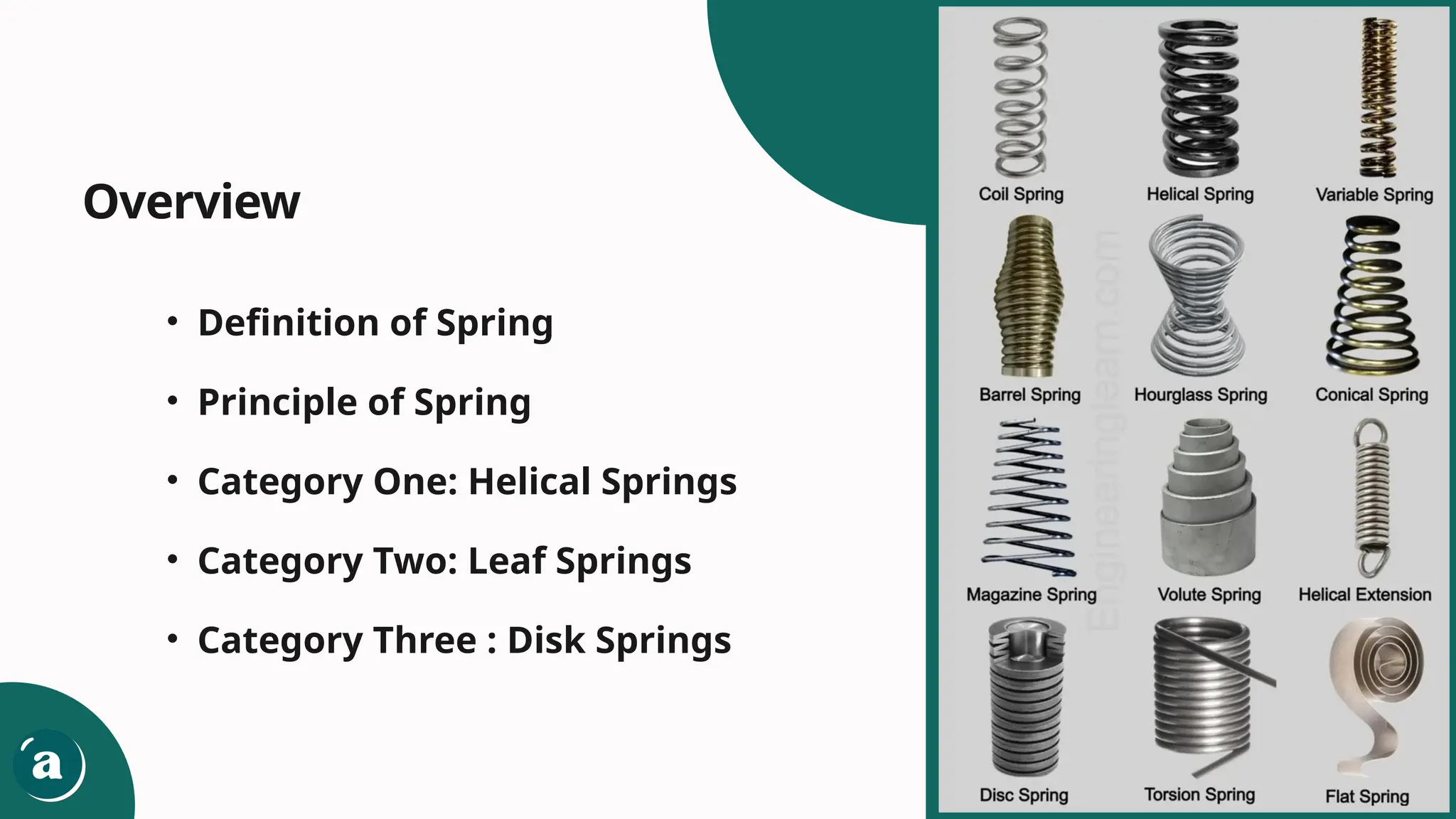
• Definition of Spring
• Principle of Spring
• Category One: Helical Springs
• Category Two: Leaf Springs
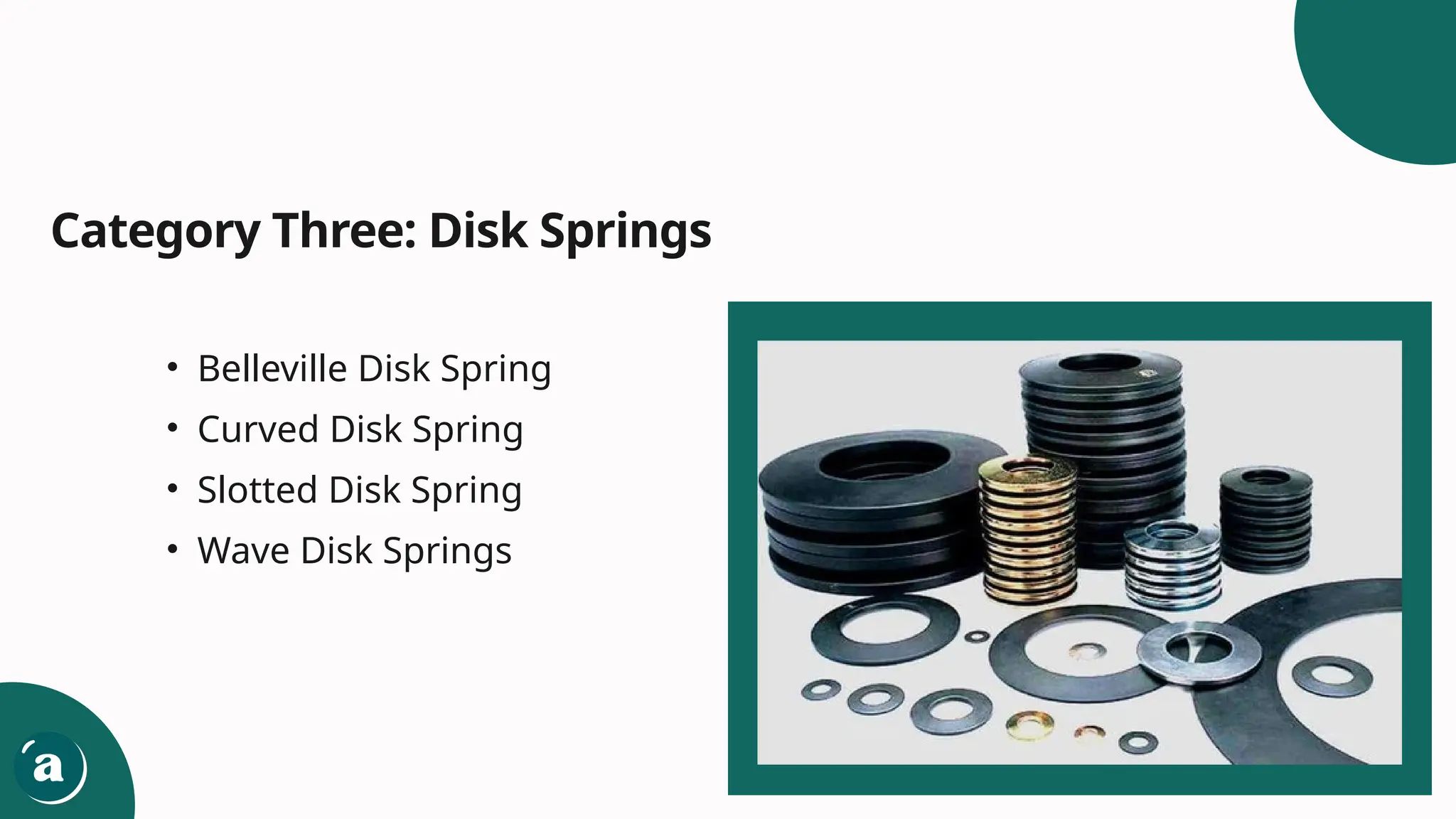
• Category Three : Disk Springs
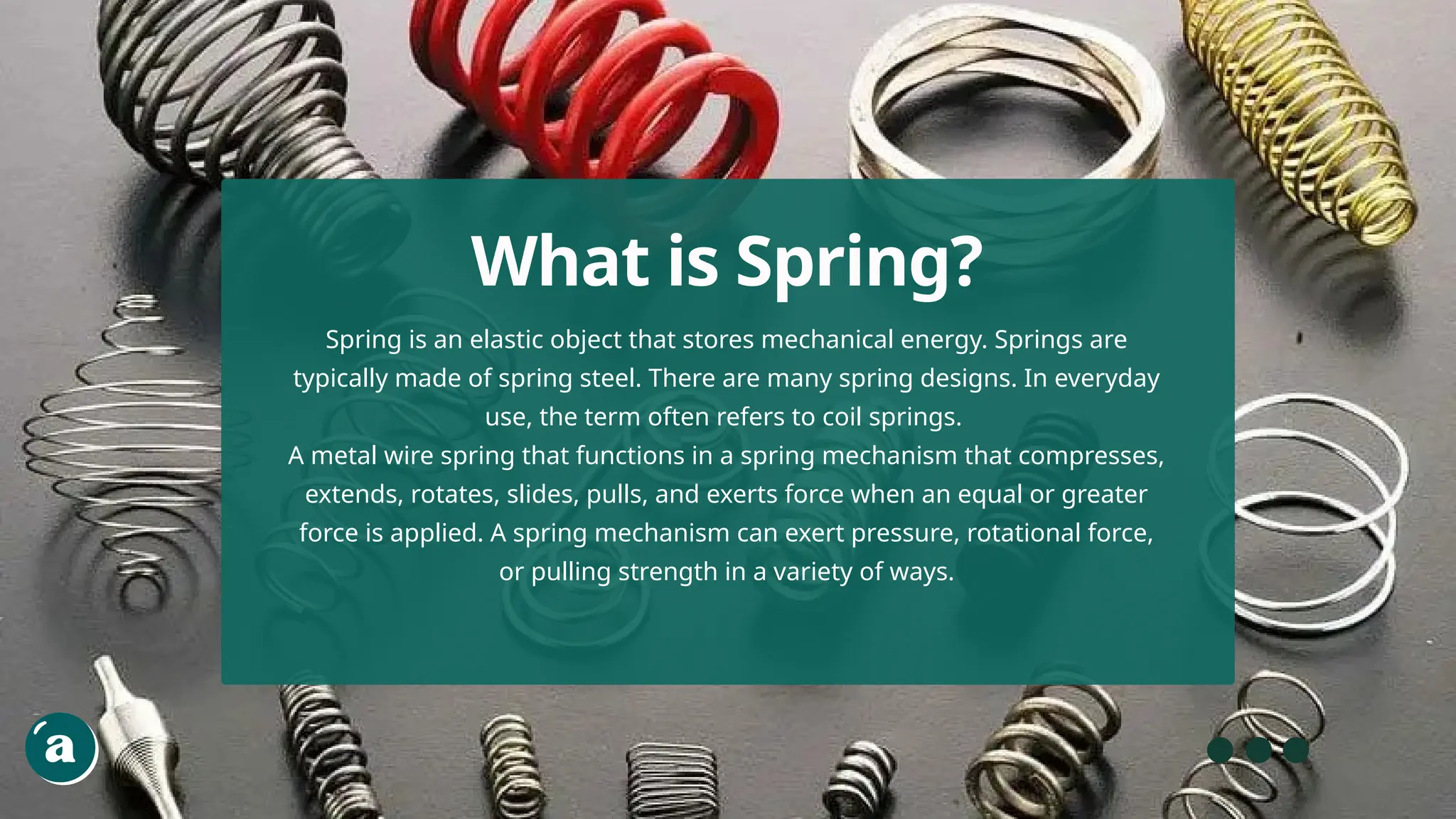
Spring is an elastic object that stores mechanical energy. Springs are
typically made of spring steel. There are many spring designs. In everyday
use, the term often refers to coil springs.
A metal wire spring that functions in a spring mechanism that compresses,
extends, rotates, slides, pulls, and exerts force when an equal or greater
force is applied. A spring mechanism can exert pressure, rotational force,
or pulling strength in a variety of ways.
What is Spring?
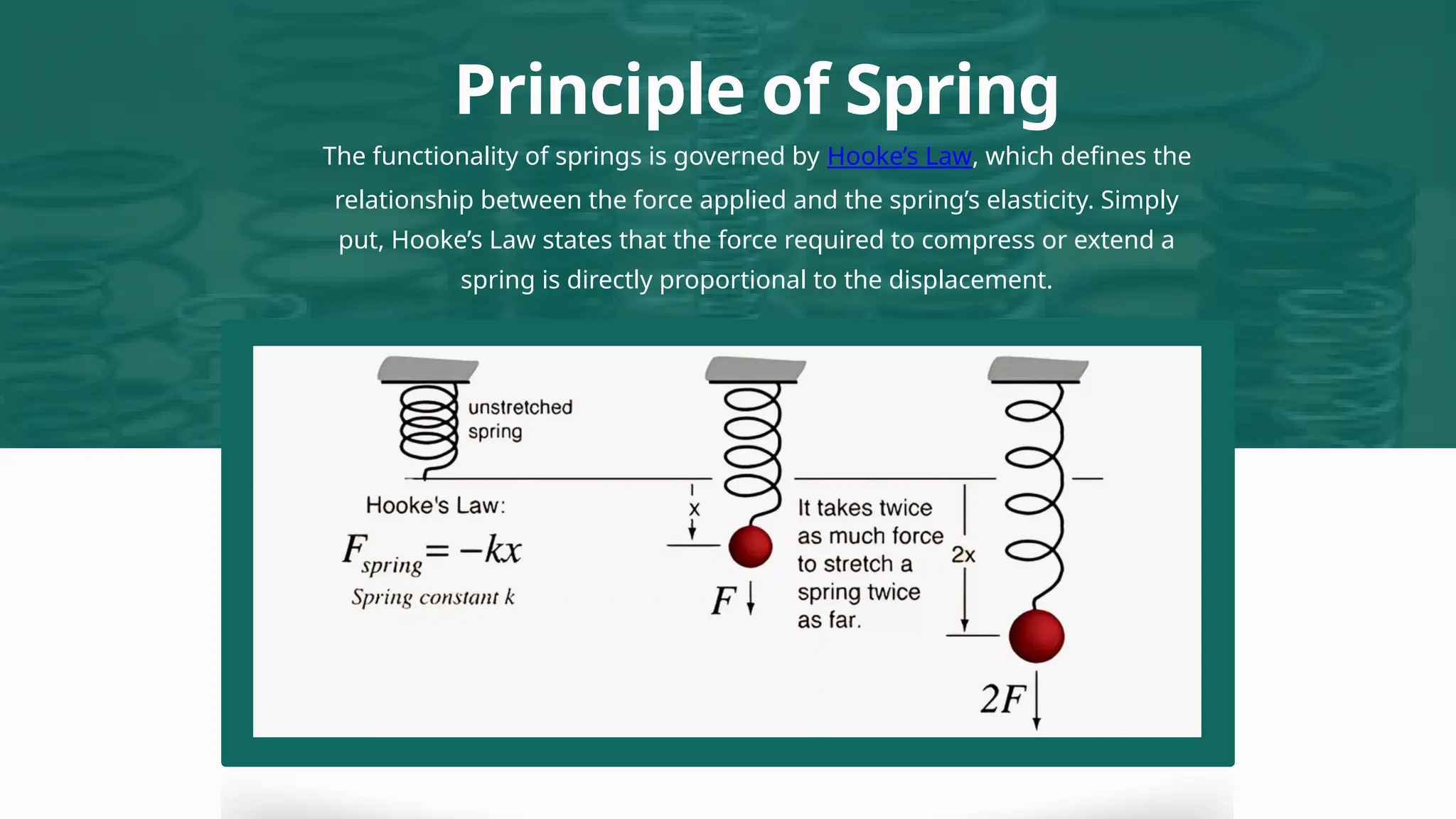
The functionality of springs is governed by Hooke’s Law, which defines the
relationship between the force applied and the spring’s elasticity. Simply
put, Hooke’s Law states that the force required to compress or extend a
spring is directly proportional to the displacement.
Principle of Spring
Category One: Helical Springs
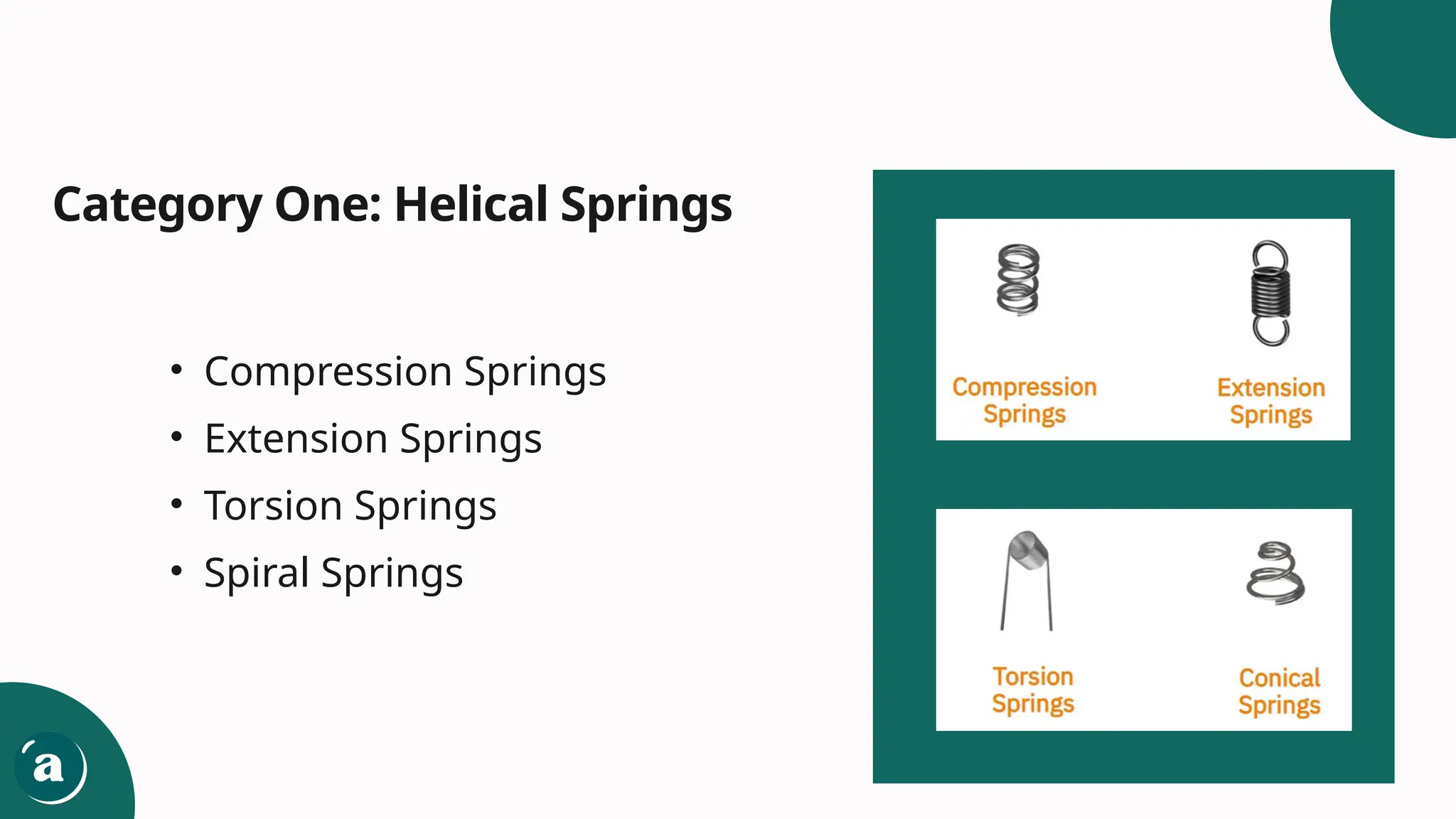
• Compression Springs
• Extension Springs
• Torsion Springs
• Spiral Springs
Helical Springs
Compression springs
feature an open-coil helical
design with a constant coil
diameter and variable
shape, resisting axial
compression.
The simplest example of its
application is in the
ballpoint pen, where it is
responsible for the
“popping” effect. It is also
applicable in valves and
suspension.
Extension springs use a
closed coil helical design,
unlike compression types.
They create tension, store
energy, and use it to return
to their original shape.
A simple example of its
applications is in garage
doors. Others are in pull
levers, jaw pliers, and
weighing machines.
Two ends of a torsion spring
attach to different
components. This keeps the
two components apart at a
certain angle. These springs
use radial direction when
force is acting radially due to
rotation. What’s more, CNC
machining capabilities can
produce custom two-bodied
torsion springs in high
volumes.
Spiral springs are made by
coiling rectangular metal
strips into flat spirals. On
activation, it stores a
reasonable amount of
energy and can release it
at a constant rate. The
constant release makes it
suitable for mechanical
watches, toys, and seat
recliners.
01 02 03 04
Helical springs are the most common in product manufacturing. Coiling
wire into a helix shape creates these springs, offering various cross-
sections. Below are the types of springs in this category.
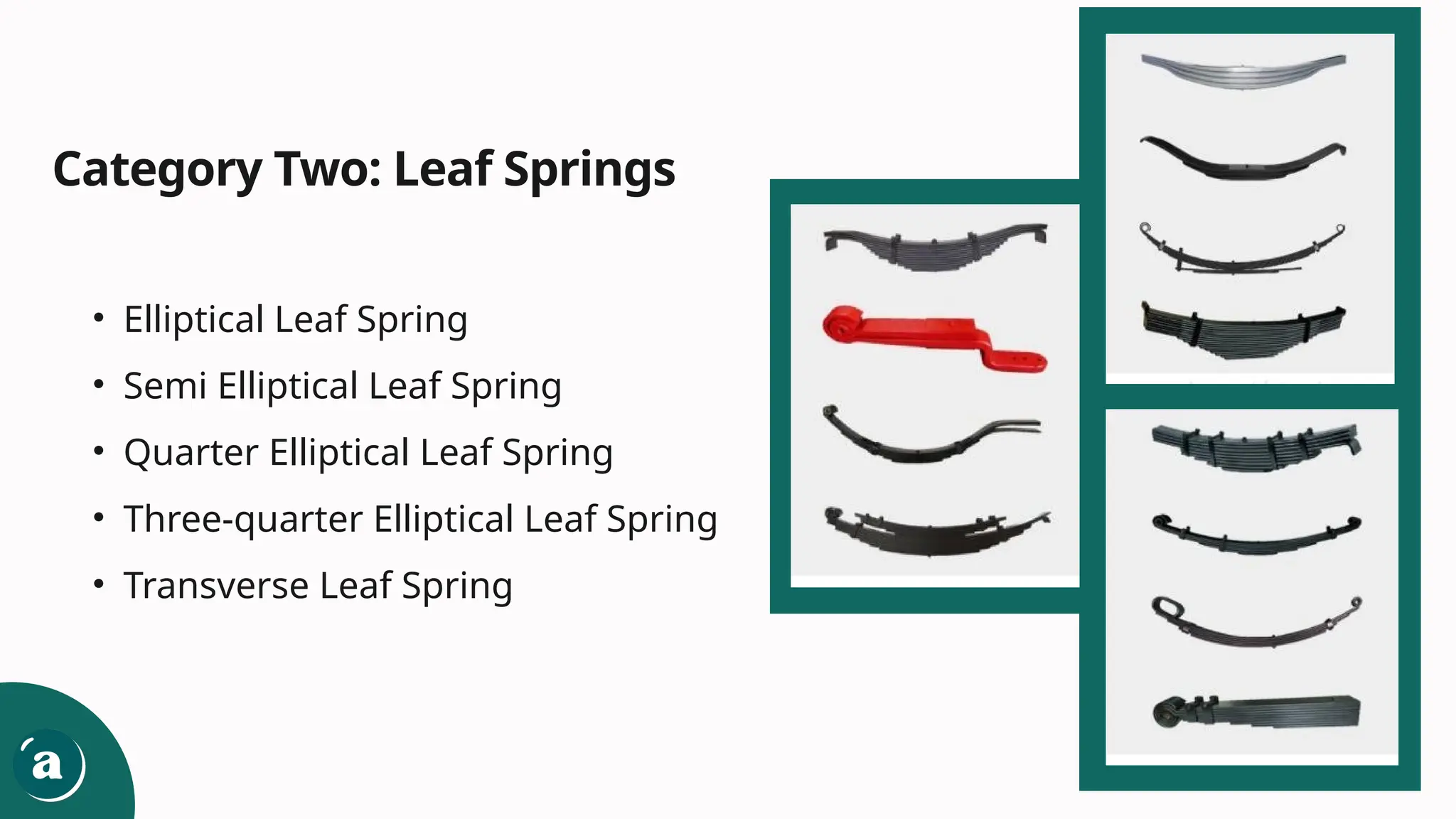
Category Two: Leaf Springs
• Elliptical Leaf Spring
• Semi Elliptical Leaf Spring
• Quarter Elliptical Leaf Spring
• Three-quarter Elliptical Leaf Spring
• Transverse Leaf Spring
Leaf Springs
Connecting two semi-elliptical
springs in opposite directions
creates an elliptical leaf spring,
forming an elliptical shape. In
older cars, these springs
attached the axle and frame,
eliminating the need for
shackles, as both semi-elliptical
springs elongated equally during
compression. However, they are
no longer used in modern
vehicles.
These are the most popular leaf springs in
automobiles. They are made from steel leaves
with different lengths but the same width and
thickness. The uppermost/longest leaf at the
two ends is the master leaf. The arrangement
of the steel leaves resembles a semi-elliptical
shape.
Semi-elliptical leaf springs have an end rigidly
fixed to the vehicle frame and the other to the
shackle. This helps in varying the lengths and
absorbing shock when traveling in rough
terrains. They require less maintenance, are
easy to repair, and have a long life.
Also known as the cantilever-type
leaf spring, the quarter elliptical
leaf spring is also old. They have
one end fixed on the side member
of the frame with the aid of a U-
Clamp or I-Bolt. The other is freely
connected to the front axle. When
the front axle beam is subjected to
a shock load, the leaves straighten
to absorb the shock.
01 02 03
Leaf springs are made from rectangular metal plates, also known as
leaves. The rectangular metal plates are normally bolted and clamped,
and they have major use in heavy vehicles. Below are the different types
of leaf springs and their applications.
Leaf Springs
A simple example of its application is a door hinge.
Here, when you open the door, the spring will store
its rotational energy; when you release the door, it
uses the stored energy to bring the door back to its
original position. The rotation force depends on the
rotation of the spring.
This type combines a quarter elliptical spring and a
semi-elliptical spring. One end of the semi-elliptical
part attaches to the vehicle frame, while the other
connects to the quarter elliptical spring, which is
then secured to the frame with an I-bolt.
A transverse leaf spring is created by
mounting a semi-elliptical spring
across the vehicle’s width. The longest
leaf is positioned at the bottom, with
the mid-portion fixed to the frame
using a U-bolt. While this design uses
two shackles, it can cause rolling,
making it unsuitable for automobile
fasteners.
04 05
Leaf springs are an integral part of your vehicle's suspension system. They
are installed to help support the entire weight of your car or truck. Leaf
springs also help to maintain the tyres grip on the road and regulate the
wheelbase lengths when it is speeding up or slowing down.
Category Three: Disk Springs
• Belleville Disk Spring
• Curved Disk Spring
• Slotted Disk Spring
• Wave Disk Springs
Disk Springs
Also known as the
coned-shaped disk
spring, the Belleville disk
spring has a cupped
construction. They do
not lie flat. Instead, they
take a canonical shape
that compresses and
allows them to handle
heavy loads.
Also known as crescent
washers, they apply light
pressure to their mating
par to resist loosening
as a result of vibration.
They are suitable for
distributing loads of
threaded bolts, screws,
and nuts evenly in
machines that produce
constant vibration.
Slots on the outer and
inner diameter of a disc
create a slotted disk
spring. This design
reduces the load and
increases deflection,
making slotted disk
springs widely used in
automatic
transmissions, clutches,
and overload couplings.
Wave disk springs have
multiple waves per turn
and are suitable for
providing prices and
predictable loading.
Here, they can act as a
cushion by absorbing
stress due to axial
compression.
01 02 03 04
Helical springs are the most common in product manufacturing. Coiling
wire into a helix shape creates these springs, offering various cross-
sections. Below are the types of springs in this category.
Conclusion
Springs are integral to many
applications, providing flexibility, energy
storage, and precise control. By
incorporating them into your designs,
you can enhance functionality and
address mechanical challenges with
greater efficiency. Let’s delve into how
springs can add value to your projects.
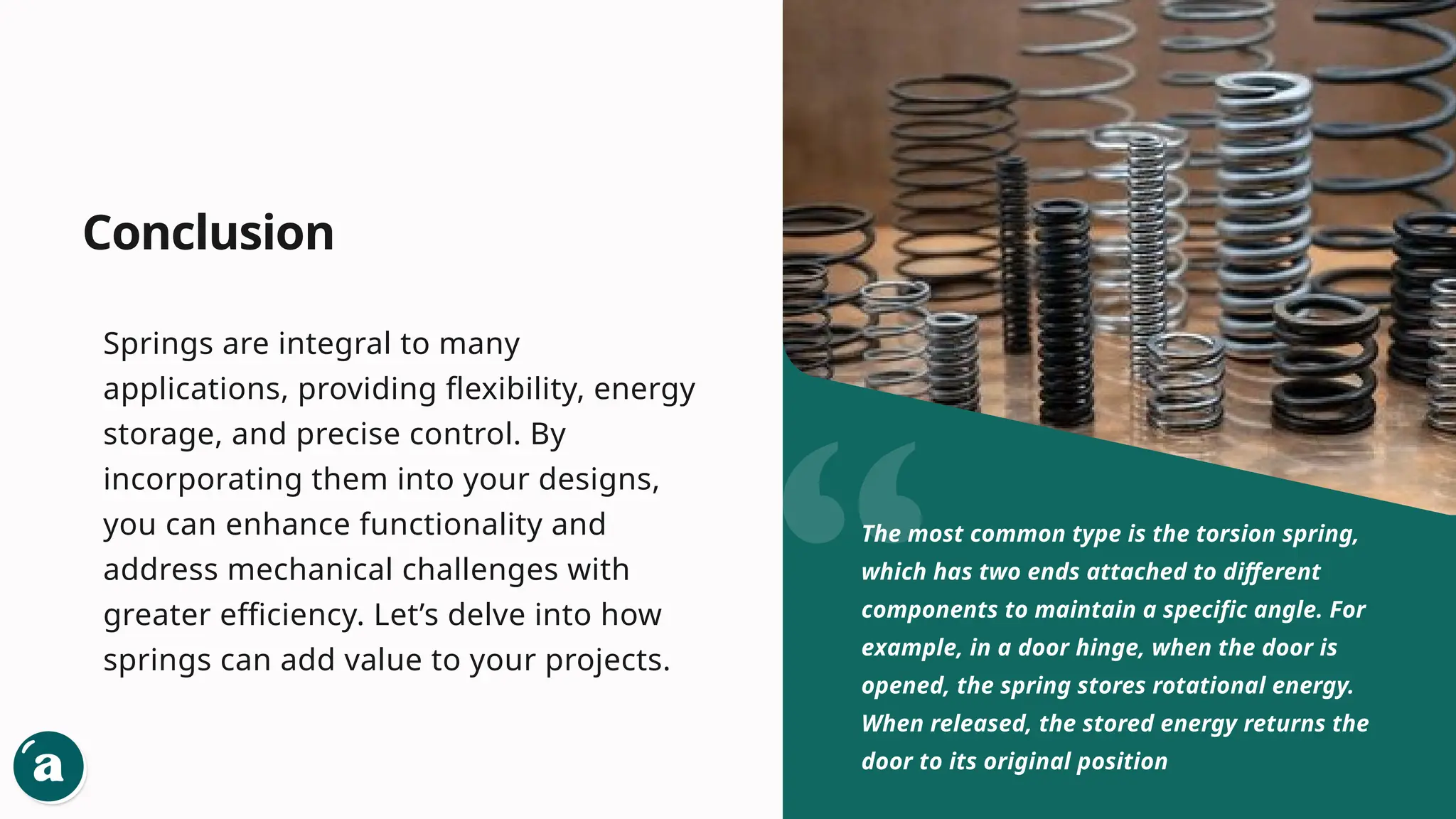
The most common type is the torsion spring,
which has two ends attached to different
components to maintain a specific angle. For
example, in a door hinge, when the door is
opened, the spring stores rotational energy.
When released, the stored energy returns the
door to its original position
Thank You

Different Types of Springs and Their Application

  • 1.
    Different Types of AndApllication Springs Procurement & Transport Anup Howlader
  • 2.
    Overview • Definition ofSpring • Principle of Spring • Category One: Helical Springs • Category Two: Leaf Springs • Category Three : Disk Springs
  • 3.
    Spring is anelastic object that stores mechanical energy. Springs are typically made of spring steel. There are many spring designs. In everyday use, the term often refers to coil springs. A metal wire spring that functions in a spring mechanism that compresses, extends, rotates, slides, pulls, and exerts force when an equal or greater force is applied. A spring mechanism can exert pressure, rotational force, or pulling strength in a variety of ways. What is Spring?
  • 4.
    The functionality ofsprings is governed by Hooke’s Law, which defines the relationship between the force applied and the spring’s elasticity. Simply put, Hooke’s Law states that the force required to compress or extend a spring is directly proportional to the displacement. Principle of Spring
  • 5.
    Category One: HelicalSprings • Compression Springs • Extension Springs • Torsion Springs • Spiral Springs
  • 6.
    Helical Springs Compression springs featurean open-coil helical design with a constant coil diameter and variable shape, resisting axial compression. The simplest example of its application is in the ballpoint pen, where it is responsible for the “popping” effect. It is also applicable in valves and suspension. Extension springs use a closed coil helical design, unlike compression types. They create tension, store energy, and use it to return to their original shape. A simple example of its applications is in garage doors. Others are in pull levers, jaw pliers, and weighing machines. Two ends of a torsion spring attach to different components. This keeps the two components apart at a certain angle. These springs use radial direction when force is acting radially due to rotation. What’s more, CNC machining capabilities can produce custom two-bodied torsion springs in high volumes. Spiral springs are made by coiling rectangular metal strips into flat spirals. On activation, it stores a reasonable amount of energy and can release it at a constant rate. The constant release makes it suitable for mechanical watches, toys, and seat recliners. 01 02 03 04 Helical springs are the most common in product manufacturing. Coiling wire into a helix shape creates these springs, offering various cross- sections. Below are the types of springs in this category.
  • 7.
    Category Two: LeafSprings • Elliptical Leaf Spring • Semi Elliptical Leaf Spring • Quarter Elliptical Leaf Spring • Three-quarter Elliptical Leaf Spring • Transverse Leaf Spring
  • 8.
    Leaf Springs Connecting twosemi-elliptical springs in opposite directions creates an elliptical leaf spring, forming an elliptical shape. In older cars, these springs attached the axle and frame, eliminating the need for shackles, as both semi-elliptical springs elongated equally during compression. However, they are no longer used in modern vehicles. These are the most popular leaf springs in automobiles. They are made from steel leaves with different lengths but the same width and thickness. The uppermost/longest leaf at the two ends is the master leaf. The arrangement of the steel leaves resembles a semi-elliptical shape. Semi-elliptical leaf springs have an end rigidly fixed to the vehicle frame and the other to the shackle. This helps in varying the lengths and absorbing shock when traveling in rough terrains. They require less maintenance, are easy to repair, and have a long life. Also known as the cantilever-type leaf spring, the quarter elliptical leaf spring is also old. They have one end fixed on the side member of the frame with the aid of a U- Clamp or I-Bolt. The other is freely connected to the front axle. When the front axle beam is subjected to a shock load, the leaves straighten to absorb the shock. 01 02 03 Leaf springs are made from rectangular metal plates, also known as leaves. The rectangular metal plates are normally bolted and clamped, and they have major use in heavy vehicles. Below are the different types of leaf springs and their applications.
  • 9.
    Leaf Springs A simpleexample of its application is a door hinge. Here, when you open the door, the spring will store its rotational energy; when you release the door, it uses the stored energy to bring the door back to its original position. The rotation force depends on the rotation of the spring. This type combines a quarter elliptical spring and a semi-elliptical spring. One end of the semi-elliptical part attaches to the vehicle frame, while the other connects to the quarter elliptical spring, which is then secured to the frame with an I-bolt. A transverse leaf spring is created by mounting a semi-elliptical spring across the vehicle’s width. The longest leaf is positioned at the bottom, with the mid-portion fixed to the frame using a U-bolt. While this design uses two shackles, it can cause rolling, making it unsuitable for automobile fasteners. 04 05 Leaf springs are an integral part of your vehicle's suspension system. They are installed to help support the entire weight of your car or truck. Leaf springs also help to maintain the tyres grip on the road and regulate the wheelbase lengths when it is speeding up or slowing down.
  • 10.
    Category Three: DiskSprings • Belleville Disk Spring • Curved Disk Spring • Slotted Disk Spring • Wave Disk Springs
  • 11.
    Disk Springs Also knownas the coned-shaped disk spring, the Belleville disk spring has a cupped construction. They do not lie flat. Instead, they take a canonical shape that compresses and allows them to handle heavy loads. Also known as crescent washers, they apply light pressure to their mating par to resist loosening as a result of vibration. They are suitable for distributing loads of threaded bolts, screws, and nuts evenly in machines that produce constant vibration. Slots on the outer and inner diameter of a disc create a slotted disk spring. This design reduces the load and increases deflection, making slotted disk springs widely used in automatic transmissions, clutches, and overload couplings. Wave disk springs have multiple waves per turn and are suitable for providing prices and predictable loading. Here, they can act as a cushion by absorbing stress due to axial compression. 01 02 03 04 Helical springs are the most common in product manufacturing. Coiling wire into a helix shape creates these springs, offering various cross- sections. Below are the types of springs in this category.
  • 12.
    Conclusion Springs are integralto many applications, providing flexibility, energy storage, and precise control. By incorporating them into your designs, you can enhance functionality and address mechanical challenges with greater efficiency. Let’s delve into how springs can add value to your projects. The most common type is the torsion spring, which has two ends attached to different components to maintain a specific angle. For example, in a door hinge, when the door is opened, the spring stores rotational energy. When released, the stored energy returns the door to its original position
  • 13.