


Flip Your Classroom Upside Down
How I got time back in my classroom to
support all learners and deepen the
learning experience for students
Crystal Kirch
@crystalkirch
Flippingwithkirch.blogspot.com
bit.ly/FWKirchBook
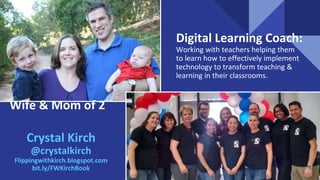
Wife & Mom of 2
Digital Learning Coach:
Working with teachers helping them
to learn how to effectively implement
technology to transform teaching &
learning in their classrooms.
Crystal Kirch
@crystalkirch
Flippingwithkirch.blogspot.com
bit.ly/FWKirchBook
1. What is a flipped classroom?
1. My Story: Results & Benefits
1. Practical strategies for
implementation
@crystalkirch -- flippingwithkirch.blogspot.com
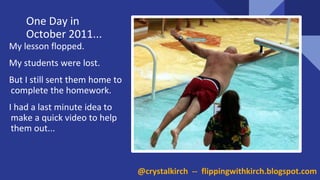
One Day in
October 2011...
My lesson flopped.
My students were lost.
But I still sent them home to
complete the homework.
I had a last minute idea to
make a quick video to help
them out...
@crystalkirch -- flippingwithkirch.blogspot.com
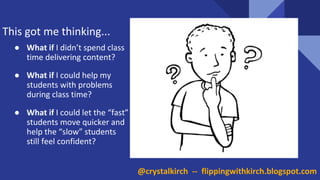
This got me thinking...
● What if I didn’t spend class
time delivering content?
● What if I could help my
students with problems
during class time?
● What if I could let the “fast”
students move quicker and
help the “slow” students
still feel confident?
@crystalkirch -- flippingwithkirch.blogspot.com
3 minutes in my
Flipped Classroom
In a flipped classroom, your role as a teacher in class is NOT “content
deliverer”, but the “designer and facilitator” of learning activities
that deepen student learning - with a lot more time to do so!
@crystalkirch -- flippingwithkirch.blogspot.com
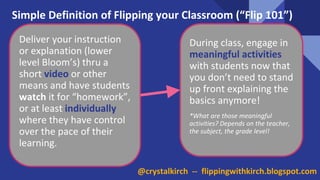
Simple Definition of Flipping your Classroom (“Flip 101”)
Deliver your instruction
or explanation (lower
level Bloom’s) thru a
short video or other
means and have students
watch it for “homework”,
or at least individually
where they have control
over the pace of their
learning.
@crystalkirch -- flippingwithkirch.blogspot.com
Simple Definition of Flipping your Classroom (“Flip 101”)
Deliver your instruction
or explanation (lower
level Bloom’s) thru a
short video or other
means and have students
watch it for “homework”,
or at least individually
where they have control
over the pace of their
learning.
During class, engage in
meaningful activities
with students now that
you don’t need to stand
up front explaining the
basics anymore!
*What are those meaningful
activities? Depends on the teacher,
the subject, the grade level!
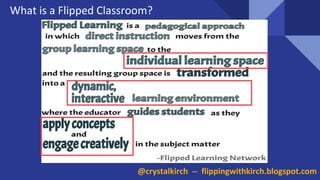
What is a Flipped Classroom?
@crystalkirch -- flippingwithkirch.blogspot.com
“I remember when I used to do
homework at home and I was
stuck on a problem, I had
nobody to help me, but now my
teacher is here when I need
her.” -2011 student
1. More time to help those that
needed it, when they needed it
2. Differentiated support
3. Students demonstrating TWIRLS
and explaining their thinking
4. Students learning at different
paces
5. Students can revisit content
anytime they needed.
thinking, writing, interacting, reading, listening, speaking
@crystalkirch -- flippingwithkirch.blogspot.com
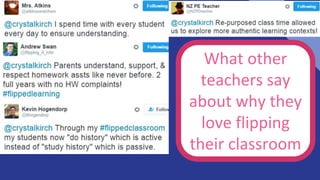
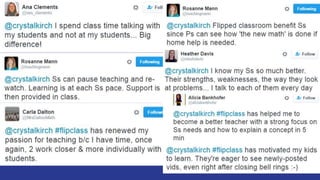
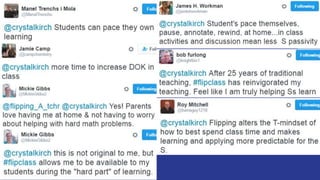
What other
teachers say
about why they
love flipping
their classroom
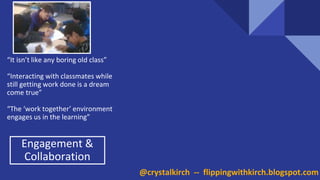
“It isn’t like any boring old class”
“Interacting with classmates while
still getting work done is a dream
come true”
“The ‘work together’ environment
engages us in the learning”
Engagement &
Collaboration
@crystalkirch -- flippingwithkirch.blogspot.com
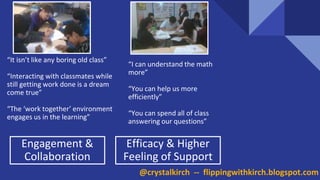
“It isn’t like any boring old class”
“Interacting with classmates while
still getting work done is a dream
come true”
“The ‘work together’ environment
engages us in the learning”
“I can understand the math
more”
“You can help us more
efficiently”
“You can spend all of class
answering our questions”
Engagement &
Collaboration
Efficacy & Higher
Feeling of Support
@crystalkirch -- flippingwithkirch.blogspot.com
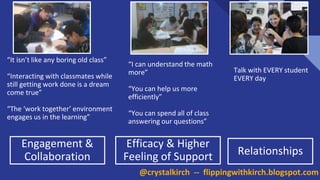
“It isn’t like any boring old class”
“Interacting with classmates while
still getting work done is a dream
come true”
“The ‘work together’ environment
engages us in the learning”
“I can understand the math
more”
“You can help us more
efficiently”
“You can spend all of class
answering our questions”
Talk with EVERY student
EVERY day
Engagement &
Collaboration
Efficacy & Higher
Feeling of Support Relationships
@crystalkirch -- flippingwithkirch.blogspot.com
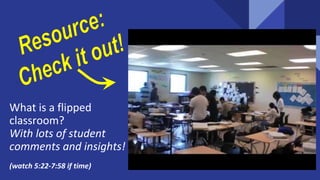
What is a flipped
classroom?
With lots of student
comments and insights!
(watch 5:22-7:58 if time)
19
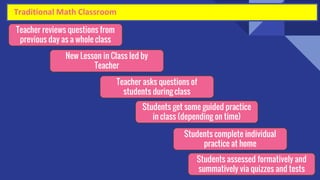
Traditional Math Classroom
New Lesson in Class led by
Teacher
Students get some guided practice
in class (depending on time)
Teacher asks questions of
students during class
Teacher reviews questions from
previous day as a whole class
Students complete individual
practice at home
Students assessed formatively and
summatively via quizzes and tests
20
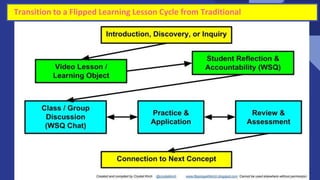
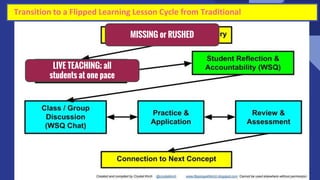
Transition to a Flipped Learning Lesson Cycle from Traditional
21
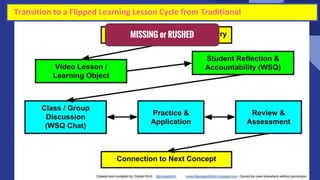
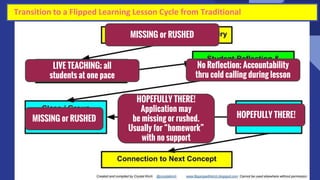
Transition to a Flipped Learning Lesson Cycle from Traditional
MISSING or RUSHED
22
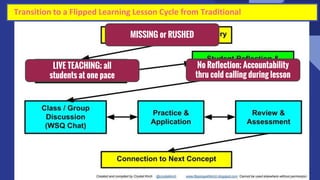
Transition to a Flipped Learning Lesson Cycle from Traditional
MISSING or RUSHED
LIVE TEACHING; all
students at one pace
23
Transition to a Flipped Learning Lesson Cycle from Traditional
MISSING or RUSHED
LIVE TEACHING; all
students at one pace
No Reflection; Accountability
thru cold calling during lesson
24
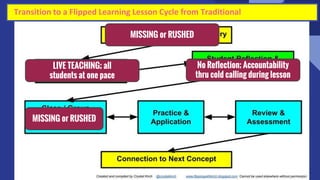
Transition to a Flipped Learning Lesson Cycle from Traditional
MISSING or RUSHED
LIVE TEACHING; all
students at one pace
No Reflection; Accountability
thru cold calling during lesson
MISSING or RUSHED
25
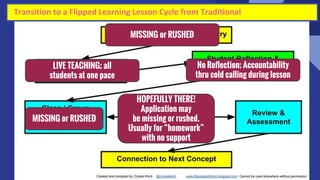
Transition to a Flipped Learning Lesson Cycle from Traditional
MISSING or RUSHED
LIVE TEACHING; all
students at one pace
No Reflection; Accountability
thru cold calling during lesson
MISSING or RUSHED
HOPEFULLY THERE!
Application may
be missing or rushed.
Usually for “homework”
with no support
26
Transition to a Flipped Learning Lesson Cycle from Traditional
MISSING or RUSHED
LIVE TEACHING; all
students at one pace
No Reflection; Accountability
thru cold calling during lesson
MISSING or RUSHED
HOPEFULLY THERE!
Application may
be missing or rushed.
Usually for “homework”
with no support
HOPEFULLY THERE!
27
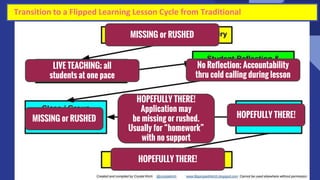
Transition to a Flipped Learning Lesson Cycle from Traditional
MISSING or RUSHED
LIVE TEACHING; all
students at one pace
No Reflection; Accountability
thru cold calling during lesson
MISSING or RUSHED
HOPEFULLY THERE!
Application may
be missing or rushed.
Usually for “homework”
with no support
HOPEFULLY THERE!
HOPEFULLY THERE!
28
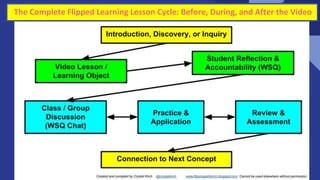
The Complete Flipped Learning Lesson Cycle: Before, During, and After the Video
29
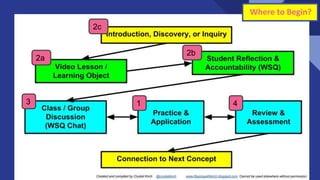
Where to Begin?
1
2a
2b
2c
3 4
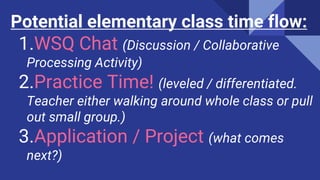
Potential elementary class time flow:
1.WSQ Chat (Discussion / Collaborative
Processing Activity)
2.Practice Time! (leveled / differentiated.
Teacher either walking around whole class or pull
out small group.)
3.Application / Project (what comes
next?)
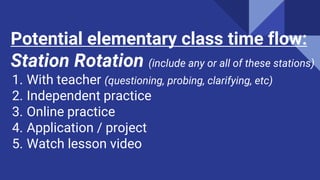
Potential elementary class time flow:
Station Rotation (include any or all of these stations)
1. With teacher (questioning, probing, clarifying, etc)
2. Independent practice
3. Online practice
4. Application / project
5. Watch lesson video
Practical Suggestions -
Delia Bush’s setup (5th grade teacher)
● http://flippedclassroom.blogspot.com/2013/10/how-my-flipclass-room-runsuntil-i.html
● http://flippedclassroom.blogspot.com/2012/11/how-am-i-making-this-work.html
● http://flippedclassroom.blogspot.com/2012/09/attempting-wsq.html
Questions I’m anticipating:
1.Holding students accountable
2.Student Access
Flip Your Classroom Upside Down
How I got time back in my classroom to support all
learners and deepen the learning experience for
students
In Summary...
1. What is a flipped classroom?
2. My Story: Results & Benefits
3. Practical strategies for implementation
Where to go from here...
resources & support
1. My contact:
a. Twitter: @crystalkirch
b. crystal.kirch@gmail.com
2. My blog
a. flippingwithkirch.blogspot.com
3. My book on Amazon.com: bit.ly/fwkirch
a. Flipping With Kirch: The Ups and Downs from Inside my Flipped Classroom
4. Resource documents:
a. This slide deck: bit.ly/TEAMP
b. bit.ly/chapmanflip
BONUS: FLIPPED CLASSROOM
MYTHS AND MISCONCEPTIONS
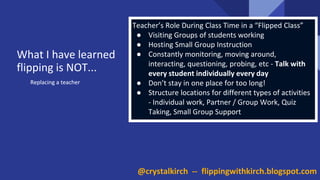
Replacing a teacher
Teacher’s Role During Class Time in a “Flipped Class”
● Visiting Groups of students working
● Hosting Small Group Instruction
● Constantly monitoring, moving around,
interacting, questioning, probing, etc - Talk with
every student individually every day
● Don’t stay in one place for too long!
● Structure locations for different types of activities
- Individual work, Partner / Group Work, Quiz
Taking, Small Group Support
Replacing a teacher
What I have learned
flipping is NOT...
@crystalkirch -- flippingwithkirch.blogspot.com
What I have learned
flipping is NOT...
Replacing a teacher
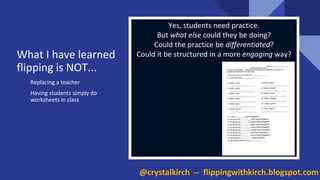
Having students simply do
worksheets in class
Yes, students need practice.
But what else could they be doing?
Could the practice be differentiated?
Could it be structured in a more engaging way?
@crystalkirch -- flippingwithkirch.blogspot.com
Replacing a teacher
Having students simply do
worksheets in class
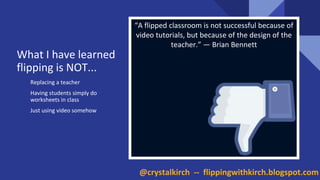
Just using video somehow
“A flipped classroom is not successful because of
video tutorials, but because of the design of the
teacher.” — Brian Bennett
What I have learned
flipping is NOT...
@crystalkirch -- flippingwithkirch.blogspot.com
Replacing a teacher
Having students simply do
worksheets in class
Just using video somehow
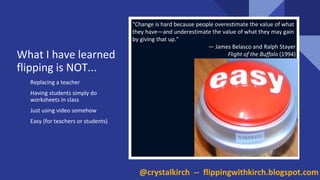
Easy (for teachers or students)
"Change is hard because people overestimate the value of what
they have—and underestimate the value of what they may gain
by giving that up."
— James Belasco and Ralph Stayer
Flight of the Buffalo (1994)What I have learned
flipping is NOT...
@crystalkirch -- flippingwithkirch.blogspot.com
Replacing a teacher
Having students simply do
worksheets in class
Just using video somehow
Easy (for teachers or students)
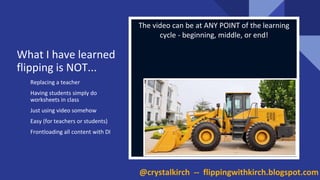
Frontloading all content with DI
The video can be at ANY POINT of the learning
cycle - beginning, middle, or end!
What I have learned
flipping is NOT...
@crystalkirch -- flippingwithkirch.blogspot.com
Replacing a teacher
Having students simply do
worksheets in class
Just using video somehow
Easy (for teachers or students)
Frontloading all content with DI
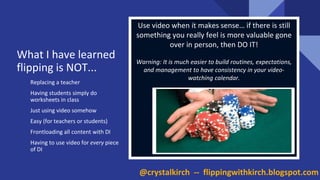
Having to use video for every piece
of DI
Use video when it makes sense… if there is still
something you really feel is more valuable gone
over in person, then DO IT!
Warning: It is much easier to build routines, expectations,
and management to have consistency in your video-
watching calendar.
What I have learned
flipping is NOT...
@crystalkirch -- flippingwithkirch.blogspot.com
BONUS: SPOON, FORK, KNIFE
ANALOGY
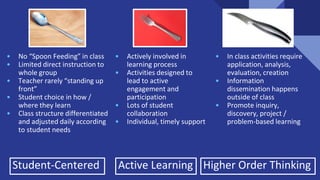
• No “Spoon Feeding” in class
• Limited direct instruction to
whole group
• Teacher rarely “standing up
front”
• Student choice in how /
where they learn
• Class structure differentiated
and adjusted daily according
to student needs
• Actively involved in
learning process
• Activities designed to
lead to active
engagement and
participation
• Lots of student
collaboration
• Individual, timely support
• In class activities require
application, analysis,
evaluation, creation
• Information
dissemination happens
outside of class
• Promote inquiry,
discovery, project /
problem-based learning
Student-Centered Active Learning Higher Order Thinking
Judge every activity
and decision against
those three shifts...
● Is this activity Student Centered?
Or am I still the focus of class
time?
● Are my students Active in their
Learning? Or are they still doing a
lot of sitting and listening, whole-
group?
● Does this activity require Higher
Order Thinking skills? How can I
adjust it to make it a deeper
activity?
@crystalkirch -- flippingwithkirch.blogspot.com
● INTENTIONALITY with at-home time
● STRUCTURING CLASS TIME around
student needs
● CLASS TIME EXTENDS AND DEEPENS,
doesn’t just review video
● MORE “STUDENT TALK”, less “teacher
talk”
● ACTIVITIES ARE STUDENT-CENTERED,
require ACTIVE LEARNING, focused on
HIGHER ORDER THINKING
What are the
differences between
“watch a video for
homework” and
“flipping a lesson”?
@crystalkirch -- flippingwithkirch.blogspot.com
BONUS: FIVE QUESTIONS EVERY
FLIPPED CLASSROOM TEACHER
MUST ANSWER
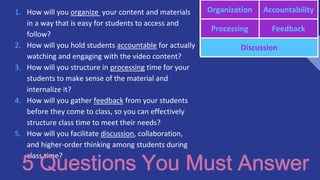
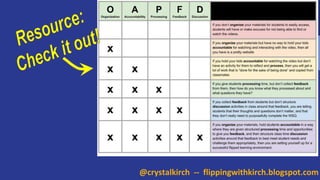
1. How will you organize your content and materials
in a way that is easy for students to access and
follow?
2. How will you hold students accountable for actually
watching and engaging with the video content?
3. How will you structure in processing time for your
students to make sense of the material and
internalize it?
4. How will you gather feedback from your students
before they come to class, so you can effectively
structure class time to meet their needs?
5. How will you facilitate discussion, collaboration,
and higher-order thinking among students during
class time?
Organization Accountability
Processing Feedback
Discussion
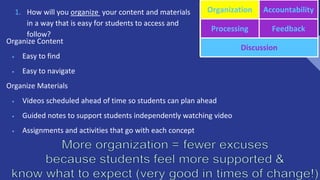
1. How will you organize your content and materials
in a way that is easy for students to access and
follow?
Organization Accountability
Processing Feedback
Discussion
Organize Content
• Easy to find
• Easy to navigate
Organize Materials
• Videos scheduled ahead of time so students can plan ahead
• Guided notes to support students independently watching video
• Assignments and activities that go with each concept
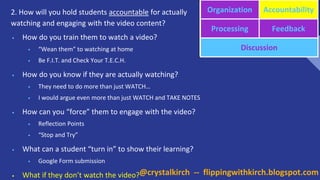
2. How will you hold students accountable for actually
watching and engaging with the video content?
Organization Accountability
Processing Feedback
Discussion
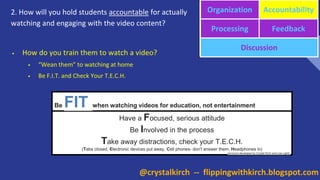
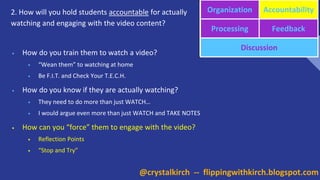
• How do you train them to watch a video?
• “Wean them” to watching at home
• Be F.I.T. and Check Your T.E.C.H.
Be FIT when watching videos for education, not entertainment
Have a Focused, serious attitude
Be Involved in the process
Take away distractions, check your T.E.C.H.
(Tabs closed, Electronic devices put away, Cell phones- don't answer them, Headphones in)
(acronym developed by Crystal Kirch and Lisa Light)
@crystalkirch -- flippingwithkirch.blogspot.com
2. How will you hold students accountable for actually
watching and engaging with the video content?
Organization Accountability
Processing Feedback
Discussion
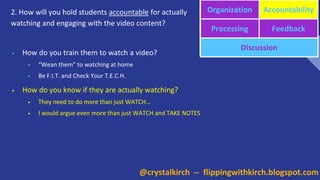
• How do you train them to watch a video?
• “Wean them” to watching at home
• Be F.I.T. and Check Your T.E.C.H.
• How do you know if they are actually watching?
• They need to do more than just WATCH…
• I would argue even more than just WATCH and TAKE NOTES
@crystalkirch -- flippingwithkirch.blogspot.com
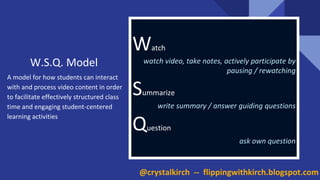
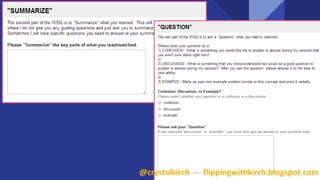
Watch
watch video, take notes, actively participate by
pausing / rewatching
Summarize
write summary / answer guiding questions
Question
ask own question
W.S.Q. Model
A model for how students can interact
with and process video content in order
to facilitate effectively structured class
time and engaging student-centered
learning activities
@crystalkirch -- flippingwithkirch.blogspot.com
2. How will you hold students accountable for actually
watching and engaging with the video content?
Organization Accountability
Processing Feedback
Discussion
• How do you train them to watch a video?
• “Wean them” to watching at home
• Be F.I.T. and Check Your T.E.C.H.
• How do you know if they are actually watching?
• They need to do more than just WATCH…
• I would argue even more than just WATCH and TAKE NOTES
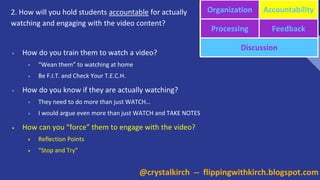
• How can you “force” them to engage with the video?
• Reflection Points
• “Stop and Try”
@crystalkirch -- flippingwithkirch.blogspot.com
2. How will you hold students accountable for actually
watching and engaging with the video content?
Organization Accountability
Processing Feedback
Discussion
• How do you train them to watch a video?
• “Wean them” to watching at home
• Be F.I.T. and Check Your T.E.C.H.
• How do you know if they are actually watching?
• They need to do more than just WATCH…
• I would argue even more than just WATCH and TAKE NOTES
• How can you “force” them to engage with the video?
• Reflection Points
• “Stop and Try”
@crystalkirch -- flippingwithkirch.blogspot.com
2. How will you hold students accountable for actually
watching and engaging with the video content?
Organization Accountability
Processing Feedback
Discussion
• How do you train them to watch a video?
• “Wean them” to watching at home
• Be F.I.T. and Check Your T.E.C.H.
• How do you know if they are actually watching?
• They need to do more than just WATCH…
• I would argue even more than just WATCH and TAKE NOTES
• How can you “force” them to engage with the video?
• Reflection Points
• “Stop and Try”
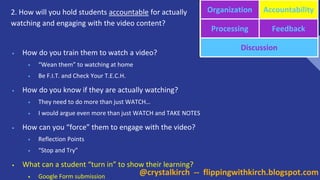
• What can a student “turn in” to show their learning?
• Google Form submission
@crystalkirch -- flippingwithkirch.blogspot.com
2. How will you hold students accountable for actually
watching and engaging with the video content?
Organization Accountability
Processing Feedback
Discussion
• How do you train them to watch a video?
• “Wean them” to watching at home
• Be F.I.T. and Check Your T.E.C.H.
• How do you know if they are actually watching?
• They need to do more than just WATCH…
• I would argue even more than just WATCH and TAKE NOTES
• How can you “force” them to engage with the video?
• Reflection Points
• “Stop and Try”
• What can a student “turn in” to show their learning?
• Google Form submission
• What if they don’t watch the video?@crystalkirch -- flippingwithkirch.blogspot.com
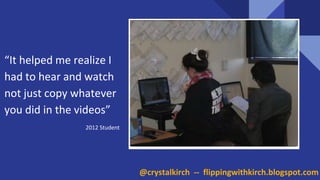
NEED PICTURE
“It helped me realize I
had to hear and watch
not just copy whatever
you did in the videos”
2012 Student
@crystalkirch -- flippingwithkirch.blogspot.com
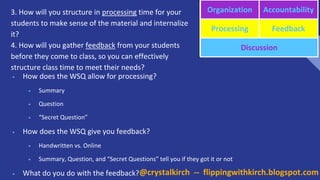
3. How will you structure in processing time for your
students to make sense of the material and internalize
it?
4. How will you gather feedback from your students
before they come to class, so you can effectively
structure class time to meet their needs?
Organization Accountability
Processing Feedback
Discussion
• How does the WSQ allow for processing?
• Summary
• Question
• “Secret Question”
• How does the WSQ give you feedback?
• Handwritten vs. Online
• Summary, Question, and “Secret Questions” tell you if they got it or not
• What do you do with the feedback?@crystalkirch -- flippingwithkirch.blogspot.com
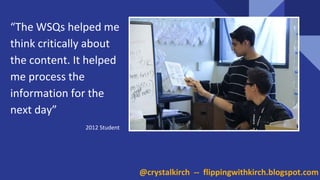
NEED PICTURE
“The WSQs helped me
think critically about
the content. It helped
me process the
information for the
next day”
2012 Student
@crystalkirch -- flippingwithkirch.blogspot.com
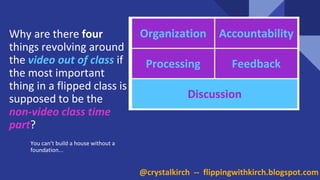
Why are there four
things revolving around
the video out of class if
the most important
thing in a flipped class is
supposed to be the
non-video class time
part?
You can’t build a house without a
foundation...
Organization Accountability
Processing Feedback
Discussion
@crystalkirch -- flippingwithkirch.blogspot.com

Spring into TEAMP: Flip your classroom upside down | Crystal Kirch

  • 1.
    Flip Your ClassroomUpside Down How I got time back in my classroom to support all learners and deepen the learning experience for students Crystal Kirch @crystalkirch Flippingwithkirch.blogspot.com bit.ly/FWKirchBook
  • 2.
    Wife & Momof 2 Digital Learning Coach: Working with teachers helping them to learn how to effectively implement technology to transform teaching & learning in their classrooms. Crystal Kirch @crystalkirch Flippingwithkirch.blogspot.com bit.ly/FWKirchBook
  • 3.
    1. What isa flipped classroom? 1. My Story: Results & Benefits 1. Practical strategies for implementation @crystalkirch -- flippingwithkirch.blogspot.com
  • 4.
    One Day in October2011... My lesson flopped. My students were lost. But I still sent them home to complete the homework. I had a last minute idea to make a quick video to help them out... @crystalkirch -- flippingwithkirch.blogspot.com
  • 5.
    This got methinking... ● What if I didn’t spend class time delivering content? ● What if I could help my students with problems during class time? ● What if I could let the “fast” students move quicker and help the “slow” students still feel confident? @crystalkirch -- flippingwithkirch.blogspot.com
  • 6.
    3 minutes inmy Flipped Classroom
  • 7.
    In a flippedclassroom, your role as a teacher in class is NOT “content deliverer”, but the “designer and facilitator” of learning activities that deepen student learning - with a lot more time to do so!
  • 8.
    @crystalkirch -- flippingwithkirch.blogspot.com SimpleDefinition of Flipping your Classroom (“Flip 101”) Deliver your instruction or explanation (lower level Bloom’s) thru a short video or other means and have students watch it for “homework”, or at least individually where they have control over the pace of their learning.
  • 9.
    @crystalkirch -- flippingwithkirch.blogspot.com SimpleDefinition of Flipping your Classroom (“Flip 101”) Deliver your instruction or explanation (lower level Bloom’s) thru a short video or other means and have students watch it for “homework”, or at least individually where they have control over the pace of their learning. During class, engage in meaningful activities with students now that you don’t need to stand up front explaining the basics anymore! *What are those meaningful activities? Depends on the teacher, the subject, the grade level!
  • 10.
    What is aFlipped Classroom? @crystalkirch -- flippingwithkirch.blogspot.com
  • 11.
    “I remember whenI used to do homework at home and I was stuck on a problem, I had nobody to help me, but now my teacher is here when I need her.” -2011 student 1. More time to help those that needed it, when they needed it 2. Differentiated support 3. Students demonstrating TWIRLS and explaining their thinking 4. Students learning at different paces 5. Students can revisit content anytime they needed. thinking, writing, interacting, reading, listening, speaking @crystalkirch -- flippingwithkirch.blogspot.com
  • 12.
    What other teachers say aboutwhy they love flipping their classroom
  • 15.
    “It isn’t likeany boring old class” “Interacting with classmates while still getting work done is a dream come true” “The ‘work together’ environment engages us in the learning” Engagement & Collaboration @crystalkirch -- flippingwithkirch.blogspot.com
  • 16.
    “It isn’t likeany boring old class” “Interacting with classmates while still getting work done is a dream come true” “The ‘work together’ environment engages us in the learning” “I can understand the math more” “You can help us more efficiently” “You can spend all of class answering our questions” Engagement & Collaboration Efficacy & Higher Feeling of Support @crystalkirch -- flippingwithkirch.blogspot.com
  • 17.
    “It isn’t likeany boring old class” “Interacting with classmates while still getting work done is a dream come true” “The ‘work together’ environment engages us in the learning” “I can understand the math more” “You can help us more efficiently” “You can spend all of class answering our questions” Talk with EVERY student EVERY day Engagement & Collaboration Efficacy & Higher Feeling of Support Relationships @crystalkirch -- flippingwithkirch.blogspot.com
  • 18.
    What is aflipped classroom? With lots of student comments and insights! (watch 5:22-7:58 if time)
  • 19.
    19 Traditional Math Classroom NewLesson in Class led by Teacher Students get some guided practice in class (depending on time) Teacher asks questions of students during class Teacher reviews questions from previous day as a whole class Students complete individual practice at home Students assessed formatively and summatively via quizzes and tests
  • 20.
    20 Transition to aFlipped Learning Lesson Cycle from Traditional
  • 21.
    21 Transition to aFlipped Learning Lesson Cycle from Traditional MISSING or RUSHED
  • 22.
    22 Transition to aFlipped Learning Lesson Cycle from Traditional MISSING or RUSHED LIVE TEACHING; all students at one pace
  • 23.
    23 Transition to aFlipped Learning Lesson Cycle from Traditional MISSING or RUSHED LIVE TEACHING; all students at one pace No Reflection; Accountability thru cold calling during lesson
  • 24.
    24 Transition to aFlipped Learning Lesson Cycle from Traditional MISSING or RUSHED LIVE TEACHING; all students at one pace No Reflection; Accountability thru cold calling during lesson MISSING or RUSHED
  • 25.
    25 Transition to aFlipped Learning Lesson Cycle from Traditional MISSING or RUSHED LIVE TEACHING; all students at one pace No Reflection; Accountability thru cold calling during lesson MISSING or RUSHED HOPEFULLY THERE! Application may be missing or rushed. Usually for “homework” with no support
  • 26.
    26 Transition to aFlipped Learning Lesson Cycle from Traditional MISSING or RUSHED LIVE TEACHING; all students at one pace No Reflection; Accountability thru cold calling during lesson MISSING or RUSHED HOPEFULLY THERE! Application may be missing or rushed. Usually for “homework” with no support HOPEFULLY THERE!
  • 27.
    27 Transition to aFlipped Learning Lesson Cycle from Traditional MISSING or RUSHED LIVE TEACHING; all students at one pace No Reflection; Accountability thru cold calling during lesson MISSING or RUSHED HOPEFULLY THERE! Application may be missing or rushed. Usually for “homework” with no support HOPEFULLY THERE! HOPEFULLY THERE!
  • 28.
    28 The Complete FlippedLearning Lesson Cycle: Before, During, and After the Video
  • 29.
  • 30.
    Potential elementary classtime flow: 1.WSQ Chat (Discussion / Collaborative Processing Activity) 2.Practice Time! (leveled / differentiated. Teacher either walking around whole class or pull out small group.) 3.Application / Project (what comes next?)
  • 31.
    Potential elementary classtime flow: Station Rotation (include any or all of these stations) 1. With teacher (questioning, probing, clarifying, etc) 2. Independent practice 3. Online practice 4. Application / project 5. Watch lesson video
  • 32.
    Practical Suggestions - DeliaBush’s setup (5th grade teacher) ● http://flippedclassroom.blogspot.com/2013/10/how-my-flipclass-room-runsuntil-i.html ● http://flippedclassroom.blogspot.com/2012/11/how-am-i-making-this-work.html ● http://flippedclassroom.blogspot.com/2012/09/attempting-wsq.html
  • 33.
    Questions I’m anticipating: 1.Holdingstudents accountable 2.Student Access
  • 34.
    Flip Your ClassroomUpside Down How I got time back in my classroom to support all learners and deepen the learning experience for students In Summary... 1. What is a flipped classroom? 2. My Story: Results & Benefits 3. Practical strategies for implementation
  • 35.
    Where to gofrom here... resources & support 1. My contact: a. Twitter: @crystalkirch b. crystal.kirch@gmail.com 2. My blog a. flippingwithkirch.blogspot.com 3. My book on Amazon.com: bit.ly/fwkirch a. Flipping With Kirch: The Ups and Downs from Inside my Flipped Classroom 4. Resource documents: a. This slide deck: bit.ly/TEAMP b. bit.ly/chapmanflip
  • 36.
  • 37.
    Replacing a teacher Teacher’sRole During Class Time in a “Flipped Class” ● Visiting Groups of students working ● Hosting Small Group Instruction ● Constantly monitoring, moving around, interacting, questioning, probing, etc - Talk with every student individually every day ● Don’t stay in one place for too long! ● Structure locations for different types of activities - Individual work, Partner / Group Work, Quiz Taking, Small Group Support Replacing a teacher What I have learned flipping is NOT... @crystalkirch -- flippingwithkirch.blogspot.com
  • 38.
    What I havelearned flipping is NOT... Replacing a teacher Having students simply do worksheets in class Yes, students need practice. But what else could they be doing? Could the practice be differentiated? Could it be structured in a more engaging way? @crystalkirch -- flippingwithkirch.blogspot.com
  • 39.
    Replacing a teacher Havingstudents simply do worksheets in class Just using video somehow “A flipped classroom is not successful because of video tutorials, but because of the design of the teacher.” — Brian Bennett What I have learned flipping is NOT... @crystalkirch -- flippingwithkirch.blogspot.com
  • 40.
    Replacing a teacher Havingstudents simply do worksheets in class Just using video somehow Easy (for teachers or students) "Change is hard because people overestimate the value of what they have—and underestimate the value of what they may gain by giving that up." — James Belasco and Ralph Stayer Flight of the Buffalo (1994)What I have learned flipping is NOT... @crystalkirch -- flippingwithkirch.blogspot.com
  • 41.
    Replacing a teacher Havingstudents simply do worksheets in class Just using video somehow Easy (for teachers or students) Frontloading all content with DI The video can be at ANY POINT of the learning cycle - beginning, middle, or end! What I have learned flipping is NOT... @crystalkirch -- flippingwithkirch.blogspot.com
  • 42.
    Replacing a teacher Havingstudents simply do worksheets in class Just using video somehow Easy (for teachers or students) Frontloading all content with DI Having to use video for every piece of DI Use video when it makes sense… if there is still something you really feel is more valuable gone over in person, then DO IT! Warning: It is much easier to build routines, expectations, and management to have consistency in your video- watching calendar. What I have learned flipping is NOT... @crystalkirch -- flippingwithkirch.blogspot.com
  • 43.
    BONUS: SPOON, FORK,KNIFE ANALOGY
  • 44.
    • No “SpoonFeeding” in class • Limited direct instruction to whole group • Teacher rarely “standing up front” • Student choice in how / where they learn • Class structure differentiated and adjusted daily according to student needs • Actively involved in learning process • Activities designed to lead to active engagement and participation • Lots of student collaboration • Individual, timely support • In class activities require application, analysis, evaluation, creation • Information dissemination happens outside of class • Promote inquiry, discovery, project / problem-based learning Student-Centered Active Learning Higher Order Thinking
  • 45.
    Judge every activity anddecision against those three shifts... ● Is this activity Student Centered? Or am I still the focus of class time? ● Are my students Active in their Learning? Or are they still doing a lot of sitting and listening, whole- group? ● Does this activity require Higher Order Thinking skills? How can I adjust it to make it a deeper activity? @crystalkirch -- flippingwithkirch.blogspot.com
  • 46.
    ● INTENTIONALITY withat-home time ● STRUCTURING CLASS TIME around student needs ● CLASS TIME EXTENDS AND DEEPENS, doesn’t just review video ● MORE “STUDENT TALK”, less “teacher talk” ● ACTIVITIES ARE STUDENT-CENTERED, require ACTIVE LEARNING, focused on HIGHER ORDER THINKING What are the differences between “watch a video for homework” and “flipping a lesson”? @crystalkirch -- flippingwithkirch.blogspot.com
  • 47.
    BONUS: FIVE QUESTIONSEVERY FLIPPED CLASSROOM TEACHER MUST ANSWER
  • 48.
    1. How willyou organize your content and materials in a way that is easy for students to access and follow? 2. How will you hold students accountable for actually watching and engaging with the video content? 3. How will you structure in processing time for your students to make sense of the material and internalize it? 4. How will you gather feedback from your students before they come to class, so you can effectively structure class time to meet their needs? 5. How will you facilitate discussion, collaboration, and higher-order thinking among students during class time? Organization Accountability Processing Feedback Discussion
  • 49.
    1. How willyou organize your content and materials in a way that is easy for students to access and follow? Organization Accountability Processing Feedback Discussion Organize Content • Easy to find • Easy to navigate Organize Materials • Videos scheduled ahead of time so students can plan ahead • Guided notes to support students independently watching video • Assignments and activities that go with each concept
  • 50.
    2. How willyou hold students accountable for actually watching and engaging with the video content? Organization Accountability Processing Feedback Discussion • How do you train them to watch a video? • “Wean them” to watching at home • Be F.I.T. and Check Your T.E.C.H. Be FIT when watching videos for education, not entertainment Have a Focused, serious attitude Be Involved in the process Take away distractions, check your T.E.C.H. (Tabs closed, Electronic devices put away, Cell phones- don't answer them, Headphones in) (acronym developed by Crystal Kirch and Lisa Light) @crystalkirch -- flippingwithkirch.blogspot.com
  • 51.
    2. How willyou hold students accountable for actually watching and engaging with the video content? Organization Accountability Processing Feedback Discussion • How do you train them to watch a video? • “Wean them” to watching at home • Be F.I.T. and Check Your T.E.C.H. • How do you know if they are actually watching? • They need to do more than just WATCH… • I would argue even more than just WATCH and TAKE NOTES @crystalkirch -- flippingwithkirch.blogspot.com
  • 52.
    Watch watch video, takenotes, actively participate by pausing / rewatching Summarize write summary / answer guiding questions Question ask own question W.S.Q. Model A model for how students can interact with and process video content in order to facilitate effectively structured class time and engaging student-centered learning activities @crystalkirch -- flippingwithkirch.blogspot.com
  • 53.
    2. How willyou hold students accountable for actually watching and engaging with the video content? Organization Accountability Processing Feedback Discussion • How do you train them to watch a video? • “Wean them” to watching at home • Be F.I.T. and Check Your T.E.C.H. • How do you know if they are actually watching? • They need to do more than just WATCH… • I would argue even more than just WATCH and TAKE NOTES • How can you “force” them to engage with the video? • Reflection Points • “Stop and Try” @crystalkirch -- flippingwithkirch.blogspot.com
  • 54.
    2. How willyou hold students accountable for actually watching and engaging with the video content? Organization Accountability Processing Feedback Discussion • How do you train them to watch a video? • “Wean them” to watching at home • Be F.I.T. and Check Your T.E.C.H. • How do you know if they are actually watching? • They need to do more than just WATCH… • I would argue even more than just WATCH and TAKE NOTES • How can you “force” them to engage with the video? • Reflection Points • “Stop and Try” @crystalkirch -- flippingwithkirch.blogspot.com
  • 55.
    2. How willyou hold students accountable for actually watching and engaging with the video content? Organization Accountability Processing Feedback Discussion • How do you train them to watch a video? • “Wean them” to watching at home • Be F.I.T. and Check Your T.E.C.H. • How do you know if they are actually watching? • They need to do more than just WATCH… • I would argue even more than just WATCH and TAKE NOTES • How can you “force” them to engage with the video? • Reflection Points • “Stop and Try” • What can a student “turn in” to show their learning? • Google Form submission @crystalkirch -- flippingwithkirch.blogspot.com
  • 56.
  • 57.
    2. How willyou hold students accountable for actually watching and engaging with the video content? Organization Accountability Processing Feedback Discussion • How do you train them to watch a video? • “Wean them” to watching at home • Be F.I.T. and Check Your T.E.C.H. • How do you know if they are actually watching? • They need to do more than just WATCH… • I would argue even more than just WATCH and TAKE NOTES • How can you “force” them to engage with the video? • Reflection Points • “Stop and Try” • What can a student “turn in” to show their learning? • Google Form submission • What if they don’t watch the video?@crystalkirch -- flippingwithkirch.blogspot.com
  • 58.
    NEED PICTURE “It helpedme realize I had to hear and watch not just copy whatever you did in the videos” 2012 Student @crystalkirch -- flippingwithkirch.blogspot.com
  • 59.
    3. How willyou structure in processing time for your students to make sense of the material and internalize it? 4. How will you gather feedback from your students before they come to class, so you can effectively structure class time to meet their needs? Organization Accountability Processing Feedback Discussion • How does the WSQ allow for processing? • Summary • Question • “Secret Question” • How does the WSQ give you feedback? • Handwritten vs. Online • Summary, Question, and “Secret Questions” tell you if they got it or not • What do you do with the feedback?@crystalkirch -- flippingwithkirch.blogspot.com
  • 60.
    NEED PICTURE “The WSQshelped me think critically about the content. It helped me process the information for the next day” 2012 Student @crystalkirch -- flippingwithkirch.blogspot.com
  • 61.
    Why are therefour things revolving around the video out of class if the most important thing in a flipped class is supposed to be the non-video class time part? You can’t build a house without a foundation... Organization Accountability Processing Feedback Discussion @crystalkirch -- flippingwithkirch.blogspot.com
  • 62.

Editor's Notes

  • #9 A transformational pedagogical strategy that utilizes technology and teacher-created video instruction to free up classroom time for more differentiated support and a deeper learning experience for all students. If you don’t have to deliver instruction, information, examples, etc to students as a whole group, what more could you do with that time?
  • #10 A transformational pedagogical strategy that utilizes technology and teacher-created video instruction to free up classroom time for more differentiated support and a deeper learning experience for all students. If you don’t have to deliver instruction, information, examples, etc to students as a whole group, what more could you do with that time?
  • #11 A transformational pedagogical strategy that utilizes technology and teacher-created video instruction to free up classroom time for more differentiated support and a deeper learning experience for all students. If you don’t have to deliver instruction, information, examples, etc to students as a whole group, what more could you do with that time?