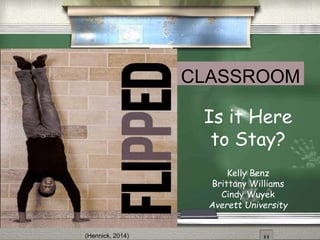
Is it Here
to Stay?
Kelly Benz
Brittany Williams
Cindy Wuyek
Averett University
(Hennick, 2014)
Yes!
Flipping the Classroom
★ With the advent of rapidly changing technology, a new
instructional trend is taking shape--the Flipped
Classroom, and it is here to stay
★ “Educational game-changer”
★ New approach to teaching and
learning
★ Positive praise from parents,
teachers and students
(Pearson , 2012)
John Dewey and The Flipped Classroom:
On the Same Page!
★ Dewey’s educational philosophy stressed activity
based learning, what we call Project Based Learning
(PBL) today
★ Student-centered activities and the responsibility of
learning new material are left up to the students
★ This creates opportunities for higher level cognitive
learning, more cooperative learning, and real-world
problem-solving (Gutek, 2011)
Maria Montessori and The Flipped
Classroom: On the Same Page!
★ Maria Montessori believed that children:
○ would be self-motivated if they chose their own
activities
○ should work at their own pace
○ should “acquire self-discipline and self-reliance by
recognizing their own mistakes and repeating a
particular task until it is done correctly” (Gutek,
2011, p. 395)
○ should learn practical life skills
★ That sounds like the Flipped Classroom concept!
Flipped Classroom Concept Founders
Jon Bergmann
● Over 26 years of teaching
experience
● Teaches Chemistry in
Woodland Park, Colorado
where flipped classrooms
started
● Began teamwork for
flipped classrooms with
Aaron Sams in 2011
Aaron Sams
● Teaches Chemistry with
Jon Bergmann in
Woodland Park, Colorado
● Awarded Presidential
Award in Mathematics and
Science Teaching in the
classroom (highest award
any teacher can receive
for grades K-12 in the
United States)
(Sams,2012)Click the screen to watch the video.
Flipped Classrooms
★ Pre-recorded lessons for students to
watch to familiarize themselves with
content before entering the classroom
★ Students can watch recorded lessons or
lectures on the web, jump-drive, or DVD
depending on the students’ technological
availability
Flipped Classrooms
★ Students take responsibility for their own
learning and choices for activities or
projects
★ Teacher acts as a facilitator and has more
time to provide one-on-one to the
students who are having difficulty, while
the students who are not can move right
along
★ Everyone works at their own pace
Flipped Classroom Instructional
Strategies
★ Flipped classroom concept is new, so no
best practices yet, but much sharing
taking place
★ Best strategy depends on context of class
★ Purpose of Flipped Classroom instructional
strategies is to offer student-centered
learning, not teacher-centered instruction
Flipped Classroom Instructional
Strategies
★ Students watch video clips at home, then complete
inquiry-based collaborative activities in class
★ Benefit: teacher has immediate feedback on concepts
that are unclear when the students enter the
classroom, rather than when they turn in assignments
at the end of class
★ Benefit: students discuss, analyze, and apply concepts,
so learn at higher cognitive levels
★ Benefit: students are engaged learners
Flipped Classroom Instructional
Strategies
★ Students complete these outside the classroom:
■ Discussion boards
■ Mini-assignments
■ Online worksheets with embedded video clips
★ Benefit: students have knowledge base when they
return to the classroom to start activities
★ Benefit: teacher can immediately remediate concepts
not widely understood before project-based activities
begin
Flipped Classrooms are Here to Stay
“ The flipped classroom, with its use of videos
that engage and focus student learning, offers
us a new model for case study teaching,
combining active, student-centered learning
with content mastery that can be applied to
solving real-world problems. It’s a win-win”
(Herreid & Schiller, 2013, p. 65).
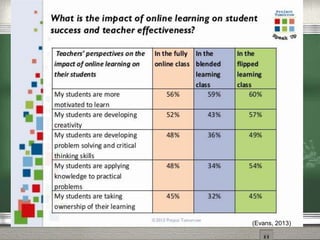
(Evans, 2013)
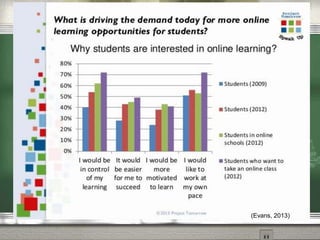
(Evans, 2013)
(Janke,, Durley, & Johnson, 2012)Click the screen to watch the video.
Flipped Classrooms are Here to Stay
Because...
★ Students accept more responsibility for
their learning--learning is student-centered
★ Classroom time is maximized
★ Flipped classes offer a more personalized
education
★ Students with learning disabilities do
better than in the traditional classroom
(Wiesen, 2014)
Students are more responsible for their
own learning
★ Motivated by video lecture vs. textbook
readings
★ Students watch video segments at their own
pace; over and over again for clarity, if needed
★ Students must watch videos prior to prepare
for the lesson
★ Students spend class time teaching one
another and asking clarifying questions
Students are more responsible for their
own learning
“It wasn't about creating more work for
students. It was about changing the type
of work that they did at home and
changing the class experience”
(Bergmann & Sams, 2012). “
Students are more responsible for their
own learning
"They were getting to choose to push the
play button," Douglass said. "They were
very, very excited about accepting that
responsibility. They actually like having the
power to make decisions. That's the biggest
impact I've seen in my classroom—the
ownership has gone from teacher to
student” (Butrymowicz, 2012).
Maximizing Classroom Learning Time
★ Teachers are able to spend class time:
■ Answering questions
■ Monitoring working
■ Probing deeper into content
■ Guiding the learning of students
★ Students are able to spend class time:
■ Doing hands-on activities and projects
■ Learning in a student-centered environment
★ Behavior is better managed because LEARNING is
now ENGAGING!
Individualized Education
The Flipped Classroom allows for:
★ Individual learning needs of each student to be
met
★ Differentiated instruction for each student
★ One-on-One time with instructor
★ Students to get individual time in class to work
with their teacher on key learning activities
(Pearson, 2013)
Flipped Classrooms Help Students with
Learning Disabilities
★ Flipped classroom time is used differently
and more effectively than traditional
classrooms (Wieson, 2014)
■ Students can watch videos as many
times as necessary for understanding
■ Teachers are facilitators in class and
can help students one-on-one
Flipped Classrooms Help Students with
Learning Disabilities
“Flipped instruction puts students with learning
disabilities on more equal footing for effective
classroom participation. Learners who formerly may
not have immediately grasped their teacher’s in-class
instruction may now feel empowered to contribute to
classroom discussions and ask informed questions
instead of worrying about ‘looking dumb’” (Wiesen,
2014)
Conclusion
The way we were taught isn't
necessarily the way we should teach…
Flipping the Classroom is a 21st century,
relevant and effective approach to
learning!
(and it began as part of John Dewey and
Maria Montessori’s educational philosophies
from the 20th century)
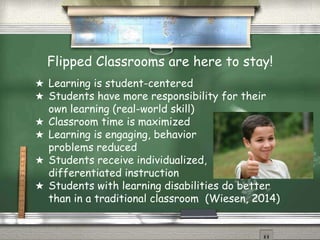
Flipped Classrooms are here to stay!
★ Learning is student-centered
★ Students have more responsibility for their
own learning (real-world skill)
★ Classroom time is maximized
★ Learning is engaging, behavior
problems reduced
★ Students receive individualized,
differentiated instruction
★ Students with learning disabilities do better
than in a traditional classroom (Wiesen, 2014)
Flipped Classrooms are here to stay!
According to Kari M. Arfstrom, Ph.D., Executive
Director of the Flipped Learning Network™, a survey
was given to 500 teachers who flipped their
classrooms.
“These innovative educators indicated a 67%
increase in test scores, and they reported an 80%
improvement in student attitudes” (Arfstrom, 2012).
Flipped classrooms are working! Why stop?
References
Arfstrom, K. (2012, September 14). Trends come and go ‒ why flipped learning has
staying power. Retrieved July 8, 2014 from http://www.ednetinsight.com/news-
alerts/voice-from-the-field/trends-come-and-go---why-flipped-learning-has-
staying-power.html
Bergman, J. and Sams, A. (2012, April 15). How the flipped classroom is radically
transforming learning. The Daily Riff, Retrieved June 29, 2014 from
http://www.thedailyriff.com/articles/how-the-flipped-classroom-is-radically-
transforming-learning-536.php
Butrymowicz, S. 'Flipped classroom' model's promise eludes poorer school districts.
Huffington Post, (June 13, 2012), Retrieved July 7, 2014 from
http://www.huffingtonpost.com/2012/06/13/flipped-classroom-models-
_n_1594279.html
Evans, J. 2013 Project tomorrow: trends in online learning virtual blended and flipped
classrooms. Retrieved July 7, 2014 from
http://www.tomorrow.org/speakup/2013_OnlineLearningReport_pres.html (slide
21)
References
Hennick, C. (2014). Flipped. Scholastic Administrator, 13(5), 38-42.
Herreid, C., & Schiller, N. A. (2013). Case studies and the flipped classroom. Journal Of
College Science Teaching, 42(5), 62-66.
Janke, P., Durley, C., & Johnson, G. (2012, May 14) The flipped classroom as a vehicle to
the future [video file]. Retrieved July 7, 2014 from
https://www.youtube.com/watch?v=ZpHfTO8SW7U
Pearson, G. (2012). Biology teacher’s flipped classroom: ‘A simple thing, but it’s so
powerful’. Education Canada. 52(5). Retrieved from http://www.cea-
ace.ca/education-canada/article/biology-teacher%E2%80%99s-flipped-
classroom-%E2%80%98-simple-thing-it%E2%80%99s-so-
powerful%E2%80%99owing p46-46
References
Pearson & The Flipped Learning Network (2013). Flipped Learning Professional
Development. Retrieved from http://www.pearsonschool.com/flippedlearning
Sams, A. (2012, September 28) The flipped classroom [video file]. Retrieved July 7,
2014 from https://www.youtube.com/watch?v=2H4RkudFzlc
Wiesen, N. (2014, February 11). Flipping the classroom for students with learning
disabilities [Web log post]. Retrieved from
http://www.scilearn.com/blog/flipping-the-classroom-for-students-with-
learning-disabilties.php

Flipped classroom debate presentation 7.9.14

  • 1.
    Is it Here toStay? Kelly Benz Brittany Williams Cindy Wuyek Averett University (Hennick, 2014)
  • 2.
  • 3.
    Flipping the Classroom ★With the advent of rapidly changing technology, a new instructional trend is taking shape--the Flipped Classroom, and it is here to stay ★ “Educational game-changer” ★ New approach to teaching and learning ★ Positive praise from parents, teachers and students (Pearson , 2012)
  • 4.
    John Dewey andThe Flipped Classroom: On the Same Page! ★ Dewey’s educational philosophy stressed activity based learning, what we call Project Based Learning (PBL) today ★ Student-centered activities and the responsibility of learning new material are left up to the students ★ This creates opportunities for higher level cognitive learning, more cooperative learning, and real-world problem-solving (Gutek, 2011)
  • 5.
    Maria Montessori andThe Flipped Classroom: On the Same Page! ★ Maria Montessori believed that children: ○ would be self-motivated if they chose their own activities ○ should work at their own pace ○ should “acquire self-discipline and self-reliance by recognizing their own mistakes and repeating a particular task until it is done correctly” (Gutek, 2011, p. 395) ○ should learn practical life skills ★ That sounds like the Flipped Classroom concept!
  • 6.
    Flipped Classroom ConceptFounders Jon Bergmann ● Over 26 years of teaching experience ● Teaches Chemistry in Woodland Park, Colorado where flipped classrooms started ● Began teamwork for flipped classrooms with Aaron Sams in 2011 Aaron Sams ● Teaches Chemistry with Jon Bergmann in Woodland Park, Colorado ● Awarded Presidential Award in Mathematics and Science Teaching in the classroom (highest award any teacher can receive for grades K-12 in the United States)
  • 7.
    (Sams,2012)Click the screento watch the video.
  • 8.
    Flipped Classrooms ★ Pre-recordedlessons for students to watch to familiarize themselves with content before entering the classroom ★ Students can watch recorded lessons or lectures on the web, jump-drive, or DVD depending on the students’ technological availability
  • 9.
    Flipped Classrooms ★ Studentstake responsibility for their own learning and choices for activities or projects ★ Teacher acts as a facilitator and has more time to provide one-on-one to the students who are having difficulty, while the students who are not can move right along ★ Everyone works at their own pace
  • 10.
    Flipped Classroom Instructional Strategies ★Flipped classroom concept is new, so no best practices yet, but much sharing taking place ★ Best strategy depends on context of class ★ Purpose of Flipped Classroom instructional strategies is to offer student-centered learning, not teacher-centered instruction
  • 11.
    Flipped Classroom Instructional Strategies ★Students watch video clips at home, then complete inquiry-based collaborative activities in class ★ Benefit: teacher has immediate feedback on concepts that are unclear when the students enter the classroom, rather than when they turn in assignments at the end of class ★ Benefit: students discuss, analyze, and apply concepts, so learn at higher cognitive levels ★ Benefit: students are engaged learners
  • 12.
    Flipped Classroom Instructional Strategies ★Students complete these outside the classroom: ■ Discussion boards ■ Mini-assignments ■ Online worksheets with embedded video clips ★ Benefit: students have knowledge base when they return to the classroom to start activities ★ Benefit: teacher can immediately remediate concepts not widely understood before project-based activities begin
  • 13.
    Flipped Classrooms areHere to Stay “ The flipped classroom, with its use of videos that engage and focus student learning, offers us a new model for case study teaching, combining active, student-centered learning with content mastery that can be applied to solving real-world problems. It’s a win-win” (Herreid & Schiller, 2013, p. 65).
  • 14.
  • 15.
  • 16.
    (Janke,, Durley, &Johnson, 2012)Click the screen to watch the video.
  • 17.
    Flipped Classrooms areHere to Stay Because... ★ Students accept more responsibility for their learning--learning is student-centered ★ Classroom time is maximized ★ Flipped classes offer a more personalized education ★ Students with learning disabilities do better than in the traditional classroom (Wiesen, 2014)
  • 18.
    Students are moreresponsible for their own learning ★ Motivated by video lecture vs. textbook readings ★ Students watch video segments at their own pace; over and over again for clarity, if needed ★ Students must watch videos prior to prepare for the lesson ★ Students spend class time teaching one another and asking clarifying questions
  • 19.
    Students are moreresponsible for their own learning “It wasn't about creating more work for students. It was about changing the type of work that they did at home and changing the class experience” (Bergmann & Sams, 2012). “
  • 20.
    Students are moreresponsible for their own learning "They were getting to choose to push the play button," Douglass said. "They were very, very excited about accepting that responsibility. They actually like having the power to make decisions. That's the biggest impact I've seen in my classroom—the ownership has gone from teacher to student” (Butrymowicz, 2012).
  • 21.
    Maximizing Classroom LearningTime ★ Teachers are able to spend class time: ■ Answering questions ■ Monitoring working ■ Probing deeper into content ■ Guiding the learning of students ★ Students are able to spend class time: ■ Doing hands-on activities and projects ■ Learning in a student-centered environment ★ Behavior is better managed because LEARNING is now ENGAGING!
  • 22.
    Individualized Education The FlippedClassroom allows for: ★ Individual learning needs of each student to be met ★ Differentiated instruction for each student ★ One-on-One time with instructor ★ Students to get individual time in class to work with their teacher on key learning activities (Pearson, 2013)
  • 23.
    Flipped Classrooms HelpStudents with Learning Disabilities ★ Flipped classroom time is used differently and more effectively than traditional classrooms (Wieson, 2014) ■ Students can watch videos as many times as necessary for understanding ■ Teachers are facilitators in class and can help students one-on-one
  • 24.
    Flipped Classrooms HelpStudents with Learning Disabilities “Flipped instruction puts students with learning disabilities on more equal footing for effective classroom participation. Learners who formerly may not have immediately grasped their teacher’s in-class instruction may now feel empowered to contribute to classroom discussions and ask informed questions instead of worrying about ‘looking dumb’” (Wiesen, 2014)
  • 25.
    Conclusion The way wewere taught isn't necessarily the way we should teach… Flipping the Classroom is a 21st century, relevant and effective approach to learning! (and it began as part of John Dewey and Maria Montessori’s educational philosophies from the 20th century)
  • 26.
    Flipped Classrooms arehere to stay! ★ Learning is student-centered ★ Students have more responsibility for their own learning (real-world skill) ★ Classroom time is maximized ★ Learning is engaging, behavior problems reduced ★ Students receive individualized, differentiated instruction ★ Students with learning disabilities do better than in a traditional classroom (Wiesen, 2014)
  • 27.
    Flipped Classrooms arehere to stay! According to Kari M. Arfstrom, Ph.D., Executive Director of the Flipped Learning Network™, a survey was given to 500 teachers who flipped their classrooms. “These innovative educators indicated a 67% increase in test scores, and they reported an 80% improvement in student attitudes” (Arfstrom, 2012). Flipped classrooms are working! Why stop?
  • 28.
    References Arfstrom, K. (2012,September 14). Trends come and go ‒ why flipped learning has staying power. Retrieved July 8, 2014 from http://www.ednetinsight.com/news- alerts/voice-from-the-field/trends-come-and-go---why-flipped-learning-has- staying-power.html Bergman, J. and Sams, A. (2012, April 15). How the flipped classroom is radically transforming learning. The Daily Riff, Retrieved June 29, 2014 from http://www.thedailyriff.com/articles/how-the-flipped-classroom-is-radically- transforming-learning-536.php Butrymowicz, S. 'Flipped classroom' model's promise eludes poorer school districts. Huffington Post, (June 13, 2012), Retrieved July 7, 2014 from http://www.huffingtonpost.com/2012/06/13/flipped-classroom-models- _n_1594279.html Evans, J. 2013 Project tomorrow: trends in online learning virtual blended and flipped classrooms. Retrieved July 7, 2014 from http://www.tomorrow.org/speakup/2013_OnlineLearningReport_pres.html (slide 21)
  • 29.
    References Hennick, C. (2014).Flipped. Scholastic Administrator, 13(5), 38-42. Herreid, C., & Schiller, N. A. (2013). Case studies and the flipped classroom. Journal Of College Science Teaching, 42(5), 62-66. Janke, P., Durley, C., & Johnson, G. (2012, May 14) The flipped classroom as a vehicle to the future [video file]. Retrieved July 7, 2014 from https://www.youtube.com/watch?v=ZpHfTO8SW7U Pearson, G. (2012). Biology teacher’s flipped classroom: ‘A simple thing, but it’s so powerful’. Education Canada. 52(5). Retrieved from http://www.cea- ace.ca/education-canada/article/biology-teacher%E2%80%99s-flipped- classroom-%E2%80%98-simple-thing-it%E2%80%99s-so- powerful%E2%80%99owing p46-46
  • 30.
    References Pearson & TheFlipped Learning Network (2013). Flipped Learning Professional Development. Retrieved from http://www.pearsonschool.com/flippedlearning Sams, A. (2012, September 28) The flipped classroom [video file]. Retrieved July 7, 2014 from https://www.youtube.com/watch?v=2H4RkudFzlc Wiesen, N. (2014, February 11). Flipping the classroom for students with learning disabilities [Web log post]. Retrieved from http://www.scilearn.com/blog/flipping-the-classroom-for-students-with- learning-disabilties.php