Flipped Classroom
- The Gain & Pain
Agenda
•
•
•
•

Background
How was it done?
Did it work?
What to do & What not to do?
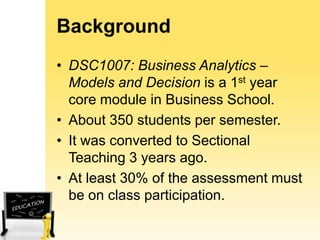
Background
• DSC1007: Business Analytics –
Models and Decision is a 1st year
core module in Business School.
• About 350 students per semester.
• It was converted to Sectional
Teaching 3 years ago.
• At least 30% of the assessment must
be on class participation.
How do students view
DSC1007?
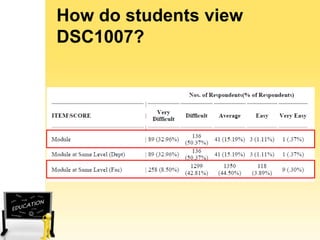
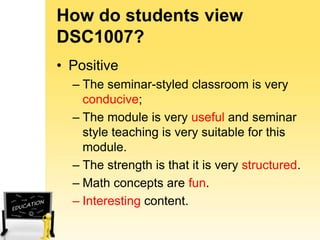
How do students view
DSC1007?
• Positive
– The seminar-styled classroom is very
conducive;
– The module is very useful and seminar
style teaching is very suitable for this
module.
– The strength is that it is very structured.
– Math concepts are fun.
– Interesting content.
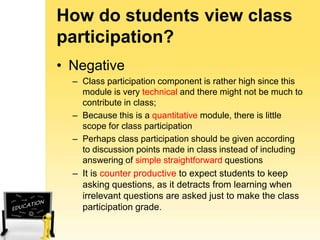
How do students view class
participation?
• Negative
– Class participation component is rather high since this
module is very technical and there might not be much to
contribute in class;
– Because this is a quantitative module, there is little
scope for class participation
– Perhaps class participation should be given according
to discussion points made in class instead of including
answering of simple straightforward questions
– It is counter productive to expect students to keep
asking questions, as it detracts from learning when
irrelevant questions are asked just to make the class
participation grade.
Polarization
• “The first half of the module is repeating
what we have learnt in A-level math.”
• “The module was simple.”
• “stats sucks! too many things to learn
too much hw, no one does all of it!”
• “examples very vague, questions hard
to do”
• “it is quite hard to understand the topic”
• “while the mathematically-inclined
students are able to remain up to
speed, others are struggling.”
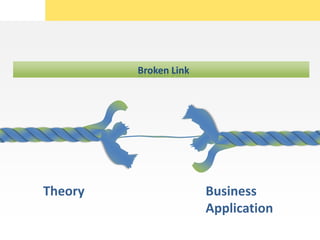
Broken Link

Theory

Business
Application
How was it done?
• 4 out of 11 lessons were flipped.
• Used “Record Slide Show” function
to record slide-based presentation.
• 2-3 cases were selected for students
to work on in each class.
Example – Probability
Theory
• Sally Clark Case
• O.J. Simpson Case
• Medical Diagnosis Case
– Mr Wong was told by the doctor that he
was diagnosed as having an
exceptionally rare disease, which
afflicts only one person in a million.
– The doctor claimed that the reliability of
the test is 99.9%
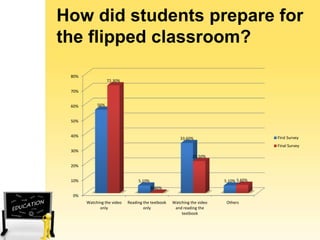
How did students prepare for
the flipped classroom?
80%

72.30%

70%
60%

56%

50%
40%

First Survey

33.60%

Final Survey
30%
21.50%

20%
10%

5.10% 5.60%

5.10%
0.40%

0%
Watching the video
only

Reading the textbook
only

Watching the video
and reading the
textbook

Others
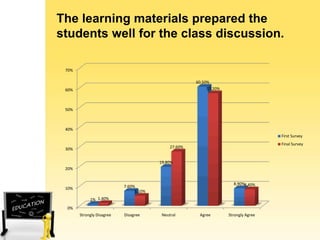
The learning materials prepared the
students well for the class discussion.
70%
60.50%
57.20%

60%

50%

40%
First Survey
Final Survey

27.60%

30%

19.80%
20%
8.90%8.40%

7.60%
5.10%

10%
1% 1.40%
0%
Strongly Disagree

Disagree

Neutral

Agree

Strongly Agree
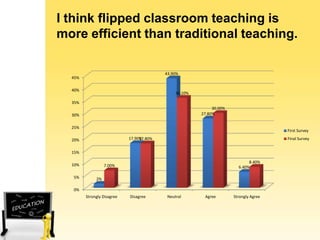
I think flipped classroom teaching is
more efficient than traditional teaching.
43.90%

45%
40%

36.10%

35%
30.00%
27.80%

30%
25%

First Survey
17.90%
17.80%

20%

Final Survey

15%
10%
5%

8.40%
6.40%

7.00%
2%

0%
Strongly Disagree

Disagree

Neutral

Agree

Strongly Agree
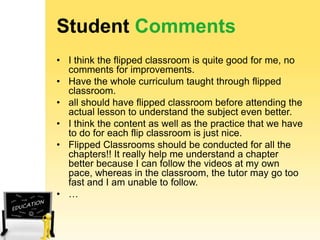
Student Comments
• I think the flipped classroom is quite good for me, no
comments for improvements.
• Have the whole curriculum taught through flipped
classroom.
• all should have flipped classroom before attending the
actual lesson to understand the subject even better.
• I think the content as well as the practice that we have
to do for each flip classroom is just nice.
• Flipped Classrooms should be conducted for all the
chapters!! It really help me understand a chapter
better because I can follow the videos at my own
pace, whereas in the classroom, the tutor may go too
fast and I am unable to follow.
• …
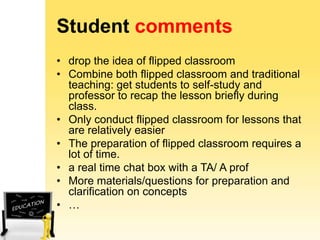
Student comments
• drop the idea of flipped classroom
• Combine both flipped classroom and traditional
teaching: get students to self-study and
professor to recap the lesson briefly during
class.
• Only conduct flipped classroom for lessons that
are relatively easier
• The preparation of flipped classroom requires a
lot of time.
• a real time chat box with a TA/ A prof
• More materials/questions for preparation and
clarification on concepts
• …
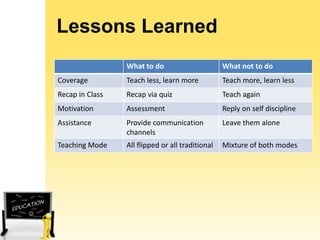
Lessons Learned
What to do

What not to do

Coverage

Teach less, learn more

Teach more, learn less

Recap in Class

Recap via quiz

Teach again

Motivation

Assessment

Reply on self discipline

Assistance

Provide communication
channels

Leave them alone

Teaching Mode

All flipped or all traditional

Mixture of both modes

Flipped Classroom - the Pain & Gain

  • 1.
  • 2.
    Agenda • • • • Background How was itdone? Did it work? What to do & What not to do?
  • 3.
    Background • DSC1007: BusinessAnalytics – Models and Decision is a 1st year core module in Business School. • About 350 students per semester. • It was converted to Sectional Teaching 3 years ago. • At least 30% of the assessment must be on class participation.
  • 4.
    How do studentsview DSC1007?
  • 5.
    How do studentsview DSC1007? • Positive – The seminar-styled classroom is very conducive; – The module is very useful and seminar style teaching is very suitable for this module. – The strength is that it is very structured. – Math concepts are fun. – Interesting content.
  • 6.
    How do studentsview class participation? • Negative – Class participation component is rather high since this module is very technical and there might not be much to contribute in class; – Because this is a quantitative module, there is little scope for class participation – Perhaps class participation should be given according to discussion points made in class instead of including answering of simple straightforward questions – It is counter productive to expect students to keep asking questions, as it detracts from learning when irrelevant questions are asked just to make the class participation grade.
  • 7.
    Polarization • “The firsthalf of the module is repeating what we have learnt in A-level math.” • “The module was simple.” • “stats sucks! too many things to learn too much hw, no one does all of it!” • “examples very vague, questions hard to do” • “it is quite hard to understand the topic” • “while the mathematically-inclined students are able to remain up to speed, others are struggling.”
  • 8.
  • 9.
    How was itdone? • 4 out of 11 lessons were flipped. • Used “Record Slide Show” function to record slide-based presentation. • 2-3 cases were selected for students to work on in each class.
  • 10.
    Example – Probability Theory •Sally Clark Case • O.J. Simpson Case • Medical Diagnosis Case – Mr Wong was told by the doctor that he was diagnosed as having an exceptionally rare disease, which afflicts only one person in a million. – The doctor claimed that the reliability of the test is 99.9%
  • 11.
    How did studentsprepare for the flipped classroom? 80% 72.30% 70% 60% 56% 50% 40% First Survey 33.60% Final Survey 30% 21.50% 20% 10% 5.10% 5.60% 5.10% 0.40% 0% Watching the video only Reading the textbook only Watching the video and reading the textbook Others
  • 12.
    The learning materialsprepared the students well for the class discussion. 70% 60.50% 57.20% 60% 50% 40% First Survey Final Survey 27.60% 30% 19.80% 20% 8.90%8.40% 7.60% 5.10% 10% 1% 1.40% 0% Strongly Disagree Disagree Neutral Agree Strongly Agree
  • 13.
    I think flippedclassroom teaching is more efficient than traditional teaching. 43.90% 45% 40% 36.10% 35% 30.00% 27.80% 30% 25% First Survey 17.90% 17.80% 20% Final Survey 15% 10% 5% 8.40% 6.40% 7.00% 2% 0% Strongly Disagree Disagree Neutral Agree Strongly Agree
  • 14.
    Student Comments • Ithink the flipped classroom is quite good for me, no comments for improvements. • Have the whole curriculum taught through flipped classroom. • all should have flipped classroom before attending the actual lesson to understand the subject even better. • I think the content as well as the practice that we have to do for each flip classroom is just nice. • Flipped Classrooms should be conducted for all the chapters!! It really help me understand a chapter better because I can follow the videos at my own pace, whereas in the classroom, the tutor may go too fast and I am unable to follow. • …
  • 15.
    Student comments • dropthe idea of flipped classroom • Combine both flipped classroom and traditional teaching: get students to self-study and professor to recap the lesson briefly during class. • Only conduct flipped classroom for lessons that are relatively easier • The preparation of flipped classroom requires a lot of time. • a real time chat box with a TA/ A prof • More materials/questions for preparation and clarification on concepts • …
  • 16.
    Lessons Learned What todo What not to do Coverage Teach less, learn more Teach more, learn less Recap in Class Recap via quiz Teach again Motivation Assessment Reply on self discipline Assistance Provide communication channels Leave them alone Teaching Mode All flipped or all traditional Mixture of both modes