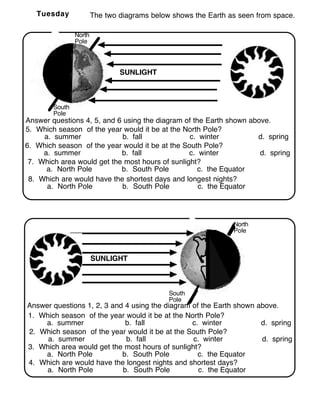
Tuesday              The two diagrams below shows the Earth as seen from space.

                North
                Pole


                                SUNLIGHT


        South
        Pole
Answer questions 4, 5, and 6 using the diagram of the Earth shown above.
5. Which season of the year would it be at the North Pole?
     a. summer               b. fall             c. winter          d. spring
6. Which season of the year would it be at the South Pole?
     a. summer              b. fall              c. winter           d. spring
 7. Which area would get the most hours of sunlight?
      a. North Pole         b. South Pole           c. the Equator
 8. Which are would have the shortest days and longest nights?
      a. North Pole         b. South Pole           c. the Equator


                                                                North
                                                                Pole


                        SUNLIGHT


                                              South
                                              Pole
Answer questions 1, 2, 3 and 4 using the diagram of the Earth shown above.
1. Which season of the year would it be at the North Pole?
    a. summer                b. fall             c. winter           d. spring
2. Which season of the year would it be at the South Pole?
     a. summer               b. fall             c. winter           d. spring
3. Which area would get the most hours of sunlight?
    a. North Pole           b. South Pole          c. the Equator
4. Which are would have the longest nights and shortest days?
     a. North Pole          b. South Pole          c. the Equator
Wednesday

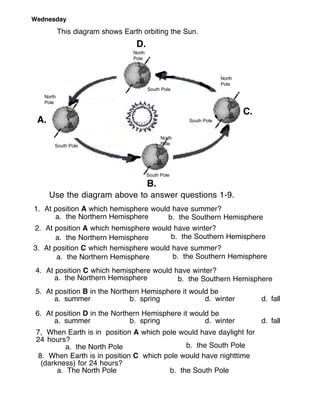
           This diagram shows Earth orbiting the Sun.
                                  D.
                                 North
                                 Pole


                                                                    North
                                                                    Pole
                                         South Pole
   North
   Pole

                                                                            C.
 A.                                                    South Pole


                                               North
       South Pole                              Pole


                                         South Pole

                                         B.
      Use the diagram above to answer questions 1-9.
1. At position A which hemisphere would have summer?
      a. the Northern Hemisphere       b. the Southern Hemisphere
2. At position A which hemisphere would have winter?
      a. the Northern Hemisphere        b. the Southern Hemisphere
3. At position C which hemisphere would have summer?
       a. the Northern Hemisphere       b. the Southern Hemisphere
 4. At position C which hemisphere would have winter?
       a. the Northern Hemisphere         b. the Southern Hemisphere
 5. At position B in the Northern Hemisphere it would be
       a. summer              b. spring             d. winter                    d. fall

 6. At position D in the Northern Hemisphere it would be
       a. summer              b. spring             d. winter                    d. fall
 7, When Earth is in position A which pole would have daylight for
 24 hours?
           a. the North Pole                 b. the South Pole
  8. When Earth is in position C which pole would have nighttime
   (darkness) for 24 hours?
        a. The North Pole               b. the South Pole
Thursday
1. We have summer in Texas because
    a. the Moon orbits the Earth
    b. the Earthʼs orbit is closer to the Sun at that time of year
    c. the North Pole is tilted towards the Sun at that time of the year
    d. the Sun has fewer sunspots and is hotter at that time of the year

 2. Day and night is caused by
      a. the Earth orbiting the Sun one time
      b. the Moon orbiting the Earth
      c. the Earth rotating one time on its axis
      d. the tilt of the Earthʼs axis

3. One year has passed when
     a. the Earth has orbited the Sun one time
     b. the Moon has orbited the Earth one time
     c. the Earth has rotated on its axis one time
     d. the Earth has tilted from left to right and right to left one time
 4. From Earth we often see the light from the Moon at night because
      a. the surface of the Moon gives off its own light
      b. The Moon absorbs light from the Sun during the day and gives off
      this light at night.
      c. Light from the Earth shines on the Moonʼs surface making it visible.
      d. Light given off by the Sun is reflected off the surface of the Moon
      to the Earth

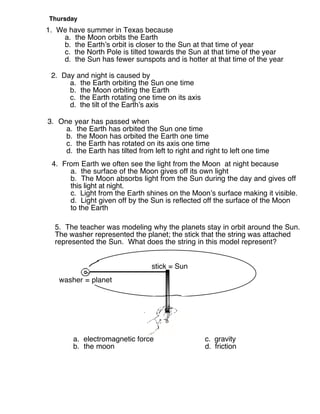
  5. The teacher was modeling why the planets stay in orbit around the Sun.
  The washer represented the planet; the stick that the string was attached
  represented the Sun. What does the string in this model represent?


                                  stick = Sun
   washer = planet


        a. electromagnetic force                    c. gravity
        b. the moon                                 d. friction

Seasons (worksheet)

  • 1.
    Tuesday The two diagrams below shows the Earth as seen from space. North Pole SUNLIGHT South Pole Answer questions 4, 5, and 6 using the diagram of the Earth shown above. 5. Which season of the year would it be at the North Pole? a. summer b. fall c. winter d. spring 6. Which season of the year would it be at the South Pole? a. summer b. fall c. winter d. spring 7. Which area would get the most hours of sunlight? a. North Pole b. South Pole c. the Equator 8. Which are would have the shortest days and longest nights? a. North Pole b. South Pole c. the Equator North Pole SUNLIGHT South Pole Answer questions 1, 2, 3 and 4 using the diagram of the Earth shown above. 1. Which season of the year would it be at the North Pole? a. summer b. fall c. winter d. spring 2. Which season of the year would it be at the South Pole? a. summer b. fall c. winter d. spring 3. Which area would get the most hours of sunlight? a. North Pole b. South Pole c. the Equator 4. Which are would have the longest nights and shortest days? a. North Pole b. South Pole c. the Equator
  • 2.
    Wednesday This diagram shows Earth orbiting the Sun. D. North Pole North Pole South Pole North Pole C. A. South Pole North South Pole Pole South Pole B. Use the diagram above to answer questions 1-9. 1. At position A which hemisphere would have summer? a. the Northern Hemisphere b. the Southern Hemisphere 2. At position A which hemisphere would have winter? a. the Northern Hemisphere b. the Southern Hemisphere 3. At position C which hemisphere would have summer? a. the Northern Hemisphere b. the Southern Hemisphere 4. At position C which hemisphere would have winter? a. the Northern Hemisphere b. the Southern Hemisphere 5. At position B in the Northern Hemisphere it would be a. summer b. spring d. winter d. fall 6. At position D in the Northern Hemisphere it would be a. summer b. spring d. winter d. fall 7, When Earth is in position A which pole would have daylight for 24 hours? a. the North Pole b. the South Pole 8. When Earth is in position C which pole would have nighttime (darkness) for 24 hours? a. The North Pole b. the South Pole
  • 3.
    Thursday 1. We havesummer in Texas because a. the Moon orbits the Earth b. the Earthʼs orbit is closer to the Sun at that time of year c. the North Pole is tilted towards the Sun at that time of the year d. the Sun has fewer sunspots and is hotter at that time of the year 2. Day and night is caused by a. the Earth orbiting the Sun one time b. the Moon orbiting the Earth c. the Earth rotating one time on its axis d. the tilt of the Earthʼs axis 3. One year has passed when a. the Earth has orbited the Sun one time b. the Moon has orbited the Earth one time c. the Earth has rotated on its axis one time d. the Earth has tilted from left to right and right to left one time 4. From Earth we often see the light from the Moon at night because a. the surface of the Moon gives off its own light b. The Moon absorbs light from the Sun during the day and gives off this light at night. c. Light from the Earth shines on the Moonʼs surface making it visible. d. Light given off by the Sun is reflected off the surface of the Moon to the Earth 5. The teacher was modeling why the planets stay in orbit around the Sun. The washer represented the planet; the stick that the string was attached represented the Sun. What does the string in this model represent? stick = Sun washer = planet a. electromagnetic force c. gravity b. the moon d. friction