Constitutional/Statutory Bases
Sec. 3. Article IX-B
1987 Philippine Constitution
 Establish a career service
 Adopt measures to promote morale, efficiency, integrity,
responsiveness, progressiveness, and courtesy in the civil service
 Strengthen the rewards and merit system
 Integrate the HRD programs for all levels & ranks
 Institutionalize a management climate conducive to public
accountability
Basic Tenets of
Performance Management
- Promulgate policies, standards and
guidelines for the Civil Service
- Adopt plans and programs to promote
economical, efficient and effective
personnel administration in the
government
(Title I, Subtitle A. Chapter 1, Book V,
EP 292)
CSC POWERS
CSC POWERS
Basic Tenets of
Performance Management

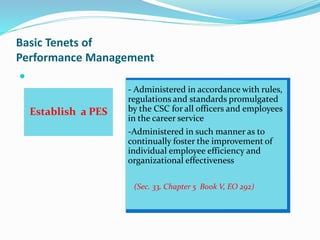
Establish a PES
- Administered in accordance with rules,
regulations and standards promulgated
by the CSC for all officers and employees
in the career service
-Administered in such manner as to
continually foster the improvement of
individual employee efficiency and
organizational effectiveness
(Sec. 33, Chapter 5 Book V, EO 292)
Basic Tenets of
Performance Management
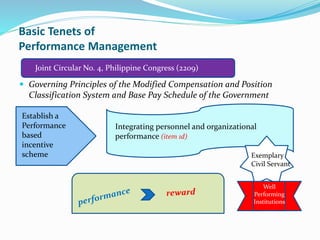
 Governing Principles of the Modified Compensation and Position
Classification System and Base Pay Schedule of the Government
Joint Circular No. 4, Philippine Congress (2209)
Establish a
Performance
based
incentive
scheme
Integrating personnel and organizational
performance (item 1d)
Exemplary
Civil Servant
Well
Performing
Institutions
Basic Tenets of
Performance Management
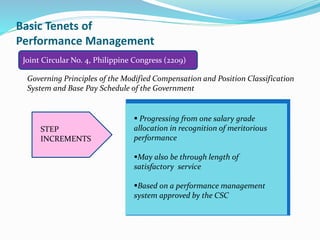
Joint Circular No. 4, Philippine Congress (2209)
Governing Principles of the Modified Compensation and Position Classification
System and Base Pay Schedule of the Government
STEP
INCREMENTS
 Progressing from one salary grade
allocation in recognition of meritorious
performance
May also be through length of
satisfactory service
Based on a performance management
system approved by the CSC
Basic Tenets of
Performance Management
 Joint Circular No. 4, Philippine Congress (2209)
Governing Principles of the Modified Compensation and Position Classification
System and Base Pay Schedule of the Government
CSC
MANDATE
Ensuring
Personnel
performance
Linked with
Organizational
performance
Enhancing
performance
Orientation of the
Compensation
system
 Guidelines in the Establishment and Implementation
of the Strategic Performance Management System
(SPMS)
 CSC Resolution No. 120481, 16 March 2012
 CSC Memorandum Circular No. 6, s. 2012
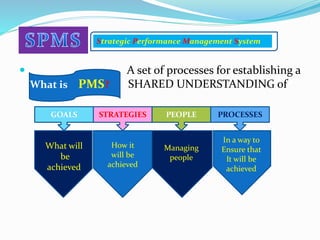
 A set of processes for establishing a
SGARED SHARED UNDERSTANDING of
Strategic Performance Management System
What is PMS?
PROCESSES
PEOPLE
STRATEGIES
GOALS
What will
be
achieved
How it
will be
achieved
Managing
people
In a way to
Ensure that
It will be
achieved
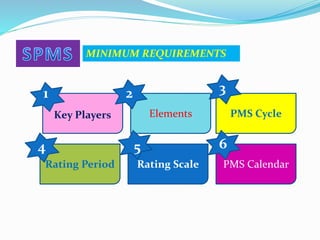
MINIMUM REQUIREMENTS
Rating Period
Elements
Rating Scale PMS Calendar
PMS Cycle
1
6
5
4
3
2
Key Players
MINIMUM REQUIREMENTS - ELEMENTS
1) Goal aligned to LGU
mandate
2) Outputs/Outcomes-
Based
3) Team Approach 4) User-friendly forms
5) Information system
6) Communication
plan
1
Goal
aligned
to LGU
mandat
e
Philippine Development Plan
Vision/Mission/Strategic
Priorities
Performance Goals
MINIMUM REQUIREMENTS - ELEMENTS
2
Outputs/
Outcomes-
Based
Those that contribute to the
realization of organizational
mandate/goals
MFO Output
 Those that
directly
contribute to
organization
goals and
objectives
 The ultimate/en
product of an
activity
 Anything that is
produced out of an
activity
 May still be an input
to another output
2
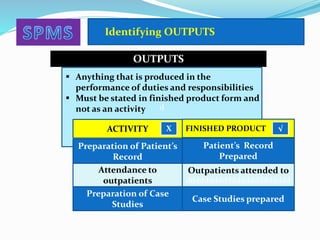
Identifying OUTPUTS
OUTPUTS
d
 Anything that is produced in the
performance of duties and responsibilities
 Must be stated in finished product form and
not as an activity
ACTIVITY FINISHED PRODUCT
X √
Preparation of Patient’s
Record
Patient’s Record
Prepared
Attendance to
outpatients
Outpatients attended to
ddddddddddddddddddddddd
dddddddddddd
Preparation of Case
Studies
Case Studies prepared
3
Team
Approach
4
User-
friendly
forms
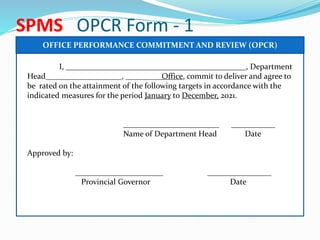
SPMS OPCR Form - 1
 rEFE
OFFICE PERFORMANCE COMMITMENT AND REVIEW (OPCR)
I i
I, _____________________________________________, Department
Head___________________, _________Office, commit to deliver and agree to
be rated on the attainment of the following targets in accordance with the
indicated measures for the period January to December, 2021.
________________________ ___________
Name of Department Head Date
Approved by:
______________________ ________________
Provincial Governor Date
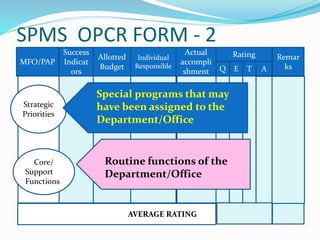
SPMS OPCR FORM - 2
MFO/PAP
Success
Indicat
ors
Allotted
Budget
Individual
Responsible
Actual
accompli
shment
Rating Remar
ks
Q E T A
Strategic
Priorities
Core/
Support
Functions
Special programs that may
have been assigned to the
Department/Office
Routine functions of the
Department/Office
AVERAGE RATINGAVE
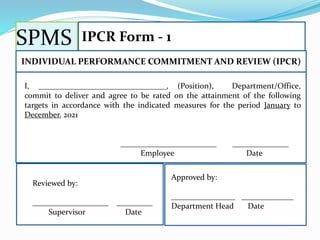
SPMS IPCR Form - 1ii
INDIVIDUAL PERFORMANCE COMMITMENT AND REVIEW (IPCR)
I
I, ________________________________, (Position), Department/Office,
commit to deliver and agree to be rated on the attainment of the following
targets in accordance with the indicated measures for the period January to
December, 2021
________________________ ______________
Employee Date
Reviewed by:
___________________ _________
Supervisor Date
Approved by:
________________ _____________
Department Head Date
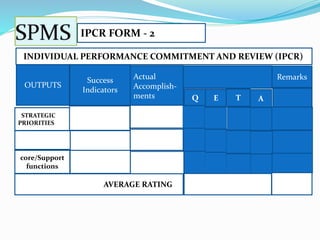
IPCR FORM - 2
INDIVIDUAL PERFORMANCE COMMITMENT AND REVIEW (IPCR)
OUTPUTS
Success
Indicators
Actual
Accomplish-
ments
Remarks
Q E T A
SSTRATEGIC
PRIORITIES
core/Support
functions
AVERAGE RATING
MINIMUM Requirements - ELEMENTS
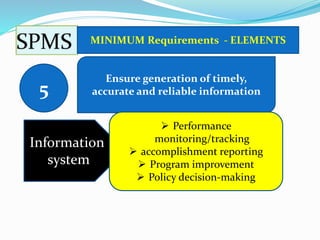
5
Information
system
Ensure generation of timely,
accurate and reliable information
 Performance
monitoring/tracking
 accomplishment reporting
 Program improvement
 Policy decision-making
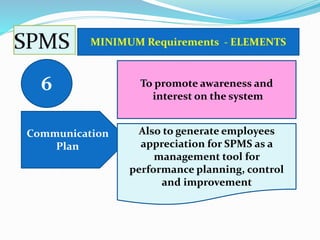
6
Communication
Plan
To promote awareness and
interest on the system
Also to generate employees
appreciation for SPMS as a
management tool for
performance planning, control
and improvement
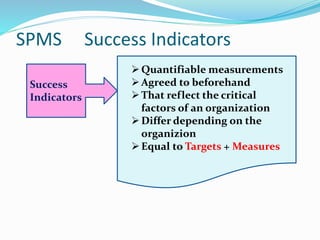
SPMS Success Indicators
Success
Indicators
Quantifiable measurements
Agreed to beforehand
That reflect the critical
factors of an organization
Differ depending on the
organizion
Equal to Targets + Measures
SPMS - SUCCESS INDICATORS
 - Must be SMART
•SPECIFIC
•MEASURABLE
•ATTAINABLE
•REALISTIC
•TIME-BOUND
SPMS – PERFORMANCE MEASURES
1. QUALITY/EFFECTIVENESS
2. EFFICIENCY
3. TIMELINESS
EFFECTIVENESS/QUALITY
 The extent to which actual performance
compares with targeted performance
 Degree to which objectives are achieved
 Extent to which targeted problems are
solved
 Relates to “getting the right things done”
Performance Measures - Efficiency
 Extent to which time or resources
are used for the intended task or
purpose
 Measures whether targets are
accomplished with minimum
amount or quantity of waste,
expenses, expenses or unnecessary
effort
Performance Measures - Timeliness
 Done on time
 Based on requirements of law and/or
clients/stakeholders
 Project completion deadline
 Time management skills; and
 Other time sensitive expectations
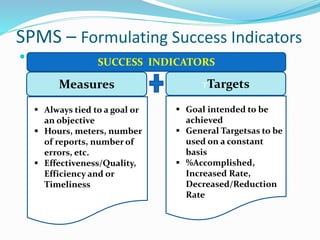
SPMS – Formulating Success Indicators
 + SUCCESS INDICATORS
Measures TTargets
 Always tied to a goal or
an objective
 Hours, meters, number
of reports, number of
errors, etc.
 Effectiveness/Quality,
Efficiency and or
Timeliness
 Goal intended to be
achieved
 General Targetsas to be
used on a constant
basis
 %Accomplished,
Increased Rate,
Decreased/Reduction
Rate
Example
 O
OUTPUTS TARGETS MEASURES
Success Indicators
(MFO + Targets +
Measures)
Outpatients
attended
Response
time
Within 3
minutes from
arrival
100 of outpatients
attended within 3
minutes from arrival
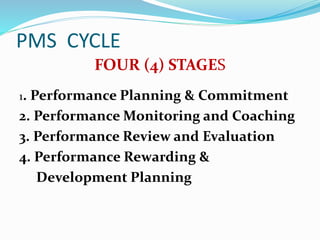
PMS CYCLE
FOUR (4) STAGES
1. Performance Planning & Commitment
2. Performance Monitoring and Coaching
3. Performance Review and Evaluation
4. Performance Rewarding &
Development Planning
PMS CYCLE
 STAGE 1 – PERFORMANCE PLANNING &
COMMITMENT
llDepartment Head
meeting with
supervisors and staff to
agree on the outputs
that should be
accomplished
SuSuccess indicators
are determined
CONSIDERATIONS
 Historical Data
 Benchmarking
 Client demand
 OPES Reference Table
 Top Management
instruction
 Future trends
PMS CYCLE
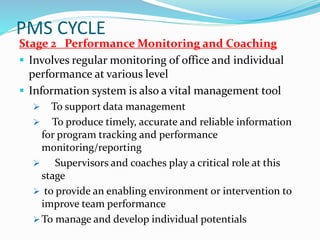
Stage 2 Performance Monitoring and Coaching
 Involves regular monitoring of office and individual
performance at various level
 Information system is also a vital management tool
 To support data management
 To produce timely, accurate and reliable information
for program tracking and performance
monitoring/reporting
 Supervisors and coaches play a critical role at this
stage
 to provide an enabling environment or intervention to
improve team performance
 To manage and develop individual potentials
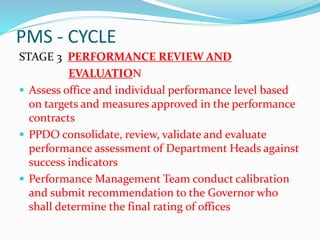
PMS - CYCLE
STAGE 3 PERFORMANCE REVIEW AND
EVALUATION
 Assess office and individual performance level based
on targets and measures approved in the performance
contracts
 PPDO consolidate, review, validate and evaluate
performance assessment of Department Heads against
success indicators
 Performance Management Team conduct calibration
and submit recommendation to the Governor who
shall determine the final rating of offices
INDIVIDUAL PERFORMANCE ASSESSMENT
 Rating for planned or intervening tasks always
supported by report or any proof of actual
performance
 Without such proof or bases, the task shall not be
rated and shall be disregarded
 Shall be discussed by te supervisor with the
concerned rate
 The average of all individual assessment shall NOT
go higher than the collective performance
assessment of the office
PMS CYCLE
STAGE 4 PERFORMANCE REWARDING AND
DEVELOPMENT PLANNING
 Part of the employee’s evaluation is the competency
assessment vis-à-vis the competency requirements of
the job
 Assessment result shall be discussed with the
supervisor and employee at the end of each rating
period
 Discussion to focus on strengths, competency-related
performance gaps and opportunities to address the
gaps,career paths and alternatives
RATING PERIOD
 SEMI ANNUAL (EVERY SIX MONTHS)
 MINIMUM PERIOD 3 MONTHS
 MAXIMUM PERIOD 1 YEAR
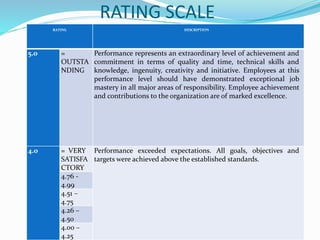
RATING SCALE
RATING DESCRIPTION
5.0 =
OUTSTA
NDING
Performance represents an extraordinary level of achievement and
commitment in terms of quality and time, technical skills and
knowledge, ingenuity, creativity and initiative. Employees at this
performance level should have demonstrated exceptional job
mastery in all major areas of responsibility. Employee achievement
and contributions to the organization are of marked excellence.
4.0 = VERY
SATISFA
CTORY
Performance exceeded expectations. All goals, objectives and
targets were achieved above the established standards.
4.76 -
4.99
4.51 –
4.75
4.26 –
4.50
4.00 –
4.25
3.0 = SATISFACTORY Performance met expectations in terms of
quality of work, efficiency and timeliness. The
most critical annual goals were met.
3.76 – 3.99
3.51 – 3.75
3.26 – 3.50
3.00 – 3.25
2.0 = UNSATISFACTORY Performance failed to meet expectations, and/or one
or more of the most critical goals were not met.
2.76 – 2.99
2.51 – 2.75
2.26 – 2.50
2.00 - 2.25
1.0 = POOR
1.76-1.99
1.51-1.75
1.26-2.50
1.00-1.25
Performance was consistently below expectations,
and/or reasonable progress toward critical goals was
not made. Significant improvement is needed in one
or more important areas.
SPMS Presentation.pptx

SPMS Presentation.pptx

  • 2.
    Constitutional/Statutory Bases Sec. 3.Article IX-B 1987 Philippine Constitution  Establish a career service  Adopt measures to promote morale, efficiency, integrity, responsiveness, progressiveness, and courtesy in the civil service  Strengthen the rewards and merit system  Integrate the HRD programs for all levels & ranks  Institutionalize a management climate conducive to public accountability
  • 3.
    Basic Tenets of PerformanceManagement - Promulgate policies, standards and guidelines for the Civil Service - Adopt plans and programs to promote economical, efficient and effective personnel administration in the government (Title I, Subtitle A. Chapter 1, Book V, EP 292) CSC POWERS CSC POWERS
  • 4.
    Basic Tenets of PerformanceManagement  Establish a PES - Administered in accordance with rules, regulations and standards promulgated by the CSC for all officers and employees in the career service -Administered in such manner as to continually foster the improvement of individual employee efficiency and organizational effectiveness (Sec. 33, Chapter 5 Book V, EO 292)
  • 5.
    Basic Tenets of PerformanceManagement  Governing Principles of the Modified Compensation and Position Classification System and Base Pay Schedule of the Government Joint Circular No. 4, Philippine Congress (2209) Establish a Performance based incentive scheme Integrating personnel and organizational performance (item 1d) Exemplary Civil Servant Well Performing Institutions
  • 6.
    Basic Tenets of PerformanceManagement Joint Circular No. 4, Philippine Congress (2209) Governing Principles of the Modified Compensation and Position Classification System and Base Pay Schedule of the Government STEP INCREMENTS  Progressing from one salary grade allocation in recognition of meritorious performance May also be through length of satisfactory service Based on a performance management system approved by the CSC
  • 7.
    Basic Tenets of PerformanceManagement  Joint Circular No. 4, Philippine Congress (2209) Governing Principles of the Modified Compensation and Position Classification System and Base Pay Schedule of the Government CSC MANDATE Ensuring Personnel performance Linked with Organizational performance Enhancing performance Orientation of the Compensation system
  • 8.
     Guidelines inthe Establishment and Implementation of the Strategic Performance Management System (SPMS)  CSC Resolution No. 120481, 16 March 2012  CSC Memorandum Circular No. 6, s. 2012
  • 9.
     A setof processes for establishing a SGARED SHARED UNDERSTANDING of Strategic Performance Management System What is PMS? PROCESSES PEOPLE STRATEGIES GOALS What will be achieved How it will be achieved Managing people In a way to Ensure that It will be achieved
  • 10.
    MINIMUM REQUIREMENTS Rating Period Elements RatingScale PMS Calendar PMS Cycle 1 6 5 4 3 2 Key Players
  • 11.
    MINIMUM REQUIREMENTS -ELEMENTS 1) Goal aligned to LGU mandate 2) Outputs/Outcomes- Based 3) Team Approach 4) User-friendly forms 5) Information system 6) Communication plan
  • 12.
    1 Goal aligned to LGU mandat e Philippine DevelopmentPlan Vision/Mission/Strategic Priorities Performance Goals
  • 13.
    MINIMUM REQUIREMENTS -ELEMENTS 2 Outputs/ Outcomes- Based Those that contribute to the realization of organizational mandate/goals
  • 14.
    MFO Output  Thosethat directly contribute to organization goals and objectives  The ultimate/en product of an activity  Anything that is produced out of an activity  May still be an input to another output 2
  • 15.
    Identifying OUTPUTS OUTPUTS d  Anythingthat is produced in the performance of duties and responsibilities  Must be stated in finished product form and not as an activity ACTIVITY FINISHED PRODUCT X √ Preparation of Patient’s Record Patient’s Record Prepared Attendance to outpatients Outpatients attended to ddddddddddddddddddddddd dddddddddddd Preparation of Case Studies Case Studies prepared
  • 16.
  • 17.
  • 18.
    SPMS OPCR Form- 1  rEFE OFFICE PERFORMANCE COMMITMENT AND REVIEW (OPCR) I i I, _____________________________________________, Department Head___________________, _________Office, commit to deliver and agree to be rated on the attainment of the following targets in accordance with the indicated measures for the period January to December, 2021. ________________________ ___________ Name of Department Head Date Approved by: ______________________ ________________ Provincial Governor Date
  • 19.
    SPMS OPCR FORM- 2 MFO/PAP Success Indicat ors Allotted Budget Individual Responsible Actual accompli shment Rating Remar ks Q E T A Strategic Priorities Core/ Support Functions Special programs that may have been assigned to the Department/Office Routine functions of the Department/Office AVERAGE RATINGAVE
  • 20.
    SPMS IPCR Form- 1ii INDIVIDUAL PERFORMANCE COMMITMENT AND REVIEW (IPCR) I I, ________________________________, (Position), Department/Office, commit to deliver and agree to be rated on the attainment of the following targets in accordance with the indicated measures for the period January to December, 2021 ________________________ ______________ Employee Date Reviewed by: ___________________ _________ Supervisor Date Approved by: ________________ _____________ Department Head Date
  • 21.
    IPCR FORM -2 INDIVIDUAL PERFORMANCE COMMITMENT AND REVIEW (IPCR) OUTPUTS Success Indicators Actual Accomplish- ments Remarks Q E T A SSTRATEGIC PRIORITIES core/Support functions AVERAGE RATING
  • 22.
    MINIMUM Requirements -ELEMENTS 5 Information system Ensure generation of timely, accurate and reliable information  Performance monitoring/tracking  accomplishment reporting  Program improvement  Policy decision-making
  • 23.
    6 Communication Plan To promote awarenessand interest on the system Also to generate employees appreciation for SPMS as a management tool for performance planning, control and improvement
  • 24.
    SPMS Success Indicators Success Indicators Quantifiablemeasurements Agreed to beforehand That reflect the critical factors of an organization Differ depending on the organizion Equal to Targets + Measures
  • 25.
    SPMS - SUCCESSINDICATORS  - Must be SMART •SPECIFIC •MEASURABLE •ATTAINABLE •REALISTIC •TIME-BOUND
  • 26.
    SPMS – PERFORMANCEMEASURES 1. QUALITY/EFFECTIVENESS 2. EFFICIENCY 3. TIMELINESS
  • 27.
    EFFECTIVENESS/QUALITY  The extentto which actual performance compares with targeted performance  Degree to which objectives are achieved  Extent to which targeted problems are solved  Relates to “getting the right things done”
  • 28.
    Performance Measures -Efficiency  Extent to which time or resources are used for the intended task or purpose  Measures whether targets are accomplished with minimum amount or quantity of waste, expenses, expenses or unnecessary effort
  • 29.
    Performance Measures -Timeliness  Done on time  Based on requirements of law and/or clients/stakeholders  Project completion deadline  Time management skills; and  Other time sensitive expectations
  • 30.
    SPMS – FormulatingSuccess Indicators  + SUCCESS INDICATORS Measures TTargets  Always tied to a goal or an objective  Hours, meters, number of reports, number of errors, etc.  Effectiveness/Quality, Efficiency and or Timeliness  Goal intended to be achieved  General Targetsas to be used on a constant basis  %Accomplished, Increased Rate, Decreased/Reduction Rate
  • 31.
    Example  O OUTPUTS TARGETSMEASURES Success Indicators (MFO + Targets + Measures) Outpatients attended Response time Within 3 minutes from arrival 100 of outpatients attended within 3 minutes from arrival
  • 32.
    PMS CYCLE FOUR (4)STAGES 1. Performance Planning & Commitment 2. Performance Monitoring and Coaching 3. Performance Review and Evaluation 4. Performance Rewarding & Development Planning
  • 33.
    PMS CYCLE  STAGE1 – PERFORMANCE PLANNING & COMMITMENT llDepartment Head meeting with supervisors and staff to agree on the outputs that should be accomplished SuSuccess indicators are determined CONSIDERATIONS  Historical Data  Benchmarking  Client demand  OPES Reference Table  Top Management instruction  Future trends
  • 34.
    PMS CYCLE Stage 2Performance Monitoring and Coaching  Involves regular monitoring of office and individual performance at various level  Information system is also a vital management tool  To support data management  To produce timely, accurate and reliable information for program tracking and performance monitoring/reporting  Supervisors and coaches play a critical role at this stage  to provide an enabling environment or intervention to improve team performance  To manage and develop individual potentials
  • 35.
    PMS - CYCLE STAGE3 PERFORMANCE REVIEW AND EVALUATION  Assess office and individual performance level based on targets and measures approved in the performance contracts  PPDO consolidate, review, validate and evaluate performance assessment of Department Heads against success indicators  Performance Management Team conduct calibration and submit recommendation to the Governor who shall determine the final rating of offices
  • 36.
    INDIVIDUAL PERFORMANCE ASSESSMENT Rating for planned or intervening tasks always supported by report or any proof of actual performance  Without such proof or bases, the task shall not be rated and shall be disregarded  Shall be discussed by te supervisor with the concerned rate  The average of all individual assessment shall NOT go higher than the collective performance assessment of the office
  • 37.
    PMS CYCLE STAGE 4PERFORMANCE REWARDING AND DEVELOPMENT PLANNING  Part of the employee’s evaluation is the competency assessment vis-à-vis the competency requirements of the job  Assessment result shall be discussed with the supervisor and employee at the end of each rating period  Discussion to focus on strengths, competency-related performance gaps and opportunities to address the gaps,career paths and alternatives
  • 38.
    RATING PERIOD  SEMIANNUAL (EVERY SIX MONTHS)  MINIMUM PERIOD 3 MONTHS  MAXIMUM PERIOD 1 YEAR
  • 39.
    RATING SCALE RATING DESCRIPTION 5.0= OUTSTA NDING Performance represents an extraordinary level of achievement and commitment in terms of quality and time, technical skills and knowledge, ingenuity, creativity and initiative. Employees at this performance level should have demonstrated exceptional job mastery in all major areas of responsibility. Employee achievement and contributions to the organization are of marked excellence. 4.0 = VERY SATISFA CTORY Performance exceeded expectations. All goals, objectives and targets were achieved above the established standards. 4.76 - 4.99 4.51 – 4.75 4.26 – 4.50 4.00 – 4.25
  • 40.
    3.0 = SATISFACTORYPerformance met expectations in terms of quality of work, efficiency and timeliness. The most critical annual goals were met. 3.76 – 3.99 3.51 – 3.75 3.26 – 3.50 3.00 – 3.25 2.0 = UNSATISFACTORY Performance failed to meet expectations, and/or one or more of the most critical goals were not met. 2.76 – 2.99 2.51 – 2.75 2.26 – 2.50 2.00 - 2.25 1.0 = POOR 1.76-1.99 1.51-1.75 1.26-2.50 1.00-1.25 Performance was consistently below expectations, and/or reasonable progress toward critical goals was not made. Significant improvement is needed in one or more important areas.