GLIZELLE D. DE LA CRUZ
RESULTS-BASED
MANAGEMENT
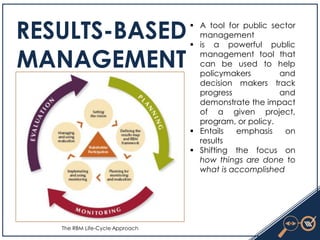
 A tool for public sector
management
 is a powerful public
management tool that
can be used to help
policymakers and
decision makers track
progress and
demonstrate the impact
of a given project,
program, or policy.
 Entails emphasis on
results
 Shifting the focus on
how things are done to
what is accomplished
The RBM Life-Cycle Approach
RESULTS-BASED
MANAGEMENT
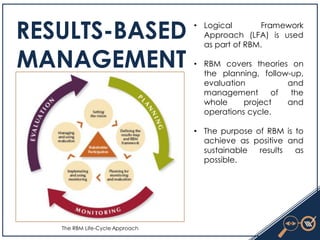
• Logical Framework
Approach (LFA) is used
as part of RBM.
• RBM covers theories on
the planning, follow-up,
evaluation and
management of the
whole project and
operations cycle.
• The purpose of RBM is to
achieve as positive and
sustainable results as
possible.
The RBM Life-Cycle Approach
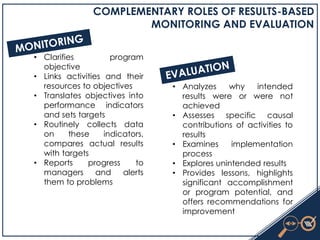
COMPLEMENTARY ROLES OF RESULTS-BASED
MONITORING AND EVALUATION
• Analyzes why intended
results were or were not
achieved
• Assesses specific causal
contributions of activities to
results
• Examines implementation
process
• Explores unintended results
• Provides lessons, highlights
significant accomplishment
or program potential, and
offers recommendations for
improvement
• Clarifies program
objective
• Links activities and their
resources to objectives
• Translates objectives into
performance indicators
and sets targets
• Routinely collects data
on these indicators,
compares actual results
with targets
• Reports progress to
managers and alerts
them to problems
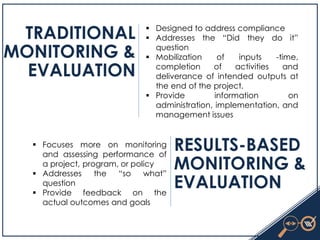
TRADITIONAL
MONITORING &
EVALUATION
RESULTS-BASED
MONITORING &
EVALUATION
 Designed to address compliance
 Addresses the ―Did they do it‖
question
 Mobilization of inputs -time,
completion of activities and
deliverance of intended outputs at
the end of the project.
 Provide information on
administration, implementation, and
management issues
 Focuses more on monitoring
and assessing performance of
a project, program, or policy
 Addresses the ―so what‖
question
 Provide feedback on the
actual outcomes and goals
10-STEP MODEL
RBMEIN DESIGNING
SYSTEMFOCUSED ON
OUTCOMEBYJODYZALLKUSEK
&RAYC.RIST
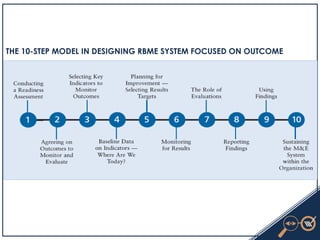
THE 10-STEP MODEL IN DESIGNING RBME SYSTEM FOCUSED ON OUTCOME
1
THE 10-STEP MODEL IN DESIGNING RBME SYSTEM FOCUSED ON OUTCOME
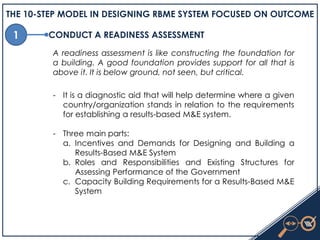
CONDUCT A READINESS ASSESSMENT
A readiness assessment is like constructing the foundation for
a building. A good foundation provides support for all that is
above it. It is below ground, not seen, but critical.
- It is a diagnostic aid that will help determine where a given
country/organization stands in relation to the requirements
for establishing a results-based M&E system.
- Three main parts:
a. Incentives and Demands for Designing and Building a
Results-Based M&E System
b. Roles and Responsibilities and Existing Structures for
Assessing Performance of the Government
c. Capacity Building Requirements for a Results-Based M&E
System
2
THE 10-STEP MODEL IN DESIGNING RBME SYSTEM FOCUSED ON OUTCOME
AGREEING ON OUTCOMES TO MONITOR AND EVALUATE
Knowing where you are going before you get moving is the key.
Indicators, baselines, and targets are derived from and based
on the setting of outcomes.
There is a political process involved in setting and agreeing
upon desired outcomes.
• Identify Specific Stakeholder Representatives
• Identify Major Concerns of Stakeholder Groups
• Translate Problems into Statements of Possible Outcome
Improvements
• Disaggregate to Capture Key Desired Outcome
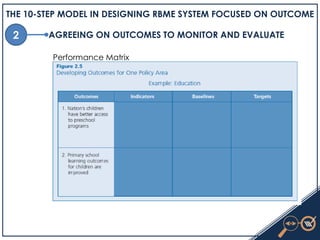
Choosing outcomes is the first step in building the performance
matrix.
2
THE 10-STEP MODEL IN DESIGNING RBME SYSTEM FOCUSED ON OUTCOME
AGREEING ON OUTCOMES TO MONITOR AND EVALUATE
Performance Matrix
3
THE 10-STEP MODEL IN DESIGNING RBME SYSTEM FOCUSED ON OUTCOME
SELECTING KEY PERFORMANCE INDICATORS
TO MONITOR OUTCOMES
Indicators are the quantitative or qualitative variables that
provide a simple and reliable means to measure
achievement, to reflect the changes connected to an
intervention, or to help assess the performance of an
organization against the stated outcome.
4
THE 10-STEP MODEL IN DESIGNING RBME SYSTEM FOCUSED ON OUTCOME
SETTING BASELINE AND GATHERING DATA ON INDICATORS
Establishing baselines is the third part of the performance
framework.
A performance baseline is information – qualitative or
quantitative that provides data at the beginning of, or just
prior to, the monitoring period.
The baseline is used as a starting point, or guide, by which to
monitor future performance. Baselines are the first critical
measurement of the indicators.
5
THE 10-STEP MODEL IN DESIGNING RBME SYSTEM FOCUSED ON OUTCOME
PLANNING FOR IMPROVEMENT – SELECTING RESULTS TARGET
Results targets are what can be achieved in a specific time
toward reaching the outcome. Identifying the expected and
desired level of project, program, or policy results requires the
selection of specific performance targets.
A target is a specified objective that indicates the number,
timing and location of that which is to be realized. In essence,
targets are the quantifiable levels of the indicators that a
country, society, or organization wants to achieve by a given
time.
5
THE 10-STEP MODEL IN DESIGNING RBME SYSTEM FOCUSED ON OUTCOME
PLANNING FOR IMPROVEMENT – SELECTING RESULTS TARGET
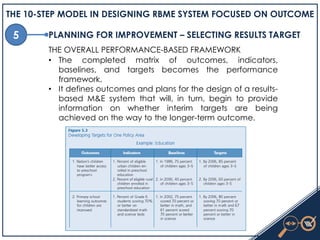
THE OVERALL PERFORMANCE-BASED FRAMEWORK
• The completed matrix of outcomes, indicators,
baselines, and targets becomes the performance
framework.
• It defines outcomes and plans for the design of a results-
based M&E system that will, in turn, begin to provide
information on whether interim targets are being
achieved on the way to the longer-term outcome.
6
THE 10-STEP MODEL IN DESIGNING RBME SYSTEM FOCUSED ON OUTCOME
MONITORING FOR RESULTS
The monitoring system gives ongoing information on the
direction of change, the pace of change, and the magnitude
of change. It can also identify unanticipated changes.
All are critical to knowing whether policies, programs, and
projects are moving in the intended direction.
An activity-based management system focuses the
organization on working against a set of identified activities,
without aligning these activities to outcomes, making it difficult
to understand how the implementation of these activities
results in improved performance.
On the other hand, results-based M&E system focuses the
organization on achieving outcomes, and manages to each
indicator.
6
THE 10-STEP MODEL IN DESIGNING RBME SYSTEM FOCUSED ON OUTCOME
MONITORING FOR RESULTS
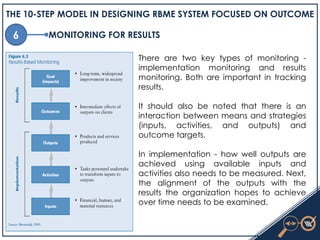
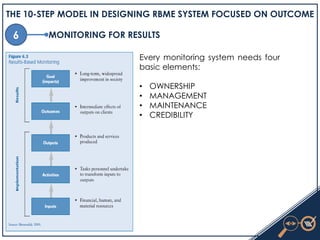
There are two key types of monitoring -
implementation monitoring and results
monitoring. Both are important in tracking
results.
It should also be noted that there is an
interaction between means and strategies
(inputs, activities, and outputs) and
outcome targets.
In implementation - how well outputs are
achieved using available inputs and
activities also needs to be measured. Next,
the alignment of the outputs with the
results the organization hopes to achieve
over time needs to be examined.
6
THE 10-STEP MODEL IN DESIGNING RBME SYSTEM FOCUSED ON OUTCOME
MONITORING FOR RESULTS
Every monitoring system needs four
basic elements:
• OWNERSHIP
• MANAGEMENT
• MAINTENANCE
• CREDIBILITY
6
THE 10-STEP MODEL IN DESIGNING RBME SYSTEM FOCUSED ON OUTCOME
MONITORING FOR RESULTS
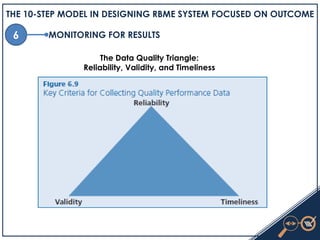
The Data Quality Triangle:
Reliability, Validity, and Timeliness
7
THE 10-STEP MODEL IN DESIGNING RBME SYSTEM FOCUSED ON OUTCOME
USING EVALUATION INFORMATION TO SUPPORT A RBMS
Evaluation was previously defined as an assessment of a
planned, ongoing, or completed intervention to determine
its relevance, efficiency, effectiveness, impact, and
sustainability.
Moving to a results-based M&E system requires building an
information and analysis system with two components -
monitoring and evaluation. Either alone, in the end, is not
sufficient.
Uses of Evaluation
1. Help Make Resource Allocation Decisions
2. Help Rethink the Causes of a Problem
3. Identify Emerging Problems
4. Support Decision-making on Competing or Best
Alternatives
5. Support Public Sector Reform and Innovation
6. Build Consensus on the Causes of a Problem and
How to Respond
7
THE 10-STEP MODEL IN DESIGNING RBME SYSTEM FOCUSED ON OUTCOME
USING EVALUATION INFORMATION TO SUPPORT A RBMS
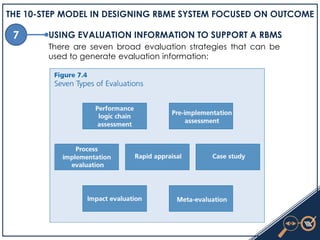
There are seven broad evaluation strategies that can be
used to generate evaluation information:
7
THE 10-STEP MODEL IN DESIGNING RBME SYSTEM FOCUSED ON OUTCOME
USING EVALUATION INFORMATION TO SUPPORT A RBMS
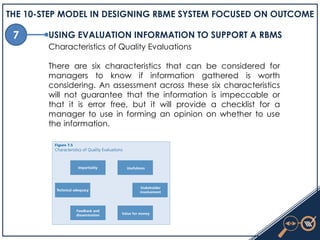
Characteristics of Quality Evaluations
There are six characteristics that can be considered for
managers to know if information gathered is worth
considering. An assessment across these six characteristics
will not guarantee that the information is impeccable or
that it is error free, but it will provide a checklist for a
manager to use in forming an opinion on whether to use
the information.
8
THE 10-STEP MODEL IN DESIGNING RBME SYSTEM FOCUSED ON OUTCOME
REPORTING THE FINDINGS
Monitoring and evaluation reports can play many different
roles, and the information produced can be put to very
different uses:
To demonstrate accountability
To convince
To educate
To explore and investigate
To document
To involve
To gain support
To promote understanding
The central purpose of evaluation results is to “deliver the message” -
inform the appropriate audiences about the findings and conclusions
resulting from the collection, analysis, and interpretation of evaluation
information.
8
THE 10-STEP MODEL IN DESIGNING RBME SYSTEM FOCUSED ON OUTCOME
REPORTING THE FINDINGS
During the ongoing process of determining monitoring and
evaluation findings, it is important to ensure that everyone is
informed of progress, and that there are no surprises. If the
information system is to provide continuous performance
feedback as a management tool, continuous communication
is also important to the process. Monitoring and evaluation
results should be continuously disseminated to provide
feedback to decision-makers.
To be a useful management tool, the written summary should
contain an introduction (including purpose of report,
evaluation questions, program background, and program
goals and objectives):
Executive Summaries
Oral Presentations
Visual Presentations
8
THE 10-STEP MODEL IN DESIGNING RBME SYSTEM FOCUSED ON OUTCOME
REPORTING THE FINDINGS
What Happens If the M&E System Produces Bad Performance
News?
One cannot manage by receiving only good news. A good
performance measurement system is intended to surface
problems—not just bring good news. This is another of the
political aspects of results-based M&E systems. Reporting on
bad news is a critical aspect of how one distinguishes success
from failure. If the difference cannot be determined, it is likely
that both failure and success are being rewarded by
managers. A good performance system can serve as a kind of
early warning system.
9
THE 10-STEP MODEL IN DESIGNING RBME SYSTEM FOCUSED ON OUTCOME
USING FINDINGS
Using findings to improve performance is the main purpose of
building a results-based M&E system. The main point of the
M&E system is not simply to generate continuous results-based
information, but to get that information to the appropriate
users in a timely fashion so that the performance feedback
can be used to better manage organizations and
governments.
M&E systems provide important feedback about the progress,
as well as the success or failure, of projects, programs, and
policies throughout their respective cycles. These systems
constitute a powerful, continuous public management tool
that decision- makers can use to improve performance, and
demonstrate accountability and transparency with respect to
results.
9
THE 10-STEP MODEL IN DESIGNING RBME SYSTEM FOCUSED ON OUTCOME
USING FINDINGS
Feedback, Knowledge, and Learning
Evaluation feedback has been broadly defined as a dynamic process
which involves the presentation and dissemination of evaluation
information in order to ensure its application into new or existing
development activities. Feedback, as distinct from dissemination of
evaluation findings, is the process of ensuring that lessons learned are
incorporated into new operations.
Learning has been described as a continuous dynamic process of
investigation where the key elements are experience, knowledge,
access and relevance. It requires a culture of inquiry and investigation,
rather than one of response and reporting.
Knowledge and knowledge management are additional key
components of using performance findings. New knowledge can be
generated through the use of findings on a continuous basis.
Knowledge management means capturing findings, institutionalizing
learning, and organizing the wealth of information produced
continually by the M&E system.
THE 10-STEP MODEL IN DESIGNING RBME SYSTEM FOCUSED ON OUTCOME
SUSTAINING THE M&E SYSTEM WITHIN THE ORGANIZATION
Six Critical Components of Sustaining Results-Based M&E Systems
Demand
In many cases, demand can also be stimulated when the strategic goals
of the government are translated into results-based M&E systems, such as
through National Poverty Reduction Strategies and other initiatives. These
are not simply activity-driven initiatives; rather, they try to answer the ―so
what‖ question. What are the consequences of policy and program
efforts to reduce poverty and address the most vulnerable groups?
Clear Roles and Responsibilities
Clear roles and responsibilities and formal organizational and political
lines of authority must be established. The organization and people who
will be in charge of collecting, analyzing, and reporting performance
information must be clearly defined. Guidance is necessary.
THE 10-STEP MODEL IN DESIGNING RBME SYSTEM FOCUSED ON OUTCOME
SUSTAINING THE M&E SYSTEM WITHIN THE ORGANIZATION
Six Critical Components of Sustaining Results-Based M&E Systems
Trustworthy and Credible Information
The M&E system must be able to produce results information that brings
both good and bad news. Performance information should be
transparent and made available to all key stakeholders. If debate of
issues is not backed up by trustworthy and credible information, only
personal opinions and presumptions are left.
Information produced by the M&E system should be transparent and
subject to independent verification. If data on government performance
are held too close, or there are gatekeepers who prevent the release of
such information, the system will again be faulty. As a further check on the
system, it would be advisable to have a periodic independent review by
the national audit office, or a group of academics to ensure that the
data being generated by the system are accurate and reliable, and to
build confidence among managers who could use the data.
THE 10-STEP MODEL IN DESIGNING RBME SYSTEM FOCUSED ON OUTCOME
SUSTAINING THE M&E SYSTEM WITHIN THE ORGANIZATION
Six Critical Components of Sustaining Results-Based M&E Systems
Accountability
No part of the government should be exempted from accountability to
stakeholders. The media, private sector, and parliament have roles to
ensure that the information produced is timely, accurate, available, and
addresses government performance. It is also important not to reward
failure. Accountability means that problems should be acknowledged
and addressed.
Capacity
Sound technical skills in data collection and analysis are necessary for the
system’s sustainability. Managerial skills in strategic goal setting and
organizational development are also needed. Data collection and
retrieval systems must be up, running, and modernized. Governments will
need to commit continuing financial resources to the upkeep and
management of results-based M&E systems. Institutional experience and
memory are also helpful in the long-term sustainability of these systems.
THE 10-STEP MODEL IN DESIGNING RBME SYSTEM FOCUSED ON OUTCOME
SUSTAINING THE M&E SYSTEM WITHIN THE ORGANIZATION
Six Critical Components of Sustaining Results-Based M&E Systems
Incentives
Incentives need to be introduced to encourage use of performance
information. This means that success needs to be acknowledged and
rewarded, problems need to be addressed, messengers must not be
punished, organizational learning is valued, and budget savings are
shared. Corrupt or ineffective systems cannot be counted on to produce
quality information and analysis.
.
Why Results-Based
Monitoring & Evaluation
Results-based M&E has become a global phenomenon as national and
international stakeholders in the development process have sought increased
accountability, transparency, and results from governments and organizations.
Political and financial support for governments and their programs are
becoming increasingly linked with a government’s ability to implement good
policies, demonstrate effectiveness in the use of resources, and deliver real
results.
For these reasons, governments and organizations are turning to results-based
M&E in the hope that this public management tool can help them devise
appropriate policies, manage financial and other resources, and fulfill their
mandates and promises to internal and external stakeholders.
Results-based M&E moves beyond the traditional input–output focused M&E,
and, when used effectively, helps policymakers and decision-makers focus on
and analyze outcomes and impacts.
END OF PRESENTATION

Ppt results based-monitoring-and-evaluation-g-dela-cruz

  • 1.
  • 2.
    RESULTS-BASED MANAGEMENT  A toolfor public sector management  is a powerful public management tool that can be used to help policymakers and decision makers track progress and demonstrate the impact of a given project, program, or policy.  Entails emphasis on results  Shifting the focus on how things are done to what is accomplished The RBM Life-Cycle Approach
  • 3.
    RESULTS-BASED MANAGEMENT • Logical Framework Approach(LFA) is used as part of RBM. • RBM covers theories on the planning, follow-up, evaluation and management of the whole project and operations cycle. • The purpose of RBM is to achieve as positive and sustainable results as possible. The RBM Life-Cycle Approach
  • 4.
    COMPLEMENTARY ROLES OFRESULTS-BASED MONITORING AND EVALUATION • Analyzes why intended results were or were not achieved • Assesses specific causal contributions of activities to results • Examines implementation process • Explores unintended results • Provides lessons, highlights significant accomplishment or program potential, and offers recommendations for improvement • Clarifies program objective • Links activities and their resources to objectives • Translates objectives into performance indicators and sets targets • Routinely collects data on these indicators, compares actual results with targets • Reports progress to managers and alerts them to problems
  • 5.
    TRADITIONAL MONITORING & EVALUATION RESULTS-BASED MONITORING & EVALUATION Designed to address compliance  Addresses the ―Did they do it‖ question  Mobilization of inputs -time, completion of activities and deliverance of intended outputs at the end of the project.  Provide information on administration, implementation, and management issues  Focuses more on monitoring and assessing performance of a project, program, or policy  Addresses the ―so what‖ question  Provide feedback on the actual outcomes and goals
  • 6.
    10-STEP MODEL RBMEIN DESIGNING SYSTEMFOCUSEDON OUTCOMEBYJODYZALLKUSEK &RAYC.RIST
  • 7.
    THE 10-STEP MODELIN DESIGNING RBME SYSTEM FOCUSED ON OUTCOME
  • 8.
    1 THE 10-STEP MODELIN DESIGNING RBME SYSTEM FOCUSED ON OUTCOME CONDUCT A READINESS ASSESSMENT A readiness assessment is like constructing the foundation for a building. A good foundation provides support for all that is above it. It is below ground, not seen, but critical. - It is a diagnostic aid that will help determine where a given country/organization stands in relation to the requirements for establishing a results-based M&E system. - Three main parts: a. Incentives and Demands for Designing and Building a Results-Based M&E System b. Roles and Responsibilities and Existing Structures for Assessing Performance of the Government c. Capacity Building Requirements for a Results-Based M&E System
  • 9.
    2 THE 10-STEP MODELIN DESIGNING RBME SYSTEM FOCUSED ON OUTCOME AGREEING ON OUTCOMES TO MONITOR AND EVALUATE Knowing where you are going before you get moving is the key. Indicators, baselines, and targets are derived from and based on the setting of outcomes. There is a political process involved in setting and agreeing upon desired outcomes. • Identify Specific Stakeholder Representatives • Identify Major Concerns of Stakeholder Groups • Translate Problems into Statements of Possible Outcome Improvements • Disaggregate to Capture Key Desired Outcome Choosing outcomes is the first step in building the performance matrix.

  • 10.
    2 THE 10-STEP MODELIN DESIGNING RBME SYSTEM FOCUSED ON OUTCOME AGREEING ON OUTCOMES TO MONITOR AND EVALUATE Performance Matrix
  • 11.
    3 THE 10-STEP MODELIN DESIGNING RBME SYSTEM FOCUSED ON OUTCOME SELECTING KEY PERFORMANCE INDICATORS TO MONITOR OUTCOMES Indicators are the quantitative or qualitative variables that provide a simple and reliable means to measure achievement, to reflect the changes connected to an intervention, or to help assess the performance of an organization against the stated outcome.
  • 12.
    4 THE 10-STEP MODELIN DESIGNING RBME SYSTEM FOCUSED ON OUTCOME SETTING BASELINE AND GATHERING DATA ON INDICATORS Establishing baselines is the third part of the performance framework. A performance baseline is information – qualitative or quantitative that provides data at the beginning of, or just prior to, the monitoring period. The baseline is used as a starting point, or guide, by which to monitor future performance. Baselines are the first critical measurement of the indicators.
  • 13.
    5 THE 10-STEP MODELIN DESIGNING RBME SYSTEM FOCUSED ON OUTCOME PLANNING FOR IMPROVEMENT – SELECTING RESULTS TARGET Results targets are what can be achieved in a specific time toward reaching the outcome. Identifying the expected and desired level of project, program, or policy results requires the selection of specific performance targets. A target is a specified objective that indicates the number, timing and location of that which is to be realized. In essence, targets are the quantifiable levels of the indicators that a country, society, or organization wants to achieve by a given time.
  • 14.
    5 THE 10-STEP MODELIN DESIGNING RBME SYSTEM FOCUSED ON OUTCOME PLANNING FOR IMPROVEMENT – SELECTING RESULTS TARGET THE OVERALL PERFORMANCE-BASED FRAMEWORK • The completed matrix of outcomes, indicators, baselines, and targets becomes the performance framework. • It defines outcomes and plans for the design of a results- based M&E system that will, in turn, begin to provide information on whether interim targets are being achieved on the way to the longer-term outcome.
  • 15.
    6 THE 10-STEP MODELIN DESIGNING RBME SYSTEM FOCUSED ON OUTCOME MONITORING FOR RESULTS The monitoring system gives ongoing information on the direction of change, the pace of change, and the magnitude of change. It can also identify unanticipated changes. All are critical to knowing whether policies, programs, and projects are moving in the intended direction. An activity-based management system focuses the organization on working against a set of identified activities, without aligning these activities to outcomes, making it difficult to understand how the implementation of these activities results in improved performance. On the other hand, results-based M&E system focuses the organization on achieving outcomes, and manages to each indicator.
  • 16.
    6 THE 10-STEP MODELIN DESIGNING RBME SYSTEM FOCUSED ON OUTCOME MONITORING FOR RESULTS There are two key types of monitoring - implementation monitoring and results monitoring. Both are important in tracking results. It should also be noted that there is an interaction between means and strategies (inputs, activities, and outputs) and outcome targets. In implementation - how well outputs are achieved using available inputs and activities also needs to be measured. Next, the alignment of the outputs with the results the organization hopes to achieve over time needs to be examined.
  • 17.
    6 THE 10-STEP MODELIN DESIGNING RBME SYSTEM FOCUSED ON OUTCOME MONITORING FOR RESULTS Every monitoring system needs four basic elements: • OWNERSHIP • MANAGEMENT • MAINTENANCE • CREDIBILITY
  • 18.
    6 THE 10-STEP MODELIN DESIGNING RBME SYSTEM FOCUSED ON OUTCOME MONITORING FOR RESULTS The Data Quality Triangle: Reliability, Validity, and Timeliness
  • 19.
    7 THE 10-STEP MODELIN DESIGNING RBME SYSTEM FOCUSED ON OUTCOME USING EVALUATION INFORMATION TO SUPPORT A RBMS Evaluation was previously defined as an assessment of a planned, ongoing, or completed intervention to determine its relevance, efficiency, effectiveness, impact, and sustainability. Moving to a results-based M&E system requires building an information and analysis system with two components - monitoring and evaluation. Either alone, in the end, is not sufficient. Uses of Evaluation 1. Help Make Resource Allocation Decisions 2. Help Rethink the Causes of a Problem 3. Identify Emerging Problems 4. Support Decision-making on Competing or Best Alternatives 5. Support Public Sector Reform and Innovation 6. Build Consensus on the Causes of a Problem and How to Respond
  • 20.
    7 THE 10-STEP MODELIN DESIGNING RBME SYSTEM FOCUSED ON OUTCOME USING EVALUATION INFORMATION TO SUPPORT A RBMS There are seven broad evaluation strategies that can be used to generate evaluation information:
  • 21.
    7 THE 10-STEP MODELIN DESIGNING RBME SYSTEM FOCUSED ON OUTCOME USING EVALUATION INFORMATION TO SUPPORT A RBMS Characteristics of Quality Evaluations There are six characteristics that can be considered for managers to know if information gathered is worth considering. An assessment across these six characteristics will not guarantee that the information is impeccable or that it is error free, but it will provide a checklist for a manager to use in forming an opinion on whether to use the information.
  • 22.
    8 THE 10-STEP MODELIN DESIGNING RBME SYSTEM FOCUSED ON OUTCOME REPORTING THE FINDINGS Monitoring and evaluation reports can play many different roles, and the information produced can be put to very different uses: To demonstrate accountability To convince To educate To explore and investigate To document To involve To gain support To promote understanding The central purpose of evaluation results is to “deliver the message” - inform the appropriate audiences about the findings and conclusions resulting from the collection, analysis, and interpretation of evaluation information.
  • 23.
    8 THE 10-STEP MODELIN DESIGNING RBME SYSTEM FOCUSED ON OUTCOME REPORTING THE FINDINGS During the ongoing process of determining monitoring and evaluation findings, it is important to ensure that everyone is informed of progress, and that there are no surprises. If the information system is to provide continuous performance feedback as a management tool, continuous communication is also important to the process. Monitoring and evaluation results should be continuously disseminated to provide feedback to decision-makers. To be a useful management tool, the written summary should contain an introduction (including purpose of report, evaluation questions, program background, and program goals and objectives): Executive Summaries Oral Presentations Visual Presentations
  • 24.
    8 THE 10-STEP MODELIN DESIGNING RBME SYSTEM FOCUSED ON OUTCOME REPORTING THE FINDINGS What Happens If the M&E System Produces Bad Performance News? One cannot manage by receiving only good news. A good performance measurement system is intended to surface problems—not just bring good news. This is another of the political aspects of results-based M&E systems. Reporting on bad news is a critical aspect of how one distinguishes success from failure. If the difference cannot be determined, it is likely that both failure and success are being rewarded by managers. A good performance system can serve as a kind of early warning system.
  • 25.
    9 THE 10-STEP MODELIN DESIGNING RBME SYSTEM FOCUSED ON OUTCOME USING FINDINGS Using findings to improve performance is the main purpose of building a results-based M&E system. The main point of the M&E system is not simply to generate continuous results-based information, but to get that information to the appropriate users in a timely fashion so that the performance feedback can be used to better manage organizations and governments. M&E systems provide important feedback about the progress, as well as the success or failure, of projects, programs, and policies throughout their respective cycles. These systems constitute a powerful, continuous public management tool that decision- makers can use to improve performance, and demonstrate accountability and transparency with respect to results.
  • 26.
    9 THE 10-STEP MODELIN DESIGNING RBME SYSTEM FOCUSED ON OUTCOME USING FINDINGS Feedback, Knowledge, and Learning Evaluation feedback has been broadly defined as a dynamic process which involves the presentation and dissemination of evaluation information in order to ensure its application into new or existing development activities. Feedback, as distinct from dissemination of evaluation findings, is the process of ensuring that lessons learned are incorporated into new operations. Learning has been described as a continuous dynamic process of investigation where the key elements are experience, knowledge, access and relevance. It requires a culture of inquiry and investigation, rather than one of response and reporting. Knowledge and knowledge management are additional key components of using performance findings. New knowledge can be generated through the use of findings on a continuous basis. Knowledge management means capturing findings, institutionalizing learning, and organizing the wealth of information produced continually by the M&E system.
  • 27.
    THE 10-STEP MODELIN DESIGNING RBME SYSTEM FOCUSED ON OUTCOME SUSTAINING THE M&E SYSTEM WITHIN THE ORGANIZATION Six Critical Components of Sustaining Results-Based M&E Systems Demand In many cases, demand can also be stimulated when the strategic goals of the government are translated into results-based M&E systems, such as through National Poverty Reduction Strategies and other initiatives. These are not simply activity-driven initiatives; rather, they try to answer the ―so what‖ question. What are the consequences of policy and program efforts to reduce poverty and address the most vulnerable groups? Clear Roles and Responsibilities Clear roles and responsibilities and formal organizational and political lines of authority must be established. The organization and people who will be in charge of collecting, analyzing, and reporting performance information must be clearly defined. Guidance is necessary.
  • 28.
    THE 10-STEP MODELIN DESIGNING RBME SYSTEM FOCUSED ON OUTCOME SUSTAINING THE M&E SYSTEM WITHIN THE ORGANIZATION Six Critical Components of Sustaining Results-Based M&E Systems Trustworthy and Credible Information The M&E system must be able to produce results information that brings both good and bad news. Performance information should be transparent and made available to all key stakeholders. If debate of issues is not backed up by trustworthy and credible information, only personal opinions and presumptions are left. Information produced by the M&E system should be transparent and subject to independent verification. If data on government performance are held too close, or there are gatekeepers who prevent the release of such information, the system will again be faulty. As a further check on the system, it would be advisable to have a periodic independent review by the national audit office, or a group of academics to ensure that the data being generated by the system are accurate and reliable, and to build confidence among managers who could use the data.
  • 29.
    THE 10-STEP MODELIN DESIGNING RBME SYSTEM FOCUSED ON OUTCOME SUSTAINING THE M&E SYSTEM WITHIN THE ORGANIZATION Six Critical Components of Sustaining Results-Based M&E Systems Accountability No part of the government should be exempted from accountability to stakeholders. The media, private sector, and parliament have roles to ensure that the information produced is timely, accurate, available, and addresses government performance. It is also important not to reward failure. Accountability means that problems should be acknowledged and addressed. Capacity Sound technical skills in data collection and analysis are necessary for the system’s sustainability. Managerial skills in strategic goal setting and organizational development are also needed. Data collection and retrieval systems must be up, running, and modernized. Governments will need to commit continuing financial resources to the upkeep and management of results-based M&E systems. Institutional experience and memory are also helpful in the long-term sustainability of these systems.
  • 30.
    THE 10-STEP MODELIN DESIGNING RBME SYSTEM FOCUSED ON OUTCOME SUSTAINING THE M&E SYSTEM WITHIN THE ORGANIZATION Six Critical Components of Sustaining Results-Based M&E Systems Incentives Incentives need to be introduced to encourage use of performance information. This means that success needs to be acknowledged and rewarded, problems need to be addressed, messengers must not be punished, organizational learning is valued, and budget savings are shared. Corrupt or ineffective systems cannot be counted on to produce quality information and analysis. .
  • 31.
    Why Results-Based Monitoring &Evaluation Results-based M&E has become a global phenomenon as national and international stakeholders in the development process have sought increased accountability, transparency, and results from governments and organizations. Political and financial support for governments and their programs are becoming increasingly linked with a government’s ability to implement good policies, demonstrate effectiveness in the use of resources, and deliver real results. For these reasons, governments and organizations are turning to results-based M&E in the hope that this public management tool can help them devise appropriate policies, manage financial and other resources, and fulfill their mandates and promises to internal and external stakeholders. Results-based M&E moves beyond the traditional input–output focused M&E, and, when used effectively, helps policymakers and decision-makers focus on and analyze outcomes and impacts.
  • 32.