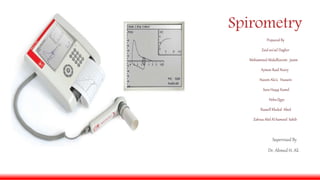
Spirometry
Prepared By
Zaid wa’ael Dagher
Mohammed AbdulKareim Jasim
Ayman Raid Noory
Hazem Ala’a Hussein
Sura Haqqi Kamel
Heba Qays
Russell Khaled Abed
Zahraa Abd Al-hameed Sahib
Supervised By
Dr. Ahmed H. Ali
Learning objectives
*Understand what is a spirometer
* Risks and limitations
*Parts
*Procedure
*Measurements
Understand what is a spirometer
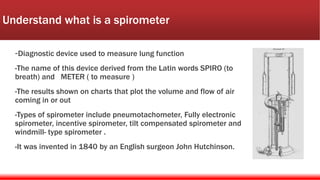
Diagnostic device used to measure lung function-
-The name of this device derived from the Latin words SPIRO (to
breath) and METER ( to measure )
-The results shown on charts that plot the volume and flow of air
coming in or out
-Types of spirometer include pneumotachometer, Fully electronic
spirometer, incentive spirometer, tilt compensated spirometer and
windmill- type spirometer .
-It was invented in 1840 by an English surgeon John Hutchinson.
Understand what is a spirometer
Risks and limitations
-It is generally safe test, but we may feel dizzy or short of breaths. The test is
NOT performed if you had a recent heart attack and rarely it may triggers
sever breathing problems .
-There is limitation of this test because it depends on the patient cooperation
and effort . As doctors we will have to repeat the test three times to get an
accurate results .
Parts
-The nose plug ; make sure that all the air comes through the mouth.
-Mouth piece ; sit inside the lips and front of the teeth attached to plastic tube to the
device.
-The breathing coach indicator ; small plastic bead set inside a vacuum chamber.
; main chamber of the spirometer .-The barrel
-The piston ; large flat weight that rises in the barrel as the user blows his breaths out,
higher the piston greater the volume of the exhalation
-Adjustable indicator ; small plastic arrow attaches to a slide on the out side of the
barrel
Procedure
Like any other test you should
prepare for it by following doctor’s
instructions . For example you
should avoid use of inhaled
breathing medication and other
preparations include wearing loose
clothing also avoid eating a large
meal therefor you will be able to
breath easier.
Usually the test take about 15m
Steps
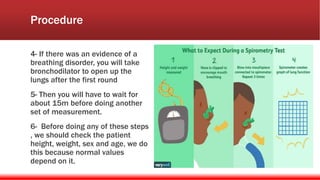
1- you will be seated in a chair then
someone will place a clip on your
nose, also a cup-like breathing
mask placed around your mouth.
2- Then you will take a deep breath
in , hold it for few seconds and
then exhale as hard as you can
3- The test will be repeated three
times, then the highest value from
three close test reading will be
taken as your final result.
Procedure
4- If there was an evidence of a
breathing disorder, you will take
bronchodilator to open up the
lungs after the first round
5- Then you will have to wait for
about 15m before doing another
set of measurement.
6- Before doing any of these steps
, we should check the patient
height, weight, sex and age, we do
this because normal values
depend on it.
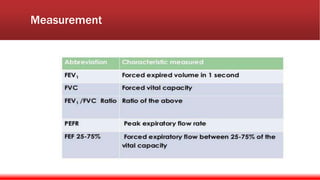
Measurement
Measurement
Measurement
Measurement
Patient 1
Measurement
Patient 2
Ask me a
Question
SOURCES
*Medical physics by Johan R. Cameron
*Wikipedia
*Maxim integrated website
*Health line website
*Medisave .uk website
*NXP website
Spirometry

Spirometry

  • 1.
    Spirometry Prepared By Zaid wa’aelDagher Mohammed AbdulKareim Jasim Ayman Raid Noory Hazem Ala’a Hussein Sura Haqqi Kamel Heba Qays Russell Khaled Abed Zahraa Abd Al-hameed Sahib Supervised By Dr. Ahmed H. Ali
  • 2.
    Learning objectives *Understand whatis a spirometer * Risks and limitations *Parts *Procedure *Measurements
  • 3.
    Understand what isa spirometer Diagnostic device used to measure lung function- -The name of this device derived from the Latin words SPIRO (to breath) and METER ( to measure ) -The results shown on charts that plot the volume and flow of air coming in or out -Types of spirometer include pneumotachometer, Fully electronic spirometer, incentive spirometer, tilt compensated spirometer and windmill- type spirometer . -It was invented in 1840 by an English surgeon John Hutchinson.
  • 4.
    Understand what isa spirometer
  • 5.
    Risks and limitations -Itis generally safe test, but we may feel dizzy or short of breaths. The test is NOT performed if you had a recent heart attack and rarely it may triggers sever breathing problems . -There is limitation of this test because it depends on the patient cooperation and effort . As doctors we will have to repeat the test three times to get an accurate results .
  • 6.
    Parts -The nose plug; make sure that all the air comes through the mouth. -Mouth piece ; sit inside the lips and front of the teeth attached to plastic tube to the device. -The breathing coach indicator ; small plastic bead set inside a vacuum chamber. ; main chamber of the spirometer .-The barrel -The piston ; large flat weight that rises in the barrel as the user blows his breaths out, higher the piston greater the volume of the exhalation -Adjustable indicator ; small plastic arrow attaches to a slide on the out side of the barrel
  • 7.
    Procedure Like any othertest you should prepare for it by following doctor’s instructions . For example you should avoid use of inhaled breathing medication and other preparations include wearing loose clothing also avoid eating a large meal therefor you will be able to breath easier. Usually the test take about 15m Steps 1- you will be seated in a chair then someone will place a clip on your nose, also a cup-like breathing mask placed around your mouth. 2- Then you will take a deep breath in , hold it for few seconds and then exhale as hard as you can 3- The test will be repeated three times, then the highest value from three close test reading will be taken as your final result.
  • 8.
    Procedure 4- If therewas an evidence of a breathing disorder, you will take bronchodilator to open up the lungs after the first round 5- Then you will have to wait for about 15m before doing another set of measurement. 6- Before doing any of these steps , we should check the patient height, weight, sex and age, we do this because normal values depend on it.
  • 9.
  • 10.
  • 11.
  • 12.
  • 13.
  • 14.
  • 15.
    SOURCES *Medical physics byJohan R. Cameron *Wikipedia *Maxim integrated website *Health line website *Medisave .uk website *NXP website