Spinocerebellar Ataxia
(SCA)
By:
Maria Celeena S. Gonzales
Mary Pruden Galye Y. Llagas
What is SCA?
• Spinocerebellar Degeneration is due
to a genetic mutation.
• In this disease, nucleotides (a group
of molecules that, when linked
together, become the building blocks
of DNA) repeat more often than they
do in healthy people.
What is SCA?
• Usually inherited in an autosomal dominant
fashion, meaning that if one of the parents
has the disorder, there is about a 50
percent chance that a child will have the
disease as well.
• Frequently, atrophy of the cerebellum
occurs, and different ataxias are known to
affect different regions within the
cerebellum
Signs and Symptoms
• SCA is neither gender specific nor is it age
specific, which means the symptoms
could appear in anyone at any time.
• FOR MOST HEREDITARY SCA initial
symptoms could also include the lack of
hand-eye co-ordination, speech
impairment, irregular or jerky
movements, temporary paralysis in the
lower limb muscles and a deformed
spine.
Signs and Symptoms
• SCA results in unsteady and clumsy
motion of the body due to a failure of the
fine coordination of muscle movements
• For the idiophatic type of SCA symptoms
may be:
– Depression, spasticity, and sleep disorders
Signs and Symptoms
• A person with ataxia retains full mental
capacity but may progressively lose
physical control and they usually end up
needing to use a wheelchair, and
eventually they may need assistance to
perform daily tasks.
DIAGNOSIS
• Examination by a neurologist, which
includes a physical exam, family history,
MRI scanning of the brain and spine, and
spinal tap.
• The most precise means of identifying
SCA is through DNA analysis.
TREATMENT
• There is NO known cure for
Spinocerebellar Ataxia, which is a
progressive and irreversible disease,
although not all types cause equally
severe disability.
• Treatments are directed towards
alleviating symptoms, not the disease
itself.
TREATMENT
• Clinical trials have also revealed that
treatment for SCA could include intensive
rehabilitation programs which coupled with
physical and occupational therapies, can
improve functional gains such as walking,
and day-to-day activities.
• STEM CELL treatment
– However, it is hoped that in the future treating ataxia
with stem cells will become more widely available and
perhaps lessen the need to travel around the world to
get the treatment that has already improved so many
lives.
TREATMENT
• Adaptive devices to allow the ataxia
individual to maintain as much
independence as possible:
– Cane, crutches, walker, or wheelchair
– devices to assist with writing, feeding
– and communication devices for those with
impaired speech.
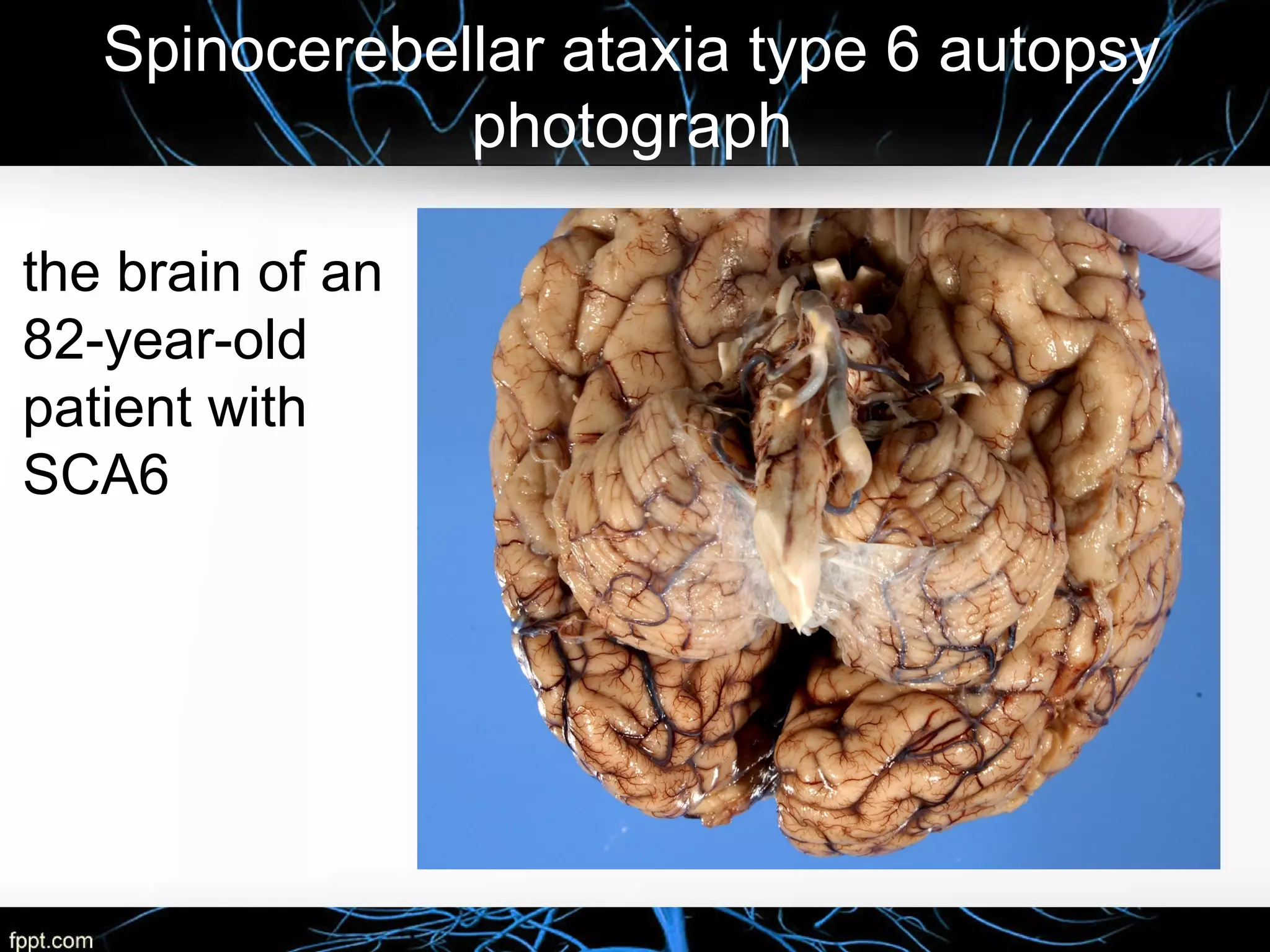
Spinocerebellar ataxia type 6 autopsy
photograph
the brain of an
82-year-old
patient with
SCA6

Spinocerbellar Ataxia

  • 1.
    Spinocerebellar Ataxia (SCA) By: Maria CeleenaS. Gonzales Mary Pruden Galye Y. Llagas
  • 2.
    What is SCA? •Spinocerebellar Degeneration is due to a genetic mutation. • In this disease, nucleotides (a group of molecules that, when linked together, become the building blocks of DNA) repeat more often than they do in healthy people.
  • 3.
    What is SCA? •Usually inherited in an autosomal dominant fashion, meaning that if one of the parents has the disorder, there is about a 50 percent chance that a child will have the disease as well. • Frequently, atrophy of the cerebellum occurs, and different ataxias are known to affect different regions within the cerebellum
  • 4.
    Signs and Symptoms •SCA is neither gender specific nor is it age specific, which means the symptoms could appear in anyone at any time. • FOR MOST HEREDITARY SCA initial symptoms could also include the lack of hand-eye co-ordination, speech impairment, irregular or jerky movements, temporary paralysis in the lower limb muscles and a deformed spine.
  • 5.
    Signs and Symptoms •SCA results in unsteady and clumsy motion of the body due to a failure of the fine coordination of muscle movements • For the idiophatic type of SCA symptoms may be: – Depression, spasticity, and sleep disorders
  • 6.
    Signs and Symptoms •A person with ataxia retains full mental capacity but may progressively lose physical control and they usually end up needing to use a wheelchair, and eventually they may need assistance to perform daily tasks.
  • 7.
    DIAGNOSIS • Examination bya neurologist, which includes a physical exam, family history, MRI scanning of the brain and spine, and spinal tap. • The most precise means of identifying SCA is through DNA analysis.
  • 8.
    TREATMENT • There isNO known cure for Spinocerebellar Ataxia, which is a progressive and irreversible disease, although not all types cause equally severe disability. • Treatments are directed towards alleviating symptoms, not the disease itself.
  • 9.
    TREATMENT • Clinical trialshave also revealed that treatment for SCA could include intensive rehabilitation programs which coupled with physical and occupational therapies, can improve functional gains such as walking, and day-to-day activities. • STEM CELL treatment – However, it is hoped that in the future treating ataxia with stem cells will become more widely available and perhaps lessen the need to travel around the world to get the treatment that has already improved so many lives.
  • 10.
    TREATMENT • Adaptive devicesto allow the ataxia individual to maintain as much independence as possible: – Cane, crutches, walker, or wheelchair – devices to assist with writing, feeding – and communication devices for those with impaired speech.
  • 11.
    Spinocerebellar ataxia type6 autopsy photograph the brain of an 82-year-old patient with SCA6

Editor's Notes

  • #2 A.K.A. Spinocerebellar Degeneration
  • #3 INFO: There have been up to 60 different types of SCA identified (most are found on autopsy) as there is no one test that can tell if an individual has SCA or what type it is. (second bullet) For example, three repeated nucleotides are known as a ‘trinucleotide repeat’. In this case a mutated form of protein is the result, which leads to symptoms of disease.
  • #4 ATROPHY - A decrease in size of an organ caused by disease
  • #6 Spasticity - The quality of moving or acting in spasms / JERKINESS
  • #8 DNA test may be done on the children of a person with the condition, to see if they are at risk of developing the condition.
  • #9 PROGRESSIVE – it gets worse with time ALLEVIATING - Provide physical relief, as from pain There are exercises available to strengthen the muscles, which can significantly improve balance.
  • #12 TYPE 6 SCA PTS EXPERIENCES: Downbeating nystagmus, positional vertigoSymptoms can appear for the first time as late as 65 years old.