
SBRT Spine Toxicities
& Management
DR. ANANDA SELVAKUMAR PANDY.
MD..DNB..FIPM.,
Senior Consultant,
Meenakshi Mission Hospital & Research centre,
Madurai
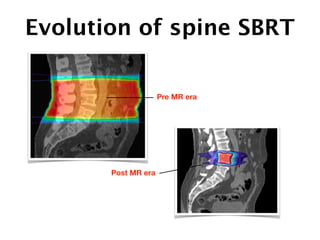
Evolution of spine SBRT
Pre MR era
Post MR era
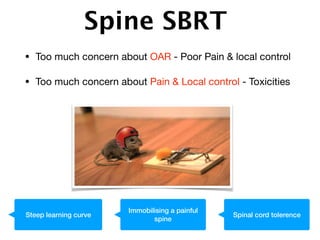
• Too much concern about OAR - Poor Pain & local control

• Too much concern about Pain & Local control - Toxicities
Steep learning curve
Immobilising a painful
spine
Spinal cord tolerence
Spine SBRT
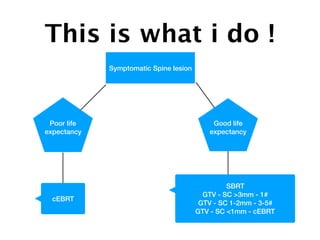
This is what i do !
Symptomatic Spine lesion
Poor life
expectancy
cEBRT
Good life
expectancy
SBRT
GTV - SC >3mm - 1#
GTV - SC 1-2mm - 3-5#
GTV - SC <1mm - cEBRT
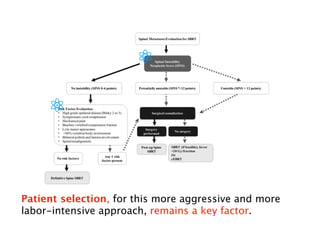
Patient selection, for this more aggressive and more
labor-intensive approach, remains a key factor.
Be Wise !!
• Vertebral compression fracture ( VCF )
• Myelopathy
• Plexopathy
• Marginal Failure
• Pain Flare
• Oesophagitis
• Myositis
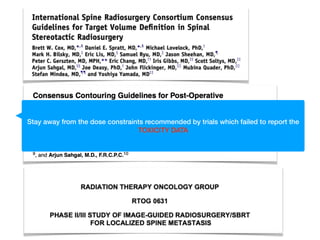
Stay away from the dose constraints recommended by trials which failed to report the
TOXICITY DATA
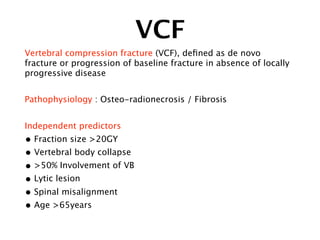
VCF
Vertebral compression fracture (VCF), defined as de novo
fracture or progression of baseline fracture in absence of locally
progressive disease
Pathophysiology : Osteo-radionecrosis / Fibrosis
Independent predictors
• Fraction size >20GY
• Vertebral body collapse
• >50% Involvement of VB
• Lytic lesion
• Spinal misalignment
• Age >65years
VCF
Mitigating strategies
• Fractionate - 24/2 or 27/3 or 30/5
• Pre SBRT SINS - Spine stabilisation
• Pre SBRT Risk factors - Vertebroplasty / Kyphoplasty
• Extracaution - Re / Salvage SBRT
• ?? Bisphosphonates / RANKL inhibitors
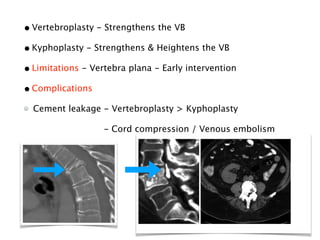
•Vertebroplasty - Strengthens the VB
•Kyphoplasty - Strengthens & Heightens the VB
•Limitations - Vertebra plana - Early intervention
•Complications
Cement leakage - Vertebroplasty > Kyphoplasty
- Cord compression / Venous embolism
Pain Flare
• Acute exacerbation of pain during or shortly after
radiotherapy treatment.
• Pathophysiology - Increased edema from treatment
induced inflammation.
• Under-reported
• Incidence : 25 - 70% in steroid naive
Pain Flare
Mitigating strategies
• Prophylactic steroids and analgesics
Dexamethasone 4mg ( D1 - D4 )
Methylprednisolone 24mg ( Taper for next 6 days )
• Fractionate : 8% in 5# / 20% in 3# / 34% in 1#
Radiation Myelopathy
• Every RO’s Worst NIGHTMARE !! 

• RM is defined as the development of neurological signs
and symptoms mapping to the irradiated spinal cord
segment without MRI evidence of recurrent or progressive
tumor.

• Paresthesia / Pain / Motor weakness / Sphincter
incontinence
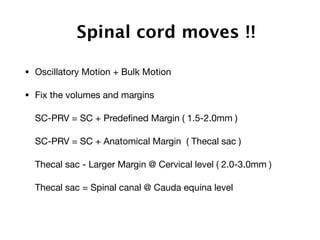
Spinal cord moves !!
• Oscillatory Motion + Bulk Motion

• Fix the volumes and margins

SC-PRV = SC + Predefined Margin ( 1.5-2.0mm )

SC-PRV = SC + Anatomical Margin ( Thecal sac )

Thecal sac - Larger Margin @ Cervical level ( 2.0-3.0mm )

Thecal sac = Spinal canal @ Cauda equina level
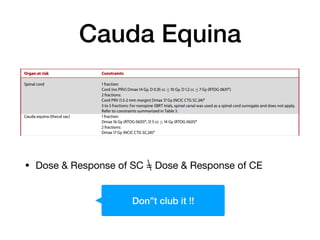
Cauda Equina
• Dose & Response of SC = Dose & Response of CE
Don”t club it !!
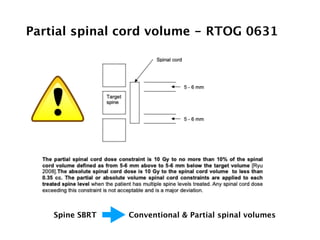
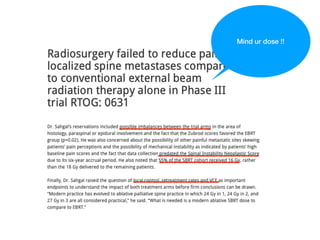
Partial spinal cord volume - RTOG 0631
Spine SBRT Conventional & Partial spinal volumes
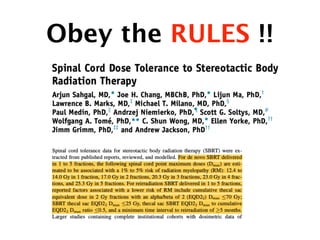
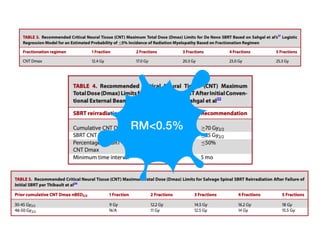
Obey the RULES !!
RM<0.5%
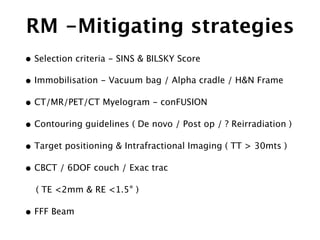
RM -Mitigating strategies
• Selection criteria - SINS & BILSKY Score
• Immobilisation - Vacuum bag / Alpha cradle / H&N Frame
• CT/MR/PET/CT Myelogram - conFUSION
• Contouring guidelines ( De novo / Post op / ? Reirradiation )
• Target positioning & Intrafractional Imaging ( TT > 30mts )
• CBCT / 6DOF couch / Exac trac
( TE <2mm & RE <1.5° )
• FFF Beam
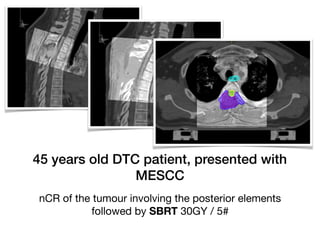
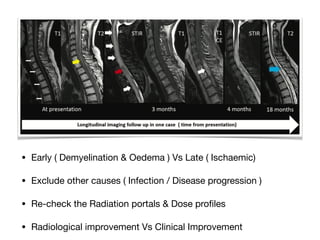
45 years old DTC patient, presented with
MESCC
nCR of the tumour involving the posterior elements
followed by SBRT 30GY / 5#
• Early ( Demyelination & Oedema ) Vs Late ( Ischaemic)

• Exclude other causes ( Infection / Disease progression )

• Re-check the Radiation portals & Dose profiles

• Radiological improvement Vs Clinical Improvement
Radiation Myelopathy
• Steroids - Dexamethasone / Methyl prednisolone
• Bevacizumab
• IV Immunoglobulin
• Hyperbaric oxygen
• Plasmapheresis
• Start praying !!
Myositis
• Radiation induced vascular & muscle injury
• Uncommon or Under reported ??
• MR - Irregular T1 enhancement / Patchy T2 hyper intensity -
Muscle volume loss
• Check the radiation field & rule out disease progression or
recurrence
Mitigating strategies
• Fractionate
• Steroids & Analgesics
Oesophagitis
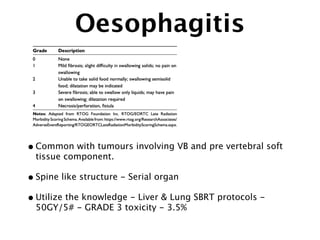
•Common with tumours involving VB and pre vertebral soft
tissue component.
•Spine like structure - Serial organ
•Utilize the knowledge - Liver & Lung SBRT protocols -
50GY/5# - GRADE 3 toxicity - 3.5%
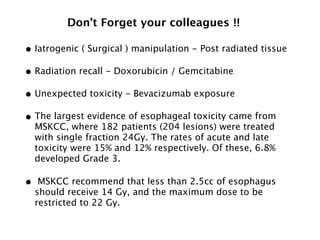
• Iatrogenic ( Surgical ) manipulation - Post radiated tissue
• Radiation recall - Doxorubicin / Gemcitabine
• Unexpected toxicity - Bevacizumab exposure
• The largest evidence of esophageal toxicity came from
MSKCC, where 182 patients (204 lesions) were treated
with single fraction 24Gy. The rates of acute and late
toxicity were 15% and 12% respectively. Of these, 6.8%
developed Grade 3.
• MSKCC recommend that less than 2.5cc of esophagus
should receive 14 Gy, and the maximum dose to be
restricted to 22 Gy.
Don’t Forget your colleagues !!
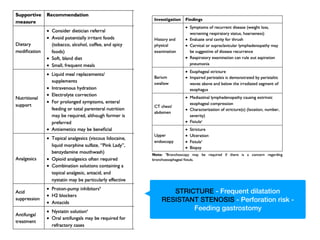
STRICTURE - Frequent dilatation
RESISTANT STENOSIS - Perforation risk -
Feeding gastrostomy
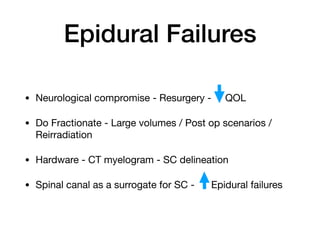
Epidural Failures
• Neurological compromise - Resurgery - QOL

• Do Fractionate - Large volumes / Post op scenarios /
Reirradiation

• Hardware - CT myelogram - SC delineation

• Spinal canal as a surrogate for SC - Epidural failures
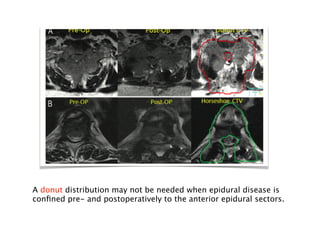
A donut distribution may not be needed when epidural disease is
confined pre- and postoperatively to the anterior epidural sectors.
Mind ur dose !!
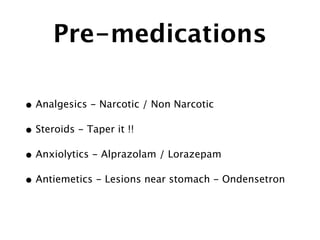
Pre-medications
• Analgesics - Narcotic / Non Narcotic
• Steroids - Taper it !!
• Anxiolytics - Alprazolam / Lorazepam
• Antiemetics - Lesions near stomach - Ondensetron
Spine SBRT toxicities & Management

Spine SBRT toxicities & Management

  • 1.
    SBRT Spine Toxicities &Management DR. ANANDA SELVAKUMAR PANDY. MD..DNB..FIPM., Senior Consultant, Meenakshi Mission Hospital & Research centre, Madurai
  • 2.
    Evolution of spineSBRT Pre MR era Post MR era
  • 3.
    • Too muchconcern about OAR - Poor Pain & local control • Too much concern about Pain & Local control - Toxicities Steep learning curve Immobilising a painful spine Spinal cord tolerence Spine SBRT
  • 4.
    This is whati do ! Symptomatic Spine lesion Poor life expectancy cEBRT Good life expectancy SBRT GTV - SC >3mm - 1# GTV - SC 1-2mm - 3-5# GTV - SC <1mm - cEBRT
  • 5.
    Patient selection, forthis more aggressive and more labor-intensive approach, remains a key factor.
  • 6.
    Be Wise !! •Vertebral compression fracture ( VCF ) • Myelopathy • Plexopathy • Marginal Failure • Pain Flare • Oesophagitis • Myositis
  • 7.
    Stay away fromthe dose constraints recommended by trials which failed to report the TOXICITY DATA
  • 8.
    VCF Vertebral compression fracture(VCF), defined as de novo fracture or progression of baseline fracture in absence of locally progressive disease Pathophysiology : Osteo-radionecrosis / Fibrosis Independent predictors • Fraction size >20GY • Vertebral body collapse • >50% Involvement of VB • Lytic lesion • Spinal misalignment • Age >65years
  • 9.
    VCF Mitigating strategies • Fractionate- 24/2 or 27/3 or 30/5 • Pre SBRT SINS - Spine stabilisation • Pre SBRT Risk factors - Vertebroplasty / Kyphoplasty • Extracaution - Re / Salvage SBRT • ?? Bisphosphonates / RANKL inhibitors
  • 10.
    •Vertebroplasty - Strengthensthe VB •Kyphoplasty - Strengthens & Heightens the VB •Limitations - Vertebra plana - Early intervention •Complications Cement leakage - Vertebroplasty > Kyphoplasty - Cord compression / Venous embolism
  • 11.
    Pain Flare • Acuteexacerbation of pain during or shortly after radiotherapy treatment. • Pathophysiology - Increased edema from treatment induced inflammation. • Under-reported • Incidence : 25 - 70% in steroid naive
  • 12.
    Pain Flare Mitigating strategies •Prophylactic steroids and analgesics Dexamethasone 4mg ( D1 - D4 ) Methylprednisolone 24mg ( Taper for next 6 days ) • Fractionate : 8% in 5# / 20% in 3# / 34% in 1#
  • 13.
    Radiation Myelopathy • EveryRO’s Worst NIGHTMARE !! • RM is defined as the development of neurological signs and symptoms mapping to the irradiated spinal cord segment without MRI evidence of recurrent or progressive tumor. • Paresthesia / Pain / Motor weakness / Sphincter incontinence
  • 14.
    Spinal cord moves!! • Oscillatory Motion + Bulk Motion • Fix the volumes and margins SC-PRV = SC + Predefined Margin ( 1.5-2.0mm ) SC-PRV = SC + Anatomical Margin ( Thecal sac ) Thecal sac - Larger Margin @ Cervical level ( 2.0-3.0mm ) Thecal sac = Spinal canal @ Cauda equina level
  • 15.
    Cauda Equina • Dose& Response of SC = Dose & Response of CE Don”t club it !!
  • 16.
    Partial spinal cordvolume - RTOG 0631 Spine SBRT Conventional & Partial spinal volumes
  • 17.
  • 18.
  • 19.
    RM -Mitigating strategies •Selection criteria - SINS & BILSKY Score • Immobilisation - Vacuum bag / Alpha cradle / H&N Frame • CT/MR/PET/CT Myelogram - conFUSION • Contouring guidelines ( De novo / Post op / ? Reirradiation ) • Target positioning & Intrafractional Imaging ( TT > 30mts ) • CBCT / 6DOF couch / Exac trac ( TE <2mm & RE <1.5° ) • FFF Beam
  • 20.
    45 years oldDTC patient, presented with MESCC nCR of the tumour involving the posterior elements followed by SBRT 30GY / 5#
  • 21.
    • Early (Demyelination & Oedema ) Vs Late ( Ischaemic) • Exclude other causes ( Infection / Disease progression ) • Re-check the Radiation portals & Dose profiles • Radiological improvement Vs Clinical Improvement
  • 22.
    Radiation Myelopathy • Steroids- Dexamethasone / Methyl prednisolone • Bevacizumab • IV Immunoglobulin • Hyperbaric oxygen • Plasmapheresis • Start praying !!
  • 23.
    Myositis • Radiation inducedvascular & muscle injury • Uncommon or Under reported ?? • MR - Irregular T1 enhancement / Patchy T2 hyper intensity - Muscle volume loss • Check the radiation field & rule out disease progression or recurrence Mitigating strategies • Fractionate • Steroids & Analgesics
  • 24.
    Oesophagitis •Common with tumoursinvolving VB and pre vertebral soft tissue component. •Spine like structure - Serial organ •Utilize the knowledge - Liver & Lung SBRT protocols - 50GY/5# - GRADE 3 toxicity - 3.5%
  • 25.
    • Iatrogenic (Surgical ) manipulation - Post radiated tissue • Radiation recall - Doxorubicin / Gemcitabine • Unexpected toxicity - Bevacizumab exposure • The largest evidence of esophageal toxicity came from MSKCC, where 182 patients (204 lesions) were treated with single fraction 24Gy. The rates of acute and late toxicity were 15% and 12% respectively. Of these, 6.8% developed Grade 3. • MSKCC recommend that less than 2.5cc of esophagus should receive 14 Gy, and the maximum dose to be restricted to 22 Gy. Don’t Forget your colleagues !!
  • 26.
    STRICTURE - Frequentdilatation RESISTANT STENOSIS - Perforation risk - Feeding gastrostomy
  • 27.
    Epidural Failures • Neurologicalcompromise - Resurgery - QOL • Do Fractionate - Large volumes / Post op scenarios / Reirradiation • Hardware - CT myelogram - SC delineation • Spinal canal as a surrogate for SC - Epidural failures
  • 28.
    A donut distributionmay not be needed when epidural disease is confined pre- and postoperatively to the anterior epidural sectors.
  • 29.
  • 30.
    Pre-medications • Analgesics -Narcotic / Non Narcotic • Steroids - Taper it !! • Anxiolytics - Alprazolam / Lorazepam • Antiemetics - Lesions near stomach - Ondensetron