Human Control of Locomotion
By: Radhika Chintamani Ref: Janda’s Approach
1. Introduction to movement.
2. Definition of locomotion.
3. 3 systems of control of locomotion.
Introduction to movement: movement is form of mobility, which is due to movement of various
joints in a link to each other.
Locomotion is defined as: movement of bilateral lower extremity in an alternative fashion, in
such a way that transmission of the COG takes place in the sinusoidal curve in order to maintain
the stability along with the mobility.
3 systems of control of locomotion:
a. Skeletal systems
b. Muscular system
c. Neural system.
Interaction of 3 different chains:
Primary chain Secondary chain Types of chain
Articular Muscular
Neurological
Postural
Kinetic
Muscular Articular
Neurological
Synergist
Muscle slings
Myofacsial chains
Neurological Articular
Muscular
Primitive reflexive chains
Sensorimotor system
Neurodevelopmental
locomotor chains
Skeletal system: Articular chains result from the biomechanical interactions of different joints
throughout a movement pattern. There are two types of articular chains: postural and kinetic.
a. Postural chains: Postural chains are the position of one joint in relation to another when
the body is in an upright posture. Postural chains influence positioning and movement
through structural and functional mechanisms. Structural mechanisms describe the
influence of static skeletal positioning on adjacent structures, while functional
mechanisms describe the dynamic influence that the position of keystone structures (the
pelvis and scapulae) has on muscles attaching to those structures. Structural chains are
influenced by static joint position, while functional chains are influenced by muscle
activity around joint structures.
- Functional chains among articular chains: The postural position of keystone structures
contributes to pathology and dysfunction. Keystone structures include skeletal
structures that serve as attachment points for groups of postural muscles, most
notably the pelvis, ribs, and scapulae. These attachments may serve as either origins
or insertions of muscle. Muscle tightness or weakness may be caused by or may be
the cause of altered postural positioning. The position of these structures is
considered a key in the assessment of posture and in the role these structures play in
dysfunction.
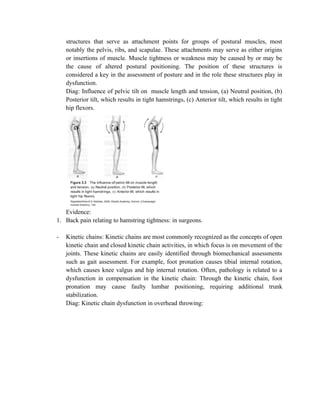
Diag: Influence of pelvic tilt on muscle length and tension, (a) Neutral position, (b)
Posterior tilt, which results in tight hamstrings, (c) Anterior tilt, which results in tight
hip flexors.
Evidence:
1. Back pain relating to hamstring tightness: in surgeons.
- Kinetic chains: Kinetic chains are most commonly recognized as the concepts of open
kinetic chain and closed kinetic chain activities, in which focus is on movement of the
joints. These kinetic chains are easily identified through biomechanical assessments
such as gait assessment. For example, foot pronation causes tibial internal rotation,
which causes knee valgus and hip internal rotation. Often, pathology is related to a
dysfunction in compensation in the kinetic chain: Through the kinetic chain, foot
pronation may cause faulty lumbar positioning, requiring additional trunk
stabilization.
Diag: Kinetic chain dysfunction in overhead throwing:
Muscular chains:
Muscular chains are groups of muscles that work together or influence each other through
movement patterns. There are three subtypes of muscular chains: synergists, muscle slings, and
myofascial chains. Each type of muscular chain interdepends on both the articular and the
neurological systems.
Synergists: A synergistic muscle works with another muscle (agonist) to produce movement or
stabilization around a joint. Synergists may include secondary movers, stabilizers, or
neutralizers. For example, during shoulder rotation, the rotator cuff is active. However, the
rhomboids, serratus anterior, and trapezius must work as stabilizers of the scapula to ensure a
stable origin for the rotator cuff. Therefore, pseudoweakness of the rotator cuff may be caused by
poor stabilization of the scapula; if the scapula is stabilized manually, the patient demonstrates
normal strength of the rotator cuff. Ususally they work locally.
Diag: Scapula, rotator cuff, rhomboid, SA, and trapezius attachment. (Force couple):
Muscle sling: muscle slings are global, providing movement and stabilization across multiple
joints. Muscle slings are thought to facilitate rotation and to transfer forces through the trunk,
particularly from the lower body to the upper body (Vleeming et al. 1995). Muscle slings also
provide stabilization and movement in reciprocal and contralateral movements such locomotion.
Typically, muscle slings are interconnected, as one muscle insertion is connected to the next
muscle's origin via a common keystone structure (see table 3.2). These keystone structures act as
fixation points from which the entire chain of muscles can stabilize.
Lower extremity slings helpful in gait:
Extensor sling Flexor sling
[Type a quote from the document or the
summary of an interesting point. You can position
the text box anywhere in the document. Use the
Text Box Tools tab to change the formatting of the
pull quote text box.]
Hip=glut max,
Knee=rectus femoris
Plantar flexion=Gastrocnemius
Hip=iliopsoas
Knee=hamstring
Dorsiflexion=tibialis anterior
During gait swing phase activates flexor sling in LE, while the stance phase activates extensor
sling in LE. Throughout the gait, these two phase alternateively activate and inhibit and
reciprocate between each lower extremity such that, when one leg is in stance (extension sling)
the other leg is in swing phase (flexion sling), hence reciprocal, rhythmic co-activation of muscle
in contralateral LE’s produce a balanced gait.
When both slings are activated simultaneously LE’s are stabilized. Such that in upright standing
position both LE’s have activated extension sling in them making an individual stable in his
BOS.
Upper Extremity:
Extensor sling
Rhomboids
Posterior deltoid
Triceps
Hand extensor
Flexor sling
Pect major
Anterior deltoid
Trapezius
Biceps brachii
Hand flexors
These extremity slings are activated along with lower extremity sling to form a reciprocal gait.
During swing phase- Rt UE= flexor sling coupled with
Lt LE=flexor sling.
Neurological Chain:
a. Protective reflexive chain: two fundamental protective reflexes are, crossed extensor and
withdrawal reflex which are triggered by sensory receptors.
 Flexor Withdrawal reflex:
Excessive heat or noxious stimulus
Activation of flexor and inhibition of extensor
Pulling of the limb away form the stimulus.
 Crossed extensor reflex:
Cutaneous noxious stimuli
Flexor activation on the same side and extensor activation on the contralateral
side.
Pushing the noxious stimuli away from the contralateral limb.
 Janda’s locomotor reflexes: Locomotion: in lower extremity, a combination of
extension, adduction and rotation provide basic gait pattern to avoid danger.
b. Sensorimotor chains: linked neurologically through afferent and efferent systems in
controlling feedback and feed-forward mechanisms. Provides both local and lobal
dynamic stabilization of the joints through muscle activity.
 Reflexive stabilization: on contraction of one muscle the other muscle has to
contract to provide stability of that particular joint.
Evidence: Eg: Horak and Nashner in 1986 in their study demonstrated that on
giving perturbation on the human body in one direction say, anterior direction the
opposite side muscle contract to maintain the balance of the body in the distal to
proximal way( ankle strategy) to maintain smaller perturbation and proximal to
distal way (hip strategy) against a larger perturbation.
The most important stabilizing sensorimtor chain in human body is the pelvic
chain, consisting of the TrA, multifidus, diaphragm, and the pelvic floor. These
four muscles are coactivated in the pelvis for its stability and force transmission.
Pelvic weakness has shown both proximal and distal pathologies such as LBP,
groin strains, IT band syndromes, anterior knee pain, ACL tears, Ankle sprains.
The sensorimotor chain depends on proprioception. Joint dysfunction often disrupts the
dyanamic stabilization of the chain.
Evidence: Eg: a study by Falla et al, demonstrated delayed activation of deep cervical
flexor on upper extremity tasks in whiplash injury patients.
Delayed activation of middle and lower traps in patients with shoulder impingement.
Cools et al.2003
 Sensorimotor adaptation chains: these adaptation takes place when dysfunction
such as pain or pathology within the sensorimotor system occurs. The adaptation
may be in the form of systemic and predictable pattern. Janda described the
adaptation as follows:
i) Horizontal adaptation: occurs when impaired function in one joint or
muscle creates reaction and adaptation in the other joint segments.
Commonly seen in spine, eg; LBA often leads to cervical syndromes.
Evidence: Horal et al, suggested that after 6y of first episode of onset of
LBA, the individual develops cervical syndromes.
Muscles conform to horizontal adaptation creating a predictable pattern.
Can be either proximal to distal or either way.
ii) Vertical adaptation: occurs between CNS and PNS. Adaptation of one part
of sensorimotor system leads to impairment in the function of entire motor
system. May progress from PNS to CNS or either way. It is seen as change
in motor programming that is reflected in abnormal movt pattern.
Demonstrated in global movt pattern or postural control.
c. Neurodevelopmental locomotor patterns:
There are two groups of muscles in phylogenetic origin: tonic and phasic.
i. Tonic system: older in origin, dominant, involoved in repetitive and rhythmic
activities and also involved in withdrawal reflex in UE and LE. Predominant
action is flexion.
ii. Phasic system: younger in origin, typically work against gravity, mainly for
postural stabilization, predominant action is extension.
Study of movements in infants as they mature is called as developmental kinesiology.
Innate reflexes seen in infants such as ATNR and STNR integrate into the
musculoskeletal system and become the function of the human being. These primitive
reflexes may reoccur if any injury is seen globally in CNS.
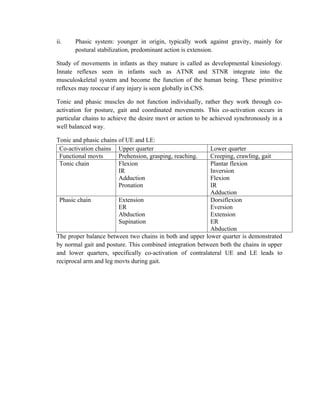
Tonic and phasic muscles do not function individually, rather they work through co-
activation for posture, gait and coordinated movements. This co-activation occurs in
particular chains to achieve the desire movt or action to be achieved synchronously in a
well balanced way.
Tonic and phasic chains of UE and LE:
Co-activation chains Upper quarter Lower quarter
Functional movts Prehension, grasping, reaching. Creeping, crawling, gait
Tonic chain Flexion
IR
Adduction
Pronation
Plantar flexion
Inversion
Flexion
IR
Adduction
Phasic chain Extension
ER
Abduction
Supination
Dorsiflexion
Eversion
Extension
ER
Abduction
The proper balance between two chains in both and upper lower quarter is demonstrated
by normal gait and posture. This combined integration between both the chains in upper
and lower quarters, specifically co-activation of contralateral UE and LE leads to
reciprocal arm and leg movts during gait.
Only neural control:
1. Introduction to movement, locomotion
2. 3 systems of locomotion control
3. Neural control of locomotion: definition, structure of neuron, muscle and NMJ
4. Interaction of NMJ to provide connection between PNS and Muscle.
5. Neurolgical chain of movt: Protective reflex (crossed extensor and withdrawal reflex),
sensorimotor chain (reflex stabilization[strategies] and sensorimotor adaptation
chain=vertical adaptation[CNS and PNS] and horizontal adaptation[muscular]),
neurodevelopmental locomotion pattern [phasic and tonic chains].

Human control of_locomotion

  • 1.
    Human Control ofLocomotion By: Radhika Chintamani Ref: Janda’s Approach 1. Introduction to movement. 2. Definition of locomotion. 3. 3 systems of control of locomotion. Introduction to movement: movement is form of mobility, which is due to movement of various joints in a link to each other. Locomotion is defined as: movement of bilateral lower extremity in an alternative fashion, in such a way that transmission of the COG takes place in the sinusoidal curve in order to maintain the stability along with the mobility. 3 systems of control of locomotion: a. Skeletal systems b. Muscular system c. Neural system. Interaction of 3 different chains: Primary chain Secondary chain Types of chain Articular Muscular Neurological Postural Kinetic Muscular Articular Neurological Synergist Muscle slings Myofacsial chains Neurological Articular Muscular Primitive reflexive chains Sensorimotor system Neurodevelopmental locomotor chains Skeletal system: Articular chains result from the biomechanical interactions of different joints throughout a movement pattern. There are two types of articular chains: postural and kinetic. a. Postural chains: Postural chains are the position of one joint in relation to another when the body is in an upright posture. Postural chains influence positioning and movement through structural and functional mechanisms. Structural mechanisms describe the influence of static skeletal positioning on adjacent structures, while functional mechanisms describe the dynamic influence that the position of keystone structures (the pelvis and scapulae) has on muscles attaching to those structures. Structural chains are influenced by static joint position, while functional chains are influenced by muscle activity around joint structures. - Functional chains among articular chains: The postural position of keystone structures contributes to pathology and dysfunction. Keystone structures include skeletal
  • 2.
    structures that serveas attachment points for groups of postural muscles, most notably the pelvis, ribs, and scapulae. These attachments may serve as either origins or insertions of muscle. Muscle tightness or weakness may be caused by or may be the cause of altered postural positioning. The position of these structures is considered a key in the assessment of posture and in the role these structures play in dysfunction. Diag: Influence of pelvic tilt on muscle length and tension, (a) Neutral position, (b) Posterior tilt, which results in tight hamstrings, (c) Anterior tilt, which results in tight hip flexors. Evidence: 1. Back pain relating to hamstring tightness: in surgeons. - Kinetic chains: Kinetic chains are most commonly recognized as the concepts of open kinetic chain and closed kinetic chain activities, in which focus is on movement of the joints. These kinetic chains are easily identified through biomechanical assessments such as gait assessment. For example, foot pronation causes tibial internal rotation, which causes knee valgus and hip internal rotation. Often, pathology is related to a dysfunction in compensation in the kinetic chain: Through the kinetic chain, foot pronation may cause faulty lumbar positioning, requiring additional trunk stabilization. Diag: Kinetic chain dysfunction in overhead throwing:
  • 3.
    Muscular chains: Muscular chainsare groups of muscles that work together or influence each other through movement patterns. There are three subtypes of muscular chains: synergists, muscle slings, and myofascial chains. Each type of muscular chain interdepends on both the articular and the neurological systems. Synergists: A synergistic muscle works with another muscle (agonist) to produce movement or stabilization around a joint. Synergists may include secondary movers, stabilizers, or neutralizers. For example, during shoulder rotation, the rotator cuff is active. However, the rhomboids, serratus anterior, and trapezius must work as stabilizers of the scapula to ensure a stable origin for the rotator cuff. Therefore, pseudoweakness of the rotator cuff may be caused by poor stabilization of the scapula; if the scapula is stabilized manually, the patient demonstrates normal strength of the rotator cuff. Ususally they work locally. Diag: Scapula, rotator cuff, rhomboid, SA, and trapezius attachment. (Force couple): Muscle sling: muscle slings are global, providing movement and stabilization across multiple joints. Muscle slings are thought to facilitate rotation and to transfer forces through the trunk, particularly from the lower body to the upper body (Vleeming et al. 1995). Muscle slings also provide stabilization and movement in reciprocal and contralateral movements such locomotion. Typically, muscle slings are interconnected, as one muscle insertion is connected to the next muscle's origin via a common keystone structure (see table 3.2). These keystone structures act as fixation points from which the entire chain of muscles can stabilize. Lower extremity slings helpful in gait: Extensor sling Flexor sling [Type a quote from the document or the summary of an interesting point. You can position the text box anywhere in the document. Use the Text Box Tools tab to change the formatting of the pull quote text box.]
  • 4.
    Hip=glut max, Knee=rectus femoris Plantarflexion=Gastrocnemius Hip=iliopsoas Knee=hamstring Dorsiflexion=tibialis anterior During gait swing phase activates flexor sling in LE, while the stance phase activates extensor sling in LE. Throughout the gait, these two phase alternateively activate and inhibit and reciprocate between each lower extremity such that, when one leg is in stance (extension sling) the other leg is in swing phase (flexion sling), hence reciprocal, rhythmic co-activation of muscle in contralateral LE’s produce a balanced gait. When both slings are activated simultaneously LE’s are stabilized. Such that in upright standing position both LE’s have activated extension sling in them making an individual stable in his BOS. Upper Extremity: Extensor sling Rhomboids Posterior deltoid Triceps Hand extensor Flexor sling Pect major Anterior deltoid Trapezius Biceps brachii Hand flexors These extremity slings are activated along with lower extremity sling to form a reciprocal gait. During swing phase- Rt UE= flexor sling coupled with Lt LE=flexor sling. Neurological Chain: a. Protective reflexive chain: two fundamental protective reflexes are, crossed extensor and withdrawal reflex which are triggered by sensory receptors.  Flexor Withdrawal reflex: Excessive heat or noxious stimulus Activation of flexor and inhibition of extensor Pulling of the limb away form the stimulus.  Crossed extensor reflex: Cutaneous noxious stimuli Flexor activation on the same side and extensor activation on the contralateral side. Pushing the noxious stimuli away from the contralateral limb.  Janda’s locomotor reflexes: Locomotion: in lower extremity, a combination of extension, adduction and rotation provide basic gait pattern to avoid danger. b. Sensorimotor chains: linked neurologically through afferent and efferent systems in controlling feedback and feed-forward mechanisms. Provides both local and lobal dynamic stabilization of the joints through muscle activity.
  • 5.
     Reflexive stabilization:on contraction of one muscle the other muscle has to contract to provide stability of that particular joint. Evidence: Eg: Horak and Nashner in 1986 in their study demonstrated that on giving perturbation on the human body in one direction say, anterior direction the opposite side muscle contract to maintain the balance of the body in the distal to proximal way( ankle strategy) to maintain smaller perturbation and proximal to distal way (hip strategy) against a larger perturbation. The most important stabilizing sensorimtor chain in human body is the pelvic chain, consisting of the TrA, multifidus, diaphragm, and the pelvic floor. These four muscles are coactivated in the pelvis for its stability and force transmission. Pelvic weakness has shown both proximal and distal pathologies such as LBP, groin strains, IT band syndromes, anterior knee pain, ACL tears, Ankle sprains. The sensorimotor chain depends on proprioception. Joint dysfunction often disrupts the dyanamic stabilization of the chain. Evidence: Eg: a study by Falla et al, demonstrated delayed activation of deep cervical flexor on upper extremity tasks in whiplash injury patients. Delayed activation of middle and lower traps in patients with shoulder impingement. Cools et al.2003  Sensorimotor adaptation chains: these adaptation takes place when dysfunction such as pain or pathology within the sensorimotor system occurs. The adaptation may be in the form of systemic and predictable pattern. Janda described the adaptation as follows: i) Horizontal adaptation: occurs when impaired function in one joint or muscle creates reaction and adaptation in the other joint segments. Commonly seen in spine, eg; LBA often leads to cervical syndromes. Evidence: Horal et al, suggested that after 6y of first episode of onset of LBA, the individual develops cervical syndromes. Muscles conform to horizontal adaptation creating a predictable pattern. Can be either proximal to distal or either way. ii) Vertical adaptation: occurs between CNS and PNS. Adaptation of one part of sensorimotor system leads to impairment in the function of entire motor system. May progress from PNS to CNS or either way. It is seen as change in motor programming that is reflected in abnormal movt pattern. Demonstrated in global movt pattern or postural control. c. Neurodevelopmental locomotor patterns: There are two groups of muscles in phylogenetic origin: tonic and phasic. i. Tonic system: older in origin, dominant, involoved in repetitive and rhythmic activities and also involved in withdrawal reflex in UE and LE. Predominant action is flexion.
  • 6.
    ii. Phasic system:younger in origin, typically work against gravity, mainly for postural stabilization, predominant action is extension. Study of movements in infants as they mature is called as developmental kinesiology. Innate reflexes seen in infants such as ATNR and STNR integrate into the musculoskeletal system and become the function of the human being. These primitive reflexes may reoccur if any injury is seen globally in CNS. Tonic and phasic muscles do not function individually, rather they work through co- activation for posture, gait and coordinated movements. This co-activation occurs in particular chains to achieve the desire movt or action to be achieved synchronously in a well balanced way. Tonic and phasic chains of UE and LE: Co-activation chains Upper quarter Lower quarter Functional movts Prehension, grasping, reaching. Creeping, crawling, gait Tonic chain Flexion IR Adduction Pronation Plantar flexion Inversion Flexion IR Adduction Phasic chain Extension ER Abduction Supination Dorsiflexion Eversion Extension ER Abduction The proper balance between two chains in both and upper lower quarter is demonstrated by normal gait and posture. This combined integration between both the chains in upper and lower quarters, specifically co-activation of contralateral UE and LE leads to reciprocal arm and leg movts during gait.
  • 7.
    Only neural control: 1.Introduction to movement, locomotion 2. 3 systems of locomotion control 3. Neural control of locomotion: definition, structure of neuron, muscle and NMJ 4. Interaction of NMJ to provide connection between PNS and Muscle. 5. Neurolgical chain of movt: Protective reflex (crossed extensor and withdrawal reflex), sensorimotor chain (reflex stabilization[strategies] and sensorimotor adaptation chain=vertical adaptation[CNS and PNS] and horizontal adaptation[muscular]), neurodevelopmental locomotion pattern [phasic and tonic chains].