Presentation on shoulder dislocation
Submitted by
Divya kumari
Bpt 5th sem
UG1888006004
Subject -orthopaedics
and Traumatology- 1
Submitted to
Dr. Anna
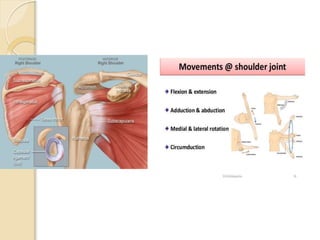
Anatomy of shoulder joint
Shoulder Dislocation
Basically related to
glenohumeral joint.
Types
1) anterior dislocation
2) posterior dislocation
3) inferior dislocation
Rarest
Anterior (forward). The head of the arm bone
(humerus) is moved forward, in front of the socket
(glenoid). This is the most common type of dislocation
and usually happens when the arm is extended.
Posterior (behind). The head of the arm bone is moved
behind and above the socket. This is an uncommon type
of dislocation that is usually caused by seizures or
electrical shock.
Inferior (bottom). The head of the arm bone is pushed
down and out of the socket toward the armpit. This is
the least common type of dislocation.
Introduction
Most unstable large joint
Reasons for instability
Shallow glenoid
Extraordinary ROM
Vulnerability of upper limb to injury
Underlying conditions eg.
ligament laxity
Mechanism
Usually Indirect fall on Abducted and
extended shoulder
May be Direct when there is a blow
on the shoulder from behind
Pathoanatomy of dislocation
Stretching/ tearing of capsule
Avulsion of glenohumeral ligaments
usually off the glenoid
Labral injury
◦ Bankart lesion
Impression fracture
◦ Hill-Sach lesion
Rotator cuff tear
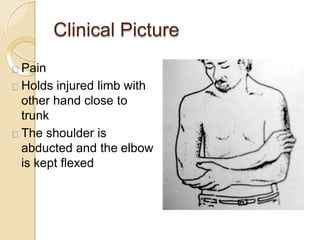
Clinical Picture
Pain
Holds injured limb with
other hand close to
trunk
The shoulder is
abducted and the elbow
is kept flexed
Clinical Picture
Loss of the normal
contour of the shoulder -
appears as a step
Anterior bulge of head
of humerus may be
visible or palpable
Empty glenoid socket
Anterior Shoulder dislocation
Radiograph
Radiograph
Anterior Dislocation of Shoulder
Management
Emergency
Should be reduced in < 24 hours or
else AVN of head of humerus
Immobilised strapped to the trunk for
3-4 weeks and rested in a collar and
cuff
Management
Reduction
◦ Closed
◦ Open
Traction-countertraction method
Hippocrates method
Stimpson’s technique
Kocher’s technique
Traction-countertraction
Hippocrates Method
Hippocrates Method
Hippocrates Method
Stimpson’s technique
Kocher’s Technique
Complications of anterior Shoulder
Dislocation : Early
Nerve – Axillary
Artery – Axillary
Ligaments
Bone - Associated fracture
◦ Neck of humerus
◦ Greater or lesser tuberosity
◦ Hill Sach
◦ Bankart
Bankart lesion – Soft tissue
Hill-Sachs lesion
Hill-Sachs lesion
Complications of anterior shoulder
Dislocation : Late
Avascular necrosis of the head of
the Humerus (high risk with delayed
reduction)
Heterotopic calcification ( used to
be called Myositis Ossificans )
Recurrent dislocation
Posterior dislocation
5-10% of shoulder dislocations
Shoulder is in adduction flexion and
internal rotation
Mechanism
Indirect
◦ Electric shock
◦ Seizure episode
Direct
◦ Force on the anterior shoulder
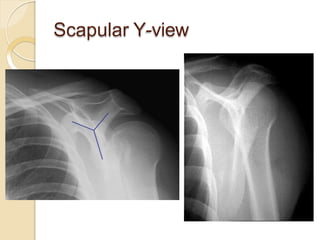
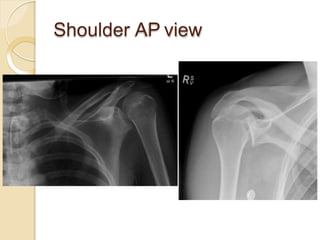
Shoulder AP view
Scapular Y-view
Closed Reduction
Traction to adduct arm in the line of
deformity
Gentle lifting of humeral head into the
glenoid fossa
Failed closed
Displaced fracture
Recurrence
Large defect
◦ Reverse Hill Sachs
Reverse Hill-Sachs
Complications
Neurological
◦ Axillary
◦ Nerve to infraspinatus
Vascular
Fractures
Recurrence
Inferior Dislocation
Luxatio erecta
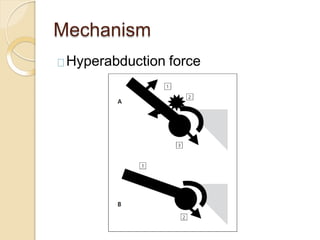
Mechanism
Hyperabduction force
Radiograph
Reduction
Operative
Buttonholing
Complications
◦ Vascular
◦ Ligaments
◦ Fractures
Evaluation of recurrent
atraumatic instability
History
◦ Trauma
◦ Sports
◦ Throwing or overhead activities
◦ Voluntary subluxation
◦ “Clunk” or knock
Physical
◦ Demonstrate dislocation/subluxation
◦ Laxity tests
◦ Stability tests
Management
Conservative
◦ Acute episode
◦ Immobilisation
◦ Physiotherapy – Strengthening exercises
Operative reconstruction
◦ Soft-tissue reconstruction
◦ Bony reconstruction
Shoulder dislocation

Shoulder dislocation