

Orphan Biopharmaceuticals
&
the CDMO
(Contract Development and
Manufacturing Organization)
Abhinav A. Shukla, Ph.D.
Vice President, Process Development &
Manufacturing
KBI Biopharma, Durham NC
Presented at: World Orphan Drug Congress, Washington DC, April 9-11, 2013
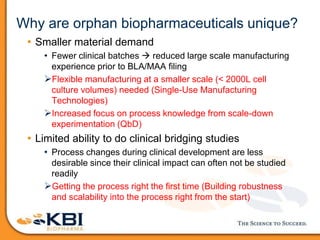
Why are orphan biopharmaceuticals unique?
• Smaller material demand
• Fewer clinical batches  reduced large scale manufacturing
experience prior to BLA/MAA filing
Flexible manufacturing at a smaller scale (< 2000L cell
culture volumes) needed (Single-Use Manufacturing
Technologies)
Increased focus on process knowledge from scale-down
experimentation (QbD)
• Limited ability to do clinical bridging studies
• Process changes during clinical development are less
desirable since their clinical impact can often not be studied
readily
Getting the process right the first time (Building robustness
and scalability into the process right from the start)
-Confidential-
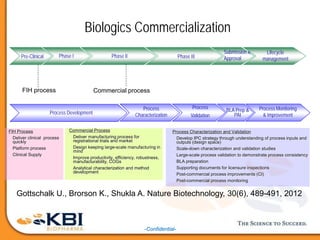
Biologics Commercialization
Pre-Clinical Phase I Phase II Phase III
Process Development
Process
Characterization
Process
Validation
Process Monitoring
& Improvement
FIH Process
• Deliver clinical process
quickly
• Platform process
• Clinical Supply
Submission &
Approval
Lifecycle
management
BLA Prep &
PAI
Commercial Process
• Deliver manufacturing process for
registrational trials and market
• Design keeping large-scale manufacturing in
mind
• Improve productivity, efficiency, robustness,
manufacturability, COGs
• Analytical characterization and method
development
Process Characterization and Validation
• Develop IPC strategy through understanding of process inputs and
outputs (design space)
• Scale-down characterization and validation studies
• Large-scale process validation to demonstrate process consistency
• BLA preparation
• Supporting documents for licensure inspections
• Post-commercial process improvements (CI)
• Post-commercial process monitoring
FIH process Commercial process
Gottschalk U., Brorson K., Shukla A. Nature Biotechnology, 30(6), 489-491, 2012
-Confidential-
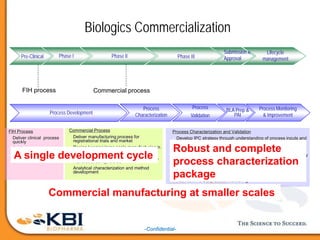
Biologics Commercialization
Pre-Clinical Phase I Phase II Phase III
Process Development
Process
Characterization
Process
Validation
Process Monitoring
& Improvement
FIH Process
• Deliver clinical process
quickly
• Platform process
• Clinical Supply
Submission &
Approval
Lifecycle
management
BLA Prep &
PAI
Commercial Process
• Deliver manufacturing process for
registrational trials and market
• Design keeping large-scale manufacturing in
mind
• Improve productivity, efficiency, robustness,
manufacturability, COGs
• Analytical characterization and method
development
Process Characterization and Validation
• Develop IPC strategy through understanding of process inputs and
outputs (design space)
• Scale-down characterization and validation studies
• Large-scale process validation to demonstrate process consistency
• BLA preparation
• Supporting documents for licensure inspections
• Post-commercial process improvements (CI)
• Post-commercial process monitoring
FIH process Commercial process
A single development cycle
Robust and complete
process characterization
package
Commercial manufacturing at smaller scales
-Confidential-
SINGLE-USE
MANUFACTURING
TECHNOLOGIES
Why are single-use manufacturing
systems growing?
• Lower capital and utility costs (up to 40% reduction*)
• Increasing titers driving bioreactor scales smaller
• Single-use bioreactors now up to 2000L volume
• Increased universalization of biomanufacturing
• Co-location of manufacturing with markets
• Biosimilars (estimated $ 17 billion market by 2020)
• Smaller market sizes for novel drugs in niche/personalized
applications
• Market fragmentation making large single-product
manufacturing facilities redundant
• Single-use systems finding application in stainless
steel facilities for enhanced operational flexibility
Laukel et al, BioProcess International, May 2011 Supplement, pp. 14-21.
-Confidential-
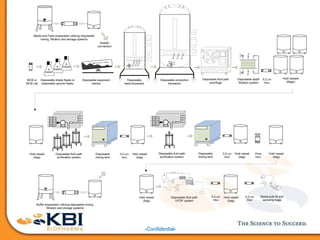
Media and Feed preparation utilizing disposable
mixing, filtration and storage systems
Disposable shake flasks or
disposable spinner flasks
MCB or
WCB vial
Disposable expansion
reactor
Disposable
seed bioreactor
Disposable production
bioreactor
Disposable fluid path
centrifuge
Disposable depth
filtration system
0,2 µm
filter
Hold vessels
(Bags)
Hold vessel
(bag)
Disposable fluid path
purification system
Disposable
mixing tank
0,2 µm
filter
Retentate
Permeate
PD
Disposable fluid path
purification system
Disposable
mixing tank
0,2 µm
filter
BPC
Virus
filter
BPC
0,2 µm
filter
BPCBPC
Sterile bulk fill and
sampling bags
Buffer preparation utilizing disposable mixing,
filtration and storage systems
0,2 µm
filter
Disposable fluid path
UF/DF system
Aseptic
connection
Hold vessel
(bag)
Hold vessel
(bag)
Hold vessel
(bag)
Hold vessel
(bag)
Hold vessel
(bag)
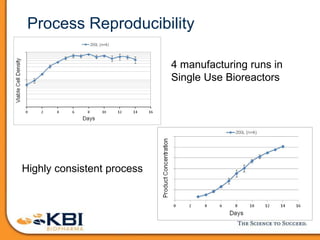
Process Reproducibility
4 manufacturing runs in
Single Use Bioreactors
Highly consistent process
-Confidential-
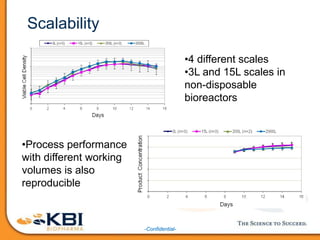
Scalability
•4 different scales
•3L and 15L scales in
non-disposable
bioreactors
•Process performance
with different working
volumes is also
reproducible
Single-use technologies in downstream processing
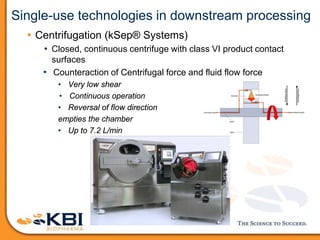
• Centrifugation (kSep® Systems)
• Closed, continuous centrifuge with class VI product contact
surfaces
• Counteraction of Centrifugal force and fluid flow force
• Very low shear
• Continuous operation
• Reversal of flow direction
empties the chamber
• Up to 7.2 L/min
Single-use technologies in downstream processing
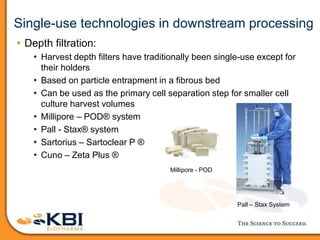
• Depth filtration:
• Harvest depth filters have traditionally been single-use except for
their holders
• Based on particle entrapment in a fibrous bed
• Can be used as the primary cell separation step for smaller cell
culture harvest volumes
• Millipore – POD® system
• Pall - Stax® system
• Sartorius – Sartoclear P ®
• Cuno – Zeta Plus ®
Pall – Stax System
Millipore - POD
Single-use technologies in downstream processing
• Chromatography
• Membrane adsorbers
• Mustang® (Pall), Sartobind® (Sartorius), Chromasorb® (Millipore),
Adsept® (Natrix),
• Q, S, HIC and salt-tolerant ion-exchange functionalities
• Most widely used for trace impurity removal in a flow-through mode
(DNA, endotoxin, viral clearance)
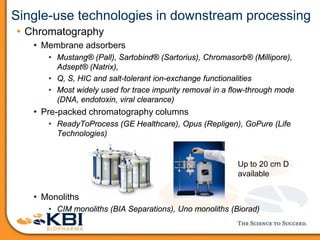
• Pre-packed chromatography columns
• ReadyToProcess (GE Healthcare), Opus (Repligen), GoPure (Life
Technologies)
• Monoliths
• CIM monoliths (BIA Separations), Uno monoliths (Biorad)
Up to 20 cm D
available
Clinical and commercial manufacturing
using single-use technologies
• Smaller material demand drives reduced scale for
commercial manufacturing
• Fidelity between clinical and commercial product
needed (ideally single facility that fits both needs)
• Single-use manufacturing technologies reduce costs
and reduce risk of cross-contamination
-Confidential-
Shukla, A., Mostafa, S., Wilson, M., Lange, D. Vertical Integration of Disposables in
Biopharmaceutical Drug Substance Manufacturing, Bioprocess International, 10(6), 34-47,
2012.
Gottschalk, U., Shukla, A. Single-use disposable technologies for biopharmaceutical
manufacturing, Trends in Biotechnology, 31(3), 147-154, 2013.
-Confidential-
QUALITY BY DESIGN (QBD)
-Confidential-
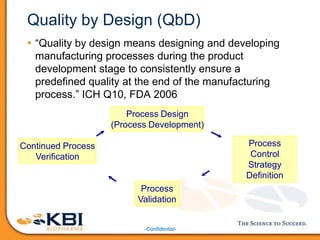
Quality by Design (QbD)
• “Quality by design means designing and developing
manufacturing processes during the product
development stage to consistently ensure a
predefined quality at the end of the manufacturing
process.” ICH Q10, FDA 2006
Process Design
(Process Development)
Process
Control
Strategy
Definition
Process
Validation
Continued Process
Verification
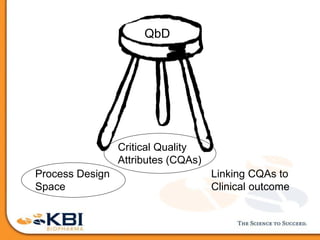
QbD
Critical Quality
Attributes (CQAs)
Process Design
Space
Linking CQAs to
Clinical outcome
-Confidential-
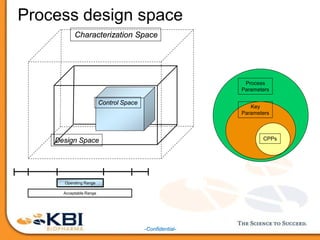
Process design space
Characterization Space
Control Space
Operating Range
Acceptable Range
Design Space
Process
Parameters
Key
Parameters
CPPs
-Confidential-
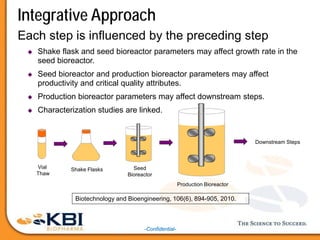
Integrative Approach
Each step is influenced by the preceding step
 Shake flask and seed bioreactor parameters may affect growth rate in the
seed bioreactor.
 Seed bioreactor and production bioreactor parameters may affect
productivity and critical quality attributes.
 Production bioreactor parameters may affect downstream steps.
 Characterization studies are linked.
Vial
Thaw
Shake Flasks Seed
Bioreactor
Production Bioreactor
Downstream Steps
Biotechnology and Bioengineering, 106(6), 894-905, 2010.
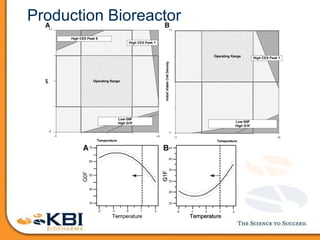
Production Bioreactor
-Confidential-
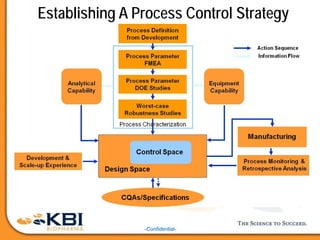
Establishing A Process Control Strategy
-Confidential-
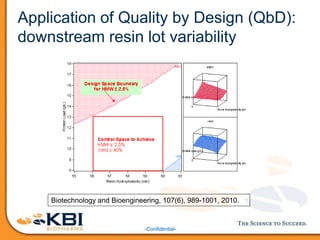
Application of Quality by Design (QbD):
downstream resin lot variability
Biotechnology and Bioengineering, 107(6), 989-1001, 2010.
-Confidential-
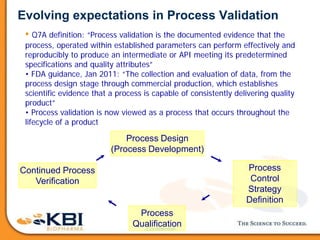
Evolving expectations in Process Validation
• Q7A definition: “Process validation is the documented evidence that the
process, operated within established parameters can perform effectively and
reproducibly to produce an intermediate or API meeting its predetermined
specifications and quality attributes”
• FDA guidance, Jan 2011: “The collection and evaluation of data, from the
process design stage through commercial production, which establishes
scientific evidence that a process is capable of consistently delivering quality
product”
• Process validation is now viewed as a process that occurs throughout the
lifecycle of a product
Process Design
(Process Development)
Process
Control
Strategy
Definition
Process
Qualification
Continued Process
Verification
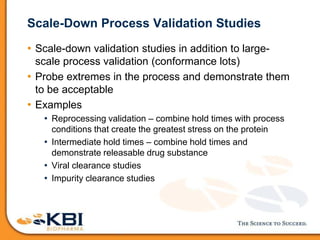
Scale-Down Process Validation Studies
• Scale-down validation studies in addition to large-
scale process validation (conformance lots)
• Probe extremes in the process and demonstrate them
to be acceptable
• Examples
• Reprocessing validation – combine hold times with process
conditions that create the greatest stress on the protein
• Intermediate hold times – combine hold times and
demonstrate releasable drug substance
• Viral clearance studies
• Impurity clearance studies
-Confidential-
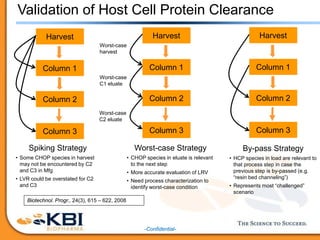
Validation of Host Cell Protein Clearance
Harvest
Column 1
Column 2
Column 3
Worst-case
C1 eluate
Worst-case
C2 eluate
Harvest
Column 1
Column 2
Column 3
Harvest
Column 1
Column 2
Column 3
Spiking Strategy
• Some CHOP species in harvest
may not be encountered by C2
and C3 in Mfg
• LVR could be overstated for C2
and C3
Worst-case Strategy
• CHOP species in eluate is relevant
to the next step
• More accurate evaluation of LRV
• Need process characterization to
identify worst-case condition
By-pass Strategy
• HCP species in load are relevant to
that process step in case the
previous step is by-passed (e.g.
“resin bed channeling”)
• Represents most “challenged”
scenario
Biotechnol. Progr., 24(3), 615 – 622, 2008
Worst-case
harvest
Development Phase
• Utilizing the right set of analytical tools for in-process
testing and release
• Characterization assays are equally important
• Utilizing a broad set of tools up front gives the best
chance of determining CQAs & linking them to the
process
-Confidential-
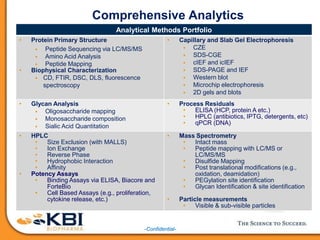
Analytical Methods Portfolio
• Protein Primary Structure
 Peptide Sequencing via LC/MS/MS
 Amino Acid Analysis
 Peptide Mapping
• Biophysical Characterization
 CD, FTIR, DSC, DLS, fluorescence
spectroscopy
• Capillary and Slab Gel Electrophoresis
 CZE
 SDS-CGE
 cIEF and icIEF
 SDS-PAGE and IEF
 Western blot
 Microchip electrophoresis
 2D gels and blots
• Glycan Analysis
 Oligosaccharide mapping
 Monosaccharide composition
 Sialic Acid Quantitation
• Process Residuals
• ELISA (HCP, protein A etc.)
• HPLC (antibiotics, IPTG, detergents, etc)
• qPCR (DNA)
• HPLC
• Size Exclusion (with MALLS)
• Ion Exchange
• Reverse Phase
• Hydrophobic Interaction
• Affinity
• Potency Assays
• Binding Assays via ELISA, Biacore and
ForteBio
• Cell Based Assays (e.g., proliferation,
cytokine release, etc.)
• Mass Spectrometry
• Intact mass
• Peptide mapping with LC/MS or
LC/MS/MS
• Disulfide Mapping
• Post translational modifications (e.g.,
oxidation, deamidation)
• PEGylation site identification
• Glycan Identification & site identification
• Particle measurements
• Visible & sub-visible particles
Comprehensive Analytics
-Confidential-
THE RIGHT SCIENCE FROM
THE START
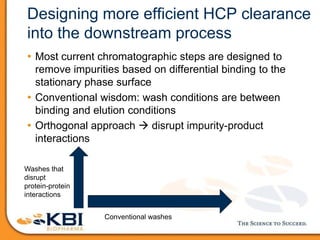
Designing more efficient HCP clearance
into the downstream process
• Most current chromatographic steps are designed to
remove impurities based on differential binding to the
stationary phase surface
• Conventional wisdom: wash conditions are between
binding and elution conditions
• Orthogonal approach  disrupt impurity-product
interactions
Washes that
disrupt
protein-protein
interactions
Conventional washes
30
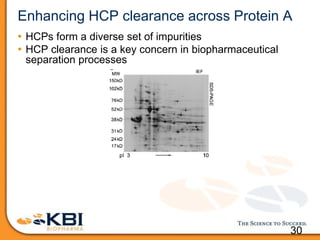
Enhancing HCP clearance across Protein A
• HCPs form a diverse set of impurities
• HCP clearance is a key concern in biopharmaceutical
separation processes
-Confidential-
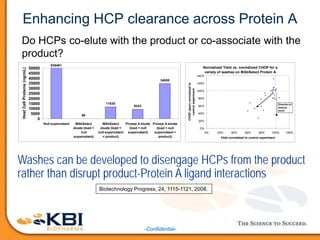
Washes can be developed to disengage HCPs from the product
rather than disrupt product-Protein A ligand interactions
96
11635
9243
34655
935491
0
5000
10000
15000
20000
25000
30000
35000
40000
45000
50000
Null supernatant MAbSelect
eluate (load =
null
supernatant)
MAbSelect
eluate (load =
null supernatant
+ product)
Prosep A eluate
(load = null
supernatant)
Prosep A eluate
(load = null
supernatant +
product)
HostCellProteins(ng/mL)
Normalized Yield vs. normalized CHOP for a
variety of washes on MAbSelect Protein A
0%
20%
40%
60%
80%
100%
120%
140%
0% 20% 40% 60% 80% 100% 120%
Yield normalized to control experiment
CHOP(ppm)normalizedto
controlexperiment
Direction of
desired
trend
Biotechnology Progress, 24, 1115-1121, 2008.
Do HCPs co-elute with the product or co-associate with the
product?
Enhancing HCP clearance across Protein A
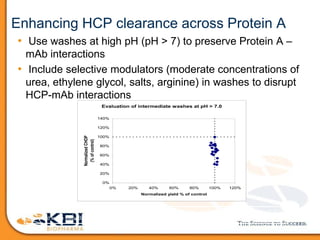
• Use washes at high pH (pH > 7) to preserve Protein A –
mAb interactions
• Include selective modulators (moderate concentrations of
urea, ethylene glycol, salts, arginine) in washes to disrupt
HCP-mAb interactions
Shukla, A., Hinckley, P. Host cell protein clearance during Protein A resin chromatography: development of an
Improved wash step, Biotechnology Progress, 24, 1115-1121, 2008.
Evaluation of intermediate washes at pH > 7.0
0%
20%
40%
60%
80%
100%
120%
140%
0% 20% 40% 60% 80% 100% 120%
Normalized yield % of control
NormalizedCHOP
(%ofcontrol)
Mixed Mode Chromatography
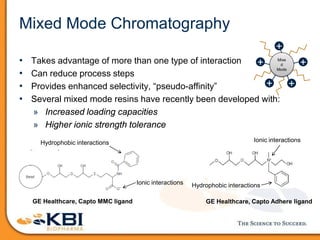
• Takes advantage of more than one type of interaction
• Can reduce process steps
• Provides enhanced selectivity, “pseudo-affinity”
• Several mixed mode resins have recently been developed with:
» Increased loading capacities
» Higher ionic strength tolerance
+
+ +
+
+Mixe
d
Mode
GE Healthcare, Capto MMC ligand
Ionic interactions
Hydrophobic interactions
Ionic interactions
GE Healthcare, Capto Adhere ligand
Log k’ vs Log [NaCl]
0.00
0.20
0.40
0.60
0.80
1.00
1.20
1.40
2.60 2.80 3.00 3.20 3.40 3.60
Logk'
Log [NaCl]
Lysozyme
pH 7.0
1M urea
5% ethylene glycol
50mM arginine
-0.40
-0.20
0.00
0.20
0.40
0.60
0.80
1.00
1.20
1.40
1.60
1.50 2.00 2.50
Logk'
Log [NaCl]
RNase
pH 7.0
1M urea
5% ethylene glycol
50mM arginine
-0.20
0.00
0.20
0.40
0.60
0.80
1.00
1.20
1.40
2.10 2.30 2.50 2.70
Logk'
Log [NaCl]
Monoclonal antibody
pH 7.0
1M urea
5% ethylene glycol
50mM arginine
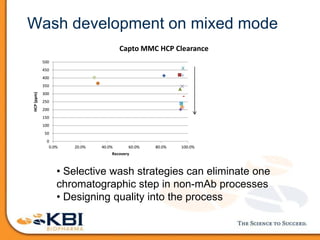
Wash development on mixed mode
0
50
100
150
200
250
300
350
400
450
500
0.0% 20.0% 40.0% 60.0% 80.0% 100.0%
HCP(ppm)
Recovery
Capto MMC HCP Clearance
25mM Tris pH 7.0 (baseline)
25mM Tris pH 7.0, 5% ethylene glycol
25mM Tris pH 7.0, 50mM arginine
25mM Tris pH 7.0, 50mM NaSCN
25mM Tris pH 7.0, 1M urea
25mM Tris pH 7.0, 1M ammonium sulfate
25mM Tris pH 7.0, 0.1M NaCl
25mM Tris pH 7.0, 0.5M ammonium sulfate
25mM Tris pH 7.0, 0.1M NaCl, 1M urea
25mM Tris pH 7.0, 0.1M NaCl, 1M urea, 5% ethylene glycol
25mM Tris pH 7.0, 0.1M NaCl, 1M urea, 5% glycerol
• Selective wash strategies can eliminate one
chromatographic step in non-mAb processes
• Designing quality into the process
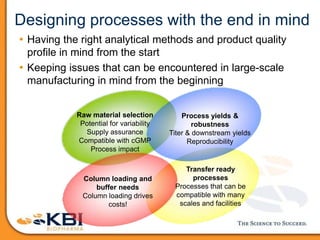
Designing processes with the end in mind
• Having the right analytical methods and product quality
profile in mind from the start
• Keeping issues that can be encountered in large-scale
manufacturing in mind from the beginning
Process yields &
robustness
Titer & downstream yields
Reproducibility
Column loading and
buffer needs
Column loading drives
costs!
Raw material selection
Potential for variability
Supply assurance
Compatible with cGMP
Process impact
Transfer ready
processes
Processes that can be
compatible with many
scales and facilities
Conclusions
• Orphan biopharmaceutical development needs
particular emphasis on
• Developing a process with the end in mind (licensure filing)
to avoid multiple changes along the way
• Manufacturing costs
• Demonstrating process robustness without recourse to an
extensive manufacturing history
• A dedicated CDMO with the right knowledge and
capabilities can help smooth the development
pathway

Orphan Biopharmaceuticals & the CDMO

  • 1.
    Orphan Biopharmaceuticals & the CDMO (ContractDevelopment and Manufacturing Organization) Abhinav A. Shukla, Ph.D. Vice President, Process Development & Manufacturing KBI Biopharma, Durham NC Presented at: World Orphan Drug Congress, Washington DC, April 9-11, 2013
  • 2.
    Why are orphanbiopharmaceuticals unique? • Smaller material demand • Fewer clinical batches  reduced large scale manufacturing experience prior to BLA/MAA filing Flexible manufacturing at a smaller scale (< 2000L cell culture volumes) needed (Single-Use Manufacturing Technologies) Increased focus on process knowledge from scale-down experimentation (QbD) • Limited ability to do clinical bridging studies • Process changes during clinical development are less desirable since their clinical impact can often not be studied readily Getting the process right the first time (Building robustness and scalability into the process right from the start)
  • 3.
    -Confidential- Biologics Commercialization Pre-Clinical PhaseI Phase II Phase III Process Development Process Characterization Process Validation Process Monitoring & Improvement FIH Process • Deliver clinical process quickly • Platform process • Clinical Supply Submission & Approval Lifecycle management BLA Prep & PAI Commercial Process • Deliver manufacturing process for registrational trials and market • Design keeping large-scale manufacturing in mind • Improve productivity, efficiency, robustness, manufacturability, COGs • Analytical characterization and method development Process Characterization and Validation • Develop IPC strategy through understanding of process inputs and outputs (design space) • Scale-down characterization and validation studies • Large-scale process validation to demonstrate process consistency • BLA preparation • Supporting documents for licensure inspections • Post-commercial process improvements (CI) • Post-commercial process monitoring FIH process Commercial process Gottschalk U., Brorson K., Shukla A. Nature Biotechnology, 30(6), 489-491, 2012
  • 4.
    -Confidential- Biologics Commercialization Pre-Clinical PhaseI Phase II Phase III Process Development Process Characterization Process Validation Process Monitoring & Improvement FIH Process • Deliver clinical process quickly • Platform process • Clinical Supply Submission & Approval Lifecycle management BLA Prep & PAI Commercial Process • Deliver manufacturing process for registrational trials and market • Design keeping large-scale manufacturing in mind • Improve productivity, efficiency, robustness, manufacturability, COGs • Analytical characterization and method development Process Characterization and Validation • Develop IPC strategy through understanding of process inputs and outputs (design space) • Scale-down characterization and validation studies • Large-scale process validation to demonstrate process consistency • BLA preparation • Supporting documents for licensure inspections • Post-commercial process improvements (CI) • Post-commercial process monitoring FIH process Commercial process A single development cycle Robust and complete process characterization package Commercial manufacturing at smaller scales
  • 5.
  • 6.
    Why are single-usemanufacturing systems growing? • Lower capital and utility costs (up to 40% reduction*) • Increasing titers driving bioreactor scales smaller • Single-use bioreactors now up to 2000L volume • Increased universalization of biomanufacturing • Co-location of manufacturing with markets • Biosimilars (estimated $ 17 billion market by 2020) • Smaller market sizes for novel drugs in niche/personalized applications • Market fragmentation making large single-product manufacturing facilities redundant • Single-use systems finding application in stainless steel facilities for enhanced operational flexibility Laukel et al, BioProcess International, May 2011 Supplement, pp. 14-21.
  • 7.
    -Confidential- Media and Feedpreparation utilizing disposable mixing, filtration and storage systems Disposable shake flasks or disposable spinner flasks MCB or WCB vial Disposable expansion reactor Disposable seed bioreactor Disposable production bioreactor Disposable fluid path centrifuge Disposable depth filtration system 0,2 µm filter Hold vessels (Bags) Hold vessel (bag) Disposable fluid path purification system Disposable mixing tank 0,2 µm filter Retentate Permeate PD Disposable fluid path purification system Disposable mixing tank 0,2 µm filter BPC Virus filter BPC 0,2 µm filter BPCBPC Sterile bulk fill and sampling bags Buffer preparation utilizing disposable mixing, filtration and storage systems 0,2 µm filter Disposable fluid path UF/DF system Aseptic connection Hold vessel (bag) Hold vessel (bag) Hold vessel (bag) Hold vessel (bag) Hold vessel (bag)
  • 8.
    Process Reproducibility 4 manufacturingruns in Single Use Bioreactors Highly consistent process
  • 9.
    -Confidential- Scalability •4 different scales •3Land 15L scales in non-disposable bioreactors •Process performance with different working volumes is also reproducible
  • 10.
    Single-use technologies indownstream processing • Centrifugation (kSep® Systems) • Closed, continuous centrifuge with class VI product contact surfaces • Counteraction of Centrifugal force and fluid flow force • Very low shear • Continuous operation • Reversal of flow direction empties the chamber • Up to 7.2 L/min
  • 11.
    Single-use technologies indownstream processing • Depth filtration: • Harvest depth filters have traditionally been single-use except for their holders • Based on particle entrapment in a fibrous bed • Can be used as the primary cell separation step for smaller cell culture harvest volumes • Millipore – POD® system • Pall - Stax® system • Sartorius – Sartoclear P ® • Cuno – Zeta Plus ® Pall – Stax System Millipore - POD
  • 12.
    Single-use technologies indownstream processing • Chromatography • Membrane adsorbers • Mustang® (Pall), Sartobind® (Sartorius), Chromasorb® (Millipore), Adsept® (Natrix), • Q, S, HIC and salt-tolerant ion-exchange functionalities • Most widely used for trace impurity removal in a flow-through mode (DNA, endotoxin, viral clearance) • Pre-packed chromatography columns • ReadyToProcess (GE Healthcare), Opus (Repligen), GoPure (Life Technologies) • Monoliths • CIM monoliths (BIA Separations), Uno monoliths (Biorad) Up to 20 cm D available
  • 13.
    Clinical and commercialmanufacturing using single-use technologies • Smaller material demand drives reduced scale for commercial manufacturing • Fidelity between clinical and commercial product needed (ideally single facility that fits both needs) • Single-use manufacturing technologies reduce costs and reduce risk of cross-contamination
  • 14.
    -Confidential- Shukla, A., Mostafa,S., Wilson, M., Lange, D. Vertical Integration of Disposables in Biopharmaceutical Drug Substance Manufacturing, Bioprocess International, 10(6), 34-47, 2012. Gottschalk, U., Shukla, A. Single-use disposable technologies for biopharmaceutical manufacturing, Trends in Biotechnology, 31(3), 147-154, 2013.
  • 15.
  • 16.
    -Confidential- Quality by Design(QbD) • “Quality by design means designing and developing manufacturing processes during the product development stage to consistently ensure a predefined quality at the end of the manufacturing process.” ICH Q10, FDA 2006 Process Design (Process Development) Process Control Strategy Definition Process Validation Continued Process Verification
  • 17.
    QbD Critical Quality Attributes (CQAs) ProcessDesign Space Linking CQAs to Clinical outcome
  • 18.
    -Confidential- Process design space CharacterizationSpace Control Space Operating Range Acceptable Range Design Space Process Parameters Key Parameters CPPs
  • 19.
    -Confidential- Integrative Approach Each stepis influenced by the preceding step  Shake flask and seed bioreactor parameters may affect growth rate in the seed bioreactor.  Seed bioreactor and production bioreactor parameters may affect productivity and critical quality attributes.  Production bioreactor parameters may affect downstream steps.  Characterization studies are linked. Vial Thaw Shake Flasks Seed Bioreactor Production Bioreactor Downstream Steps Biotechnology and Bioengineering, 106(6), 894-905, 2010.
  • 20.
  • 21.
  • 22.
    -Confidential- Application of Qualityby Design (QbD): downstream resin lot variability Biotechnology and Bioengineering, 107(6), 989-1001, 2010.
  • 23.
    -Confidential- Evolving expectations inProcess Validation • Q7A definition: “Process validation is the documented evidence that the process, operated within established parameters can perform effectively and reproducibly to produce an intermediate or API meeting its predetermined specifications and quality attributes” • FDA guidance, Jan 2011: “The collection and evaluation of data, from the process design stage through commercial production, which establishes scientific evidence that a process is capable of consistently delivering quality product” • Process validation is now viewed as a process that occurs throughout the lifecycle of a product Process Design (Process Development) Process Control Strategy Definition Process Qualification Continued Process Verification
  • 24.
    Scale-Down Process ValidationStudies • Scale-down validation studies in addition to large- scale process validation (conformance lots) • Probe extremes in the process and demonstrate them to be acceptable • Examples • Reprocessing validation – combine hold times with process conditions that create the greatest stress on the protein • Intermediate hold times – combine hold times and demonstrate releasable drug substance • Viral clearance studies • Impurity clearance studies
  • 25.
    -Confidential- Validation of HostCell Protein Clearance Harvest Column 1 Column 2 Column 3 Worst-case C1 eluate Worst-case C2 eluate Harvest Column 1 Column 2 Column 3 Harvest Column 1 Column 2 Column 3 Spiking Strategy • Some CHOP species in harvest may not be encountered by C2 and C3 in Mfg • LVR could be overstated for C2 and C3 Worst-case Strategy • CHOP species in eluate is relevant to the next step • More accurate evaluation of LRV • Need process characterization to identify worst-case condition By-pass Strategy • HCP species in load are relevant to that process step in case the previous step is by-passed (e.g. “resin bed channeling”) • Represents most “challenged” scenario Biotechnol. Progr., 24(3), 615 – 622, 2008 Worst-case harvest
  • 26.
    Development Phase • Utilizingthe right set of analytical tools for in-process testing and release • Characterization assays are equally important • Utilizing a broad set of tools up front gives the best chance of determining CQAs & linking them to the process
  • 27.
    -Confidential- Analytical Methods Portfolio •Protein Primary Structure  Peptide Sequencing via LC/MS/MS  Amino Acid Analysis  Peptide Mapping • Biophysical Characterization  CD, FTIR, DSC, DLS, fluorescence spectroscopy • Capillary and Slab Gel Electrophoresis  CZE  SDS-CGE  cIEF and icIEF  SDS-PAGE and IEF  Western blot  Microchip electrophoresis  2D gels and blots • Glycan Analysis  Oligosaccharide mapping  Monosaccharide composition  Sialic Acid Quantitation • Process Residuals • ELISA (HCP, protein A etc.) • HPLC (antibiotics, IPTG, detergents, etc) • qPCR (DNA) • HPLC • Size Exclusion (with MALLS) • Ion Exchange • Reverse Phase • Hydrophobic Interaction • Affinity • Potency Assays • Binding Assays via ELISA, Biacore and ForteBio • Cell Based Assays (e.g., proliferation, cytokine release, etc.) • Mass Spectrometry • Intact mass • Peptide mapping with LC/MS or LC/MS/MS • Disulfide Mapping • Post translational modifications (e.g., oxidation, deamidation) • PEGylation site identification • Glycan Identification & site identification • Particle measurements • Visible & sub-visible particles Comprehensive Analytics
  • 28.
  • 29.
    Designing more efficientHCP clearance into the downstream process • Most current chromatographic steps are designed to remove impurities based on differential binding to the stationary phase surface • Conventional wisdom: wash conditions are between binding and elution conditions • Orthogonal approach  disrupt impurity-product interactions Washes that disrupt protein-protein interactions Conventional washes
  • 30.
    30 Enhancing HCP clearanceacross Protein A • HCPs form a diverse set of impurities • HCP clearance is a key concern in biopharmaceutical separation processes
  • 31.
    -Confidential- Washes can bedeveloped to disengage HCPs from the product rather than disrupt product-Protein A ligand interactions 96 11635 9243 34655 935491 0 5000 10000 15000 20000 25000 30000 35000 40000 45000 50000 Null supernatant MAbSelect eluate (load = null supernatant) MAbSelect eluate (load = null supernatant + product) Prosep A eluate (load = null supernatant) Prosep A eluate (load = null supernatant + product) HostCellProteins(ng/mL) Normalized Yield vs. normalized CHOP for a variety of washes on MAbSelect Protein A 0% 20% 40% 60% 80% 100% 120% 140% 0% 20% 40% 60% 80% 100% 120% Yield normalized to control experiment CHOP(ppm)normalizedto controlexperiment Direction of desired trend Biotechnology Progress, 24, 1115-1121, 2008. Do HCPs co-elute with the product or co-associate with the product? Enhancing HCP clearance across Protein A
  • 32.
    Enhancing HCP clearanceacross Protein A • Use washes at high pH (pH > 7) to preserve Protein A – mAb interactions • Include selective modulators (moderate concentrations of urea, ethylene glycol, salts, arginine) in washes to disrupt HCP-mAb interactions Shukla, A., Hinckley, P. Host cell protein clearance during Protein A resin chromatography: development of an Improved wash step, Biotechnology Progress, 24, 1115-1121, 2008. Evaluation of intermediate washes at pH > 7.0 0% 20% 40% 60% 80% 100% 120% 140% 0% 20% 40% 60% 80% 100% 120% Normalized yield % of control NormalizedCHOP (%ofcontrol)
  • 33.
    Mixed Mode Chromatography •Takes advantage of more than one type of interaction • Can reduce process steps • Provides enhanced selectivity, “pseudo-affinity” • Several mixed mode resins have recently been developed with: » Increased loading capacities » Higher ionic strength tolerance + + + + +Mixe d Mode GE Healthcare, Capto MMC ligand Ionic interactions Hydrophobic interactions Hydrophobic interactions Ionic interactions GE Healthcare, Capto Adhere ligand
  • 34.
    Log k’ vsLog [NaCl] 0.00 0.20 0.40 0.60 0.80 1.00 1.20 1.40 2.60 2.80 3.00 3.20 3.40 3.60 Logk' Log [NaCl] Lysozyme pH 7.0 1M urea 5% ethylene glycol 50mM arginine -0.40 -0.20 0.00 0.20 0.40 0.60 0.80 1.00 1.20 1.40 1.60 1.50 2.00 2.50 Logk' Log [NaCl] RNase pH 7.0 1M urea 5% ethylene glycol 50mM arginine -0.20 0.00 0.20 0.40 0.60 0.80 1.00 1.20 1.40 2.10 2.30 2.50 2.70 Logk' Log [NaCl] Monoclonal antibody pH 7.0 1M urea 5% ethylene glycol 50mM arginine
  • 35.
    Wash development onmixed mode 0 50 100 150 200 250 300 350 400 450 500 0.0% 20.0% 40.0% 60.0% 80.0% 100.0% HCP(ppm) Recovery Capto MMC HCP Clearance 25mM Tris pH 7.0 (baseline) 25mM Tris pH 7.0, 5% ethylene glycol 25mM Tris pH 7.0, 50mM arginine 25mM Tris pH 7.0, 50mM NaSCN 25mM Tris pH 7.0, 1M urea 25mM Tris pH 7.0, 1M ammonium sulfate 25mM Tris pH 7.0, 0.1M NaCl 25mM Tris pH 7.0, 0.5M ammonium sulfate 25mM Tris pH 7.0, 0.1M NaCl, 1M urea 25mM Tris pH 7.0, 0.1M NaCl, 1M urea, 5% ethylene glycol 25mM Tris pH 7.0, 0.1M NaCl, 1M urea, 5% glycerol • Selective wash strategies can eliminate one chromatographic step in non-mAb processes • Designing quality into the process
  • 36.
    Designing processes withthe end in mind • Having the right analytical methods and product quality profile in mind from the start • Keeping issues that can be encountered in large-scale manufacturing in mind from the beginning Process yields & robustness Titer & downstream yields Reproducibility Column loading and buffer needs Column loading drives costs! Raw material selection Potential for variability Supply assurance Compatible with cGMP Process impact Transfer ready processes Processes that can be compatible with many scales and facilities
  • 37.
    Conclusions • Orphan biopharmaceuticaldevelopment needs particular emphasis on • Developing a process with the end in mind (licensure filing) to avoid multiple changes along the way • Manufacturing costs • Demonstrating process robustness without recourse to an extensive manufacturing history • A dedicated CDMO with the right knowledge and capabilities can help smooth the development pathway