1
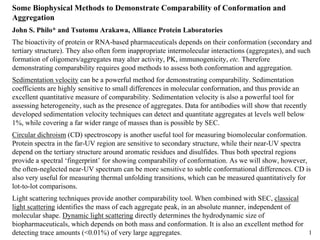
Some Biophysical Methods to Demonstrate Comparability of Conformation and
Aggregation
John S. Philo* and Tsutomu Arakawa, Alliance Protein Laboratories
The bioactivity of protein or RNA-based pharmaceuticals depends on their conformation (secondary and
tertiary structure). They also often form inappropriate intermolecular interactions (aggregates), and such
formation of oligomers/aggregates may alter activity, PK, immunogenicity, etc. Therefore
demonstrating comparability requires good methods to assess both conformation and aggregation.
Sedimentation velocity can be a powerful method for demonstrating comparability. Sedimentation
coefficients are highly sensitive to small differences in molecular conformation, and thus provide an
excellent quantitative measure of comparability. Sedimentation velocity is also a powerful tool for
assessing heterogeneity, such as the presence of aggregates. Data for antibodies will show that recently
developed sedimentation velocity techniques can detect and quantitate aggregates at levels well below
1%, while covering a far wider range of masses than is possible by SEC.
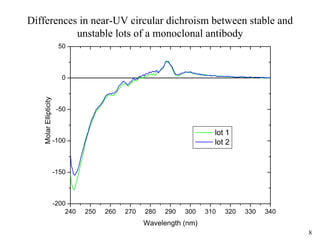
Circular dichroism (CD) spectroscopy is another useful tool for measuring biomolecular conformation.
Protein spectra in the far-UV region are sensitive to secondary structure, while their near-UV spectra
depend on the tertiary structure around aromatic residues and disulfides. Thus both spectral regions
provide a spectral โ€˜fingerprintโ€™ for showing comparability of conformation. As we will show, however,
the often-neglected near-UV spectrum can be more sensitive to subtle conformational differences. CD is
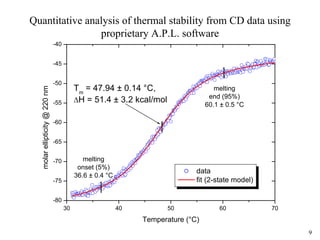
also very useful for measuring thermal unfolding transitions, which can be measured quantitatively for
lot-to-lot comparisons.
Light scattering techniques provide another comparability tool. When combined with SEC, classical
light scattering identifies the mass of each aggregate peak, in an absolute manner, independent of
molecular shape. Dynamic light scattering directly determines the hydrodynamic size of
biopharmaceuticals, which depends on both mass and conformation. It is also an excellent method for
detecting trace amounts (<0.01%) of very large aggregates.
2
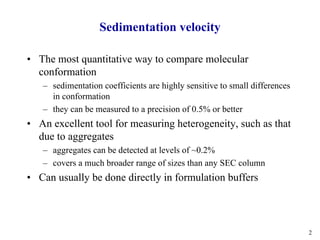
Sedimentation velocity
โ€ข The most quantitative way to compare molecular
conformation
โ€“ sedimentation coefficients are highly sensitive to small differences
in conformation
โ€“ they can be measured to a precision of 0.5% or better
โ€ข An excellent tool for measuring heterogeneity, such as that
due to aggregates
โ€“ aggregates can be detected at levels of ~0.2%
โ€“ covers a much broader range of sizes than any SEC column
โ€ข Can usually be done directly in formulation buffers
3
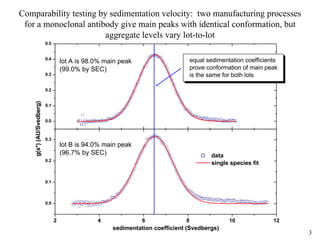
Comparability testing by sedimentation velocity: two manufacturing processes
for a monoclonal antibody give main peaks with identical conformation, but
aggregate levels vary lot-to-lot
2 4 6 8 10 12
0.0
0.1
0.2
0.3
lot B is 94.0% main peak
(96.7% by SEC)
g(s*)(AU/Svedberg)
sedimentation coefficient (Svedbergs)
0.0
0.1
0.2
0.3
0.4
0.5
equal sedimentation coefficients
prove conformation of main peak
is the same for both lots
data
single species fit
lot A is 98.0% main peak
(99.0% by SEC)
4
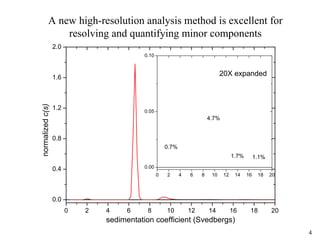
A new high-resolution analysis method is excellent for
resolving and quantifying minor components
0 2 4 6 8 10 12 14 16 18 20
0.0
0.4
0.8
1.2
1.6
2.0normalizedc(s)
sedimentation coefficient (Svedbergs)
0 2 4 6 8 10 12 14 16 18 20
0.00
0.05
0.10
0.7%
1.1%1.7%
4.7%
20X expanded
5
0 2 4 6 8 10 12 14 16 18 20 22 24
0.0
0.2
0.4
0.6
0.8
1.0
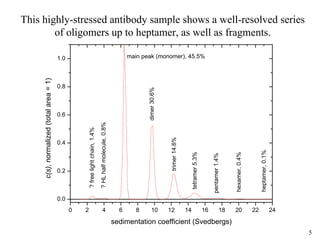
heptamer,0.1%
hexamer,0.4%
pentamer1.4%
tetramer5.3%
trimer14.6%
dimer30.6%
main peak (monomer), 45.5%
?HLhalfmolecule,0.8%
?freelightchain,1.4%
c(s),normalized(totalarea=1)
sedimentation coefficient (Svedbergs)
This highly-stressed antibody sample shows a well-resolved series
of oligomers up to heptamer, as well as fragments.
6
Circular dichroism (CD) spectroscopy
โ€ข Spectra provide a โ€˜fingerprintโ€™ for comparing conformation
โ€“ โ€˜far-UVโ€™ spectra (190-240 nm) are sensitive to secondary structure
โ€“ โ€˜near-UVโ€™ spectra (240-340 nm) are sensitive to local tertiary
structure around aromatic residues and disulfide bonds
โ€ข In our experience near-UV spectra are often more sensitive
to subtle conformational differences than far-UV spectra
โ€ข Temperature-dependent spectra can quantitate and
compare thermal stability
โ€“ variations in conformation will lead to variation in the thermal
unfolding profile
โ€“ CD studies can usually be done at lower concentration than DSC,
reducing problems with irreversible unfolding and thus giving data
that is more relevant
7
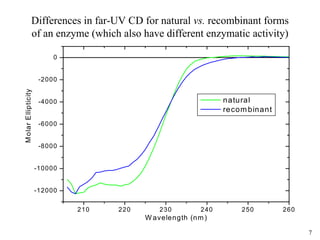
Differences in far-UV CD for natural vs. recombinant forms
of an enzyme (which also have different enzymatic activity)
210 220 230 240 250 260
-12000
-10000
-8000
-6000
-4000
-2000
0
MolarEllipticity
W avelength (nm)
natural
recombinant
8
Differences in near-UV circular dichroism between stable and
unstable lots of a monoclonal antibody
240 250 260 270 280 290 300 310 320 330 340
-200
-150
-100
-50
0
50MolarEllipticity
Wavelength (nm)
lot 1
lot 2
9
Quantitative analysis of thermal stability from CD data using
proprietary A.P.L. software
30 40 50 60 70
-80
-75
-70
-65
-60
-55
-50
-45
-40
melting
end (95%)
60.1 ยฑ 0.5 ยฐC
melting
onset (5%)
36.6 ยฑ 0.4 ยฐC
Tm
= 47.94 ยฑ 0.14 ยฐC,
โˆ†H = 51.4 ยฑ 3.2 kcal/mol
data
fit (2-state model)
molarellipticity@220nm
Temperature (ยฐC)
10
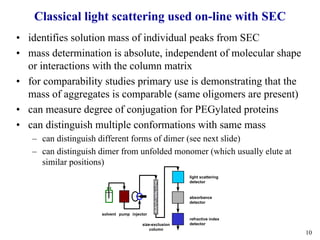
Classical light scattering used on-line with SEC
โ€ข identifies solution mass of individual peaks from SEC
โ€ข mass determination is absolute, independent of molecular shape
or interactions with the column matrix
โ€ข for comparability studies primary use is demonstrating that the
mass of aggregates is comparable (same oligomers are present)
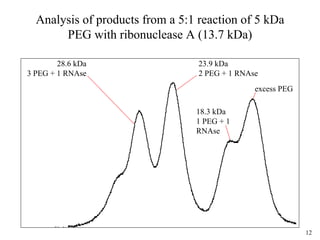
โ€ข can measure degree of conjugation for PEGylated proteins
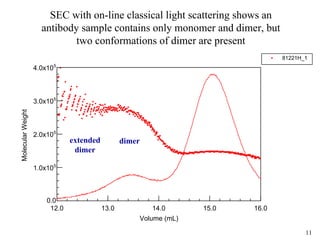
โ€ข can distinguish multiple conformations with same mass
โ€“ can distinguish different forms of dimer (see next slide)
โ€“ can distinguish dimer from unfolded monomer (which usually elute at
similar positions)
light scattering
detector
absorbance
detector
refractive index
detectorsize-exclusion
column
injectorpumpsolvent
11
0.0
5
1.0x10
5
2.0x10
5
3.0x10
5
4.0x10
12.0 13.0 14.0 15.0 16.0
MolecularWeight
Volume (mL)
81221H_1
dimerextended
dimer
SEC with on-line classical light scattering shows an
antibody sample contains only monomer and dimer, but
two conformations of dimer are present
12
Analysis of products from a 5:1 reaction of 5 kDa
PEG with ribonuclease A (13.7 kDa)
28.6 kDa
3 PEG + 1 RNAse
23.9 kDa
2 PEG + 1 RNAse
18.3 kDa
1 PEG + 1
RNAse
excess PEG
13
Dynamic light scattering
โ€ข measures Brownian motion of molecules, which is directly
related to their hydrodynamic size (which depends on both
mass and conformation)
โ€ข data are usually converted to a distribution of
hydrodynamic radius graph
โ€ข excellent for detecting trace amounts (0.01% to <1 p.p.m.)
of very large aggregates
โ€ข covers extremely large range of sizes at one time
โ€ข works in wide range of solvent conditions
โ€ข useful for continuous monitoring of aggregation at elevated
temperatures (accelerated stability)
14
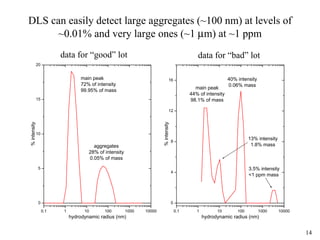
DLS can easily detect large aggregates (~100 nm) at levels of
~0.01% and very large ones (~1 ยตm) at ~1 ppm
0.1 1 10 100 1000 10000
0
4
8
12
16
13% intensity
1.8% mass
3.5% intensity
<1 ppm mass
main peak
44% of intensity
98.1% of mass
40% intensity
0.06% mass
%intensity
hydrodynamic radius (nm)
0.1 1 10 100 1000 10000
0
5
10
15
20
main peak
72% of intensity
99.95% of mass
aggregates
28% of intensity
0.05% of mass
%intensity
hydrodynamic radius (nm)
data for โ€œgoodโ€ lot data for โ€œbadโ€ lot
15
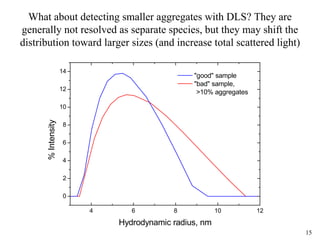
What about detecting smaller aggregates with DLS? They are
generally not resolved as separate species, but they may shift the
distribution toward larger sizes (and increase total scattered light)
4 6 8 10 12
0
2
4
6
8
10
12
14
"good" sample
"bad" sample,
>10% aggregates
%Intensity
Hydrodynamic radius, nm

Some Biophysical Methods for Demonstrating Comparability of Conformation and Aggregation

  • 1.
    1 Some Biophysical Methodsto Demonstrate Comparability of Conformation and Aggregation John S. Philo* and Tsutomu Arakawa, Alliance Protein Laboratories The bioactivity of protein or RNA-based pharmaceuticals depends on their conformation (secondary and tertiary structure). They also often form inappropriate intermolecular interactions (aggregates), and such formation of oligomers/aggregates may alter activity, PK, immunogenicity, etc. Therefore demonstrating comparability requires good methods to assess both conformation and aggregation. Sedimentation velocity can be a powerful method for demonstrating comparability. Sedimentation coefficients are highly sensitive to small differences in molecular conformation, and thus provide an excellent quantitative measure of comparability. Sedimentation velocity is also a powerful tool for assessing heterogeneity, such as the presence of aggregates. Data for antibodies will show that recently developed sedimentation velocity techniques can detect and quantitate aggregates at levels well below 1%, while covering a far wider range of masses than is possible by SEC. Circular dichroism (CD) spectroscopy is another useful tool for measuring biomolecular conformation. Protein spectra in the far-UV region are sensitive to secondary structure, while their near-UV spectra depend on the tertiary structure around aromatic residues and disulfides. Thus both spectral regions provide a spectral โ€˜fingerprintโ€™ for showing comparability of conformation. As we will show, however, the often-neglected near-UV spectrum can be more sensitive to subtle conformational differences. CD is also very useful for measuring thermal unfolding transitions, which can be measured quantitatively for lot-to-lot comparisons. Light scattering techniques provide another comparability tool. When combined with SEC, classical light scattering identifies the mass of each aggregate peak, in an absolute manner, independent of molecular shape. Dynamic light scattering directly determines the hydrodynamic size of biopharmaceuticals, which depends on both mass and conformation. It is also an excellent method for detecting trace amounts (<0.01%) of very large aggregates.
  • 2.
    2 Sedimentation velocity โ€ข Themost quantitative way to compare molecular conformation โ€“ sedimentation coefficients are highly sensitive to small differences in conformation โ€“ they can be measured to a precision of 0.5% or better โ€ข An excellent tool for measuring heterogeneity, such as that due to aggregates โ€“ aggregates can be detected at levels of ~0.2% โ€“ covers a much broader range of sizes than any SEC column โ€ข Can usually be done directly in formulation buffers
  • 3.
    3 Comparability testing bysedimentation velocity: two manufacturing processes for a monoclonal antibody give main peaks with identical conformation, but aggregate levels vary lot-to-lot 2 4 6 8 10 12 0.0 0.1 0.2 0.3 lot B is 94.0% main peak (96.7% by SEC) g(s*)(AU/Svedberg) sedimentation coefficient (Svedbergs) 0.0 0.1 0.2 0.3 0.4 0.5 equal sedimentation coefficients prove conformation of main peak is the same for both lots data single species fit lot A is 98.0% main peak (99.0% by SEC)
  • 4.
    4 A new high-resolutionanalysis method is excellent for resolving and quantifying minor components 0 2 4 6 8 10 12 14 16 18 20 0.0 0.4 0.8 1.2 1.6 2.0normalizedc(s) sedimentation coefficient (Svedbergs) 0 2 4 6 8 10 12 14 16 18 20 0.00 0.05 0.10 0.7% 1.1%1.7% 4.7% 20X expanded
  • 5.
    5 0 2 46 8 10 12 14 16 18 20 22 24 0.0 0.2 0.4 0.6 0.8 1.0 heptamer,0.1% hexamer,0.4% pentamer1.4% tetramer5.3% trimer14.6% dimer30.6% main peak (monomer), 45.5% ?HLhalfmolecule,0.8% ?freelightchain,1.4% c(s),normalized(totalarea=1) sedimentation coefficient (Svedbergs) This highly-stressed antibody sample shows a well-resolved series of oligomers up to heptamer, as well as fragments.
  • 6.
    6 Circular dichroism (CD)spectroscopy โ€ข Spectra provide a โ€˜fingerprintโ€™ for comparing conformation โ€“ โ€˜far-UVโ€™ spectra (190-240 nm) are sensitive to secondary structure โ€“ โ€˜near-UVโ€™ spectra (240-340 nm) are sensitive to local tertiary structure around aromatic residues and disulfide bonds โ€ข In our experience near-UV spectra are often more sensitive to subtle conformational differences than far-UV spectra โ€ข Temperature-dependent spectra can quantitate and compare thermal stability โ€“ variations in conformation will lead to variation in the thermal unfolding profile โ€“ CD studies can usually be done at lower concentration than DSC, reducing problems with irreversible unfolding and thus giving data that is more relevant
  • 7.
    7 Differences in far-UVCD for natural vs. recombinant forms of an enzyme (which also have different enzymatic activity) 210 220 230 240 250 260 -12000 -10000 -8000 -6000 -4000 -2000 0 MolarEllipticity W avelength (nm) natural recombinant
  • 8.
    8 Differences in near-UVcircular dichroism between stable and unstable lots of a monoclonal antibody 240 250 260 270 280 290 300 310 320 330 340 -200 -150 -100 -50 0 50MolarEllipticity Wavelength (nm) lot 1 lot 2
  • 9.
    9 Quantitative analysis ofthermal stability from CD data using proprietary A.P.L. software 30 40 50 60 70 -80 -75 -70 -65 -60 -55 -50 -45 -40 melting end (95%) 60.1 ยฑ 0.5 ยฐC melting onset (5%) 36.6 ยฑ 0.4 ยฐC Tm = 47.94 ยฑ 0.14 ยฐC, โˆ†H = 51.4 ยฑ 3.2 kcal/mol data fit (2-state model) molarellipticity@220nm Temperature (ยฐC)
  • 10.
    10 Classical light scatteringused on-line with SEC โ€ข identifies solution mass of individual peaks from SEC โ€ข mass determination is absolute, independent of molecular shape or interactions with the column matrix โ€ข for comparability studies primary use is demonstrating that the mass of aggregates is comparable (same oligomers are present) โ€ข can measure degree of conjugation for PEGylated proteins โ€ข can distinguish multiple conformations with same mass โ€“ can distinguish different forms of dimer (see next slide) โ€“ can distinguish dimer from unfolded monomer (which usually elute at similar positions) light scattering detector absorbance detector refractive index detectorsize-exclusion column injectorpumpsolvent
  • 11.
    11 0.0 5 1.0x10 5 2.0x10 5 3.0x10 5 4.0x10 12.0 13.0 14.015.0 16.0 MolecularWeight Volume (mL) 81221H_1 dimerextended dimer SEC with on-line classical light scattering shows an antibody sample contains only monomer and dimer, but two conformations of dimer are present
  • 12.
    12 Analysis of productsfrom a 5:1 reaction of 5 kDa PEG with ribonuclease A (13.7 kDa) 28.6 kDa 3 PEG + 1 RNAse 23.9 kDa 2 PEG + 1 RNAse 18.3 kDa 1 PEG + 1 RNAse excess PEG
  • 13.
    13 Dynamic light scattering โ€ขmeasures Brownian motion of molecules, which is directly related to their hydrodynamic size (which depends on both mass and conformation) โ€ข data are usually converted to a distribution of hydrodynamic radius graph โ€ข excellent for detecting trace amounts (0.01% to <1 p.p.m.) of very large aggregates โ€ข covers extremely large range of sizes at one time โ€ข works in wide range of solvent conditions โ€ข useful for continuous monitoring of aggregation at elevated temperatures (accelerated stability)
  • 14.
    14 DLS can easilydetect large aggregates (~100 nm) at levels of ~0.01% and very large ones (~1 ยตm) at ~1 ppm 0.1 1 10 100 1000 10000 0 4 8 12 16 13% intensity 1.8% mass 3.5% intensity <1 ppm mass main peak 44% of intensity 98.1% of mass 40% intensity 0.06% mass %intensity hydrodynamic radius (nm) 0.1 1 10 100 1000 10000 0 5 10 15 20 main peak 72% of intensity 99.95% of mass aggregates 28% of intensity 0.05% of mass %intensity hydrodynamic radius (nm) data for โ€œgoodโ€ lot data for โ€œbadโ€ lot
  • 15.
    15 What about detectingsmaller aggregates with DLS? They are generally not resolved as separate species, but they may shift the distribution toward larger sizes (and increase total scattered light) 4 6 8 10 12 0 2 4 6 8 10 12 14 "good" sample "bad" sample, >10% aggregates %Intensity Hydrodynamic radius, nm