
Speech synthesis
by Aveen M
Principles of speech synthesis
• Speech synthesis is a process which artificially
produces speech for various application.
• Anybody can easily understand.
• Paper free.
Cont..
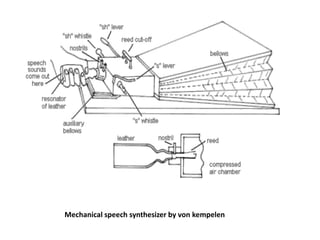
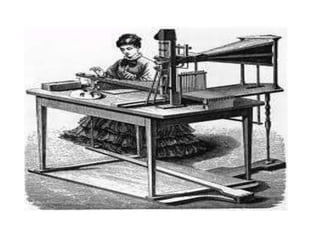
• First speech synthesizer is constructed in 1791.
• This synthesizer, capable of producing both
vowels and consonants.
• Sounds originating through the vibration of reeds
were modulated by the resonance of a leather
tube and radiated as a speech wave.
• Able to produce 19 consonants and 5 vowels.
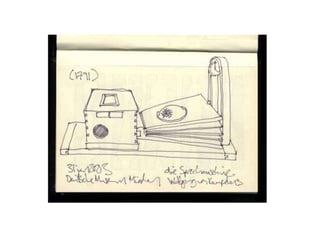
Mechanical speech synthesizer by von kempelen
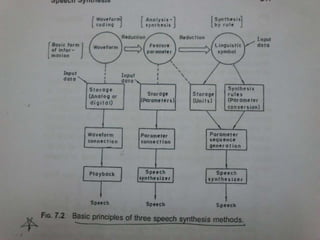
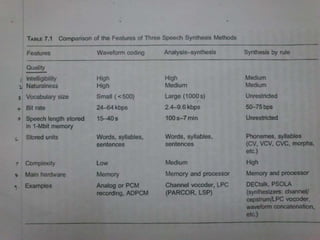
Three speech synthesis methods
• Waveform coding.
• Analysis-synthesis.
• Synthesis by rule.
Synthesis based on waveform coding
• In which speech waves of recorded human voice stored
after waveform coding are used to produce speech.
• Speech is synthesis by selecting and connecting the
appropriate units.
• Store variations of the same words with rising, flat and
falling inflections.
• Pitch synchronous method is used.
Time domain pitch synchronous
overlap add
• The TD-PSOLA is a concatenation method.
• This method relies on the speech production model described by
the sinusoidal framework.
• The analysis part consists of extracting short-time analysis signals
by multiplying the speech waveform by a sequence of time-
translated analysis windows.
• The analysis windows are located around glottal closure instants
and their length is proportional to the local pitch period.
• Mapping specifies which of the short-time analysis signal will be
eliminated.
Harmonic pulse noise model
• Spectrum is divided into two bands, with lowband
being represented by harmonically.
• The noise part ,n(t) is obtained by filtering.
• Time-varying parameter referred to as maximum
voiced frequency determines the limit.
• Synthesis time HNM frames are concatenated and the
prosody of units is altered according to the desired
prosody.
Thank you

Speech synthesis in

  • 1.
  • 2.
    Principles of speechsynthesis • Speech synthesis is a process which artificially produces speech for various application. • Anybody can easily understand. • Paper free.
  • 3.
    Cont.. • First speechsynthesizer is constructed in 1791. • This synthesizer, capable of producing both vowels and consonants. • Sounds originating through the vibration of reeds were modulated by the resonance of a leather tube and radiated as a speech wave. • Able to produce 19 consonants and 5 vowels.
  • 4.
  • 7.
    Three speech synthesismethods • Waveform coding. • Analysis-synthesis. • Synthesis by rule.
  • 10.
    Synthesis based onwaveform coding • In which speech waves of recorded human voice stored after waveform coding are used to produce speech. • Speech is synthesis by selecting and connecting the appropriate units. • Store variations of the same words with rising, flat and falling inflections. • Pitch synchronous method is used.
  • 11.
    Time domain pitchsynchronous overlap add • The TD-PSOLA is a concatenation method. • This method relies on the speech production model described by the sinusoidal framework. • The analysis part consists of extracting short-time analysis signals by multiplying the speech waveform by a sequence of time- translated analysis windows. • The analysis windows are located around glottal closure instants and their length is proportional to the local pitch period. • Mapping specifies which of the short-time analysis signal will be eliminated.
  • 12.
    Harmonic pulse noisemodel • Spectrum is divided into two bands, with lowband being represented by harmonically. • The noise part ,n(t) is obtained by filtering. • Time-varying parameter referred to as maximum voiced frequency determines the limit. • Synthesis time HNM frames are concatenated and the prosody of units is altered according to the desired prosody.
  • 13.