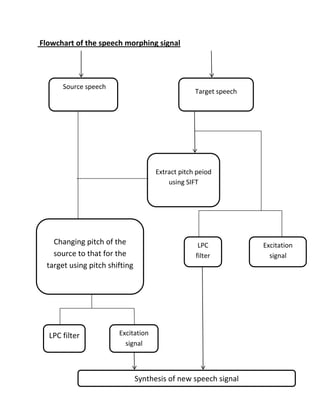
Voice morphing<br />Introduction<br />Voice morphing means the transition of one speech signal into another. Voice morphing which is also referred to as voice transformation and voice conversion is a technique to modify a source speaker’s speech utterance to sound as if it was spoken by a target speaker.<br />Speech is generated by pumping air from the lung through the vocal tract which consists of throat, nose, mouth, palate, tongue, teeth and lips. Speech is usually characterized as voiced, unvoiced or transient forms.<br />Voiced speech is produced by an air flow of pulses caused by the vibration of vocal cords. The resulting signal could be described as quasi-periodic waveform with high energy and high adjacent sample correlation. On the other hand, unvoiced speech, which  is produced by turbulent air flow resulting from constructions in the vocal tract, is characterized by a random and aperiodic waveform with low energy and low correlation. Voiced sounds (like vowels) have a periodic structure, i.e., their signal form repeats itself after some time which is called pitch period (TP). Its reciprocal value fp=1/TP is called pitch frequency.<br />There exist a number of algorithms for pitch period estimation. Two broad categories of pitch-estimation algorithms are:<br />Time-domain algorithms
Autocorrelation method, and
Linear prediction coding (LPC)
Frequency-domain algorithms
Real cepstrum methodTime domain algorithms attempts to determine pitch directly from the speech waveform. Frequency domain algorithms use some form of spectral analysis to determine the pitch period. Changing, scaling or modifying the pitch means transposing the pitch without changing the characteristics of the sound. It can be seen as the process of changing the pitch without affecting the speed.<br />History<br />Voice morphing is a technology developed at Los Alamos National Laboratory in New Mexico, USA by George Papcun and publicly demonstrated in 1999.<br />With different names, and using different signal processing techniques, the idea of audio morphing is well known in Computer Music Community (Serra, 1994; Tellman, Haken, Holloway, 1995; Osaka, 1995; Slaney, Covell, Lassiter, 1996; Settel, Lippe, 1996).<br />Speech Processing<br />It is the study of the speech signals and hence the processing methods of these signals. The signals may be in analogue or digital format but usually it is processed in a digital representation.<br />It is needed to analyze the speech signal into its components which are the excitation signal and the linear prediction filter but before analysis the signal must be pre-emphasis using the pre-emphasis filter.<br />Pre-emphasis and de-emphasis in Morphing  <br />In speech processing, pre-emphasis should usually be applied to the input signal before the LPC analysis.<br />During the reconstruction following the LPC synthesis, a de-emphasis process is applied to the signal to reverse the effect of pre-emphasis.<br />Pre-emphasis and de-emphasis are necessary because in the spectrum of a human speech signal, the energy in the signal decreases as the frequency increases. Pre-emhasis increases the energy in parts of signal by an amount inversely proportional to its frequency. This process therefore serves to flatten the signal so that the resulting spectrum consist of formants of similar heights. Pre-emphasis is applied to reduce the range. This can be achieved by using a FIR filter of the form given by equation-<br />                                        H(z)=1-az-1                             0.9 < a < 1.0<br />Linear Predictive Analysis<br />Linear predictive coding (LPC) is a method of predicting a sample of a speech signal based on several previous samples; the LPC coefficients may be used to separate a speech signal into two parts; the transfer function (which contains the vocal quality) and the excitation (which contains the pitch and the sound). The method of looking at speech as two parts is known as the source filter model of speech. The nth sample in a sequence of speech samples is represented by weighted sum of the p previous samples ass illustrated by equation<br />                                            S(n) = Σk=1 to p ak . S(n-k)<br />Where p is the order of the prediction filter and ak are the filter prediction coefficients (LPC coefficients) which are chosen in order to minimize the mean squared error between the real sample and its predicted value.<br />Speech analysis into filter and excitation then speech synthesis process is shown in the following figure and explained by the equations<br />                                            A(z) = 1 – Σk=1 to p ak . z-k<br />                                            E(z) = S(z) . A(z)<br />Where A(z) represent the transfer function and E(z) is the excitation function.<br />38100001047751409700104775002247899-200025LPC00LPC         Original signal s(n)filter coefficient ak<br />2247900153670A (z)A (z)    <br />1409700116205038100001543050          Original signal s(n)excitation<br />e(n)=Σak*s(n-k)<br />1409700699135385762563246022479002800351/A(z)filter1/A(z)filter<br />excitation component                                                                                                            original signal s(n)<br />                          fig: speech analysis and synthesis process<br />Pitch Detection<br />The pitch of the source and target signals must be detected in order to change the pitch of the source to match that of the target using pitch scaling algorithm. Five basic pitch determination algorithms are: <br />SIFT
Comb Filter Energy Maximization
Spectrum Decimation / Accumulation
Optimal Temporal Similarity
Dyadic Wavelet TransformPitch Scaling  <br />Once the source and target pitch values are determined, the source pitch is scaled by the scaling factor α (α= pitch of the source / pitch of the target) in order for the source pitch value to match that of the target one. The original speech signal is first divided into separate, but often overlapping, short-term analysis signals  (ST). Short term signals xm(n) are obtained from digital speech waveform x(n) by multiplying the signal by a sequence of pitch-synchronous analysis window hm(n) as shown in equation<br />                                        Xm(n) = hm(tm-n) . x(n)<br />Where, m is an index for the short-time signal the pitch modification was performed such that each frame is modified according to the target pitch by the scaling factor.<br />Speech Morphing   <br />The concept of morphing relies heavily upon the fact that specific algorithm can synthesize the various characteristics of voice. If one had two speakers “A” and “B” and we wanted to take what “A” said, but make it come out in “B’s”.<br />The most important part of voice morphing is speech synthesis since the quality of the synthesized speech is the ultimate aim of voice conversion. Speech signals will be synthesized by means of the same parametric representation that was used in the analysis. It can be synthesized from the linear predictive analysis parameters. <br />421957532385000105727532385000                       Flowchart of the speech morphing signal<br />3429000159385Target speech0Target speech276225159385     Source speech     Source speech<br />952500218567009810755473700131445049955452343150533844554292553384455429245338445391477529667203914775296672059340752966720542925029667205429250103314438195241033145234315064052454000500432879538100005473709810756843395Synthesis of new speech signalSynthesis of new speech signal51435003604895Excitation signalExcitation signal35623503604895LPC filterLPC filter17526005738495Excitation signalExcitation signal1428755738495LPC filterLPC filter-285753166745Changing pitch of the source to that for the target using pitch shiftingChanging pitch of the source to that for the target using pitch shifting26670001576070Extract pitch peiod using SIFTExtract pitch peiod using SIFT<br />Applications<br />Text to speech customization systems where speech can be produced with a desired voice or email may be red out in the sender’s voice.

Voice morphing document

  • 1.
    Voice morphing<br />Introduction<br/>Voice morphing means the transition of one speech signal into another. Voice morphing which is also referred to as voice transformation and voice conversion is a technique to modify a source speaker’s speech utterance to sound as if it was spoken by a target speaker.<br />Speech is generated by pumping air from the lung through the vocal tract which consists of throat, nose, mouth, palate, tongue, teeth and lips. Speech is usually characterized as voiced, unvoiced or transient forms.<br />Voiced speech is produced by an air flow of pulses caused by the vibration of vocal cords. The resulting signal could be described as quasi-periodic waveform with high energy and high adjacent sample correlation. On the other hand, unvoiced speech, which is produced by turbulent air flow resulting from constructions in the vocal tract, is characterized by a random and aperiodic waveform with low energy and low correlation. Voiced sounds (like vowels) have a periodic structure, i.e., their signal form repeats itself after some time which is called pitch period (TP). Its reciprocal value fp=1/TP is called pitch frequency.<br />There exist a number of algorithms for pitch period estimation. Two broad categories of pitch-estimation algorithms are:<br />Time-domain algorithms
  • 2.
  • 3.
  • 4.
  • 5.
    Real cepstrum methodTimedomain algorithms attempts to determine pitch directly from the speech waveform. Frequency domain algorithms use some form of spectral analysis to determine the pitch period. Changing, scaling or modifying the pitch means transposing the pitch without changing the characteristics of the sound. It can be seen as the process of changing the pitch without affecting the speed.<br />History<br />Voice morphing is a technology developed at Los Alamos National Laboratory in New Mexico, USA by George Papcun and publicly demonstrated in 1999.<br />With different names, and using different signal processing techniques, the idea of audio morphing is well known in Computer Music Community (Serra, 1994; Tellman, Haken, Holloway, 1995; Osaka, 1995; Slaney, Covell, Lassiter, 1996; Settel, Lippe, 1996).<br />Speech Processing<br />It is the study of the speech signals and hence the processing methods of these signals. The signals may be in analogue or digital format but usually it is processed in a digital representation.<br />It is needed to analyze the speech signal into its components which are the excitation signal and the linear prediction filter but before analysis the signal must be pre-emphasis using the pre-emphasis filter.<br />Pre-emphasis and de-emphasis in Morphing <br />In speech processing, pre-emphasis should usually be applied to the input signal before the LPC analysis.<br />During the reconstruction following the LPC synthesis, a de-emphasis process is applied to the signal to reverse the effect of pre-emphasis.<br />Pre-emphasis and de-emphasis are necessary because in the spectrum of a human speech signal, the energy in the signal decreases as the frequency increases. Pre-emhasis increases the energy in parts of signal by an amount inversely proportional to its frequency. This process therefore serves to flatten the signal so that the resulting spectrum consist of formants of similar heights. Pre-emphasis is applied to reduce the range. This can be achieved by using a FIR filter of the form given by equation-<br /> H(z)=1-az-1 0.9 < a < 1.0<br />Linear Predictive Analysis<br />Linear predictive coding (LPC) is a method of predicting a sample of a speech signal based on several previous samples; the LPC coefficients may be used to separate a speech signal into two parts; the transfer function (which contains the vocal quality) and the excitation (which contains the pitch and the sound). The method of looking at speech as two parts is known as the source filter model of speech. The nth sample in a sequence of speech samples is represented by weighted sum of the p previous samples ass illustrated by equation<br /> S(n) = Σk=1 to p ak . S(n-k)<br />Where p is the order of the prediction filter and ak are the filter prediction coefficients (LPC coefficients) which are chosen in order to minimize the mean squared error between the real sample and its predicted value.<br />Speech analysis into filter and excitation then speech synthesis process is shown in the following figure and explained by the equations<br /> A(z) = 1 – Σk=1 to p ak . z-k<br /> E(z) = S(z) . A(z)<br />Where A(z) represent the transfer function and E(z) is the excitation function.<br />38100001047751409700104775002247899-200025LPC00LPC Original signal s(n)filter coefficient ak<br />2247900153670A (z)A (z) <br />1409700116205038100001543050 Original signal s(n)excitation<br />e(n)=Σak*s(n-k)<br />1409700699135385762563246022479002800351/A(z)filter1/A(z)filter<br />excitation component original signal s(n)<br /> fig: speech analysis and synthesis process<br />Pitch Detection<br />The pitch of the source and target signals must be detected in order to change the pitch of the source to match that of the target using pitch scaling algorithm. Five basic pitch determination algorithms are: <br />SIFT
  • 6.
    Comb Filter EnergyMaximization
  • 7.
  • 8.
  • 9.
    Dyadic Wavelet TransformPitchScaling <br />Once the source and target pitch values are determined, the source pitch is scaled by the scaling factor α (α= pitch of the source / pitch of the target) in order for the source pitch value to match that of the target one. The original speech signal is first divided into separate, but often overlapping, short-term analysis signals (ST). Short term signals xm(n) are obtained from digital speech waveform x(n) by multiplying the signal by a sequence of pitch-synchronous analysis window hm(n) as shown in equation<br /> Xm(n) = hm(tm-n) . x(n)<br />Where, m is an index for the short-time signal the pitch modification was performed such that each frame is modified according to the target pitch by the scaling factor.<br />Speech Morphing <br />The concept of morphing relies heavily upon the fact that specific algorithm can synthesize the various characteristics of voice. If one had two speakers “A” and “B” and we wanted to take what “A” said, but make it come out in “B’s”.<br />The most important part of voice morphing is speech synthesis since the quality of the synthesized speech is the ultimate aim of voice conversion. Speech signals will be synthesized by means of the same parametric representation that was used in the analysis. It can be synthesized from the linear predictive analysis parameters. <br />421957532385000105727532385000 Flowchart of the speech morphing signal<br />3429000159385Target speech0Target speech276225159385 Source speech Source speech<br />952500218567009810755473700131445049955452343150533844554292553384455429245338445391477529667203914775296672059340752966720542925029667205429250103314438195241033145234315064052454000500432879538100005473709810756843395Synthesis of new speech signalSynthesis of new speech signal51435003604895Excitation signalExcitation signal35623503604895LPC filterLPC filter17526005738495Excitation signalExcitation signal1428755738495LPC filterLPC filter-285753166745Changing pitch of the source to that for the target using pitch shiftingChanging pitch of the source to that for the target using pitch shifting26670001576070Extract pitch peiod using SIFTExtract pitch peiod using SIFT<br />Applications<br />Text to speech customization systems where speech can be produced with a desired voice or email may be red out in the sender’s voice.