TIPS ON HISTORY
TAKING
Prof. Dr. Aswinikumar
Surendran. MD
Professor of Medicine,
MCH TrivandrumModule No: 2
HISTORY TAKING
Story of the illness as narrated by the patient
Student or doctor elicits all the details
Then writes down in a specific format
What is meant by history taking?
HISTORY
It gives you a diagnosis in >70% of cases
Then investigate to confirm and localise
Then treat for a cure/symptom relief
Why is history taking very important?
DIAGNOSIS FROM HISTORY
Migraine, an important cause of headache
Diagnosis arrived at from history alone
No investigations needed - simply treat
Give an example?
DIAGNOSIS
Dia= Disease
Gnosis = Knowledge
Diagnosis = Knowledge about the disease
What is meant by “diagnosis”?
HISTORY TAKING
10-15' in a long case in examination
5-10' in the outpatient department
<5' in an emergency department
How much time to allot for history taking?
GREET THE PATIENT
Say “Hello” or “ Good Morning”
Introduce yourself as a medical student
Get permission for interview/examination
First of all
BUILD UP A RAPPORT
Common place of residence
Common nature of job of relatives
Common area of interest like computers
Find some way
TALK TO THE PATIENT DIRECT
Patient - best person to describe his illness
Only he can, describe sequence of events
And tell the severity and important ones
Not to the relative or bystander
NEED NOT TALK TO BYSTANDERS
Project their own ideas about the case
Give importance to details of their choice
Even interfere in interview /examination
May be unrelated/uneducated/employed
POSITION PATIENT CORRECTLY
Patient lying comfortably
Yourself standing on right side
Throughout the period of interview
Make yourself comfortable
NO NOTE-TAKING DURING HISTORY
Gets disinterested; even walk away
Instead use only small spiral books
Just note down forgettable things
Not in large note books in any case
CASE SHEET
Sit at some other place
Write legibly and beautifully
To read, understand and refer later
Better written later
HOW TO TAKE HISTORY
Name, age, sex
Residence, occupation, nature of work
IP number, Date of admission
First collect the patient details
PRESENTING COMPLAINTS
Major complaints of the patient
For which he has approached doctor
Or admitted to the hospital this time
What is meant by presenting complaints?
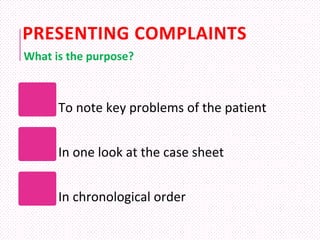
PRESENTING COMPLAINTS
To note key problems of the patient
In one look at the case sheet
In chronological order
What is the purpose?
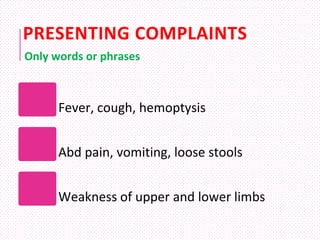
PRESENTING COMPLAINTS
Fever, cough, hemoptysis
Abd pain, vomiting, loose stools
Weakness of upper and lower limbs
Only words or phrases
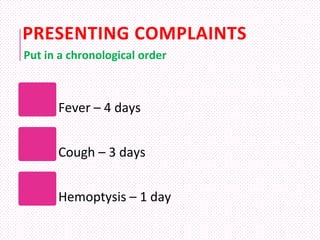
PRESENTING COMPLAINTS
Fever – 4 days
Cough – 3 days
Hemoptysis – 1 day
Put in a chronological order
HISTORY OF PRESENT ILLNESS
Whole story as narrated by patient
So be a “good listener” to the story
Later become a good “story teller”
Not the “h/o presenting complaints”
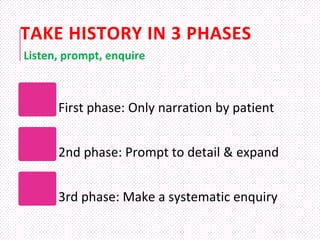
TAKE HISTORY IN 3 PHASES
First phase: Only narration by patient
2nd phase: Prompt to detail & expand
3rd phase: Make a systematic enquiry
Listen, prompt, enquire
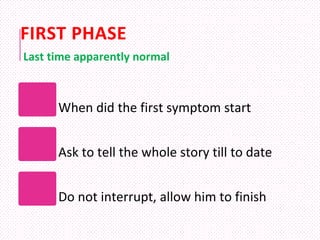
FIRST PHASE
When did the first symptom start
Ask to tell the whole story till to date
Do not interrupt, allow him to finish
Last time apparently normal
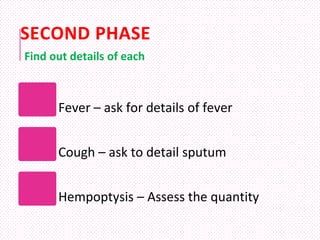
SECOND PHASE
Fever – ask for details of fever
Cough – ask to detail sputum
Hempoptysis – Assess the quantity
Find out details of each
THIRD PHASE
Ask for cardinal symptoms
Select a list from each system
Find out each system is affected/not
Systematic enquiry
SYSTEMATIC ENQUIRY
CVS: Chest pain, dyspnoea, palpitation,
syncope
RS: Chest pain, cough, dyspnoea,
hemoptysis
GIT: Vomiting, loose stools, abdominal
pain
System wise
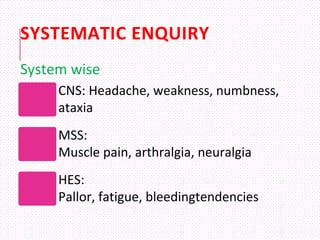
SYSTEMATIC ENQUIRY
CNS: Headache, weakness, numbness,
ataxia
MSS:
Muscle pain, arthralgia, neuralgia
HES:
Pallor, fatigue, bleedingtendencies
System wise
INVESTIGATION DETAILS
Details of all investigations
Done elsewhere in other clinics
Done after admission to this hospital
Make a detailed enquiry
TREATMENT DETAILS
Ask for all treatment received
Both in outside hospitals and inside
Tolerance to drugs and side effects
Make a detailed enquiry
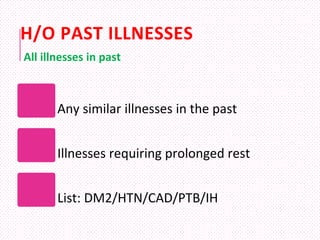
H/O PAST ILLNESSES
Any similar illnesses in the past
Illnesses requiring prolonged rest
List: DM2/HTN/CAD/PTB/IH
All illnesses in past
PERSONAL HISTORY
Appetite, loss or gain in weight
Veg/non-veg, food for the day
Bladder/bowel/sexual habits
Regarding habits/what change occurred?
FAMILY HISTORY
Father/mother/brothers/sisters
Wife and children
Similar 3 step approach
All illnesses in members of family
SUMMARY OF NATURAL HISTORY
How the illness started?
How it progressed then?
What is the state now?
Put it in a nutshell
DIAGNOSTIC POSSIBILITIES
Give 4-5 broad diagnosis?
Give points in favour of diagnosis?
Give points against diagnosis?
From history alone
His | history module | 002

His | history module | 002

  • 1.
    TIPS ON HISTORY TAKING Prof.Dr. Aswinikumar Surendran. MD Professor of Medicine, MCH TrivandrumModule No: 2
  • 2.
    HISTORY TAKING Story ofthe illness as narrated by the patient Student or doctor elicits all the details Then writes down in a specific format What is meant by history taking?
  • 3.
    HISTORY It gives youa diagnosis in >70% of cases Then investigate to confirm and localise Then treat for a cure/symptom relief Why is history taking very important?
  • 4.
    DIAGNOSIS FROM HISTORY Migraine,an important cause of headache Diagnosis arrived at from history alone No investigations needed - simply treat Give an example?
  • 5.
    DIAGNOSIS Dia= Disease Gnosis =Knowledge Diagnosis = Knowledge about the disease What is meant by “diagnosis”?
  • 6.
    HISTORY TAKING 10-15' ina long case in examination 5-10' in the outpatient department <5' in an emergency department How much time to allot for history taking?
  • 7.
    GREET THE PATIENT Say“Hello” or “ Good Morning” Introduce yourself as a medical student Get permission for interview/examination First of all
  • 8.
    BUILD UP ARAPPORT Common place of residence Common nature of job of relatives Common area of interest like computers Find some way
  • 9.
    TALK TO THEPATIENT DIRECT Patient - best person to describe his illness Only he can, describe sequence of events And tell the severity and important ones Not to the relative or bystander
  • 10.
    NEED NOT TALKTO BYSTANDERS Project their own ideas about the case Give importance to details of their choice Even interfere in interview /examination May be unrelated/uneducated/employed
  • 11.
    POSITION PATIENT CORRECTLY Patientlying comfortably Yourself standing on right side Throughout the period of interview Make yourself comfortable
  • 12.
    NO NOTE-TAKING DURINGHISTORY Gets disinterested; even walk away Instead use only small spiral books Just note down forgettable things Not in large note books in any case
  • 13.
    CASE SHEET Sit atsome other place Write legibly and beautifully To read, understand and refer later Better written later
  • 14.
    HOW TO TAKEHISTORY Name, age, sex Residence, occupation, nature of work IP number, Date of admission First collect the patient details
  • 15.
    PRESENTING COMPLAINTS Major complaintsof the patient For which he has approached doctor Or admitted to the hospital this time What is meant by presenting complaints?
  • 16.
    PRESENTING COMPLAINTS To notekey problems of the patient In one look at the case sheet In chronological order What is the purpose?
  • 17.
    PRESENTING COMPLAINTS Fever, cough,hemoptysis Abd pain, vomiting, loose stools Weakness of upper and lower limbs Only words or phrases
  • 18.
    PRESENTING COMPLAINTS Fever –4 days Cough – 3 days Hemoptysis – 1 day Put in a chronological order
  • 19.
    HISTORY OF PRESENTILLNESS Whole story as narrated by patient So be a “good listener” to the story Later become a good “story teller” Not the “h/o presenting complaints”
  • 20.
    TAKE HISTORY IN3 PHASES First phase: Only narration by patient 2nd phase: Prompt to detail & expand 3rd phase: Make a systematic enquiry Listen, prompt, enquire
  • 21.
    FIRST PHASE When didthe first symptom start Ask to tell the whole story till to date Do not interrupt, allow him to finish Last time apparently normal
  • 22.
    SECOND PHASE Fever –ask for details of fever Cough – ask to detail sputum Hempoptysis – Assess the quantity Find out details of each
  • 23.
    THIRD PHASE Ask forcardinal symptoms Select a list from each system Find out each system is affected/not Systematic enquiry
  • 24.
    SYSTEMATIC ENQUIRY CVS: Chestpain, dyspnoea, palpitation, syncope RS: Chest pain, cough, dyspnoea, hemoptysis GIT: Vomiting, loose stools, abdominal pain System wise
  • 25.
    SYSTEMATIC ENQUIRY CNS: Headache,weakness, numbness, ataxia MSS: Muscle pain, arthralgia, neuralgia HES: Pallor, fatigue, bleedingtendencies System wise
  • 26.
    INVESTIGATION DETAILS Details ofall investigations Done elsewhere in other clinics Done after admission to this hospital Make a detailed enquiry
  • 27.
    TREATMENT DETAILS Ask forall treatment received Both in outside hospitals and inside Tolerance to drugs and side effects Make a detailed enquiry
  • 28.
    H/O PAST ILLNESSES Anysimilar illnesses in the past Illnesses requiring prolonged rest List: DM2/HTN/CAD/PTB/IH All illnesses in past
  • 29.
    PERSONAL HISTORY Appetite, lossor gain in weight Veg/non-veg, food for the day Bladder/bowel/sexual habits Regarding habits/what change occurred?
  • 30.
    FAMILY HISTORY Father/mother/brothers/sisters Wife andchildren Similar 3 step approach All illnesses in members of family
  • 31.
    SUMMARY OF NATURALHISTORY How the illness started? How it progressed then? What is the state now? Put it in a nutshell
  • 32.
    DIAGNOSTIC POSSIBILITIES Give 4-5broad diagnosis? Give points in favour of diagnosis? Give points against diagnosis? From history alone