ORAL COMMUNICATION
THREE TYPES OF
SPEECH ACT
IN EVERY UTTERANCE
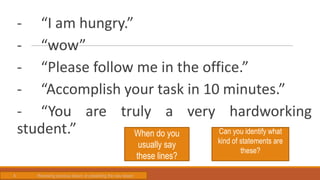
- “I am hungry.”
- “wow”
- “Please follow me in the office.”
- “Accomplish your task in 10 minutes.”
- “You are truly a very hardworking
student.” When do you
usually say
these lines?
Can you identify what
kind of statements are
these?
A. Reviewing previous lesson or presenting the new lesson
MELC - EN11/12OC- IIab-22
Employs various communicative
strategies in different situations
B. Establishing a purpose for the lesson
OBJECTIVES
1. Analyze the contextual nuances
and cultural variations influencing
the choice and interpretation of
speech acts in diverse social
settings.
OBJECTIVES
2. Reflect on personal experiences
where the use of different speech
acts affected communication and
relationships.
OBJECTIVES
3. Role-play and perform
scripted scenarios, applying
different speech acts
effectively and convincingly.
Is there any
instance in your
life where in
you would wish
to change in
your utterances
so that you
would not be
misunderstood?
Can you please share
some of your
experiences here in
school, at home and
with your friends?
C. Presenting examples/ instances of the Lesson
Speech acts are not isolated; their meaning is deeply
embedded in the context in which they occur.
Contextual nuances encompass the physical setting, the
participants involved, their relationships, and the timing of
the communication.

Contextual nuances refer to the subtle and specific details of
a given situation that can significantly influence the
interpretation of speech acts. Here are a few examples to
illustrate how contextual nuances can impact communication.
D. Discussing new concepts and practicing new skills
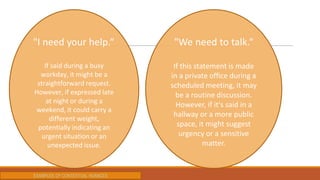
"I need your help.“
If said during a busy
workday, it might be a
straightforward request.
However, if expressed late
at night or during a
weekend, it could carry a
different weight,
potentially indicating an
urgent situation or an
unexpected issue.
"We need to talk.“
If this statement is made
in a private office during a
scheduled meeting, it may
be a routine discussion.
However, if it's said in a
hallway or a more public
space, it might suggest
urgency or a sensitive
matter.
EXAMPLES OF CONTEXTUAL NUANCES
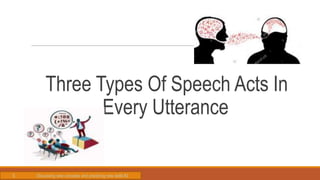
Three Types Of Speech Acts In
Every Utterance
E. Discussing new concepts and practicing new skills #2
Locutionary act –
it is the actual act of uttering or
saying something. This act
happens with the utterances of
sound, a word or even a phrase as
natural unit of speech.
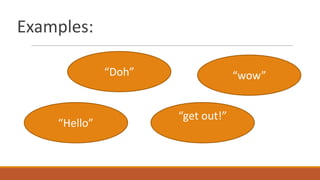
Examples:
“Doh” “wow”
“Hello”
“get out!”
2. Illocutionary act –
It is the social function of what
is said.
- It is not just saying something
itself but with the act of saying
something with the intention of:
-Stating an opinion, confirming, or
denying something
-Making a prediction, a promise, a
request;
-Issuing an order or a decision;
-Giving advice or permission.
Examples:
Statement: "The sun rises in the
east.“
Request: "Please pass me the
salt.“
Command: "Close the door."
Examples:
Advice: "You should start
preparing for the exam early to
avoid last-minute stress.”
Permission: "Do you mind if I
borrow your pen for a moment?"
3. Perlocutionary Speech Act
It refers to the consequent effect
of what was said. This is based on
the particular context in which the
speech act was mentioned.
Remember that this is seen when a
particular effect is sought from
either the speaker or the listener,
or both.
The response may not necessarily be
physical or verbal and elicited by:
-inspiring or insulting
- persuading/convincing
-deterring/scaring
Examples:
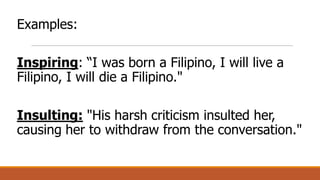
Inspiring: “I was born a Filipino, I will live a
Filipino, I will die a Filipino."
Insulting: "His harsh criticism insulted her,
causing her to withdraw from the conversation."
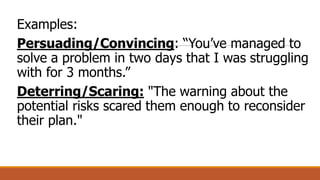
Examples:
Persuading/Convincing: “You’ve managed to
solve a problem in two days that I was struggling
with for 3 months.”
Deterring/Scaring: "The warning about the
potential risks scared them enough to reconsider
their plan."
What is the aim of
Perlocutionary Speech
Act?
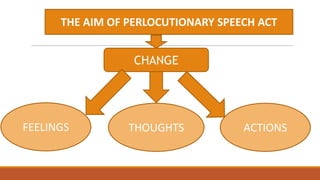
CHANGE
FEELINGS THOUGHTS ACTIONS
THE AIM OF PERLOCUTIONARY SPEECH ACT
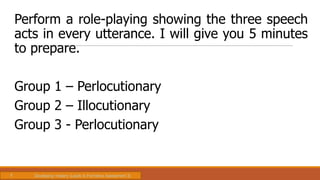
Perform a role-playing showing the three speech
acts in every utterance. I will give you 5 minutes
to prepare.
Group 1 – Perlocutionary
Group 2 – Illocutionary
Group 3 - Perlocutionary
F. Developing mastery (Leads to Formative Assessment 3)
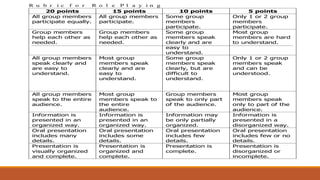
R u b r i c f o r R o l e P l a y i n g
20 points 15 points 10 points 5 points
All group members
participate equally.
All group members
participate.
Some group
members
participate.
Only 1 or 2 group
members
participate.
Group members
help each other as
needed.
Group members
help each other as
needed.
Some group
members speak
clearly and are
easy to
understand.
Most group
members are hard
to understand.
All group members
speak clearly and
are easy to
understand.
Most group
members speak
clearly and are
easy to
understand.
Some group
members speak
clearly, but are
difficult to
understand.
Only 1 or 2 group
members speak
and can be
understood.
All group members
speak to the entire
audience.
Most group
members speak to
the entire
audience.
Group members
speak to only part
of the audience.
Most group
members speak
only to part of the
audience.
Information is
presented in an
organized way.
Information is
presented in an
organized way.
Information may
be only partially
organized.
Information is
presented in a
disorganized way.
Oral presentation
includes many
details.
Oral presentation
includes some
details.
Oral presentation
includes few
details.
Oral presentation
includes few or no
details.
Presentation is
visually organized
and complete.
Presentation is
organized and
complete.
Presentation is
complete.
Presentation is
disorganized or
incomplete.
ROLE-PLAYING PREPARATION
How can positive and constructive
speech acts contribute to building
resilience in challenging situations?
G. Finding practical applications of concepts and skills in daily living
EVALUATION
5-ITEM MCQ
I. Evaluating learning
REMEMBER:
Locutionary acts convey literal
meaning, illocutionary acts express
intentions, and perlocutionary acts
focus on the impact on the listener.
H. Making generalizations and abstractions about the lesson
What realization can you make after
learning the three types of speech acts
in every utterance?
Types of Speech Act .pptx

Types of Speech Act .pptx

  • 1.
    ORAL COMMUNICATION THREE TYPESOF SPEECH ACT IN EVERY UTTERANCE
  • 3.
    - “I amhungry.” - “wow” - “Please follow me in the office.” - “Accomplish your task in 10 minutes.” - “You are truly a very hardworking student.” When do you usually say these lines? Can you identify what kind of statements are these? A. Reviewing previous lesson or presenting the new lesson
  • 4.
    MELC - EN11/12OC-IIab-22 Employs various communicative strategies in different situations B. Establishing a purpose for the lesson
  • 5.
    OBJECTIVES 1. Analyze thecontextual nuances and cultural variations influencing the choice and interpretation of speech acts in diverse social settings.
  • 6.
    OBJECTIVES 2. Reflect onpersonal experiences where the use of different speech acts affected communication and relationships.
  • 7.
    OBJECTIVES 3. Role-play andperform scripted scenarios, applying different speech acts effectively and convincingly.
  • 8.
    Is there any instancein your life where in you would wish to change in your utterances so that you would not be misunderstood? Can you please share some of your experiences here in school, at home and with your friends? C. Presenting examples/ instances of the Lesson
  • 9.
    Speech acts arenot isolated; their meaning is deeply embedded in the context in which they occur. Contextual nuances encompass the physical setting, the participants involved, their relationships, and the timing of the communication. Contextual nuances refer to the subtle and specific details of a given situation that can significantly influence the interpretation of speech acts. Here are a few examples to illustrate how contextual nuances can impact communication. D. Discussing new concepts and practicing new skills
  • 10.
    "I need yourhelp.“ If said during a busy workday, it might be a straightforward request. However, if expressed late at night or during a weekend, it could carry a different weight, potentially indicating an urgent situation or an unexpected issue. "We need to talk.“ If this statement is made in a private office during a scheduled meeting, it may be a routine discussion. However, if it's said in a hallway or a more public space, it might suggest urgency or a sensitive matter. EXAMPLES OF CONTEXTUAL NUANCES
  • 11.
    Three Types OfSpeech Acts In Every Utterance E. Discussing new concepts and practicing new skills #2
  • 12.
    Locutionary act – itis the actual act of uttering or saying something. This act happens with the utterances of sound, a word or even a phrase as natural unit of speech.
  • 13.
  • 14.
    2. Illocutionary act– It is the social function of what is said. - It is not just saying something itself but with the act of saying something with the intention of:
  • 15.
    -Stating an opinion,confirming, or denying something -Making a prediction, a promise, a request;
  • 16.
    -Issuing an orderor a decision; -Giving advice or permission.
  • 17.
    Examples: Statement: "The sunrises in the east.“ Request: "Please pass me the salt.“ Command: "Close the door."
  • 18.
    Examples: Advice: "You shouldstart preparing for the exam early to avoid last-minute stress.” Permission: "Do you mind if I borrow your pen for a moment?"
  • 19.
    3. Perlocutionary SpeechAct It refers to the consequent effect of what was said. This is based on the particular context in which the speech act was mentioned.
  • 20.
    Remember that thisis seen when a particular effect is sought from either the speaker or the listener, or both.
  • 21.
    The response maynot necessarily be physical or verbal and elicited by: -inspiring or insulting - persuading/convincing -deterring/scaring
  • 22.
    Examples: Inspiring: “I wasborn a Filipino, I will live a Filipino, I will die a Filipino." Insulting: "His harsh criticism insulted her, causing her to withdraw from the conversation."
  • 23.
    Examples: Persuading/Convincing: “You’ve managedto solve a problem in two days that I was struggling with for 3 months.” Deterring/Scaring: "The warning about the potential risks scared them enough to reconsider their plan."
  • 24.
    What is theaim of Perlocutionary Speech Act?
  • 25.
    CHANGE FEELINGS THOUGHTS ACTIONS THEAIM OF PERLOCUTIONARY SPEECH ACT
  • 26.
    Perform a role-playingshowing the three speech acts in every utterance. I will give you 5 minutes to prepare. Group 1 – Perlocutionary Group 2 – Illocutionary Group 3 - Perlocutionary F. Developing mastery (Leads to Formative Assessment 3)
  • 27.
    R u br i c f o r R o l e P l a y i n g 20 points 15 points 10 points 5 points All group members participate equally. All group members participate. Some group members participate. Only 1 or 2 group members participate. Group members help each other as needed. Group members help each other as needed. Some group members speak clearly and are easy to understand. Most group members are hard to understand. All group members speak clearly and are easy to understand. Most group members speak clearly and are easy to understand. Some group members speak clearly, but are difficult to understand. Only 1 or 2 group members speak and can be understood. All group members speak to the entire audience. Most group members speak to the entire audience. Group members speak to only part of the audience. Most group members speak only to part of the audience. Information is presented in an organized way. Information is presented in an organized way. Information may be only partially organized. Information is presented in a disorganized way. Oral presentation includes many details. Oral presentation includes some details. Oral presentation includes few details. Oral presentation includes few or no details. Presentation is visually organized and complete. Presentation is organized and complete. Presentation is complete. Presentation is disorganized or incomplete.
  • 28.
  • 29.
    How can positiveand constructive speech acts contribute to building resilience in challenging situations? G. Finding practical applications of concepts and skills in daily living
  • 30.
  • 31.
    REMEMBER: Locutionary acts conveyliteral meaning, illocutionary acts express intentions, and perlocutionary acts focus on the impact on the listener. H. Making generalizations and abstractions about the lesson
  • 32.
    What realization canyou make after learning the three types of speech acts in every utterance?