

Student Learning Outcomes:  How to Benchmark Student Progress National Chinese Language Conference Chicago, Illinois April 30-May 2, 2009 Marty Abbott American Council on the Teaching of Foreign Languages (ACTFL)
 
ACTFL PERFORMANCE GUIDELINES FOR K-12 LEARNERS www.actfl.org
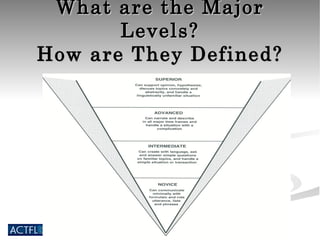
What are the Major Levels? How are They Defined?
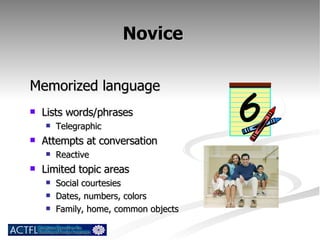
Novice  Memorized language Lists words/phrases Telegraphic Attempts at conversation Reactive Limited topic areas Social courtesies Dates, numbers, colors Family, home, common objects
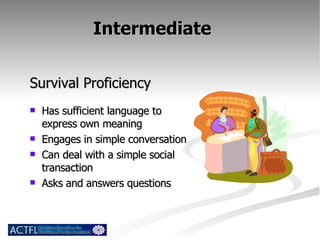
Intermediate  Survival Proficiency Has sufficient language to express own meaning Engages in simple conversation Can deal with a simple social transaction Asks and answers questions
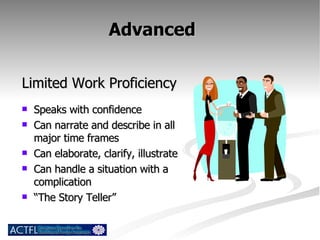
Advanced  Limited Work Proficiency  Speaks with confidence Can narrate and describe in all major time frames Can elaborate, clarify, illustrate Can handle a situation with a complication  “ The Story Teller”
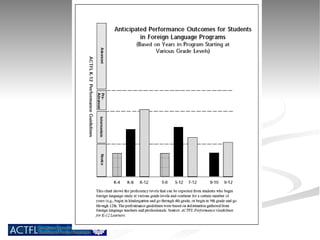
Benchmarks Novice Learner Range Parallels Novice High in  ACTFL Proficiency Guidelines (K – 4, 5 – 8, 9 – 10) Intermediate Learner Range Parallels Intermediate Mid in  ACTFL Proficiency Guidelines  (K-8, 5-12, 9-12) Pre-advanced Learner Range Parallels Intermediate High in  ACTFL Proficiency Guidelines  (K-12)
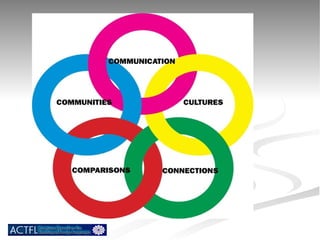
National Standards Communication Goal Interpersonal Mode—two-way interaction Interpretive Mode—one way listening or reading Presentational Mode—one way speaking or writing
Domains Comprehensibility  How well is the student understood? Comprehension  How well does the student understand? Language Control  How accurate is the student’s language? Vocabulary  How extensive and applicable is the student’s vocabulary? Cultural Awareness  How is the student’s cultural knowledge reflected in language use?  Communication Strategies  How does the student maintain  communication?
 
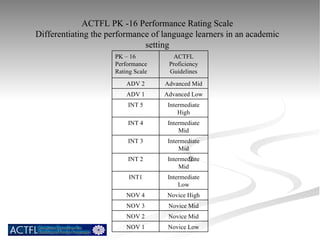
ACTFL PK -16 Performance Rating Scale Differentiating the performance of language learners in an academic setting Novice Low NOV 1 Novice Mid NOV 2 Novice Mid NOV 3 Novice High NOV 4 Intermediate Low INT1 Intermediate Mid INT 2 Intermediate Mid INT 3 Intermediate Mid INT 4 Intermediate High INT 5 Advanced Low ADV 1 Advanced Mid ADV 2 ACTFL Proficiency Guidelines PK – 16 Performance Rating Scale
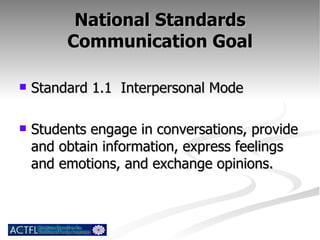
National Standards Communication Goal Standard 1.1  Interpersonal Mode Students engage in conversations, provide and obtain information, express feelings and emotions, and exchange opinions.
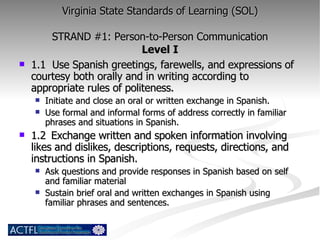
Virginia State Standards of Learning (SOL) STRAND #1: Person-to-Person Communication Level I 1.1  Use Spanish greetings, farewells, and expressions of courtesy both orally and in writing according to appropriate rules of politeness. Initiate and close an oral or written exchange in Spanish. Use formal and informal forms of address correctly in familiar phrases and situations in Spanish. 1.2  Exchange written and spoken information involving likes and dislikes, descriptions, requests, directions, and instructions in Spanish. Ask questions and provide responses in Spanish based on self and familiar material Sustain brief oral and written exchanges in Spanish using familiar phrases and sentences.
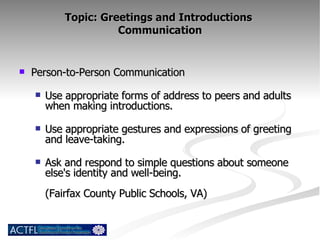
Topic: Greetings and Introductions  Communication Person-to-Person Communication Use appropriate forms of address to peers and adults when making introductions. Use appropriate gestures and expressions of greeting and leave-taking. Ask and respond to simple questions about someone else's identity and well-being. (Fairfax County Public Schools, VA)
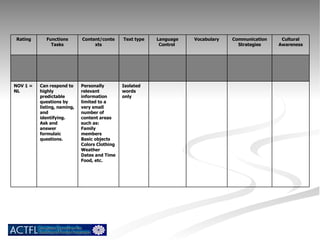
Isolated words only Personally relevant information limited to a very small number of content areas such as: Family members Basic objects Colors Clothing Weather Dates and Time Food, etc. Can respond to highly predictable questions by listing, naming, and identifying.  Ask and answer formulaic questions. NOV 1 = NL Cultural Awareness Communication Strategies Vocabulary Language Control  Text type Content/contexts Functions Tasks Rating
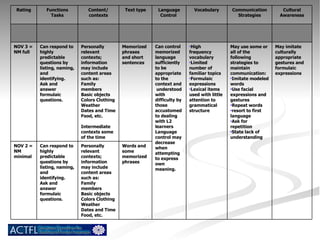
Words and some memorized phrases Personally relevant contexts; information may include content areas such as: Family members Basic objects Colors Clothing Weather Dates and Time Food, etc. Can respond to highly predictable questions by listing, naming, and identifying.  Ask and answer formulaic questions. NOV 2 = NM  minimal May imitate culturally appropriate gestures and formulaic expressions  May use some or all of the following strategies to maintain communication: Imitate modeled words  Use facial expressions and gestures Repeat words resort to first language  Ask for repetition State lack of understanding High frequency vocabulary Limited number of familiar topics  Formulaic expressions Lexical items used with little attention to grammatical structure Can control memorized language sufficiently to be appropriate to the context and  understood with difficulty by  those accustomed to dealing with L2 learners Language control may decrease when attempting to express own meaning.  Memorized phrases and short sentences Personally relevant contexts; information may include content areas such as: Family members Basic objects Colors Clothing Weather Dates and Time Food, etc. Intermediate contexts some of the time  Can respond to highly predictable questions by listing, naming, and identifying.  Ask and answer formulaic questions. NOV 3 = NM full  Cultural Awareness Communication Strategies Vocabulary Language Control  Text type Content/ contexts Functions Tasks Rating
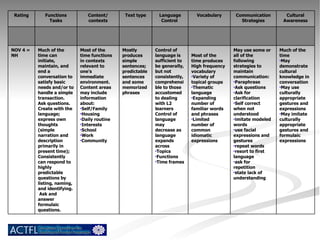
Much of the time May demonstrate cultural knowledge in conversation May use   culturally appropriate gestures and expressions  May imitate culturally appropriate gestures and formulaic expressions  May use some or all of the following strategies to maintain communication: Paraphrase Ask questions Ask for clarification Self correct when not understood imitate modeled words  use facial expressions and gestures repeat words resort to first language  ask for repetition state lack of understanding Most of the time produces   High frequency vocabulary Variety of topical groups Thematic language Expanding number of familiar words and phrases Limited number of common idiomatic expressions Control of language is sufficient to be generally, but not consistently, comprehensible to those accustomed to dealing with L2 learners Control of language may decrease as language expands across Topics Functions Time frames  Mostly produces simple sentences; predictable sentences and some memorized phrases Most of the time functions in contexts relevant to one’s immediate environment.  Content areas may include information about: Self/Family Housing Daily routine Interests  School Work Community Much of the time can initiate, maintain, and end a conversation to satisfy basic needs and/or to handle a simple transaction. Ask questions.  Create with the language; express own thoughts (simple narration and description primarily in present time); Consistently can respond to highly predictable questions by listing, naming, and identifying.  Ask and answer formulaic questions. NOV 4 = NH Cultural Awareness Communication Strategies Vocabulary Language Control  Text type Content/ contexts Functions Tasks Rating
ACTFL Assessment for the Performance and Proficiency of Language (AAPPL)
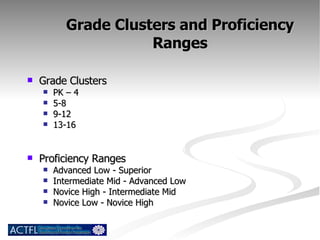
Grade Clusters and Proficiency Ranges Grade Clusters PK – 4 5-8 9-12  13-16 Proficiency Ranges Advanced Low - Superior Intermediate Mid - Advanced Low Novice High - Intermediate Mid Novice Low - Novice High
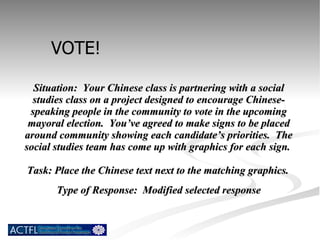
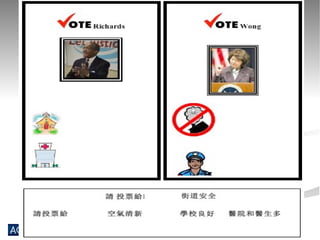
Situation:  Your Chinese class is partnering with a social studies class on a project designed to encourage Chinese-speaking people in the community to vote in the upcoming mayoral election.  You’ve agreed to make signs to be placed around community showing each candidate’s priorities.  The social studies team has come up with graphics for each sign.  Task: Place the Chinese text next to the matching graphics.   Type of Response:  Modified selected response VOTE!


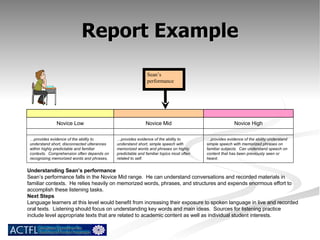
Report Example Understanding Sean’s performance Sean’s performance falls in the Novice Mid range.  He can understand conversations and recorded materials in familiar contexts.  He relies heavily on memorized words, phrases, and structures and expends enormous effort to accomplish these listening tasks.  Next Steps Language learners at this level would benefit from increasing their exposure to spoken language in live and recorded oral texts.  Listening should focus on understanding key words and main ideas.  Sources for listening practice include level appropriate texts that are related to academic content as well as individual student interests.  Sean’s performance … provides evidence of the ability understand simple speech with memorized phrases on familiar subjects.  Can understand speech on content that has been previously seen or heard. … provides evidence of the ability to understand short, simple speech with memorized words and phrases on highly predictable and familiar topics most often related to self.  … provides evidence of the ability to understand short, disconnected utterances within highly predictable and familiar contexts.  Comprehension often depends on recognizing memorized words and phrases,  Novice High Novice Mid Novice Low
ACTFL PERFORMANCE GUIDELINES FOR K-12 LEARNERS Integrated Performance Assessment (IPA) INTASC

Abbott Student Learning Outcomes

  • 1.
    Student Learning Outcomes: How to Benchmark Student Progress National Chinese Language Conference Chicago, Illinois April 30-May 2, 2009 Marty Abbott American Council on the Teaching of Foreign Languages (ACTFL)
  • 2.
  • 3.
    ACTFL PERFORMANCE GUIDELINESFOR K-12 LEARNERS www.actfl.org
  • 4.
    What are theMajor Levels? How are They Defined?
  • 5.
    Novice Memorizedlanguage Lists words/phrases Telegraphic Attempts at conversation Reactive Limited topic areas Social courtesies Dates, numbers, colors Family, home, common objects
  • 6.
    Intermediate SurvivalProficiency Has sufficient language to express own meaning Engages in simple conversation Can deal with a simple social transaction Asks and answers questions
  • 7.
    Advanced LimitedWork Proficiency Speaks with confidence Can narrate and describe in all major time frames Can elaborate, clarify, illustrate Can handle a situation with a complication “ The Story Teller”
  • 8.
    Benchmarks Novice LearnerRange Parallels Novice High in ACTFL Proficiency Guidelines (K – 4, 5 – 8, 9 – 10) Intermediate Learner Range Parallels Intermediate Mid in ACTFL Proficiency Guidelines (K-8, 5-12, 9-12) Pre-advanced Learner Range Parallels Intermediate High in ACTFL Proficiency Guidelines (K-12)
  • 9.
    National Standards CommunicationGoal Interpersonal Mode—two-way interaction Interpretive Mode—one way listening or reading Presentational Mode—one way speaking or writing
  • 10.
    Domains Comprehensibility How well is the student understood? Comprehension How well does the student understand? Language Control How accurate is the student’s language? Vocabulary How extensive and applicable is the student’s vocabulary? Cultural Awareness How is the student’s cultural knowledge reflected in language use? Communication Strategies How does the student maintain communication?
  • 11.
  • 12.
    ACTFL PK -16Performance Rating Scale Differentiating the performance of language learners in an academic setting Novice Low NOV 1 Novice Mid NOV 2 Novice Mid NOV 3 Novice High NOV 4 Intermediate Low INT1 Intermediate Mid INT 2 Intermediate Mid INT 3 Intermediate Mid INT 4 Intermediate High INT 5 Advanced Low ADV 1 Advanced Mid ADV 2 ACTFL Proficiency Guidelines PK – 16 Performance Rating Scale
  • 13.
    National Standards CommunicationGoal Standard 1.1 Interpersonal Mode Students engage in conversations, provide and obtain information, express feelings and emotions, and exchange opinions.
  • 14.
    Virginia State Standardsof Learning (SOL) STRAND #1: Person-to-Person Communication Level I 1.1 Use Spanish greetings, farewells, and expressions of courtesy both orally and in writing according to appropriate rules of politeness. Initiate and close an oral or written exchange in Spanish. Use formal and informal forms of address correctly in familiar phrases and situations in Spanish. 1.2 Exchange written and spoken information involving likes and dislikes, descriptions, requests, directions, and instructions in Spanish. Ask questions and provide responses in Spanish based on self and familiar material Sustain brief oral and written exchanges in Spanish using familiar phrases and sentences.
  • 15.
    Topic: Greetings andIntroductions Communication Person-to-Person Communication Use appropriate forms of address to peers and adults when making introductions. Use appropriate gestures and expressions of greeting and leave-taking. Ask and respond to simple questions about someone else's identity and well-being. (Fairfax County Public Schools, VA)
  • 16.
    Isolated words onlyPersonally relevant information limited to a very small number of content areas such as: Family members Basic objects Colors Clothing Weather Dates and Time Food, etc. Can respond to highly predictable questions by listing, naming, and identifying. Ask and answer formulaic questions. NOV 1 = NL Cultural Awareness Communication Strategies Vocabulary Language Control Text type Content/contexts Functions Tasks Rating
  • 17.
    Words and somememorized phrases Personally relevant contexts; information may include content areas such as: Family members Basic objects Colors Clothing Weather Dates and Time Food, etc. Can respond to highly predictable questions by listing, naming, and identifying. Ask and answer formulaic questions. NOV 2 = NM minimal May imitate culturally appropriate gestures and formulaic expressions May use some or all of the following strategies to maintain communication: Imitate modeled words Use facial expressions and gestures Repeat words resort to first language Ask for repetition State lack of understanding High frequency vocabulary Limited number of familiar topics Formulaic expressions Lexical items used with little attention to grammatical structure Can control memorized language sufficiently to be appropriate to the context and understood with difficulty by those accustomed to dealing with L2 learners Language control may decrease when attempting to express own meaning. Memorized phrases and short sentences Personally relevant contexts; information may include content areas such as: Family members Basic objects Colors Clothing Weather Dates and Time Food, etc. Intermediate contexts some of the time Can respond to highly predictable questions by listing, naming, and identifying. Ask and answer formulaic questions. NOV 3 = NM full Cultural Awareness Communication Strategies Vocabulary Language Control Text type Content/ contexts Functions Tasks Rating
  • 18.
    Much of thetime May demonstrate cultural knowledge in conversation May use culturally appropriate gestures and expressions May imitate culturally appropriate gestures and formulaic expressions May use some or all of the following strategies to maintain communication: Paraphrase Ask questions Ask for clarification Self correct when not understood imitate modeled words use facial expressions and gestures repeat words resort to first language ask for repetition state lack of understanding Most of the time produces High frequency vocabulary Variety of topical groups Thematic language Expanding number of familiar words and phrases Limited number of common idiomatic expressions Control of language is sufficient to be generally, but not consistently, comprehensible to those accustomed to dealing with L2 learners Control of language may decrease as language expands across Topics Functions Time frames Mostly produces simple sentences; predictable sentences and some memorized phrases Most of the time functions in contexts relevant to one’s immediate environment. Content areas may include information about: Self/Family Housing Daily routine Interests School Work Community Much of the time can initiate, maintain, and end a conversation to satisfy basic needs and/or to handle a simple transaction. Ask questions. Create with the language; express own thoughts (simple narration and description primarily in present time); Consistently can respond to highly predictable questions by listing, naming, and identifying. Ask and answer formulaic questions. NOV 4 = NH Cultural Awareness Communication Strategies Vocabulary Language Control Text type Content/ contexts Functions Tasks Rating
  • 19.
    ACTFL Assessment forthe Performance and Proficiency of Language (AAPPL)
  • 20.
    Grade Clusters andProficiency Ranges Grade Clusters PK – 4 5-8 9-12 13-16 Proficiency Ranges Advanced Low - Superior Intermediate Mid - Advanced Low Novice High - Intermediate Mid Novice Low - Novice High
  • 21.
    Situation: YourChinese class is partnering with a social studies class on a project designed to encourage Chinese-speaking people in the community to vote in the upcoming mayoral election. You’ve agreed to make signs to be placed around community showing each candidate’s priorities. The social studies team has come up with graphics for each sign. Task: Place the Chinese text next to the matching graphics. Type of Response: Modified selected response VOTE!
  • 22.
  • 23.
  • 24.
  • 25.
    Report Example UnderstandingSean’s performance Sean’s performance falls in the Novice Mid range. He can understand conversations and recorded materials in familiar contexts. He relies heavily on memorized words, phrases, and structures and expends enormous effort to accomplish these listening tasks. Next Steps Language learners at this level would benefit from increasing their exposure to spoken language in live and recorded oral texts. Listening should focus on understanding key words and main ideas. Sources for listening practice include level appropriate texts that are related to academic content as well as individual student interests. Sean’s performance … provides evidence of the ability understand simple speech with memorized phrases on familiar subjects. Can understand speech on content that has been previously seen or heard. … provides evidence of the ability to understand short, simple speech with memorized words and phrases on highly predictable and familiar topics most often related to self. … provides evidence of the ability to understand short, disconnected utterances within highly predictable and familiar contexts. Comprehension often depends on recognizing memorized words and phrases, Novice High Novice Mid Novice Low
  • 26.
    ACTFL PERFORMANCE GUIDELINESFOR K-12 LEARNERS Integrated Performance Assessment (IPA) INTASC