TYPES OF SPEECH
CONTEXT
Unit 1: Lesson 2
Oral Communication in Context
TYPES OF SPEECH CONTEXT
At the end of the lesson, learners are expected to:
a. identify the various types of speech context
(EN11/12OC-Ifj-15);
a. exhibit appropriate verbal and non-verbal behavior
in a given speech context (EN11/12OC-Ifj-16).
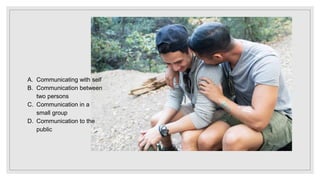
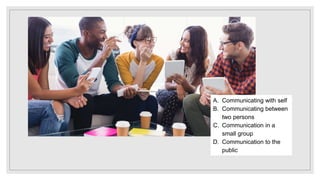
A. Communicating with self
B. Communication between
two persons
C. Communication in a
small group
D. Communication to the
public
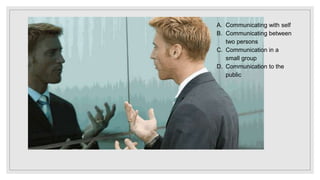
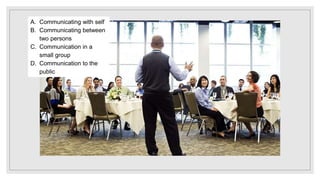
A. Communicating with self
B. Communicating between
two persons
C. Communication in a
small group
D. Communication to the
public
A. Communicating with self
B. Communicating between
two persons
C. Communication in a
small group
D. Communication to the
public
A. Communicating with self
B. Communicating between
two persons
C. Communication in a
small group
D. Communication to the
public
Activity 1:
Answer the questions as fast as you can.
Write the whole answer on your illustration board and after the
countdown, raise your board to show your answer.
This Photo by Unknown Author is licensed under CC BY-SA-NC
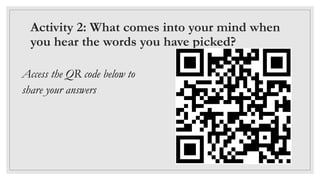
Activity 2: What comes into your mind when
you hear the words you have picked?
Access the QR code below to
share your answers
TYPES OF SPEECH CONTEXT
1. Intrapersonal – This refers to communication
that centers on one person where the speaker
acts both as the sender and the receiver of
message. “The message is made up of your
thoughts and feelings.
Example:
◦You spent the night thinking and analyzing
why a student from the other class talked
to you on the way home and you decided it
probably meant nothing.
TYPES OF SPEECH CONTEXT
2. Interpersonal – This refers to communication
between and among people and establishes
personal relationship between and among them.
Types of Interpersonal Context
Dyad Communication – communication that occurs
between two people
Example: You offered feedback on the speech
performance of your classmate. You provided
comfort to a friend who was feeling down.
Types of Interpersonal Context
Small Group – This refers to communication that
involves at least three but not more than twelve people
engaging in a face-to-face interaction to achieve a
desired goal. In this type of communication, all
participants can freely share ideas in a loose and open
discussion.
Example: You are participating in an organizational meeting
which aims to address the concerns of your fellow
students
TYPES OF SPEECH CONTEXT
3. Public – This type refers to communication
that requires you to deliver or send the message
before or in front of a group. The message can
be driven by informational or persuasive
purposes.
Example:
◦You deliver a graduation speech to your
batch.
◦You participate in a declamation,
oratorical, or debate contest watched by a
number of people.
TYPES OF SPEECH CONTEXT
4. Mass Communication – This refers to
communication that takes place through
television, radio, newspapers, magazines,
books, billboards, internet, and other types of
media.
Example:
You are a student journalist articulating your
stand on current issues through the
school’s newspaper.
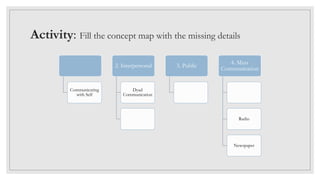
Activity: Fill the concept map with the missing details
1. Intrapersonal
Communicating
with Self
2. Interpersonal
Dyad
Communication
Small Group
3. Public
Delivering
message in front
of a group
4. Mass
Communication
TV
Radio
Newspaper
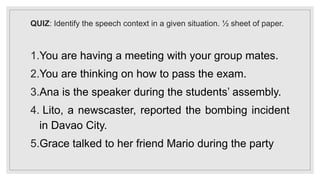
QUIZ: Identify the speech context in a given situation. ½ sheet of paper.
1.You are having a meeting with your group mates.
2.You are thinking on how to pass the exam.
3.Ana is the speaker during the students’ assembly.
4. Lito, a newscaster, reported the bombing incident
in Davao City.
5.Grace talked to her friend Mario during the party
Assignment:
Find two persons in your community, and conduct
an interview on his/her strategies in developing
his/her interpersonal and intrapersonal skills in the
workplace. Have a video recording of your
interview, after seeking the permission of your
interviewee. (This will be submitted on Thursday.)
REFLECTION
◦ The learners, in their notebook, journal or portfolio will write their personal
insights about the lesson using the prompts below.
I understand that . I realize that .

TYPES OF SPEECH CONTEXT.pptx

  • 1.
    TYPES OF SPEECH CONTEXT Unit1: Lesson 2 Oral Communication in Context
  • 2.
    TYPES OF SPEECHCONTEXT At the end of the lesson, learners are expected to: a. identify the various types of speech context (EN11/12OC-Ifj-15); a. exhibit appropriate verbal and non-verbal behavior in a given speech context (EN11/12OC-Ifj-16).
  • 3.
    A. Communicating withself B. Communication between two persons C. Communication in a small group D. Communication to the public
  • 4.
    A. Communicating withself B. Communicating between two persons C. Communication in a small group D. Communication to the public
  • 5.
    A. Communicating withself B. Communicating between two persons C. Communication in a small group D. Communication to the public
  • 6.
    A. Communicating withself B. Communicating between two persons C. Communication in a small group D. Communication to the public
  • 7.
    Activity 1: Answer thequestions as fast as you can. Write the whole answer on your illustration board and after the countdown, raise your board to show your answer.
  • 8.
    This Photo byUnknown Author is licensed under CC BY-SA-NC
  • 9.
    This Photo byUnknown Author is licensed under CC BY-SA-NC
  • 12.
    Activity 2: Whatcomes into your mind when you hear the words you have picked? Access the QR code below to share your answers
  • 13.
    TYPES OF SPEECHCONTEXT 1. Intrapersonal – This refers to communication that centers on one person where the speaker acts both as the sender and the receiver of message. “The message is made up of your thoughts and feelings.
  • 14.
    Example: ◦You spent thenight thinking and analyzing why a student from the other class talked to you on the way home and you decided it probably meant nothing.
  • 15.
    TYPES OF SPEECHCONTEXT 2. Interpersonal – This refers to communication between and among people and establishes personal relationship between and among them.
  • 16.
    Types of InterpersonalContext Dyad Communication – communication that occurs between two people Example: You offered feedback on the speech performance of your classmate. You provided comfort to a friend who was feeling down.
  • 17.
    Types of InterpersonalContext Small Group – This refers to communication that involves at least three but not more than twelve people engaging in a face-to-face interaction to achieve a desired goal. In this type of communication, all participants can freely share ideas in a loose and open discussion. Example: You are participating in an organizational meeting which aims to address the concerns of your fellow students
  • 18.
    TYPES OF SPEECHCONTEXT 3. Public – This type refers to communication that requires you to deliver or send the message before or in front of a group. The message can be driven by informational or persuasive purposes.
  • 19.
    Example: ◦You deliver agraduation speech to your batch. ◦You participate in a declamation, oratorical, or debate contest watched by a number of people.
  • 20.
    TYPES OF SPEECHCONTEXT 4. Mass Communication – This refers to communication that takes place through television, radio, newspapers, magazines, books, billboards, internet, and other types of media.
  • 21.
    Example: You are astudent journalist articulating your stand on current issues through the school’s newspaper.
  • 22.
    Activity: Fill theconcept map with the missing details 1. Intrapersonal Communicating with Self 2. Interpersonal Dyad Communication Small Group 3. Public Delivering message in front of a group 4. Mass Communication TV Radio Newspaper
  • 23.
    QUIZ: Identify thespeech context in a given situation. ½ sheet of paper. 1.You are having a meeting with your group mates. 2.You are thinking on how to pass the exam. 3.Ana is the speaker during the students’ assembly. 4. Lito, a newscaster, reported the bombing incident in Davao City. 5.Grace talked to her friend Mario during the party
  • 24.
    Assignment: Find two personsin your community, and conduct an interview on his/her strategies in developing his/her interpersonal and intrapersonal skills in the workplace. Have a video recording of your interview, after seeking the permission of your interviewee. (This will be submitted on Thursday.)
  • 25.
    REFLECTION ◦ The learners,in their notebook, journal or portfolio will write their personal insights about the lesson using the prompts below. I understand that . I realize that .