ASIA-PACIFIC TELECOMMUNITY
           The 9th Meeting of the APT Wireless Forum (AWF-9)   Document
                                                               AWF-9/INP-70
           13 – 16 September 2010, Seoul, Republic of Korea    13 September 2010


       SPECTRUM FEE BASED ON BANDWIDTH LICENSE APPROACH
                                          by

                           PT Telekomunikasi Indonesia


Contact:    ARIEF HAMDANI GUNAWAN                     Tel:
                                                      Fax:
            PT Telekomunikasi Indonesia               Email:
AWF-9/INP-70


                  Spectrum Fee
                  S     t   F
                    Based on
            Bandwidth License Approach
                      Arief Hamdani Gunawan
           Senior Officer – Telematics Regulation Proposal


       The 9th Meeting of the APT Wireless Forum (AWF-9)
                 Seoul, 13-16 September 2010


                              Agenda

• Telkom Indonesia
• Spectrum Fee Regime in Indonesia
   – Apparatus-License-Based Fee
   – Bandwidth-License-Based Fee

• Bandwidth Approaches
   – Network Capacity and Scarcity Resources
   – Exponential Growth in Wireless Communications
   – P f
     Performance P User b Format
                 Per U  by F   t
   – Urban and Rural Phenomena
   – Future Bandwidth Deployment


                                                             Page 1 of 10   1
AWF-9/INP-70


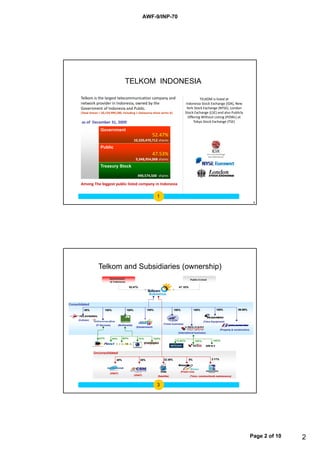
                                              TELKOM INDONESIA

       Telkom is the largest telecommunication company and                                                   TELKOM is listed at 
       network provider in Indonesia, owned by the                                                 Indonesia Stock Exchange (IDX), New 
       Government of Indonesia and Public. 
       Government of Indonesia and Public                                                           York Stock Exchange (NYSE), London 
                                                                                                    York Stock Exchange (NYSE) London
       (Total shares = 20,159,999,280, including 1 Dwiwarna share series A)                        Stock Exchange (LSE) and also Publicly
                                                                                                     Offering Without Listing (POWL) at 
        as of  December 31, 2009                                                                         Tokyo Stock Exchange (TSE)

                      Government
                                                                     52.47%
                                                        10,320,470,712 shares
                      Public
                                                                     47.53%
                                                         9,348,954,068 shares
                      Treasury Stock

                                                          490,574,500 shares

       Among The biggest public listed company in Indonesia

                                                                           1
                                                                                                                                                                 3


                    Telkom and Subsidiaries (ownership)
                               Government                                                               Public/Listed
                               of Indonesia

                                                  52.47%                                    47. 53%


Consolidated
          65%              100%                 100%              100%                   100%               100%                 100%              99.99%


     (Cellular)
                                                                                                                      (Telco Equipment)
                                                                                (Tower business)
                   (IT Services)         (Multimedia)
                                                         (Edutainment)
                                                                                                                                    (Property & construction)
                                                                                           (International business)

                     65%           60%      80%            75%           100%
                                                                                          15.86%               100%          100%

                                                                                                                       AWI B.V

                  Unconsolidated

                                     40%                    25%                 22.38%                 5%                   2.11%


                                                                                                (Fixed Line)
                               (VSAT)
                                                        (VSAT)             (Satellite)                  (Telco. construction& maintenance)


                                                                           3


                                                                                                                                                                Page 2 of 10   2
AWF-9/INP-70


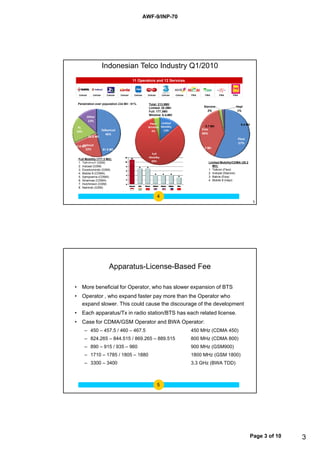
                           Indonesian Telco Industry Q1/2010
                                                    11 Operators and 12 Services


  Cellular      Cellular      Cellular   Cellular   Cellular    Cellular       Cellular   Cellular   FWA      FWA         FWA      FWA


 Penetration over population 234 Mil : 91%                       Total: 213.8Mil
                                                                 Limited: 28 2Mil
                                                                          28.2Mil                            Starone                 Hepi
                                                                                                                                       p
                                                                 Full: 177.3Mil                                2%                     1%
                                                                 Wireline: 8.4JMil
         Other
         13%
                                                                 Fixed  Limited                                                          0.4 Mil
 XL                                                             Wireline Mobility                             0.7 Mil
                           Telkomsel                              4%      13%                               Esia
19%
                              46%                                                                           40%
             23.6 Mil
                                                                                                                                      Flexi
                                                                                                                                      57%
      Indosat
32.6 Mil
        22%                                                                                                11.2 Mil
                           81.9 Mil
                                                                  Full 
                                                                 Mobility
                                                                   bili                                                               15.9 Mil
  Full Mobility (177.3 Mil):
                                                                  83%                                              Limited Mobility/CDMA (28.2
  1. Telkomsel (GSM)
        39.1 Mil
  2. Indosat (GSM)                                                                                                    Mil):
  3. Excelcomindo (GSM)                                                                                            1. Telkom (Flexi)
  4. Mobile 8 (CDMA)                                                                                               2. Indosat (Starone)
  5. Sampoerna (CDMA)                                                                                              3. Bakrie (Esia)
  6. Sinarmas (CDMA)                                                                                               4. Mobile 8 (Hepi)
  7. Hutchinson (GSM)
  8. Natrindo (GSM)


                                                                           4
                                                                                                                                                   5


                                Apparatus-License-Based Fee

• More beneficial for Operator, who has slower expansion of BTS
• Operator , who expand faster pay more than the Operator who
  expand slower. This could cause the discourage of the development
• Each apparatus/Tx in radio station/BTS has each related license.
• Case for CDMA/GSM Operator and BWA Operator:
       – 450 – 457.5 / 460 – 467.5                                                                   450 MHz (CDMA 450)
       – 824.265 – 844.515 / 869.265 – 889.515                                                       800 MHz (CDMA 800)
       – 890 – 915 / 935 – 960                                                                       900 MHz (GSM900)
                                                                                                         MH
       – 1710 – 1785 / 1805 – 1880                                                                   1800 MHz (GSM 1800)
       – 3300 – 3400                                                                                 3.3 GHz (BWA TDD)


                                                                           5


                                                                                                                                                 Page 3 of 10   3
AWF-9/INP-70


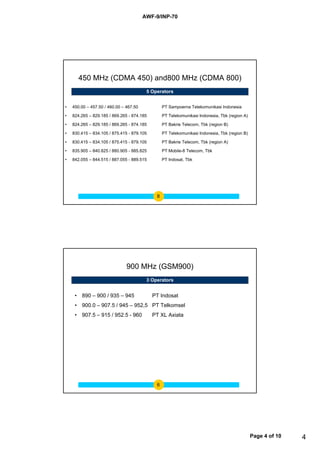
       450 MHz (CDMA 450) and800 MHz (CDMA 800)
                                         5 Operators


•   450.00 – 457.50 / 460.00 – 467.50            PT Sampoerna Telekomunikasi Indonesia

•   824.265 – 829.185 / 869.265 - 874.185        PT Telekomunikasi Indonesia, Tbk (region A)

•   824.265 – 829.185 / 869.265 - 874.185        PT Bakrie Telecom, Tbk (region B)

•   830.415 – 834.105 / 875.415 - 879.105        PT Telekomunikasi Indonesia, Tbk (region B)

•   830.415 – 834.105 / 875.415 - 879.105        PT Bakrie Telecom, Tbk (region A)

•   835.905 – 840.825 / 880.905 - 885.825        PT Mobile-8 Telecom, Tbk

•   842.055 – 844.515 / 887.055 - 889.515        PT Indosat, Tbk


                                             8


                               900 MHz (GSM900)
                                         3 Operators


     • 890 – 900 / 935 – 945                PT Indosat
     • 900.0 – 907.5 / 945 – 952,5 PT Telkomsel
     • 907.5 – 915 / 952.5 - 960            PT XL Axiata


                                             6


                                                                                               Page 4 of 10   4
AWF-9/INP-70


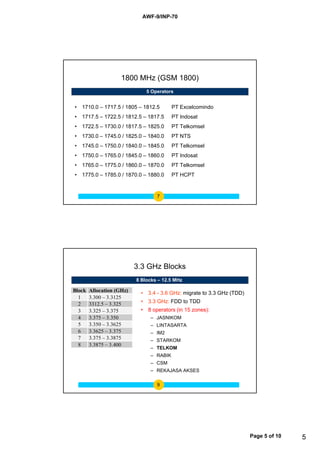
                     1800 MHz (GSM 1800)
                               5 Operators


• 1710 0 – 1717 5 / 1805 – 1812 5
  1710.0 1717.5            1812.5         PT Excelcomindo
• 1717.5 – 1722.5 / 1812.5 – 1817.5       PT Indosat
• 1722.5 – 1730.0 / 1817.5 – 1825.0       PT Telkomsel
• 1730.0 – 1745.0 / 1825.0 – 1840.0       PT NTS
• 1745.0 – 1750.0 / 1840.0 – 1845.0       PT Telkomsel
• 1750 0 – 1765 0 / 1845 0 – 1860 0
  1750.0 1765.0 1845.0 1860.0             PT Indosat
• 1765.0 – 1775.0 / 1860.0 – 1870.0       PT Telkomsel
• 1775.0 – 1785.0 / 1870.0 – 1880.0       PT HCPT


                                   7


                           3.3 GHz Blocks
                           8 Blocks – 12.5 MHz

Block   Allocation (GHz)    • 3.4 - 3.6 GHz: migrate to 3.3 GHz (TDD)
  1     3.300 3.3125
        3 300 – 3 3125
  2     3312.5 – 3.325      • 3.3 GHz: FDD to TDD
  3     3.325 – 3.375       • 8 operators (in 15 zones):
  4     3.375 – 3.350           – JASNIKOM
  5     3.350 – 3.3625          – LINTASARTA
  6     3.3625 – 3.375          – IM2
  7     3.375 – 3.3875          – STARKOM
  8     3.3875 3.400
        3 3875 – 3 400
                                – TELKOM
                                – RABIK
                                – CSM
                                – REKAJASA AKSES

                                   9


                                                                        Page 5 of 10   5
AWF-9/INP-70


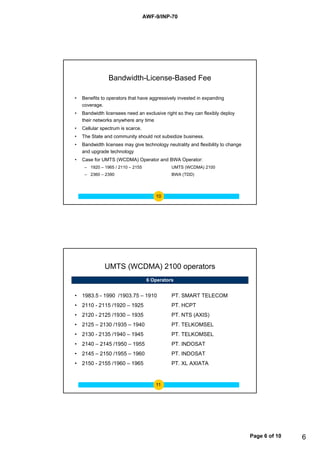
                Bandwidth-License-Based Fee

•   Benefits to operators that have aggressively invested in expanding
    coverage.
•   Bandwidth licensees need an exclusive right so they can flexibly deploy
    their networks anywhere any time
•   Cellular spectrum is scarce.
•   The State and community should not subsidize business.
•   Bandwidth licenses may give technology neutrality and flexibility to change
    and upgrade technology
•   Case for UMTS (WCDMA) Operator and BWA Operator:
     – 1920 – 1965 / 2110 – 2155              UMTS (WCDMA) 2100
     – 2360 – 2390                            BWA (TDD)


                                       10


              UMTS (WCDMA) 2100 operators
                                    6 Operators


• 1983 5 - 1990 /1903 75 – 1910
  1983.5        /1903.75                      PT.
                                              PT SMART TELECOM
• 2110 - 2115 /1920 – 1925                    PT. HCPT
• 2120 - 2125 /1930 – 1935                    PT. NTS (AXIS)
• 2125 – 2130 /1935 – 1940                    PT. TELKOMSEL
• 2130 - 2135 /1940 – 1945                    PT. TELKOMSEL
• 2140 – 2145 /1950 – 1955                    PT.
                                              PT INDOSAT
• 2145 – 2150 /1955 – 1960                    PT. INDOSAT
• 2150 - 2155 /1960 – 1965                    PT. XL AXIATA


                                       11


                                                                                  Page 6 of 10   6
AWF-9/INP-70


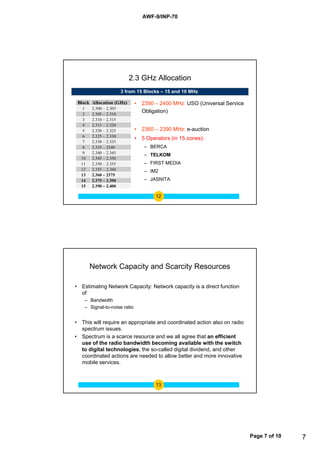
                          2.3 GHz Allocation
                       3 from 15 Blocks – 15 and 10 MHz

 Block Allocation (GHz)       • 2390 – 2400 MHz: USO (Universal Service
   1   2.300 2.305
       2 300 – 2 305
   2   2.305 – 2.310
                                Obligation)
   3   2.310 – 2.315
   4   2.315 – 2.320
   5   2.320 – 2.325          • 2360 – 2390 MHz: e-auction
   6   2.325 – 2.330
                              • 5 Operators (in 15 zones):
   7   2.330 – 2.335
   8   2.335 – 2340              – BERCA
   9   2.340 – 2.345
                                 – TELKOM
                                       O
  10   2.345 – 2.350
  11   2.350 – 2.355             – FIRST MEDIA
  12   2.355 – 2.360             – IM2
  13   2.360 – 2375
  14   2.375 – 2.390             – JASNITA
  15   2.390 – 2.400

                                      12


       Network Capacity and Scarcity Resources

• Estimating Network Capacity: Network capacity is a direct function
  of
    – Bandwidth
    – Signal-to-noise ratio


• This will require an appropriate and coordinated action also on radio
  spectrum issues.
• Spectrum is a scarce resource and we all agree that an efficient
  use of the radio bandwidth becoming available with the switch
                                         g
  to digital technologies, the so-called digital dividend, and other
  coordinated actions are needed to allow better and more innovative
  mobile services.


                                      13


                                                                          Page 7 of 10   7
AWF-9/INP-70


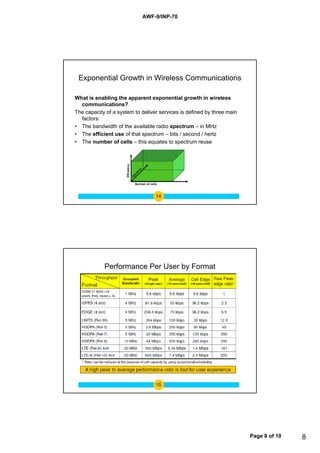
 Exponential Growth in Wireless Communications

What is enabling the apparent exponential growth in wireless
  communications?
The capacity of a system to deliver services is defined by three main
  factors:
• The bandwidth of the available radio spectrum – in MHz
• The efficient use of that spectrum – bits / second / hertz
• The number of cells – this equates to spectrum reuse


                                  14


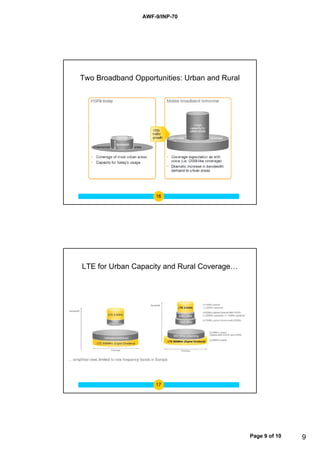
            Performance Per User by Format


                                  15


                                                                        Page 8 of 10   8
AWF-9/INP-70


Two Broadband Opportunities: Urban and Rural


                     16


LTE for Urban Capacity and Rural Coverage…


                     17


                                               Page 9 of 10   9
AWF-9/INP-70


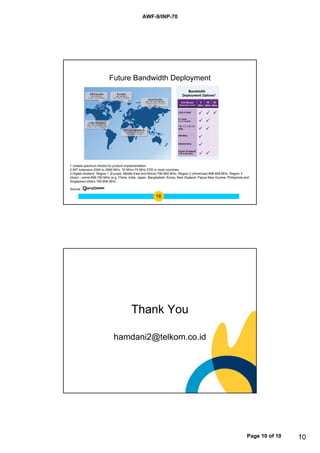
                         Future Bandwidth Deployment


1 Usable spectrum blocks for product implementation.
2 IMT extension 2500 to 2690 MHz, 70 MHz+70 MHz FDD in most countries.
3 Digital dividend; Region 1 (Europe, Middle East and Africa) 790-862 MHz, Region 2 (Americas) 698-806 MHz. Region 3
(Asia) – some 698-790 MHz (e.g. China, India, Japan, Bangladesh, Korea, New Zealand, Papua New Guinea, Philippines and
Singapore) others 790-806 MHz

Source:

                                                        18


                                        Thank You

                            hamdani2@telkom.co.id


                                                                                                                    Page 10 of 10   10

Spectrum fee based on bandwidth license approach

  • 1.
    ASIA-PACIFIC TELECOMMUNITY The 9th Meeting of the APT Wireless Forum (AWF-9) Document AWF-9/INP-70 13 – 16 September 2010, Seoul, Republic of Korea 13 September 2010 SPECTRUM FEE BASED ON BANDWIDTH LICENSE APPROACH by PT Telekomunikasi Indonesia Contact: ARIEF HAMDANI GUNAWAN Tel: Fax: PT Telekomunikasi Indonesia Email:
  • 2.
    AWF-9/INP-70 Spectrum Fee S t F Based on Bandwidth License Approach Arief Hamdani Gunawan Senior Officer – Telematics Regulation Proposal The 9th Meeting of the APT Wireless Forum (AWF-9) Seoul, 13-16 September 2010 Agenda • Telkom Indonesia • Spectrum Fee Regime in Indonesia – Apparatus-License-Based Fee – Bandwidth-License-Based Fee • Bandwidth Approaches – Network Capacity and Scarcity Resources – Exponential Growth in Wireless Communications – P f Performance P User b Format Per U by F t – Urban and Rural Phenomena – Future Bandwidth Deployment Page 1 of 10 1
  • 3.
    AWF-9/INP-70 TELKOM INDONESIA Telkom is the largest telecommunication company and  TELKOM is listed at  network provider in Indonesia, owned by the  Indonesia Stock Exchange (IDX), New  Government of Indonesia and Public.  Government of Indonesia and Public York Stock Exchange (NYSE), London  York Stock Exchange (NYSE) London (Total shares = 20,159,999,280, including 1 Dwiwarna share series A) Stock Exchange (LSE) and also Publicly Offering Without Listing (POWL) at  as of  December 31, 2009  Tokyo Stock Exchange (TSE) Government 52.47% 10,320,470,712 shares Public 47.53% 9,348,954,068 shares Treasury Stock 490,574,500 shares Among The biggest public listed company in Indonesia 1 3 Telkom and Subsidiaries (ownership) Government Public/Listed of Indonesia 52.47% 47. 53% Consolidated 65% 100% 100% 100% 100% 100% 100% 99.99% (Cellular) (Telco Equipment) (Tower business) (IT Services) (Multimedia) (Edutainment) (Property & construction) (International business) 65% 60% 80% 75% 100% 15.86% 100% 100% AWI B.V Unconsolidated 40% 25% 22.38% 5% 2.11% (Fixed Line) (VSAT) (VSAT) (Satellite) (Telco. construction& maintenance) 3 Page 2 of 10 2
  • 4.
    AWF-9/INP-70 Indonesian Telco Industry Q1/2010 11 Operators and 12 Services Cellular Cellular Cellular Cellular Cellular Cellular Cellular Cellular FWA FWA FWA FWA Penetration over population 234 Mil : 91% Total: 213.8Mil Limited: 28 2Mil 28.2Mil Starone Hepi p Full: 177.3Mil 2% 1% Wireline: 8.4JMil Other 13% Fixed  Limited  0.4 Mil XL Wireline Mobility 0.7 Mil Telkomsel 4% 13% Esia 19% 46% 40% 23.6 Mil Flexi 57% Indosat 32.6 Mil 22% 11.2 Mil 81.9 Mil Full  Mobility bili 15.9 Mil Full Mobility (177.3 Mil): 83% Limited Mobility/CDMA (28.2 1. Telkomsel (GSM) 39.1 Mil 2. Indosat (GSM) Mil): 3. Excelcomindo (GSM) 1. Telkom (Flexi) 4. Mobile 8 (CDMA) 2. Indosat (Starone) 5. Sampoerna (CDMA) 3. Bakrie (Esia) 6. Sinarmas (CDMA) 4. Mobile 8 (Hepi) 7. Hutchinson (GSM) 8. Natrindo (GSM) 4 5 Apparatus-License-Based Fee • More beneficial for Operator, who has slower expansion of BTS • Operator , who expand faster pay more than the Operator who expand slower. This could cause the discourage of the development • Each apparatus/Tx in radio station/BTS has each related license. • Case for CDMA/GSM Operator and BWA Operator: – 450 – 457.5 / 460 – 467.5 450 MHz (CDMA 450) – 824.265 – 844.515 / 869.265 – 889.515 800 MHz (CDMA 800) – 890 – 915 / 935 – 960 900 MHz (GSM900) MH – 1710 – 1785 / 1805 – 1880 1800 MHz (GSM 1800) – 3300 – 3400 3.3 GHz (BWA TDD) 5 Page 3 of 10 3
  • 5.
    AWF-9/INP-70 450 MHz (CDMA 450) and800 MHz (CDMA 800) 5 Operators • 450.00 – 457.50 / 460.00 – 467.50 PT Sampoerna Telekomunikasi Indonesia • 824.265 – 829.185 / 869.265 - 874.185 PT Telekomunikasi Indonesia, Tbk (region A) • 824.265 – 829.185 / 869.265 - 874.185 PT Bakrie Telecom, Tbk (region B) • 830.415 – 834.105 / 875.415 - 879.105 PT Telekomunikasi Indonesia, Tbk (region B) • 830.415 – 834.105 / 875.415 - 879.105 PT Bakrie Telecom, Tbk (region A) • 835.905 – 840.825 / 880.905 - 885.825 PT Mobile-8 Telecom, Tbk • 842.055 – 844.515 / 887.055 - 889.515 PT Indosat, Tbk 8 900 MHz (GSM900) 3 Operators • 890 – 900 / 935 – 945 PT Indosat • 900.0 – 907.5 / 945 – 952,5 PT Telkomsel • 907.5 – 915 / 952.5 - 960 PT XL Axiata 6 Page 4 of 10 4
  • 6.
    AWF-9/INP-70 1800 MHz (GSM 1800) 5 Operators • 1710 0 – 1717 5 / 1805 – 1812 5 1710.0 1717.5 1812.5 PT Excelcomindo • 1717.5 – 1722.5 / 1812.5 – 1817.5 PT Indosat • 1722.5 – 1730.0 / 1817.5 – 1825.0 PT Telkomsel • 1730.0 – 1745.0 / 1825.0 – 1840.0 PT NTS • 1745.0 – 1750.0 / 1840.0 – 1845.0 PT Telkomsel • 1750 0 – 1765 0 / 1845 0 – 1860 0 1750.0 1765.0 1845.0 1860.0 PT Indosat • 1765.0 – 1775.0 / 1860.0 – 1870.0 PT Telkomsel • 1775.0 – 1785.0 / 1870.0 – 1880.0 PT HCPT 7 3.3 GHz Blocks 8 Blocks – 12.5 MHz Block Allocation (GHz) • 3.4 - 3.6 GHz: migrate to 3.3 GHz (TDD) 1 3.300 3.3125 3 300 – 3 3125 2 3312.5 – 3.325 • 3.3 GHz: FDD to TDD 3 3.325 – 3.375 • 8 operators (in 15 zones): 4 3.375 – 3.350 – JASNIKOM 5 3.350 – 3.3625 – LINTASARTA 6 3.3625 – 3.375 – IM2 7 3.375 – 3.3875 – STARKOM 8 3.3875 3.400 3 3875 – 3 400 – TELKOM – RABIK – CSM – REKAJASA AKSES 9 Page 5 of 10 5
  • 7.
    AWF-9/INP-70 Bandwidth-License-Based Fee • Benefits to operators that have aggressively invested in expanding coverage. • Bandwidth licensees need an exclusive right so they can flexibly deploy their networks anywhere any time • Cellular spectrum is scarce. • The State and community should not subsidize business. • Bandwidth licenses may give technology neutrality and flexibility to change and upgrade technology • Case for UMTS (WCDMA) Operator and BWA Operator: – 1920 – 1965 / 2110 – 2155 UMTS (WCDMA) 2100 – 2360 – 2390 BWA (TDD) 10 UMTS (WCDMA) 2100 operators 6 Operators • 1983 5 - 1990 /1903 75 – 1910 1983.5 /1903.75 PT. PT SMART TELECOM • 2110 - 2115 /1920 – 1925 PT. HCPT • 2120 - 2125 /1930 – 1935 PT. NTS (AXIS) • 2125 – 2130 /1935 – 1940 PT. TELKOMSEL • 2130 - 2135 /1940 – 1945 PT. TELKOMSEL • 2140 – 2145 /1950 – 1955 PT. PT INDOSAT • 2145 – 2150 /1955 – 1960 PT. INDOSAT • 2150 - 2155 /1960 – 1965 PT. XL AXIATA 11 Page 6 of 10 6
  • 8.
    AWF-9/INP-70 2.3 GHz Allocation 3 from 15 Blocks – 15 and 10 MHz Block Allocation (GHz) • 2390 – 2400 MHz: USO (Universal Service 1 2.300 2.305 2 300 – 2 305 2 2.305 – 2.310 Obligation) 3 2.310 – 2.315 4 2.315 – 2.320 5 2.320 – 2.325 • 2360 – 2390 MHz: e-auction 6 2.325 – 2.330 • 5 Operators (in 15 zones): 7 2.330 – 2.335 8 2.335 – 2340 – BERCA 9 2.340 – 2.345 – TELKOM O 10 2.345 – 2.350 11 2.350 – 2.355 – FIRST MEDIA 12 2.355 – 2.360 – IM2 13 2.360 – 2375 14 2.375 – 2.390 – JASNITA 15 2.390 – 2.400 12 Network Capacity and Scarcity Resources • Estimating Network Capacity: Network capacity is a direct function of – Bandwidth – Signal-to-noise ratio • This will require an appropriate and coordinated action also on radio spectrum issues. • Spectrum is a scarce resource and we all agree that an efficient use of the radio bandwidth becoming available with the switch g to digital technologies, the so-called digital dividend, and other coordinated actions are needed to allow better and more innovative mobile services. 13 Page 7 of 10 7
  • 9.
    AWF-9/INP-70 Exponential Growthin Wireless Communications What is enabling the apparent exponential growth in wireless communications? The capacity of a system to deliver services is defined by three main factors: • The bandwidth of the available radio spectrum – in MHz • The efficient use of that spectrum – bits / second / hertz • The number of cells – this equates to spectrum reuse 14 Performance Per User by Format 15 Page 8 of 10 8
  • 10.
    AWF-9/INP-70 Two Broadband Opportunities:Urban and Rural 16 LTE for Urban Capacity and Rural Coverage… 17 Page 9 of 10 9
  • 11.
    AWF-9/INP-70 Future Bandwidth Deployment 1 Usable spectrum blocks for product implementation. 2 IMT extension 2500 to 2690 MHz, 70 MHz+70 MHz FDD in most countries. 3 Digital dividend; Region 1 (Europe, Middle East and Africa) 790-862 MHz, Region 2 (Americas) 698-806 MHz. Region 3 (Asia) – some 698-790 MHz (e.g. China, India, Japan, Bangladesh, Korea, New Zealand, Papua New Guinea, Philippines and Singapore) others 790-806 MHz Source: 18 Thank You hamdani2@telkom.co.id Page 10 of 10 10