INTRODUCTION
The telecom services have been recognized the world-over as an
important tool for socio-economic development for a nation. It is
one of the prime support services needed for rapid growth and
modernization of various sectors of the economy. Indian
telecommunication sector has undergone a major process of
transformation through significant policy reforms, particularly
beginning with the announcement of NTP 1994 and was
subsequently re-emphasized and carried forward under NTP
1999. Driven by various policy initiatives, the Indian telecom
sector witnessed a complete transformation in the last decade. It
has achieved a phenomenal growth during the last few years and
is poised to take a big leap in the future also.
The Indian Telecommunications network with 621 million
connections (as on March 2010) is the third largest in the world.
The sector is growing at a speed of 45% during the recent years.
This rapid growth is possible due to various proactive and
positive decisions of the Government and contribution of both
by the public and the private sectors. The rapid strides in the
telecom sector have been facilitated by liberal policies of the
Government that provides easy market access for telecom
equipment and a fair regulatory framework for offering telecom
services to the Indian consumers at affordable prices. Presently,
all the telecom services have been opened for private
participation.http://www.dot.gov.in/osp/Brochure/Brochure.htm

TATA TELESERVICES LTD.
Type           Public (BSE: 532371)

Industry       Telecommunications

Founded        1996

               Mumbai, Maharashtra,
Headquarters
               India


               Kishor Anant Chaukar
Key people     (Chairman)
               Narasimhan Srinat
               (Managing Director)

               Fixed-line and mobile
               telephony, broadband
               and fixed-line internet
Products
               services, digital
               television and network
               services

Revenue        31.91 billion
(US$580.76 million)
                (2011)

Parent          Tata Group

                Tata       DoCoMo
                (CDMA/GSM)Virgin
Divisions       Mobile        India
                (CDMA/GSM)


Communications is among the Tata Group's larger investments, with
over $7.5 billion already committed. The Group's objective is to provide
end-to-end telecommunications solutions for business and residential
customers across the nation and internationally. The Group's
communications activities are currently spread primarily over four
companies-Tata Teleservices Limited, its associate Tata Teleservices
(Maharashtra) Limited, Tata Communications (erstwhile VSNL) and
Tata Sky. Together, these companies cover the full range of
communications services, including:

     Telephony Services: Fixed and Mobile
     Media & Entertainment Services: Satellite TV
     Data Services: Leased Lines, Managed Data Networks, IP/MPLS
     VPN, Dial-up Internet, Wi-Fi and Broadband
     Value-added Services: Mobile and Broadband
     Content/Applications, Calling Cards, Net Telephony and Managed
     Services
     Infrastructure Services: Submarine Cable Bandwidth, Terrestrial
     Fiber Network and Satellite Earth Stations and VSAT Connectivity

The Tata Group includes over 100 companies, over 450,000 employees
worldwide and more than 3.8 million shareholders.
Incorporated in 1996, Tata Teleservices Limited was the pioneer of the
CDMA 1x technology platform in India, embarking on a growth path
after the acquisition of Hughes Tele.com (India) Ltd [renamed Tata
Teleservices (Maharashtra) Limited] by the Tata Group in 2002. Over
the last few years, the company has launched significant services CDMA
mobile operations in January 2005 under the brand name Tata Indicom,
market-defining wireless mobile broadband services under the brand
name Tata Photon in 2008 and 2G GSM services under the brand name
Tata DOCOMO in 2009.http://www.tatateleservices.com/t-aboutus-ttsl-organization.aspx


SCOPE AND GROWTH
    Tata Teleservices intends to invest over Rs 100 crore every year in
     developing and marketing solutions for small and medium
     businesses.
    The company has carved out a special business unit in order to
     give the desired degree of focus to this practice so that target the
     numerous SMB clusters in the country can be systematically
     targeted, according to Mr AG Rao, Executive President, Enterprise
     Business & Technology, Tata Teleservices.
    TTSL provides both wireless and wireline products that assist
     SMBs with their voice and data needs.
    It already had 20,000 SMB customers, many of whom prefer the
     „pay as you use' and „build as you go' model, said Mr Rao. By
     definition, many of the SME clusters are located in and around
     tier-two cities, be it Jalandhar (for sports goods), Nagpur (for
     powerloom and fabrication) or Coimbatore (machine tools).
    Going forward, TTSL's plan is to collaborate with handset makers
     and tablet manufacturers to offer SMB customers customised
     handheld devices that can be used on the go, said Mr Rao.
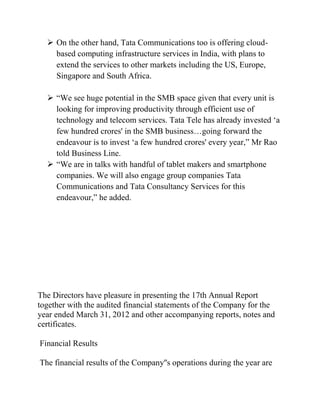
 On the other hand, Tata Communications too is offering cloud-
    based computing infrastructure services in India, with plans to
    extend the services to other markets including the US, Europe,
    Singapore and South Africa.

   “We see huge potential in the SMB space given that every unit is
    looking for improving productivity through efficient use of
    technology and telecom services. Tata Tele has already invested „a
    few hundred crores' in the SMB business…going forward the
    endeavour is to invest „a few hundred crores' every year,” Mr Rao
    told Business Line.
   “We are in talks with handful of tablet makers and smartphone
    companies. We will also engage group companies Tata
    Communications and Tata Consultancy Services for this
    endeavour,” he added.


The Directors have pleasure in presenting the 17th Annual Report
together with the audited financial statements of the Company for the
year ended March 31, 2012 and other accompanying reports, notes and
certificates.

Financial Results

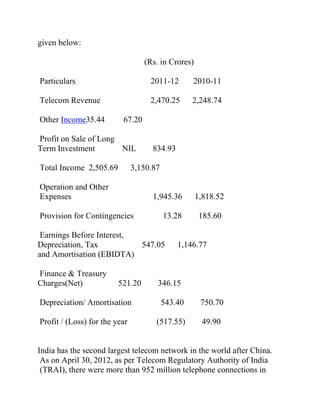
The financial results of the Company''s operations during the year are
given below:

                                  (Rs. in Crores)

Particulars                         2011-12        2010-11

Telecom Revenue                     2,470.25       2,248.74

Other Income35.44         67.20

Profit on Sale of Long
Term Investment        NIL           834.93

Total Income 2,505.69          3,150.87

Operation and Other
Expenses                             1,945.36       1,818.52

Provision for Contingencies               13.28      185.60

 Earnings Before Interest,
Depreciation, Tax          547.05             1,146.77
and Amortisation (EBIDTA)

Finance & Treasury
Charges(Net)             521.20       346.15

Depreciation/ Amortisation                543.40     750.70

Profit / (Loss) for the year          (517.55)       49.90


India has the second largest telecom network in the world after China.
 As on April 30, 2012, as per Telecom Regulatory Authority of India
 (TRAI), there were more than 952 million telephone connections in
the country of which 921 million were wireless connections and 31
million were Wireline connections. Approximately 8-10 million mobile
connections (SIMs) are being added every month. The national
tele-density is 78 per hundred.

Telecom

  • 1.
    INTRODUCTION The telecom serviceshave been recognized the world-over as an important tool for socio-economic development for a nation. It is one of the prime support services needed for rapid growth and
  • 2.
    modernization of varioussectors of the economy. Indian telecommunication sector has undergone a major process of transformation through significant policy reforms, particularly beginning with the announcement of NTP 1994 and was subsequently re-emphasized and carried forward under NTP 1999. Driven by various policy initiatives, the Indian telecom sector witnessed a complete transformation in the last decade. It has achieved a phenomenal growth during the last few years and is poised to take a big leap in the future also. The Indian Telecommunications network with 621 million connections (as on March 2010) is the third largest in the world. The sector is growing at a speed of 45% during the recent years. This rapid growth is possible due to various proactive and positive decisions of the Government and contribution of both by the public and the private sectors. The rapid strides in the telecom sector have been facilitated by liberal policies of the Government that provides easy market access for telecom equipment and a fair regulatory framework for offering telecom services to the Indian consumers at affordable prices. Presently, all the telecom services have been opened for private participation.http://www.dot.gov.in/osp/Brochure/Brochure.htm TATA TELESERVICES LTD.
  • 3.
    Type Public (BSE: 532371) Industry Telecommunications Founded 1996 Mumbai, Maharashtra, Headquarters India Kishor Anant Chaukar Key people (Chairman) Narasimhan Srinat (Managing Director) Fixed-line and mobile telephony, broadband and fixed-line internet Products services, digital television and network services Revenue 31.91 billion
  • 4.
    (US$580.76 million) (2011) Parent Tata Group Tata DoCoMo (CDMA/GSM)Virgin Divisions Mobile India (CDMA/GSM) Communications is among the Tata Group's larger investments, with over $7.5 billion already committed. The Group's objective is to provide end-to-end telecommunications solutions for business and residential customers across the nation and internationally. The Group's communications activities are currently spread primarily over four companies-Tata Teleservices Limited, its associate Tata Teleservices (Maharashtra) Limited, Tata Communications (erstwhile VSNL) and Tata Sky. Together, these companies cover the full range of communications services, including: Telephony Services: Fixed and Mobile Media & Entertainment Services: Satellite TV Data Services: Leased Lines, Managed Data Networks, IP/MPLS VPN, Dial-up Internet, Wi-Fi and Broadband Value-added Services: Mobile and Broadband Content/Applications, Calling Cards, Net Telephony and Managed Services Infrastructure Services: Submarine Cable Bandwidth, Terrestrial Fiber Network and Satellite Earth Stations and VSAT Connectivity The Tata Group includes over 100 companies, over 450,000 employees worldwide and more than 3.8 million shareholders.
  • 5.
    Incorporated in 1996,Tata Teleservices Limited was the pioneer of the CDMA 1x technology platform in India, embarking on a growth path after the acquisition of Hughes Tele.com (India) Ltd [renamed Tata Teleservices (Maharashtra) Limited] by the Tata Group in 2002. Over the last few years, the company has launched significant services CDMA mobile operations in January 2005 under the brand name Tata Indicom, market-defining wireless mobile broadband services under the brand name Tata Photon in 2008 and 2G GSM services under the brand name Tata DOCOMO in 2009.http://www.tatateleservices.com/t-aboutus-ttsl-organization.aspx SCOPE AND GROWTH  Tata Teleservices intends to invest over Rs 100 crore every year in developing and marketing solutions for small and medium businesses.  The company has carved out a special business unit in order to give the desired degree of focus to this practice so that target the numerous SMB clusters in the country can be systematically targeted, according to Mr AG Rao, Executive President, Enterprise Business & Technology, Tata Teleservices.  TTSL provides both wireless and wireline products that assist SMBs with their voice and data needs.  It already had 20,000 SMB customers, many of whom prefer the „pay as you use' and „build as you go' model, said Mr Rao. By definition, many of the SME clusters are located in and around tier-two cities, be it Jalandhar (for sports goods), Nagpur (for powerloom and fabrication) or Coimbatore (machine tools).  Going forward, TTSL's plan is to collaborate with handset makers and tablet manufacturers to offer SMB customers customised handheld devices that can be used on the go, said Mr Rao.
  • 6.
     On theother hand, Tata Communications too is offering cloud- based computing infrastructure services in India, with plans to extend the services to other markets including the US, Europe, Singapore and South Africa.  “We see huge potential in the SMB space given that every unit is looking for improving productivity through efficient use of technology and telecom services. Tata Tele has already invested „a few hundred crores' in the SMB business…going forward the endeavour is to invest „a few hundred crores' every year,” Mr Rao told Business Line.  “We are in talks with handful of tablet makers and smartphone companies. We will also engage group companies Tata Communications and Tata Consultancy Services for this endeavour,” he added. The Directors have pleasure in presenting the 17th Annual Report together with the audited financial statements of the Company for the year ended March 31, 2012 and other accompanying reports, notes and certificates. Financial Results The financial results of the Company''s operations during the year are
  • 7.
    given below: (Rs. in Crores) Particulars 2011-12 2010-11 Telecom Revenue 2,470.25 2,248.74 Other Income35.44 67.20 Profit on Sale of Long Term Investment NIL 834.93 Total Income 2,505.69 3,150.87 Operation and Other Expenses 1,945.36 1,818.52 Provision for Contingencies 13.28 185.60 Earnings Before Interest, Depreciation, Tax 547.05 1,146.77 and Amortisation (EBIDTA) Finance & Treasury Charges(Net) 521.20 346.15 Depreciation/ Amortisation 543.40 750.70 Profit / (Loss) for the year (517.55) 49.90 India has the second largest telecom network in the world after China. As on April 30, 2012, as per Telecom Regulatory Authority of India (TRAI), there were more than 952 million telephone connections in
  • 8.
    the country ofwhich 921 million were wireless connections and 31 million were Wireline connections. Approximately 8-10 million mobile connections (SIMs) are being added every month. The national tele-density is 78 per hundred.