TOPIC : SPECTRAL DETERMINATION OF
LOPERAMIDE HCL
Submitted To : Mr. Pratik Dash
Submitted By: Dipankar Patra
INTRODUCTION ABOUT VALIDATION
1. Validation is the process of establishing documentary evidence
demonstrating that a procedure, process, or activity carried out in
testing.
2. In the pharmaceutical industry, it is very important that in addition
to final testing and compliance of products.
3. it is assured that the process will consistently produce the
expected results.
4. The reason behind validation is "Establishing documented evidence
that provides a high degree of assurance that a specific process
will consistently produce .
INTRODUCTION ABOUT
SPECTROSCOPY
1. Spectroscopy is the study of the interaction between matter and
electromagnetic radiation.
2. Ultra violet visible spectroscopy refers to absorption spectroscopy
in the ultra violet spectral region which ranges from 200-400 nm.
This means it in the visible and adjacent ranges.
3. The basic parts of a spectrometer are a light source, a holder for
sample, a diffraction gration in a monochromator or a prism to
separate different wavelength of light and a detector.
4. These spectrometer are usually used in the quantitative analysis.
Such that determination of functional groups or carbon skeleton of
the molecule.
SPECTROPHOTOMETRIC METHOD
Spectrophotometric method of analysis is based on measuring the
absorption of a monochromatic light by colorless compounds in the
near ultraviolet path of spectrum (200-380nm).
The photometric methods of analysis are based on the Lambert-
Beer’s law, which establishes the absorbance of a solution is directly
proportional to the concentration of the analyte.
Important applications of spectrophotometer:
1. Identification of many types of organic, inorganic molecules and
ions.
2. Quantitative determination of many biological, organic and
inorganic species.
3. Quantitative determination of mixtures of analytes.
ULTRAVIOLET
SPECTROSCOPY
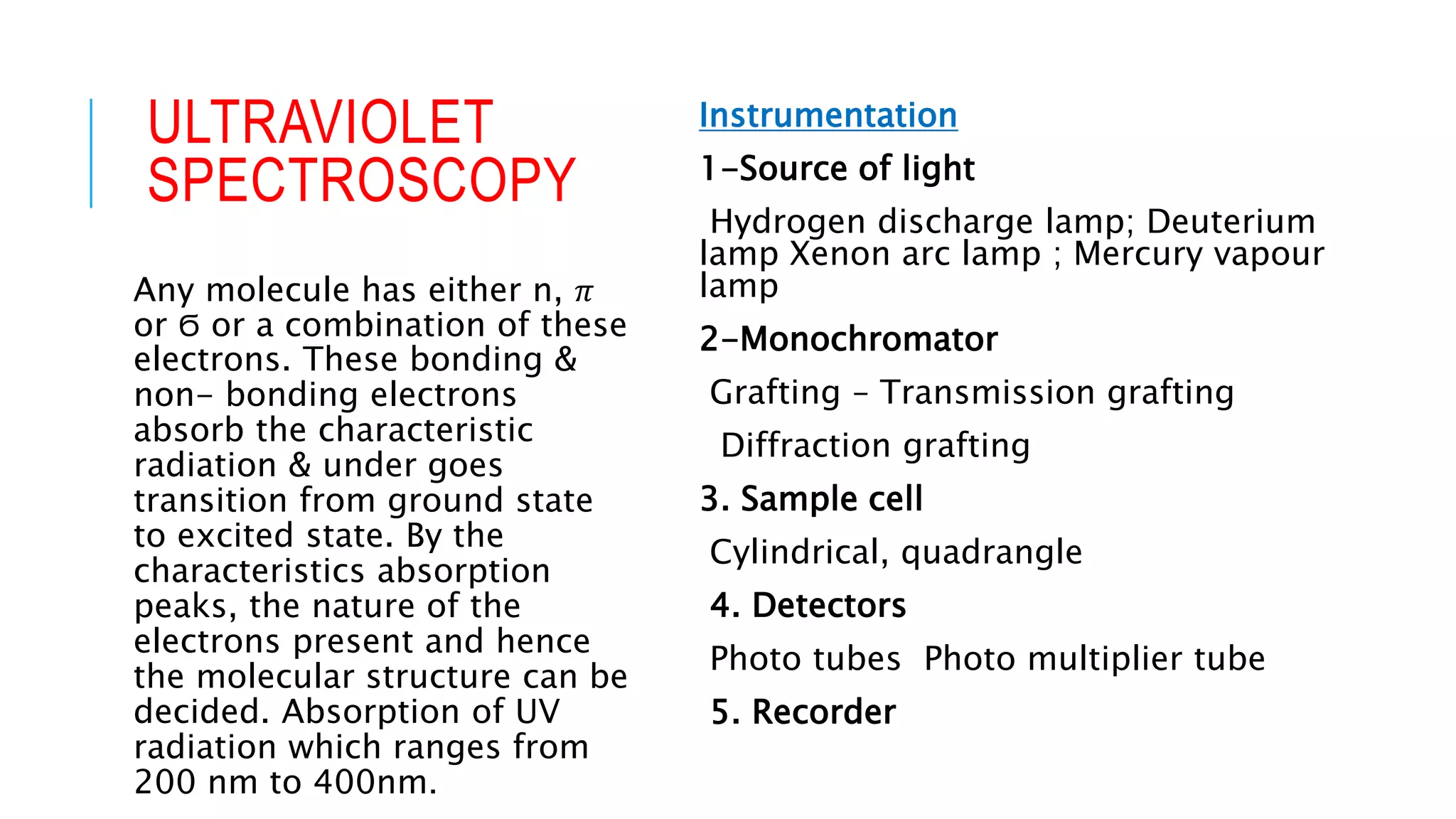
Instrumentation
1-Source of light
Hydrogen discharge lamp; Deuterium
lamp Xenon arc lamp ; Mercury vapour
lamp
2-Monochromator
Grafting – Transmission grafting
Diffraction grafting
3. Sample cell
Cylindrical, quadrangle
4. Detectors
Photo tubes Photo multiplier tube
5. Recorder
Any molecule has either n, 𝜋
or Ϭ or a combination of these
electrons. These bonding &
non- bonding electrons
absorb the characteristic
radiation & under goes
transition from ground state
to excited state. By the
characteristics absorption
peaks, the nature of the
electrons present and hence
the molecular structure can be
decided. Absorption of UV
radiation which ranges from
200 nm to 400nm.
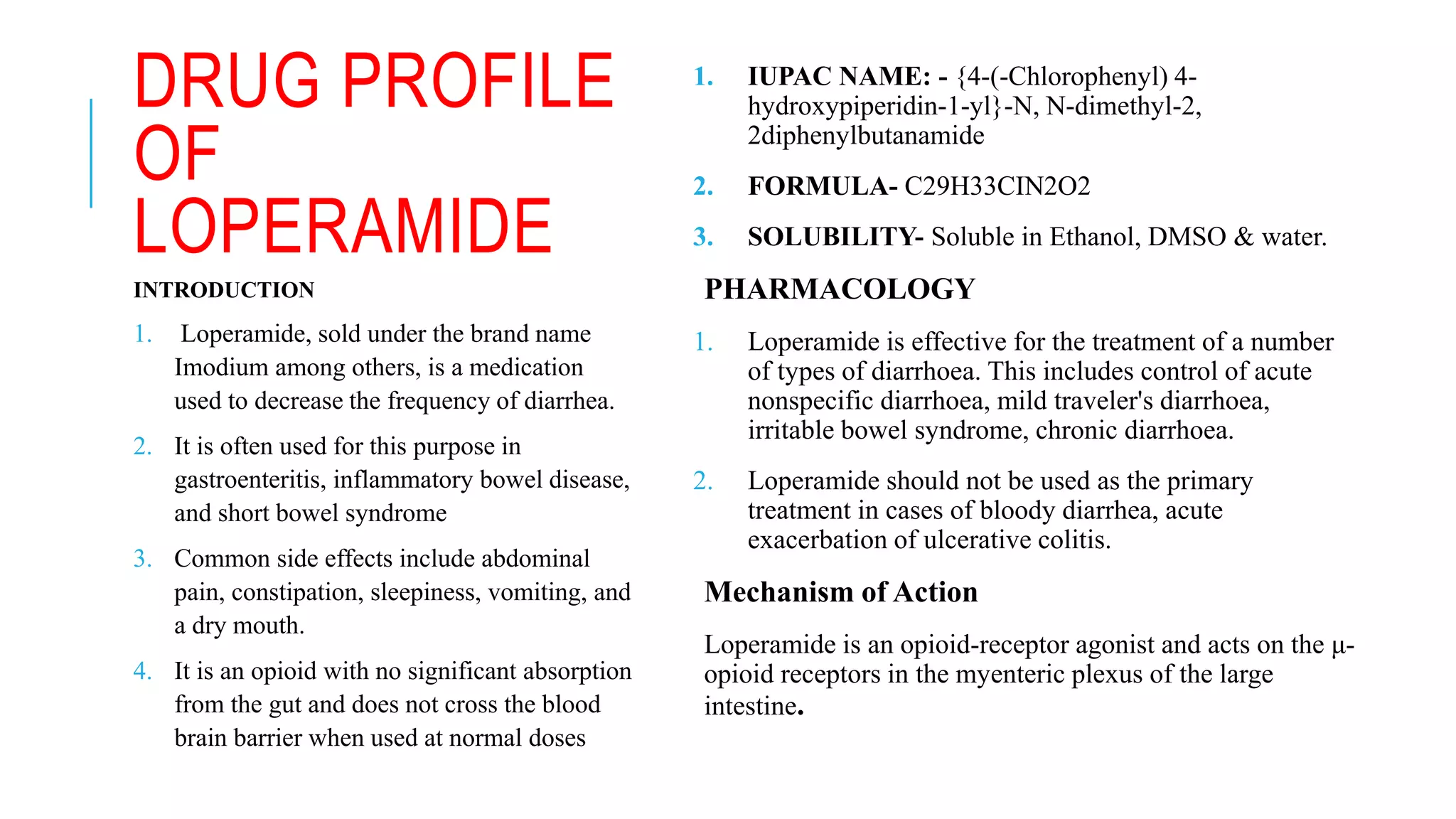
DRUG PROFILE
OF
LOPERAMIDE
1. IUPAC NAME: - {4-(-Chlorophenyl) 4-
hydroxypiperidin-1-yl}-N, N-dimethyl-2,
2diphenylbutanamide
2. FORMULA- C29H33CIN2O2
3. SOLUBILITY- Soluble in Ethanol, DMSO & water.
PHARMACOLOGY
1. Loperamide is effective for the treatment of a number
of types of diarrhoea. This includes control of acute
nonspecific diarrhoea, mild traveler's diarrhoea,
irritable bowel syndrome, chronic diarrhoea.
2. Loperamide should not be used as the primary
treatment in cases of bloody diarrhea, acute
exacerbation of ulcerative colitis.
Mechanism of Action
Loperamide is an opioid-receptor agonist and acts on the μ-
opioid receptors in the myenteric plexus of the large
intestine.
INTRODUCTION
1. Loperamide, sold under the brand name
Imodium among others, is a medication
used to decrease the frequency of diarrhea.
2. It is often used for this purpose in
gastroenteritis, inflammatory bowel disease,
and short bowel syndrome
3. Common side effects include abdominal
pain, constipation, sleepiness, vomiting, and
a dry mouth.
4. It is an opioid with no significant absorption
from the gut and does not cross the blood
brain barrier when used at normal doses
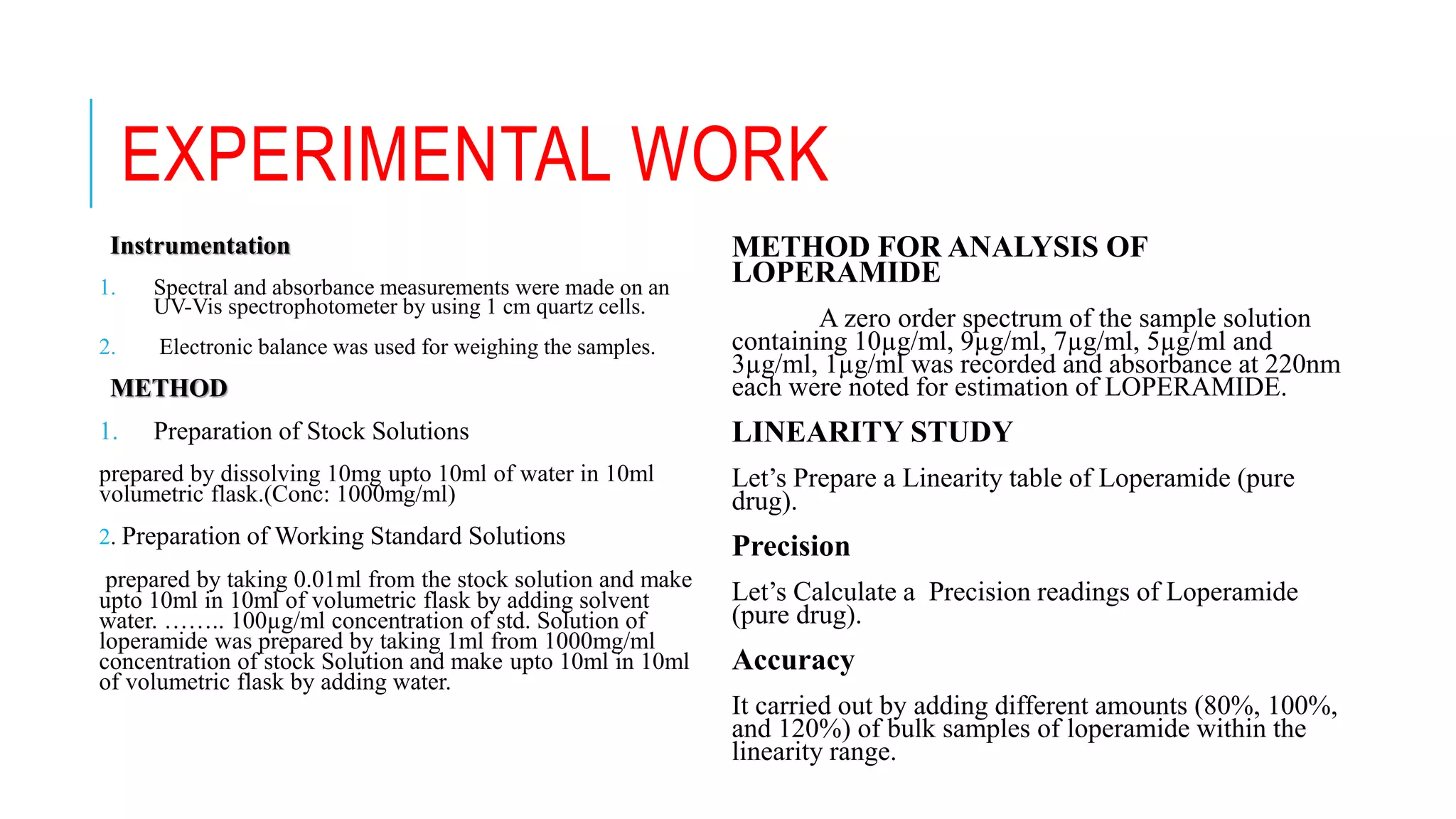
EXPERIMENTAL WORK
Instrumentation
1. Spectral and absorbance measurements were made on an
UV-Vis spectrophotometer by using 1 cm quartz cells.
2. Electronic balance was used for weighing the samples.
METHOD
1. Preparation of Stock Solutions
prepared by dissolving 10mg upto 10ml of water in 10ml
volumetric flask.(Conc: 1000mg/ml)
2. Preparation of Working Standard Solutions
prepared by taking 0.01ml from the stock solution and make
upto 10ml in 10ml of volumetric flask by adding solvent
water. …….. 100µg/ml concentration of std. Solution of
loperamide was prepared by taking 1ml from 1000mg/ml
concentration of stock Solution and make upto 10ml in 10ml
of volumetric flask by adding water.
METHOD FOR ANALYSIS OF
LOPERAMIDE
A zero order spectrum of the sample solution
containing 10µg/ml, 9µg/ml, 7µg/ml, 5µg/ml and
3µg/ml, 1µg/ml was recorded and absorbance at 220nm
each were noted for estimation of LOPERAMIDE.
LINEARITY STUDY
Let’s Prepare a Linearity table of Loperamide (pure
drug).
Precision
Let’s Calculate a Precision readings of Loperamide
(pure drug).
Accuracy
It carried out by adding different amounts (80%, 100%,
and 120%) of bulk samples of loperamide within the
linearity range.
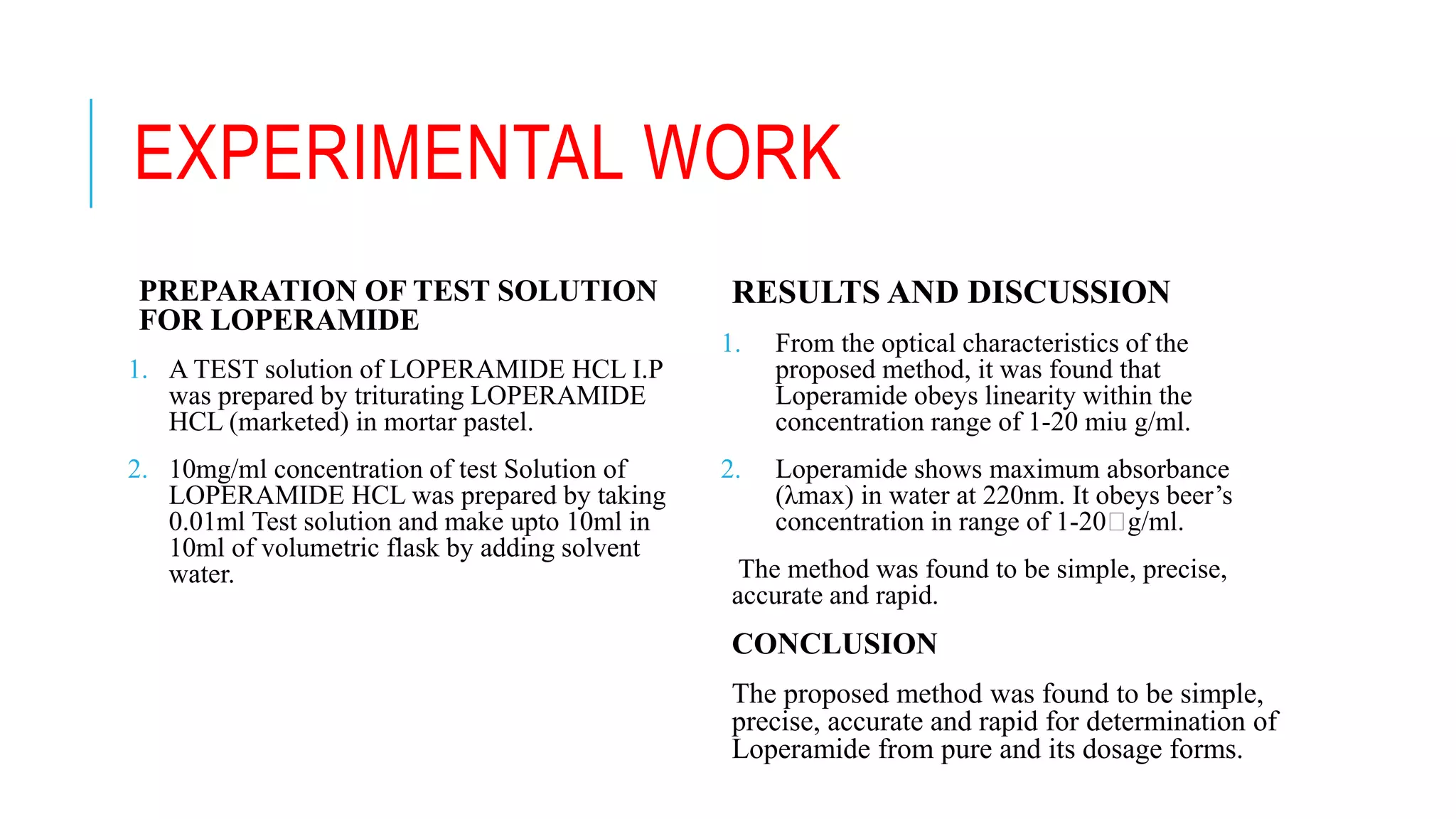
EXPERIMENTAL WORK
PREPARATION OF TEST SOLUTION
FOR LOPERAMIDE
1. A TEST solution of LOPERAMIDE HCL I.P
was prepared by triturating LOPERAMIDE
HCL (marketed) in mortar pastel.
2. 10mg/ml concentration of test Solution of
LOPERAMIDE HCL was prepared by taking
0.01ml Test solution and make upto 10ml in
10ml of volumetric flask by adding solvent
water.
RESULTS AND DISCUSSION
1. From the optical characteristics of the
proposed method, it was found that
Loperamide obeys linearity within the
concentration range of 1-20 miu g/ml.
2. Loperamide shows maximum absorbance
(λmax) in water at 220nm. It obeys beer’s
concentration in range of 1-20 g/ml.
The method was found to be simple, precise,
accurate and rapid.
CONCLUSION
The proposed method was found to be simple,
precise, accurate and rapid for determination of
Loperamide from pure and its dosage forms.

Spectral determination technique of loperamide hcl

  • 1.
    TOPIC : SPECTRALDETERMINATION OF LOPERAMIDE HCL Submitted To : Mr. Pratik Dash Submitted By: Dipankar Patra
  • 2.
    INTRODUCTION ABOUT VALIDATION 1.Validation is the process of establishing documentary evidence demonstrating that a procedure, process, or activity carried out in testing. 2. In the pharmaceutical industry, it is very important that in addition to final testing and compliance of products. 3. it is assured that the process will consistently produce the expected results. 4. The reason behind validation is "Establishing documented evidence that provides a high degree of assurance that a specific process will consistently produce .
  • 3.
    INTRODUCTION ABOUT SPECTROSCOPY 1. Spectroscopyis the study of the interaction between matter and electromagnetic radiation. 2. Ultra violet visible spectroscopy refers to absorption spectroscopy in the ultra violet spectral region which ranges from 200-400 nm. This means it in the visible and adjacent ranges. 3. The basic parts of a spectrometer are a light source, a holder for sample, a diffraction gration in a monochromator or a prism to separate different wavelength of light and a detector. 4. These spectrometer are usually used in the quantitative analysis. Such that determination of functional groups or carbon skeleton of the molecule.
  • 4.
    SPECTROPHOTOMETRIC METHOD Spectrophotometric methodof analysis is based on measuring the absorption of a monochromatic light by colorless compounds in the near ultraviolet path of spectrum (200-380nm). The photometric methods of analysis are based on the Lambert- Beer’s law, which establishes the absorbance of a solution is directly proportional to the concentration of the analyte. Important applications of spectrophotometer: 1. Identification of many types of organic, inorganic molecules and ions. 2. Quantitative determination of many biological, organic and inorganic species. 3. Quantitative determination of mixtures of analytes.
  • 5.
    ULTRAVIOLET SPECTROSCOPY Instrumentation 1-Source of light Hydrogendischarge lamp; Deuterium lamp Xenon arc lamp ; Mercury vapour lamp 2-Monochromator Grafting – Transmission grafting Diffraction grafting 3. Sample cell Cylindrical, quadrangle 4. Detectors Photo tubes Photo multiplier tube 5. Recorder Any molecule has either n, 𝜋 or Ϭ or a combination of these electrons. These bonding & non- bonding electrons absorb the characteristic radiation & under goes transition from ground state to excited state. By the characteristics absorption peaks, the nature of the electrons present and hence the molecular structure can be decided. Absorption of UV radiation which ranges from 200 nm to 400nm.
  • 6.
    DRUG PROFILE OF LOPERAMIDE 1. IUPACNAME: - {4-(-Chlorophenyl) 4- hydroxypiperidin-1-yl}-N, N-dimethyl-2, 2diphenylbutanamide 2. FORMULA- C29H33CIN2O2 3. SOLUBILITY- Soluble in Ethanol, DMSO & water. PHARMACOLOGY 1. Loperamide is effective for the treatment of a number of types of diarrhoea. This includes control of acute nonspecific diarrhoea, mild traveler's diarrhoea, irritable bowel syndrome, chronic diarrhoea. 2. Loperamide should not be used as the primary treatment in cases of bloody diarrhea, acute exacerbation of ulcerative colitis. Mechanism of Action Loperamide is an opioid-receptor agonist and acts on the μ- opioid receptors in the myenteric plexus of the large intestine. INTRODUCTION 1. Loperamide, sold under the brand name Imodium among others, is a medication used to decrease the frequency of diarrhea. 2. It is often used for this purpose in gastroenteritis, inflammatory bowel disease, and short bowel syndrome 3. Common side effects include abdominal pain, constipation, sleepiness, vomiting, and a dry mouth. 4. It is an opioid with no significant absorption from the gut and does not cross the blood brain barrier when used at normal doses
  • 7.
    EXPERIMENTAL WORK Instrumentation 1. Spectraland absorbance measurements were made on an UV-Vis spectrophotometer by using 1 cm quartz cells. 2. Electronic balance was used for weighing the samples. METHOD 1. Preparation of Stock Solutions prepared by dissolving 10mg upto 10ml of water in 10ml volumetric flask.(Conc: 1000mg/ml) 2. Preparation of Working Standard Solutions prepared by taking 0.01ml from the stock solution and make upto 10ml in 10ml of volumetric flask by adding solvent water. …….. 100µg/ml concentration of std. Solution of loperamide was prepared by taking 1ml from 1000mg/ml concentration of stock Solution and make upto 10ml in 10ml of volumetric flask by adding water. METHOD FOR ANALYSIS OF LOPERAMIDE A zero order spectrum of the sample solution containing 10µg/ml, 9µg/ml, 7µg/ml, 5µg/ml and 3µg/ml, 1µg/ml was recorded and absorbance at 220nm each were noted for estimation of LOPERAMIDE. LINEARITY STUDY Let’s Prepare a Linearity table of Loperamide (pure drug). Precision Let’s Calculate a Precision readings of Loperamide (pure drug). Accuracy It carried out by adding different amounts (80%, 100%, and 120%) of bulk samples of loperamide within the linearity range.
  • 8.
    EXPERIMENTAL WORK PREPARATION OFTEST SOLUTION FOR LOPERAMIDE 1. A TEST solution of LOPERAMIDE HCL I.P was prepared by triturating LOPERAMIDE HCL (marketed) in mortar pastel. 2. 10mg/ml concentration of test Solution of LOPERAMIDE HCL was prepared by taking 0.01ml Test solution and make upto 10ml in 10ml of volumetric flask by adding solvent water. RESULTS AND DISCUSSION 1. From the optical characteristics of the proposed method, it was found that Loperamide obeys linearity within the concentration range of 1-20 miu g/ml. 2. Loperamide shows maximum absorbance (λmax) in water at 220nm. It obeys beer’s concentration in range of 1-20 g/ml. The method was found to be simple, precise, accurate and rapid. CONCLUSION The proposed method was found to be simple, precise, accurate and rapid for determination of Loperamide from pure and its dosage forms.