1
CENTRIFUGAL PUMP AND PUMPING SYSTEM
A report submitted to the Department of Mechanical Engineering, Khulna University of
Engineering & Technology in partial fulfillment of the requirements for the
“Course of ME 3100”
Supervised by Submitted by
Dr. Abdullah Al Faruk MD. Mahedi Hasan
Assistant Professor Roll: 1405024
Section: A
July 2017
Department of Mechanical Engineering
Khulna University of Engineering & Technology
Khulna 9203, Bangladesh
2
Acknowledgement
All the praises to the almighty who makes author capable to complete this Special work
successfully. The author is very much indebted to his course Dr. Abdullah Al Faruk, assistant
professor of Department of Mechanical Engineering, Khulna University of Engineering &
Technology, Bangladesh, for his wise inspiration to do such extraordinary special work. The
author expresses the heart- felt respect to him for his proper guidance and all kind of support to
perform and complete this special study.
The author is extremely grateful to Prof. Golam Kader, Head of the department of Mechanical
Engineering Khulna University of Engineering & Technology, Bangladesh, to provide such
a good opportunity to do the special work and for providing all other supports.
May ALLAH bless the course teacher.
“Author”
3
Abstract
The report introduces and describes the principle of centrifugal pump and its performance.
Centrifugal pumps are used to transport fluids by the conversion of rotational kinetic energy to the
hydrodynamic energy of the fluid flow. Its common usages as a sewage, petroleum and
petrochemical pumping. The mechanical energy is converted into pressure energy by means of
centrifugal force acting on the fluid, the hydraulic machine is called “Centrifugal Pump”. Its
works on a principle of vortex flow. The centrifugal pumps acts as a reversal of an inward radial
flow reaction turbine. It means the flow in centrifugal pumps is in radial outward direction. The
mains of centrifugal pumps are impeller, casing, shaft, shaft sealings, bearings etc.
A centrifugal pump converts rotational energy, often from a motor, to energy in a moving fluid.
A portion of the energy goes into kinetic energy of the fluid. Fluid enters axially through eye of
the casing, is caught up in the impeller blades, and is whirled tangentially and radially outward
until it leaves through all circumferential parts of the impeller into the diffuser part of the casing.
The fluid gains both velocity and pressure while passing through the impeller. The doughnut
shaped diffuser, or scroll, section of the casing decelerates the flow and further increases the
pressure.
4
Table of Contents
Title Page
Acknowledgements ................................................................................................................. 1
Abstract.................................................................................................................................... 3
List of Figure ........................................................................................................................... 6
List of Tables........................................................................................................................... 6
Report on Centrifugal Pump and pumping System
Title Page
1.0 Introduction .................................................................................................................. 8
3.0 Historical Background.................................................................................................. 8
4.0 Types of Pump ............................................................................................................ 9
4.1 Vertical centrifugal pumps.................................................................................... 9
4.2 Froth pumps ................................................................................................... 9
4.3 Multistage centrifugal pumps............................................................. 10
4.4 Magnetically coupled pumps .................................................... 11
4.5 Self priming centrifugal pump .......................................... 11
5.0 Applications................................................................................................................ 12
5
7.0 Energy usage .................................................................................................................. 16
8.0 Efficiency ................................................................................................................... 18
9.0 Main Parts of a Centrifugal machine.......................................................................... 19
9.1 Types of Impellers in Centrifugal Pumps ............................................... 23
10.0 Working Principle .................................................................................................... 25
11.0 Advantages and Disadvantage.................................................................................. 29
11.1 Advantages of centrifugal pump ..................................................................... 29
11.2 Disadvantages of centrifugal pump ........................................................ 29
12.0 Conclusion................................................................................................................ 29
13.0 References ................................................................................................................ 30
14.0 Article and Images sources....................................................................................... 31
6
List of Figures
Figure Title Page
Figure 1: Forth Pumps ................................................................................................................. 10
Figure 2: Multistage centrifugal pump ........................................................................................ 10
Figure 3: Magnetically coupled pumps........................................................................................ 11
Figure 4: Self Priming pump........................................................................................................ 12
Figure 5: Soda Fountain machine ................................................................................................. 14
Figure 6: Pie chart for maintenance cost of a pump. ................................................................... 15
Figure 07: Velocity diagram ........................................................................................................ 18
Figure 8: Various parts of a centrifugal pump............................................................................. 20
Figure 9: Impeller ........................................................................................................................ 21
Figure 10: Casing ........................................................................................................................ 21
Figure 11: Shaft ........................................................................................................................... 22
Figure 12: Shaft sealing ............................................................................................................... 22
Figure 13: Bearings...................................................................................................................... 23
Figure 14: Types Of impeller....................................................................................................... 24
Figure 15: Impellers..................................................................................................................... 25
Figure 16: Working manual......................................................................................................... 26
Figure 17: Fluid Flow diagram .................................................................................................... 27
Figure 18: A working Centrifugal Pump ..................................................................................... 28
7
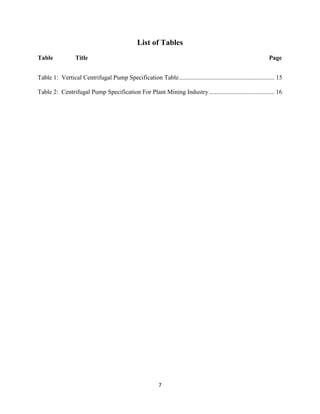
List of Tables
Table Title Page
Table 1: Vertical Centrifugal Pump Specification Table............................................................. 15
Table 2: Centrifugal Pump Specification For Plant Mining Industry.......................................... 16
8
1.0 Introduction
A centrifugal pump is a rotodynamic pump that uses a rotating impeller to increase the pressure
of a fluid. Centrifugal pumps are commonly used to move liquids through a piping system. The
fluid enters the pump impeller along or near to the rotating axis and is accelerated by the impeller,
flowing radially outward into a diffuser or volute chamber (casing), from where it exits into
the downstream piping system. Centrifugal pumps are used for large discharge through smaller
heads.
Centrifugal pump are a sub class of dynamic work, absorbing turbomachinery. Centrifugal pumps
are used to transport fluids by the conversion of rotational kinetic energy to the hydrodynamic
energy of the fluid flow. The rotational energy typically comes from an engine or electric motor.
The fluid enters the pump impeller along or near to the rotating axis and is accelerated by the
impeller, flowing radially outward into a diffuser or volute chamber (casing), from where it
exits.
Common uses include water, sewage, petroleum and petrochemical pumping; a centrifugal fan is
commonly used to implement a vacuum cleaner. The reverse function of the centrifugal pump is
a water turbine converting potential energy of water pressure into mechanical rotational energy.
2.0 Objectives
The objective of this study is to-
i. To study on Centrifugal pump and its components.
ii. To become familiar with centrifugal pump operations.
iii. To explore the applications of centrifugal pump.
3.0 Historical Background
According to Reti, the Brazilian soldier and historian of science, the first machine that could be
characterized as a centrifugal pump was a mud lifting machine which appeared as early as 1475 in
a treatise by the Italian Renaissance engineer Francesco di Giorgio Martini.True centrifugal
pumps were not developed until the late 17th century, when Denis Papin made one with straight
vanes. The curved vane was introduced by British inventor John Appold in 1851.
9
4.0 Types of Pump
4.1 Vertical centrifugal pumps
Vertical centrifugal pumps are also referred to as cantilever pumps. They utilize a unique shaft
and bearing support configuration that allows the volute to hang in the sump while the bearings
are outside the sump. This style of pump uses no stuffing box to seal the shaft but instead utilizes
a "throttle bushing". A common application for this style of pump is in a parts washer.
Figure 1: Vertical centrifugal pump
4.2 Froth pumps
In the mineral industry, or in the extraction of oils and, froth is generated to separate the rich
minerals or bitumen from the sand and clays. Froth contains air that tends to block conventional
pumps and cause loss of prime. Over history, industry has developed different ways to deal with
this problem. In the pulp and paper industry holes are drilled in the impeller. Air escapes to the
back of the impeller and a special expeller discharges the air back to the suction tank. The impeller
may also feature special small vanes between the primary vanes called split vanes or secondary
vanes. Some pumps may feature a large eye, an inducer or recirculation of pressurized froth from
the pump discharge back to the suction to break the bubbles.
10
Figure 1: Forth Pumps
4.3 Multistage centrifugal pumps
Figure 2: Multistage centrifugal pump
A centrifugal pump containing two or more impellers is called a multistage centrifugal pump. The
impellers may be mounted on the same shaft or on different shafts. At each stage, the fluid is
directed to the center before making its way to the discharge on the outer diameter.
For higher pressures at the outlet, impellers can be connected in series. For higher flow output,
impellers can be connected parallel.
A common application of the multistage centrifugal pump is the boiler feedwater pump. For
example, a 350 MW unit would require two feed pumps in parallel. Each feed pump is a
multistage centrifugal pump producing 150 l/s at 21 MPa.
11
All energy transferred to the fluid is derived from the mechanical energy driving the impeller.
This can be measured at isentropic compression, resulting in a slight temperature increase (in
addition to the pressure increase).
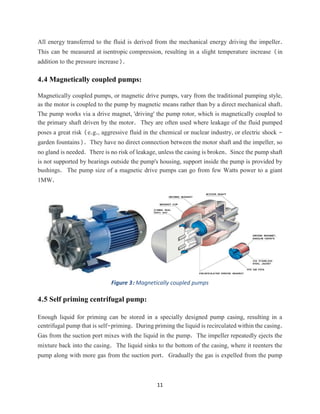
4.4 Magnetically coupled pumps:
Magnetically coupled pumps, or magnetic drive pumps, vary from the traditional pumping style,
as the motor is coupled to the pump by magnetic means rather than by a direct mechanical shaft.
The pump works via a drive magnet, 'driving' the pump rotor, which is magnetically coupled to
the primary shaft driven by the motor. They are often used where leakage of the fluid pumped
poses a great risk (e.g., aggressive fluid in the chemical or nuclear industry, or electric shock -
garden fountains). They have no direct connection between the motor shaft and the impeller, so
no gland is needed. There is no risk of leakage, unless the casing is broken. Since the pump shaft
is not supported by bearings outside the pump's housing, support inside the pump is provided by
bushings. The pump size of a magnetic drive pumps can go from few Watts power to a giant
1MW.
Figure 3: Magnetically coupled pumps
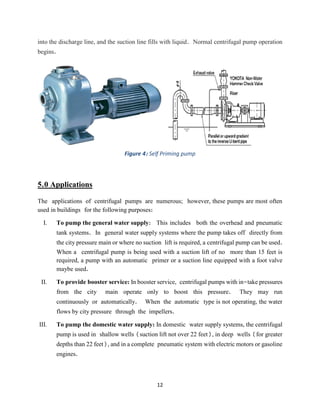
4.5 Self priming centrifugal pump:
Enough liquid for priming can be stored in a specially designed pump casing, resulting in a
centrifugal pump that is self-priming. During priming the liquid is recirculated within the casing.
Gas from the suction port mixes with the liquid in the pump. The impeller repeatedly ejects the
mixture back into the casing. The liquid sinks to the bottom of the casing, where it reenters the
pump along with more gas from the suction port. Gradually the gas is expelled from the pump
12
into the discharge line, and the suction line fills with liquid. Normal centrifugal pump operation
begins.
Figure 4: Self Priming pump
5.0 Applications
The applications of centrifugal pumps are numerous; however, these pumps are most often
used in buildings for the following purposes:
I. To pump the general water supply: This includes both the overhead and pneumatic
tank systems. In general water supply systems where the pump takes off directly from
the city pressure main or where no suction lift is required, a centrifugal pump can be used.
When a centrifugal pump is being used with a suction lift of no more than 15 feet is
required, a pump with an automatic primer or a suction line equipped with a foot valve
maybe used.
II. To provide booster service: In booster service, centrifugal pumps with in-take pressures
from the city main operate only to boost this pressure. They may run
continuously or automatically. When the automatic type is not operating, the water
flows by city pressure through the impellers.
III. To pump the domestic water supply: In domestic water supply systems, the centrifugal
pump is used in shallow wells (suction lift not over 22 feet), in deep wells (for greater
depths than 22 feet), and in a complete pneumatic system with electric motors or gasoline
engines.
13
IV. To support the fire protection systems: Fire pumps usually are the centrifugal type,
either single or multi stage. Electricity, steam, or gasoline may drive them. Whatever
the power supply, it must be permanent and, if steam, must have a constant minimum
pressure of 50 pounds of steam. The pumps should agree with the specifications of the
NFPA. Booster fire pumps have a low head to boost the pressure of the already
available city supply
V. To provide a hot-water circulating service: Hot-water circulating pumps are
centrifugal. They move water in a closed system and thus usually require only a low
head, though the static pressure in the systems maybe high. The pumps should be selected
with attention to strength of casing, efficient stuffing box, freedom from
air and vapor binding, and flexible mounting.
VI. To provide sump drainage: Sump pumps are not classified as sewage pumps; however,
they can be used as such. They may be vertical or horizontal centrifugal. The vertical
type sump pump usually has the impeller submerged and the motor mounted above the
pit. Units are equipped with an automatic switch operated by the float and are available
in single or duplex type.
VII. In commercial soda Industry: In corporate industry a soda fountain machine is a popular
name which works under the same principle of centrifugal pumping for incompressible
fluid. A soda fountain is a device that dispenses carbonated soft drinks, called fountain
drinks. They can be found in restaurants, concession stands and other locations such
as convenience stores. The device combines flavored syrup or
syrup concentrate and carbon dioxide with chilled and purified water to make soft drinks,
either manually, or in a vending machine which is essentially an automated soda fountain
that is operated using a soda gun. Today, the syrup often is pumped from a special
container called a bag-in-box.
The two secret ingredients to making carbonated water, it turns out, are pressure and
temperature. If carbon dioxide is mixed with very cold water in a sealed, high-pressure
environment, the elements will successfully combine. The first man to invent such a
pressurized carbonation system was Johann Jacob Schweppe, a Swiss scientist who
developed a hand-cranked compression pump back in 1783 and whose name still graces
bottles of fizzy ginger ale and club soda .
The scientific process of carbonation requires water and carbon dioxide to be pressurized
in a sealed chamber to seven times the normal atmospheric pressure. At that point,
individual molecules of C02 begin to separate and surround themselves with water
14
molecules [source: Discovery]. Under those extreme conditions, the gas fully dissolves
in the liquid.
The temperature of water at carbonation is also critical. Water that's carbonated at near-
freezing temperature (32 degrees Fahrenheit or 0 degrees Celsius) can hold five times
as much C02as water that's carbonated at 140 degrees F (60 degrees C).
Inside the pressure chamber, carbonated water has absolutely no fizz. The bubbles only
emerge when the liquid is released from the chamber back into normal atmospheric
pressure. Carbonated water contains 16,000 times more C02than regular water, roughly
five "glasses" of C02 for every glass of water. When you pop the cap on a soda bottle,
the release of pressure causes all of those dissolved C02 molecules to become gas again
and rush to escape through the surface of the liquid as bubbles.
Figure 5: Soda Fountain machine
VIII. In Household work: Centrifugal pumps are used in buildings for pumping the general
water supply, as a booster and for domestic water supplies.
IX. In Sewage system: The design of a centrifugal pump makes them useful
for pumping sewage and slurries.
X. For controlling process: They are also used in fire protection systems and for heating
and cooling applications.
6.0 Specifications
Centrifugal pumps are commonly rated by horsepower, flow rate, outlet pressure in metres (or
feet) of head, inlet suction in suction feet (or metres) of head. The head can be simplified as
15
the number of feet or metres the pump can raise or lower a column of water at atmospheric
pressure.
Figure 6: Pie chart for maintenance cost of a pump.
Following is a table for vertical centrifugal pump specification and overall performance.
Table 1: Vertical Centrifugal Pump Specification Table
From an initial design point of view, engineers often use a quantity termed the specific speed to
identify the most suitable pump type for a particular combination of flow rate and head.
16
Table 2: Centrifugal Pump Specification For Plant Mining Industry
7.0 Energy usage
The energy usage in a pumping installation is determined by the flow required, the height lifted
and the length and friction characteristics of the pipeline. The power required to drive a pump, is
defined simply using SI units by:
where:
P is the input power required (W)
ρ is the fluid density (kg/m3
)
17
g is the standard acceleration of gravity (9.80665 m/s2
)
H is the energy Head added to the flow (m)
Q is the flow rate (m3
/s)
η is the efficiency of the pump plant as a decimal
The head added by the pump (H) is a sum of the static lift, the head loss due to friction and any
losses due to valves or pipe bends all expressed in metres of fluid. Power is more commonly
expressed as kilowatts (103
W, kW) or horsepower (hp = kW/0.746). The value for the
pump efficiency, η , may be stated for the pump itself or as a combined efficiency of the pump and
motor system.
The energy usage is determined by multiplying the power requirement by the length of time the
pump is operating.
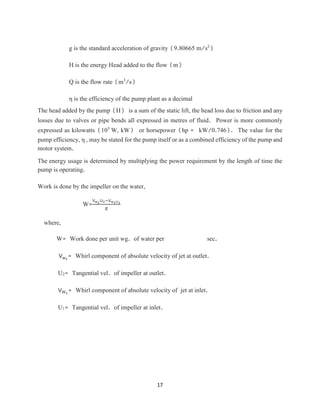
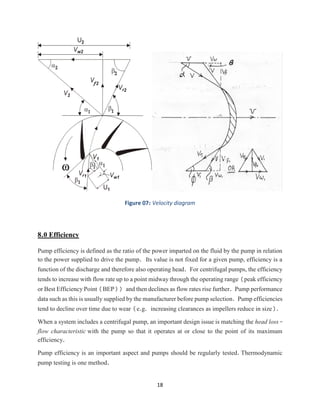
Work is done by the impeller on the water,
W=
Vw2U2−Vw1U1
g
where,
W= Work done per unit wg. of water per sec.
Vw2
= Whirl component of absolute velocity of jet at outlet.
U2= Tangential vel. of impeller at outlet.
VW1
= Whirl component of absolute velocity of jet at inlet.
U1= Tangential vel. of impeller at inlet.
18
Figure 07: Velocity diagram
8.0 Efficiency
Pump efficiency is defined as the ratio of the power imparted on the fluid by the pump in relation
to the power supplied to drive the pump. Its value is not fixed for a given pump, efficiency is a
function of the discharge and therefore also operating head. For centrifugal pumps, the efficiency
tends to increase with flow rate up to a point midway through the operating range (peak efficiency
or Best Efficiency Point (BEP)) and then declines as flow rates rise further. Pump performance
data such as this is usually supplied by the manufacturer before pump selection. Pump efficiencies
tend to decline over time due to wear (e.g. increasing clearances as impellers reduce in size).
When a system includes a centrifugal pump, an important design issue is matching the head loss-
flow characteristic with the pump so that it operates at or close to the point of its maximum
efficiency.
Pump efficiency is an important aspect and pumps should be regularly tested. Thermodynamic
pump testing is one method.
19
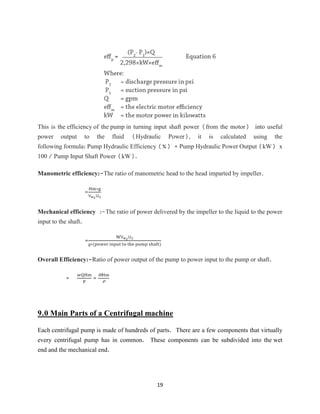
This is the efficiency of the pump in turning input shaft power (from the motor) into useful
power output to the fluid (Hydraulic Power), it is calculated using the
following formula: Pump Hydraulic Efficiency (%) = Pump Hydraulic Power Output (kW) x
100 / Pump Input Shaft Power (kW).
Manometric efficiency:-The ratio of manometric head to the head imparted by impeller.
=
Hm∗g
Vw2U2
Mechanical efficiency :-The ratio of power delivered by the impeller to the liquid to the power
input to the shaft.
=
WVw2U2
g∗(power input to the pump shaft)
Overall Efficiency:-Ratio of power output of the pump to power input to the pump or shaft.
=
wQHm
P
=
WHm
P
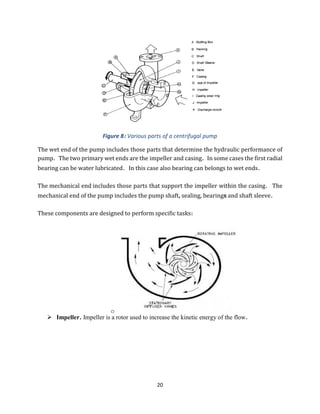
9.0 Main Parts of a Centrifugal machine
Each centrifugal pump is made of hundreds of parts. There are a few components that virtually
every centrifugal pump has in common. These components can be subdivided into the wet
end and the mechanical end.
20
Figure 8: Various parts of a centrifugal pump
The wet end of the pump includes those parts that determine the hydraulic performance of
pump. The two primary wet ends are the impeller and casing. In some cases the first radial
bearing can be water lubricated. In this case also bearing can belongs to wet ends.
The mechanical end includes those parts that support the impeller within the casing. The
mechanical end of the pump includes the pump shaft, sealing, bearings and shaft sleeve.
These components are designed to perform specific tasks:
o
➢ Impeller. Impeller is a rotor used to increase the kinetic energy of the flow.
21
o
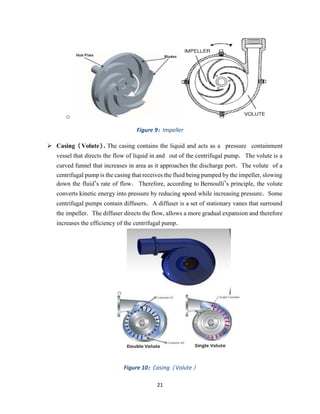
Figure 9: Impeller
➢ Casing (Volute). The casing contains the liquid and acts as a pressure containment
vessel that directs the flow of liquid in and out of the centrifugal pump. The volute is a
curved funnel that increases in area as it approaches the discharge port. The volute of a
centrifugal pump is the casing that receives the fluid being pumped by the impeller, slowing
down the fluid’s rate of flow. Therefore, according to Bernoulli’s principle, the volute
converts kinetic energy into pressure by reducing speed while increasing pressure. Some
centrifugal pumps contain diffusers. A diffuser is a set of stationary vanes that surround
the impeller. The diffuser directs the flow, allows a more gradual expansion and therefore
increases the efficiency of the centrifugal pump.
o
Figure 10: Casing (Volute)
22
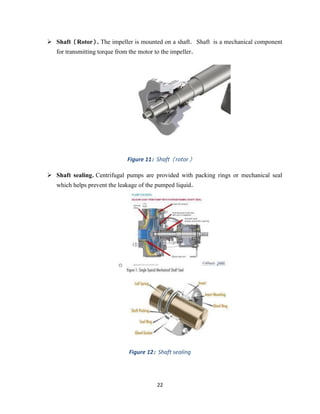
➢ Shaft (Rotor). The impeller is mounted on a shaft. Shaft is a mechanical component
for transmitting torque from the motor to the impeller.
Figure 11: Shaft (rotor)
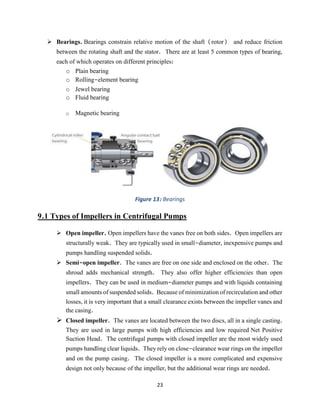
➢ Shaft sealing. Centrifugal pumps are provided with packing rings or mechanical seal
which helps prevent the leakage of the pumped liquid.
o
Figure 12: Shaft sealing
23
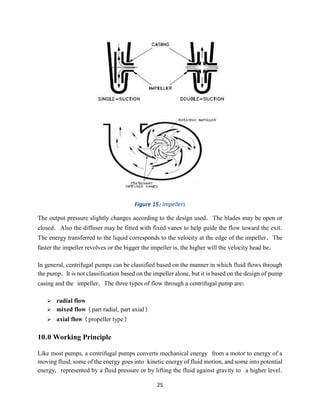
➢ Bearings. Bearings constrain relative motion of the shaft (rotor) and reduce friction
between the rotating shaft and the stator. There are at least 5 common types of bearing,
each of which operates on different principles:
o Plain bearing
o Rolling-element bearing
o Jewel bearing
o Fluid bearing
o Magnetic bearing
Figure 13: Bearings
9.1 Types of Impellers in Centrifugal Pumps
➢ Open impeller. Open impellers have the vanes free on both sides. Open impellers are
structurally weak. They are typically used in small-diameter, inexpensive pumps and
pumps handling suspended solids.
➢ Semi-open impeller. The vanes are free on one side and enclosed on the other. The
shroud adds mechanical strength. They also offer higher efficiencies than open
impellers. They can be used in medium-diameter pumps and with liquids containing
small amounts of suspended solids. Because of minimization of recirculation and other
losses, it is very important that a small clearance exists between the impeller vanes and
the casing.
➢ Closed impeller. The vanes are located between the two discs, all in a single casting.
They are used in large pumps with high efficiencies and low required Net Positive
Suction Head. The centrifugal pumps with closed impeller are the most widely used
pumps handling clear liquids. They rely on close-clearance wear rings on the impeller
and on the pump casing. The closed impeller is a more complicated and expensive
design not only because of the impeller, but the additional wear rings are needed.
24
Figure 14: Types Of impeller
Impeller design is the most significant factor for determining performance of a centrifugal pump.
A properly designed impeller optimizes flow while minimizing turbulence and maximizing
efficiency.
The impeller of a centrifugal pump can be of three basic types:
The impeller blades can be:
➢ Backward-curved blade design (prefered design due to negative slope of performance
curve)
➢ Radial blade design
➢ Forward-curved blade design (due to positive slope conditions this design can cause
pump surge)
Impellers can be either:
➢ Single-suction. A single-suction impeller allows liquid to enter the center of the blades
from only one direction.
➢ Double-suction. A double-suction impeller allows liquid to enter the center of the
impeller blades from both sides simultaneously. This reduces forces exerted on the shaft.
25
Figure 15: Impellers
The output pressure slightly changes according to the design used. The blades may be open or
closed. Also the diffuser may be fitted with fixed vanes to help guide the flow toward the exit.
The energy transferred to the liquid corresponds to the velocity at the edge of the impeller. The
faster the impeller revolves or the bigger the impeller is, the higher will the velocity head be.
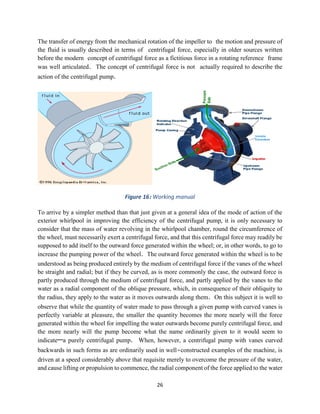
In general, centrifugal pumps can be classified based on the manner in which fluid flows through
the pump. It is not classification based on the impeller alone, but it is based on the design of pump
casing and the impeller. The three types of flow through a centrifugal pump are:
➢ radial flow
➢ mixed flow (part radial, part axial)
➢ axial flow (propeller type)
10.0 Working Principle
Like most pumps, a centrifugal pumps converts mechanical energy from a motor to energy of a
moving fluid; some of the energy goes into kinetic energy of fluid motion, and some into potential
energy, represented by a fluid pressure or by lifting the fluid against gravity to a higher level.
26
The transfer of energy from the mechanical rotation of the impeller to the motion and pressure of
the fluid is usually described in terms of centrifugal force, especially in older sources written
before the modern concept of centrifugal force as a fictitious force in a rotating reference frame
was well articulated. The concept of centrifugal force is not actually required to describe the
action of the centrifugal pump.
Figure 16: Working manual
To arrive by a simpler method than that just given at a general idea of the mode of action of the
exterior whirlpool in improving the efficiency of the centrifugal pump, it is only necessary to
consider that the mass of water revolving in the whirlpool chamber, round the circumference of
the wheel, must necessarily exert a centrifugal force, and that this centrifugal force may readily be
supposed to add itself to the outward force generated within the wheel; or, in other words, to go to
increase the pumping power of the wheel. The outward force generated within the wheel is to be
understood as being produced entirely by the medium of centrifugal force if the vanes of the wheel
be straight and radial; but if they be curved, as is more commonly the case, the outward force is
partly produced through the medium of centrifugal force, and partly applied by the vanes to the
water as a radial component of the oblique pressure, which, in consequence of their obliquity to
the radius, they apply to the water as it moves outwards along them. On this subject it is well to
observe that while the quantity of water made to pass through a given pump with curved vanes is
perfectly variable at pleasure, the smaller the quantity becomes the more nearly will the force
generated within the wheel for impelling the water outwards become purely centrifugal force, and
the more nearly will the pump become what the name ordinarily given to it would seem to
indicate—a purely centrifugal pump. When, however, a centrifugal pump with vanes curved
backwards in such forms as are ordinarily used in well-constructed examples of the machine, is
driven at a speed considerably above that requisite merely to overcome the pressure of the water,
and cause lifting or propulsion to commence, the radial component of the force applied to the water
27
by the vanes will become considerable, and the water leaving the circumference of the wheel will
have a velocity less than that of the circumference of the wheel in a degree having some real
importance in practice.
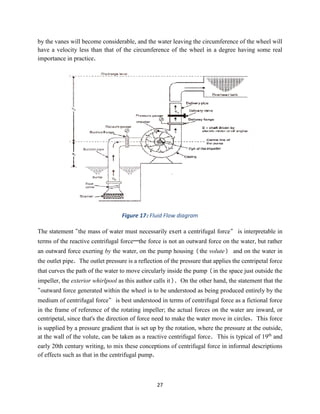
Figure 17: Fluid Flow diagram
The statement "the mass of water must necessarily exert a centrifugal force" is interpretable in
terms of the reactive centrifugal force—the force is not an outward force on the water, but rather
an outward force exerting by the water, on the pump housing (the volute) and on the water in
the outlet pipe. The outlet pressure is a reflection of the pressure that applies the centripetal force
that curves the path of the water to move circularly inside the pump (in the space just outside the
impeller, the exterior whirlpool as this author calls it). On the other hand, the statement that the
"outward force generated within the wheel is to be understood as being produced entirely by the
medium of centrifugal force" is best understood in terms of centrifugal force as a fictional force
in the frame of reference of the rotating impeller; the actual forces on the water are inward, or
centripetal, since that's the direction of force need to make the water move in circles. This force
is supplied by a pressure gradient that is set up by the rotation, where the pressure at the outside,
at the wall of the volute, can be taken as a reactive centrifugal force. This is typical of 19th
and
early 20th century writing, to mix these conceptions of centrifugal force in informal descriptions
of effects such as that in the centrifugal pump.
28
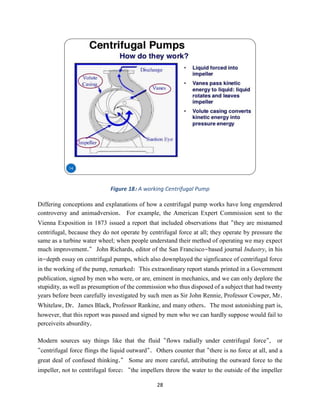
Figure 18: A working Centrifugal Pump
Differing conceptions and explanations of how a centrifugal pump works have long engendered
controversy and animadversion. For example, the American Expert Commission sent to the
Vienna Exposition in 1873 issued a report that included observations that "they are misnamed
centrifugal, because they do not operate by centrifugal force at all; they operate by pressure the
same as a turbine water wheel; when people understand their method of operating we may expect
much improvement." John Richards, editor of the San Francisco-based journal Industry, in his
in-depth essay on centrifugal pumps, which also downplayed the signficance of centrifugal force
in the working of the pump, remarked: This extraordinary report stands printed in a Government
publication, signed by men who were, or are, eminent in mechanics, and we can only deplore the
stupidity, as well as presumption of the commission who thus disposed of a subject that had twenty
years before been carefully investigated by such men as Sir John Rennie, Professor Cowper, Mr.
Whitelaw, Dr. James Black, Professor Rankine, and many others. The most astonishing part is,
however, that this report was passed and signed by men who we can hardly suppose would fail to
perceiveits absurdity.
Modern sources say things like that the fluid "flows radially under centrifugal force", or
"centrifugal force flings the liquid outward". Others counter that "there is no force at all, and a
great deal of confused thinking." Some are more careful, attributing the outward force to the
impeller, not to centrifugal force: "the impellers throw the water to the outside of the impeller
29
case. This centrifugal action is what creates the pressure" Even serious texts that explain the
working of the pump without mention of centrifugal force introduce the pump as one in which
"the mechanical energy is converted, into pressure energy by means of centrifugal force acting on
the fluid."
11.0 Advantages and Disadvantage
11.1 Advantages of centrifugal pump
I. As there is no drive seal so there is no leakage in pump.
II. It can pump hazardous liquids.
III. There are very less frictional losses.
IV. There in almost no noise.
V. Pump has almost 100 percent efficiency.
VI. Centrifugal pump has minimum wear with respect to others.
VII. There is a gap between pump chamber and motor, so there is no heat transfer between
them.
VIII. Because of the gap between pump chamber and motor, water cannot enter into motor.
IX. Centrifugal pump use magnetic coupling which breakup on high load eliminating the risk
of damaging the motor.
11.2 Disadvantages of centrifugal pump
I. Because of the magnetic resistance there is some energy losses.
II. Unexpected heavy load may cause the coupling to slip.
III. Ferrous particles in liquid are problematic when you are using magnetic drive. This is
because particle collect at impeller and cause the stoppage of pump after some time.
12.0 Conclusion
Due to wide range of applications and millions of sold pumps, nowadays pumps are technically
mature machines. Reasons for high efficiencies are a lot of experience as well as modern finite
element optimisition. The flow optimision procedures are standard engineering methods and lead
to well-constructed casings and impellers. This lead to many different special designs,
30
constructed for a specific range of applications. Equipped with well selected anti wear systems
and materials in combination with reasonable maintenance, a long lifespan can be met.
13.0 References
[1] Ladislao Reti, “Francesco di Giorgio (Armani) Martini's Treatise on Engineering and Its
Plagiarists”, Technology and Culture, Vol. 4, No. 3. (Summer, 1963), pp. 287-298 (290)
[2] James Thomson (Dec. 23, 1859). "Professor Thomson's Centrifugal Pump". The
Mechanics' magazine, and journal of engineering, agricultural machinery, manufactures and
shipbuilding (Robertson, Brooman, & Co.) II: 408–410.
[3] John Richards (1894). Centrifugal pumps: an essay on their construction and operation,
and some account of the origin and development in this and other countries
(http://books.google.com/books?id=013VAAAAMAAJ&pg=PA41). The Industrial
Publishing Company.p. 40–41.
[4] Markus Reiner (14 April 1960). "A centripetal air pump"
(http://books.google.com/books?id=9x-5Nx7OqHoC&pg=PA946). NewScientist 7
(178): 946. .
[5] Charles F. Conaway (1999). The petroleum industry:
anontechnicalguide(http://books.google.com/books?id=sJ7BO1cCD20C&pg=SA8-PA52).
PennWell Books. p. 200. ISBN9780878147632.
[6] Pete Melby (1995). Simplified Irrigation Design
(http://books.google.com/books?id=raxr9AbTgFwC&pg=PA145) (2nd ed.). John Wiley
and Sons. p.145. ISBN 9780471286226.
[7] R. K. Bansal (2005). A textbook of fluid mechanics and hydraulic machines
(http://books.google.com/books?id=nCnifcUdNp4C&pg=PA938) (9th ed.). Firewall
Media. p. 938.ISBN 9788170083115.
31
14.0 Article and Images sources
Centrifugal pump Source: http://en.wikipedia.org/w/index.php?oldid=418585443
Image:warman centrifugal pump.jpg Source:
http://en.wikipedia.org/w/index.php?title=File:Warman_centrifugal_pump.jpg License:
Creative Commons Attribution 2.5 Contributors:Bernard S. Janse
Image:Centrifugal Pump.png Source:
http://en.wikipedia.org/w/index.php?title=File:Centrifugal_Pump.png License: Public
Domain Contributors: User:Fantagu
Image:Centrifugal 2.png Source:
http://en.wikipedia.org/w/index.php?title=File:Centrifugal_2.png License: Creative
Commons Attribution-Sharealike 2.5 Contributors: Jack Ver, Ub,
WikipediaMaster
File:Centrifugal pump volute Richards 1894.png Source:
http://en.wikipedia.org/w/index.php?title=File:Centrifugal_pump_volute_Richards_1894.pn
g License: Public Domain Contributors:
John Richards
Image:Centrifugal Pump-mod.jpg Source:
http://en.wikipedia.org/w/index.php?title=File:Centrifugal_Pump-mod.jpg License:
Creative Commons Attribution-Sharealike 3.0 Contributors:
User:Kaze0010

Special study on Centrifugal Pump

  • 1.
    1 CENTRIFUGAL PUMP ANDPUMPING SYSTEM A report submitted to the Department of Mechanical Engineering, Khulna University of Engineering & Technology in partial fulfillment of the requirements for the “Course of ME 3100” Supervised by Submitted by Dr. Abdullah Al Faruk MD. Mahedi Hasan Assistant Professor Roll: 1405024 Section: A July 2017 Department of Mechanical Engineering Khulna University of Engineering & Technology Khulna 9203, Bangladesh
  • 2.
    2 Acknowledgement All the praisesto the almighty who makes author capable to complete this Special work successfully. The author is very much indebted to his course Dr. Abdullah Al Faruk, assistant professor of Department of Mechanical Engineering, Khulna University of Engineering & Technology, Bangladesh, for his wise inspiration to do such extraordinary special work. The author expresses the heart- felt respect to him for his proper guidance and all kind of support to perform and complete this special study. The author is extremely grateful to Prof. Golam Kader, Head of the department of Mechanical Engineering Khulna University of Engineering & Technology, Bangladesh, to provide such a good opportunity to do the special work and for providing all other supports. May ALLAH bless the course teacher. “Author”
  • 3.
    3 Abstract The report introducesand describes the principle of centrifugal pump and its performance. Centrifugal pumps are used to transport fluids by the conversion of rotational kinetic energy to the hydrodynamic energy of the fluid flow. Its common usages as a sewage, petroleum and petrochemical pumping. The mechanical energy is converted into pressure energy by means of centrifugal force acting on the fluid, the hydraulic machine is called “Centrifugal Pump”. Its works on a principle of vortex flow. The centrifugal pumps acts as a reversal of an inward radial flow reaction turbine. It means the flow in centrifugal pumps is in radial outward direction. The mains of centrifugal pumps are impeller, casing, shaft, shaft sealings, bearings etc. A centrifugal pump converts rotational energy, often from a motor, to energy in a moving fluid. A portion of the energy goes into kinetic energy of the fluid. Fluid enters axially through eye of the casing, is caught up in the impeller blades, and is whirled tangentially and radially outward until it leaves through all circumferential parts of the impeller into the diffuser part of the casing. The fluid gains both velocity and pressure while passing through the impeller. The doughnut shaped diffuser, or scroll, section of the casing decelerates the flow and further increases the pressure.
  • 4.
    4 Table of Contents TitlePage Acknowledgements ................................................................................................................. 1 Abstract.................................................................................................................................... 3 List of Figure ........................................................................................................................... 6 List of Tables........................................................................................................................... 6 Report on Centrifugal Pump and pumping System Title Page 1.0 Introduction .................................................................................................................. 8 3.0 Historical Background.................................................................................................. 8 4.0 Types of Pump ............................................................................................................ 9 4.1 Vertical centrifugal pumps.................................................................................... 9 4.2 Froth pumps ................................................................................................... 9 4.3 Multistage centrifugal pumps............................................................. 10 4.4 Magnetically coupled pumps .................................................... 11 4.5 Self priming centrifugal pump .......................................... 11 5.0 Applications................................................................................................................ 12
  • 5.
    5 7.0 Energy usage.................................................................................................................. 16 8.0 Efficiency ................................................................................................................... 18 9.0 Main Parts of a Centrifugal machine.......................................................................... 19 9.1 Types of Impellers in Centrifugal Pumps ............................................... 23 10.0 Working Principle .................................................................................................... 25 11.0 Advantages and Disadvantage.................................................................................. 29 11.1 Advantages of centrifugal pump ..................................................................... 29 11.2 Disadvantages of centrifugal pump ........................................................ 29 12.0 Conclusion................................................................................................................ 29 13.0 References ................................................................................................................ 30 14.0 Article and Images sources....................................................................................... 31
  • 6.
    6 List of Figures FigureTitle Page Figure 1: Forth Pumps ................................................................................................................. 10 Figure 2: Multistage centrifugal pump ........................................................................................ 10 Figure 3: Magnetically coupled pumps........................................................................................ 11 Figure 4: Self Priming pump........................................................................................................ 12 Figure 5: Soda Fountain machine ................................................................................................. 14 Figure 6: Pie chart for maintenance cost of a pump. ................................................................... 15 Figure 07: Velocity diagram ........................................................................................................ 18 Figure 8: Various parts of a centrifugal pump............................................................................. 20 Figure 9: Impeller ........................................................................................................................ 21 Figure 10: Casing ........................................................................................................................ 21 Figure 11: Shaft ........................................................................................................................... 22 Figure 12: Shaft sealing ............................................................................................................... 22 Figure 13: Bearings...................................................................................................................... 23 Figure 14: Types Of impeller....................................................................................................... 24 Figure 15: Impellers..................................................................................................................... 25 Figure 16: Working manual......................................................................................................... 26 Figure 17: Fluid Flow diagram .................................................................................................... 27 Figure 18: A working Centrifugal Pump ..................................................................................... 28
  • 7.
    7 List of Tables TableTitle Page Table 1: Vertical Centrifugal Pump Specification Table............................................................. 15 Table 2: Centrifugal Pump Specification For Plant Mining Industry.......................................... 16
  • 8.
    8 1.0 Introduction A centrifugalpump is a rotodynamic pump that uses a rotating impeller to increase the pressure of a fluid. Centrifugal pumps are commonly used to move liquids through a piping system. The fluid enters the pump impeller along or near to the rotating axis and is accelerated by the impeller, flowing radially outward into a diffuser or volute chamber (casing), from where it exits into the downstream piping system. Centrifugal pumps are used for large discharge through smaller heads. Centrifugal pump are a sub class of dynamic work, absorbing turbomachinery. Centrifugal pumps are used to transport fluids by the conversion of rotational kinetic energy to the hydrodynamic energy of the fluid flow. The rotational energy typically comes from an engine or electric motor. The fluid enters the pump impeller along or near to the rotating axis and is accelerated by the impeller, flowing radially outward into a diffuser or volute chamber (casing), from where it exits. Common uses include water, sewage, petroleum and petrochemical pumping; a centrifugal fan is commonly used to implement a vacuum cleaner. The reverse function of the centrifugal pump is a water turbine converting potential energy of water pressure into mechanical rotational energy. 2.0 Objectives The objective of this study is to- i. To study on Centrifugal pump and its components. ii. To become familiar with centrifugal pump operations. iii. To explore the applications of centrifugal pump. 3.0 Historical Background According to Reti, the Brazilian soldier and historian of science, the first machine that could be characterized as a centrifugal pump was a mud lifting machine which appeared as early as 1475 in a treatise by the Italian Renaissance engineer Francesco di Giorgio Martini.True centrifugal pumps were not developed until the late 17th century, when Denis Papin made one with straight vanes. The curved vane was introduced by British inventor John Appold in 1851.
  • 9.
    9 4.0 Types ofPump 4.1 Vertical centrifugal pumps Vertical centrifugal pumps are also referred to as cantilever pumps. They utilize a unique shaft and bearing support configuration that allows the volute to hang in the sump while the bearings are outside the sump. This style of pump uses no stuffing box to seal the shaft but instead utilizes a "throttle bushing". A common application for this style of pump is in a parts washer. Figure 1: Vertical centrifugal pump 4.2 Froth pumps In the mineral industry, or in the extraction of oils and, froth is generated to separate the rich minerals or bitumen from the sand and clays. Froth contains air that tends to block conventional pumps and cause loss of prime. Over history, industry has developed different ways to deal with this problem. In the pulp and paper industry holes are drilled in the impeller. Air escapes to the back of the impeller and a special expeller discharges the air back to the suction tank. The impeller may also feature special small vanes between the primary vanes called split vanes or secondary vanes. Some pumps may feature a large eye, an inducer or recirculation of pressurized froth from the pump discharge back to the suction to break the bubbles.
  • 10.
    10 Figure 1: ForthPumps 4.3 Multistage centrifugal pumps Figure 2: Multistage centrifugal pump A centrifugal pump containing two or more impellers is called a multistage centrifugal pump. The impellers may be mounted on the same shaft or on different shafts. At each stage, the fluid is directed to the center before making its way to the discharge on the outer diameter. For higher pressures at the outlet, impellers can be connected in series. For higher flow output, impellers can be connected parallel. A common application of the multistage centrifugal pump is the boiler feedwater pump. For example, a 350 MW unit would require two feed pumps in parallel. Each feed pump is a multistage centrifugal pump producing 150 l/s at 21 MPa.
  • 11.
    11 All energy transferredto the fluid is derived from the mechanical energy driving the impeller. This can be measured at isentropic compression, resulting in a slight temperature increase (in addition to the pressure increase). 4.4 Magnetically coupled pumps: Magnetically coupled pumps, or magnetic drive pumps, vary from the traditional pumping style, as the motor is coupled to the pump by magnetic means rather than by a direct mechanical shaft. The pump works via a drive magnet, 'driving' the pump rotor, which is magnetically coupled to the primary shaft driven by the motor. They are often used where leakage of the fluid pumped poses a great risk (e.g., aggressive fluid in the chemical or nuclear industry, or electric shock - garden fountains). They have no direct connection between the motor shaft and the impeller, so no gland is needed. There is no risk of leakage, unless the casing is broken. Since the pump shaft is not supported by bearings outside the pump's housing, support inside the pump is provided by bushings. The pump size of a magnetic drive pumps can go from few Watts power to a giant 1MW. Figure 3: Magnetically coupled pumps 4.5 Self priming centrifugal pump: Enough liquid for priming can be stored in a specially designed pump casing, resulting in a centrifugal pump that is self-priming. During priming the liquid is recirculated within the casing. Gas from the suction port mixes with the liquid in the pump. The impeller repeatedly ejects the mixture back into the casing. The liquid sinks to the bottom of the casing, where it reenters the pump along with more gas from the suction port. Gradually the gas is expelled from the pump
  • 12.
    12 into the dischargeline, and the suction line fills with liquid. Normal centrifugal pump operation begins. Figure 4: Self Priming pump 5.0 Applications The applications of centrifugal pumps are numerous; however, these pumps are most often used in buildings for the following purposes: I. To pump the general water supply: This includes both the overhead and pneumatic tank systems. In general water supply systems where the pump takes off directly from the city pressure main or where no suction lift is required, a centrifugal pump can be used. When a centrifugal pump is being used with a suction lift of no more than 15 feet is required, a pump with an automatic primer or a suction line equipped with a foot valve maybe used. II. To provide booster service: In booster service, centrifugal pumps with in-take pressures from the city main operate only to boost this pressure. They may run continuously or automatically. When the automatic type is not operating, the water flows by city pressure through the impellers. III. To pump the domestic water supply: In domestic water supply systems, the centrifugal pump is used in shallow wells (suction lift not over 22 feet), in deep wells (for greater depths than 22 feet), and in a complete pneumatic system with electric motors or gasoline engines.
  • 13.
    13 IV. To supportthe fire protection systems: Fire pumps usually are the centrifugal type, either single or multi stage. Electricity, steam, or gasoline may drive them. Whatever the power supply, it must be permanent and, if steam, must have a constant minimum pressure of 50 pounds of steam. The pumps should agree with the specifications of the NFPA. Booster fire pumps have a low head to boost the pressure of the already available city supply V. To provide a hot-water circulating service: Hot-water circulating pumps are centrifugal. They move water in a closed system and thus usually require only a low head, though the static pressure in the systems maybe high. The pumps should be selected with attention to strength of casing, efficient stuffing box, freedom from air and vapor binding, and flexible mounting. VI. To provide sump drainage: Sump pumps are not classified as sewage pumps; however, they can be used as such. They may be vertical or horizontal centrifugal. The vertical type sump pump usually has the impeller submerged and the motor mounted above the pit. Units are equipped with an automatic switch operated by the float and are available in single or duplex type. VII. In commercial soda Industry: In corporate industry a soda fountain machine is a popular name which works under the same principle of centrifugal pumping for incompressible fluid. A soda fountain is a device that dispenses carbonated soft drinks, called fountain drinks. They can be found in restaurants, concession stands and other locations such as convenience stores. The device combines flavored syrup or syrup concentrate and carbon dioxide with chilled and purified water to make soft drinks, either manually, or in a vending machine which is essentially an automated soda fountain that is operated using a soda gun. Today, the syrup often is pumped from a special container called a bag-in-box. The two secret ingredients to making carbonated water, it turns out, are pressure and temperature. If carbon dioxide is mixed with very cold water in a sealed, high-pressure environment, the elements will successfully combine. The first man to invent such a pressurized carbonation system was Johann Jacob Schweppe, a Swiss scientist who developed a hand-cranked compression pump back in 1783 and whose name still graces bottles of fizzy ginger ale and club soda . The scientific process of carbonation requires water and carbon dioxide to be pressurized in a sealed chamber to seven times the normal atmospheric pressure. At that point, individual molecules of C02 begin to separate and surround themselves with water
  • 14.
    14 molecules [source: Discovery].Under those extreme conditions, the gas fully dissolves in the liquid. The temperature of water at carbonation is also critical. Water that's carbonated at near- freezing temperature (32 degrees Fahrenheit or 0 degrees Celsius) can hold five times as much C02as water that's carbonated at 140 degrees F (60 degrees C). Inside the pressure chamber, carbonated water has absolutely no fizz. The bubbles only emerge when the liquid is released from the chamber back into normal atmospheric pressure. Carbonated water contains 16,000 times more C02than regular water, roughly five "glasses" of C02 for every glass of water. When you pop the cap on a soda bottle, the release of pressure causes all of those dissolved C02 molecules to become gas again and rush to escape through the surface of the liquid as bubbles. Figure 5: Soda Fountain machine VIII. In Household work: Centrifugal pumps are used in buildings for pumping the general water supply, as a booster and for domestic water supplies. IX. In Sewage system: The design of a centrifugal pump makes them useful for pumping sewage and slurries. X. For controlling process: They are also used in fire protection systems and for heating and cooling applications. 6.0 Specifications Centrifugal pumps are commonly rated by horsepower, flow rate, outlet pressure in metres (or feet) of head, inlet suction in suction feet (or metres) of head. The head can be simplified as
  • 15.
    15 the number offeet or metres the pump can raise or lower a column of water at atmospheric pressure. Figure 6: Pie chart for maintenance cost of a pump. Following is a table for vertical centrifugal pump specification and overall performance. Table 1: Vertical Centrifugal Pump Specification Table From an initial design point of view, engineers often use a quantity termed the specific speed to identify the most suitable pump type for a particular combination of flow rate and head.
  • 16.
    16 Table 2: CentrifugalPump Specification For Plant Mining Industry 7.0 Energy usage The energy usage in a pumping installation is determined by the flow required, the height lifted and the length and friction characteristics of the pipeline. The power required to drive a pump, is defined simply using SI units by: where: P is the input power required (W) ρ is the fluid density (kg/m3 )
  • 17.
    17 g is thestandard acceleration of gravity (9.80665 m/s2 ) H is the energy Head added to the flow (m) Q is the flow rate (m3 /s) η is the efficiency of the pump plant as a decimal The head added by the pump (H) is a sum of the static lift, the head loss due to friction and any losses due to valves or pipe bends all expressed in metres of fluid. Power is more commonly expressed as kilowatts (103 W, kW) or horsepower (hp = kW/0.746). The value for the pump efficiency, η , may be stated for the pump itself or as a combined efficiency of the pump and motor system. The energy usage is determined by multiplying the power requirement by the length of time the pump is operating. Work is done by the impeller on the water, W= Vw2U2−Vw1U1 g where, W= Work done per unit wg. of water per sec. Vw2 = Whirl component of absolute velocity of jet at outlet. U2= Tangential vel. of impeller at outlet. VW1 = Whirl component of absolute velocity of jet at inlet. U1= Tangential vel. of impeller at inlet.
  • 18.
    18 Figure 07: Velocitydiagram 8.0 Efficiency Pump efficiency is defined as the ratio of the power imparted on the fluid by the pump in relation to the power supplied to drive the pump. Its value is not fixed for a given pump, efficiency is a function of the discharge and therefore also operating head. For centrifugal pumps, the efficiency tends to increase with flow rate up to a point midway through the operating range (peak efficiency or Best Efficiency Point (BEP)) and then declines as flow rates rise further. Pump performance data such as this is usually supplied by the manufacturer before pump selection. Pump efficiencies tend to decline over time due to wear (e.g. increasing clearances as impellers reduce in size). When a system includes a centrifugal pump, an important design issue is matching the head loss- flow characteristic with the pump so that it operates at or close to the point of its maximum efficiency. Pump efficiency is an important aspect and pumps should be regularly tested. Thermodynamic pump testing is one method.
  • 19.
    19 This is theefficiency of the pump in turning input shaft power (from the motor) into useful power output to the fluid (Hydraulic Power), it is calculated using the following formula: Pump Hydraulic Efficiency (%) = Pump Hydraulic Power Output (kW) x 100 / Pump Input Shaft Power (kW). Manometric efficiency:-The ratio of manometric head to the head imparted by impeller. = Hm∗g Vw2U2 Mechanical efficiency :-The ratio of power delivered by the impeller to the liquid to the power input to the shaft. = WVw2U2 g∗(power input to the pump shaft) Overall Efficiency:-Ratio of power output of the pump to power input to the pump or shaft. = wQHm P = WHm P 9.0 Main Parts of a Centrifugal machine Each centrifugal pump is made of hundreds of parts. There are a few components that virtually every centrifugal pump has in common. These components can be subdivided into the wet end and the mechanical end.
  • 20.
    20 Figure 8: Variousparts of a centrifugal pump The wet end of the pump includes those parts that determine the hydraulic performance of pump. The two primary wet ends are the impeller and casing. In some cases the first radial bearing can be water lubricated. In this case also bearing can belongs to wet ends. The mechanical end includes those parts that support the impeller within the casing. The mechanical end of the pump includes the pump shaft, sealing, bearings and shaft sleeve. These components are designed to perform specific tasks: o ➢ Impeller. Impeller is a rotor used to increase the kinetic energy of the flow.
  • 21.
    21 o Figure 9: Impeller ➢Casing (Volute). The casing contains the liquid and acts as a pressure containment vessel that directs the flow of liquid in and out of the centrifugal pump. The volute is a curved funnel that increases in area as it approaches the discharge port. The volute of a centrifugal pump is the casing that receives the fluid being pumped by the impeller, slowing down the fluid’s rate of flow. Therefore, according to Bernoulli’s principle, the volute converts kinetic energy into pressure by reducing speed while increasing pressure. Some centrifugal pumps contain diffusers. A diffuser is a set of stationary vanes that surround the impeller. The diffuser directs the flow, allows a more gradual expansion and therefore increases the efficiency of the centrifugal pump. o Figure 10: Casing (Volute)
  • 22.
    22 ➢ Shaft (Rotor).The impeller is mounted on a shaft. Shaft is a mechanical component for transmitting torque from the motor to the impeller. Figure 11: Shaft (rotor) ➢ Shaft sealing. Centrifugal pumps are provided with packing rings or mechanical seal which helps prevent the leakage of the pumped liquid. o Figure 12: Shaft sealing
  • 23.
    23 ➢ Bearings. Bearingsconstrain relative motion of the shaft (rotor) and reduce friction between the rotating shaft and the stator. There are at least 5 common types of bearing, each of which operates on different principles: o Plain bearing o Rolling-element bearing o Jewel bearing o Fluid bearing o Magnetic bearing Figure 13: Bearings 9.1 Types of Impellers in Centrifugal Pumps ➢ Open impeller. Open impellers have the vanes free on both sides. Open impellers are structurally weak. They are typically used in small-diameter, inexpensive pumps and pumps handling suspended solids. ➢ Semi-open impeller. The vanes are free on one side and enclosed on the other. The shroud adds mechanical strength. They also offer higher efficiencies than open impellers. They can be used in medium-diameter pumps and with liquids containing small amounts of suspended solids. Because of minimization of recirculation and other losses, it is very important that a small clearance exists between the impeller vanes and the casing. ➢ Closed impeller. The vanes are located between the two discs, all in a single casting. They are used in large pumps with high efficiencies and low required Net Positive Suction Head. The centrifugal pumps with closed impeller are the most widely used pumps handling clear liquids. They rely on close-clearance wear rings on the impeller and on the pump casing. The closed impeller is a more complicated and expensive design not only because of the impeller, but the additional wear rings are needed.
  • 24.
    24 Figure 14: TypesOf impeller Impeller design is the most significant factor for determining performance of a centrifugal pump. A properly designed impeller optimizes flow while minimizing turbulence and maximizing efficiency. The impeller of a centrifugal pump can be of three basic types: The impeller blades can be: ➢ Backward-curved blade design (prefered design due to negative slope of performance curve) ➢ Radial blade design ➢ Forward-curved blade design (due to positive slope conditions this design can cause pump surge) Impellers can be either: ➢ Single-suction. A single-suction impeller allows liquid to enter the center of the blades from only one direction. ➢ Double-suction. A double-suction impeller allows liquid to enter the center of the impeller blades from both sides simultaneously. This reduces forces exerted on the shaft.
  • 25.
    25 Figure 15: Impellers Theoutput pressure slightly changes according to the design used. The blades may be open or closed. Also the diffuser may be fitted with fixed vanes to help guide the flow toward the exit. The energy transferred to the liquid corresponds to the velocity at the edge of the impeller. The faster the impeller revolves or the bigger the impeller is, the higher will the velocity head be. In general, centrifugal pumps can be classified based on the manner in which fluid flows through the pump. It is not classification based on the impeller alone, but it is based on the design of pump casing and the impeller. The three types of flow through a centrifugal pump are: ➢ radial flow ➢ mixed flow (part radial, part axial) ➢ axial flow (propeller type) 10.0 Working Principle Like most pumps, a centrifugal pumps converts mechanical energy from a motor to energy of a moving fluid; some of the energy goes into kinetic energy of fluid motion, and some into potential energy, represented by a fluid pressure or by lifting the fluid against gravity to a higher level.
  • 26.
    26 The transfer ofenergy from the mechanical rotation of the impeller to the motion and pressure of the fluid is usually described in terms of centrifugal force, especially in older sources written before the modern concept of centrifugal force as a fictitious force in a rotating reference frame was well articulated. The concept of centrifugal force is not actually required to describe the action of the centrifugal pump. Figure 16: Working manual To arrive by a simpler method than that just given at a general idea of the mode of action of the exterior whirlpool in improving the efficiency of the centrifugal pump, it is only necessary to consider that the mass of water revolving in the whirlpool chamber, round the circumference of the wheel, must necessarily exert a centrifugal force, and that this centrifugal force may readily be supposed to add itself to the outward force generated within the wheel; or, in other words, to go to increase the pumping power of the wheel. The outward force generated within the wheel is to be understood as being produced entirely by the medium of centrifugal force if the vanes of the wheel be straight and radial; but if they be curved, as is more commonly the case, the outward force is partly produced through the medium of centrifugal force, and partly applied by the vanes to the water as a radial component of the oblique pressure, which, in consequence of their obliquity to the radius, they apply to the water as it moves outwards along them. On this subject it is well to observe that while the quantity of water made to pass through a given pump with curved vanes is perfectly variable at pleasure, the smaller the quantity becomes the more nearly will the force generated within the wheel for impelling the water outwards become purely centrifugal force, and the more nearly will the pump become what the name ordinarily given to it would seem to indicate—a purely centrifugal pump. When, however, a centrifugal pump with vanes curved backwards in such forms as are ordinarily used in well-constructed examples of the machine, is driven at a speed considerably above that requisite merely to overcome the pressure of the water, and cause lifting or propulsion to commence, the radial component of the force applied to the water
  • 27.
    27 by the vaneswill become considerable, and the water leaving the circumference of the wheel will have a velocity less than that of the circumference of the wheel in a degree having some real importance in practice. Figure 17: Fluid Flow diagram The statement "the mass of water must necessarily exert a centrifugal force" is interpretable in terms of the reactive centrifugal force—the force is not an outward force on the water, but rather an outward force exerting by the water, on the pump housing (the volute) and on the water in the outlet pipe. The outlet pressure is a reflection of the pressure that applies the centripetal force that curves the path of the water to move circularly inside the pump (in the space just outside the impeller, the exterior whirlpool as this author calls it). On the other hand, the statement that the "outward force generated within the wheel is to be understood as being produced entirely by the medium of centrifugal force" is best understood in terms of centrifugal force as a fictional force in the frame of reference of the rotating impeller; the actual forces on the water are inward, or centripetal, since that's the direction of force need to make the water move in circles. This force is supplied by a pressure gradient that is set up by the rotation, where the pressure at the outside, at the wall of the volute, can be taken as a reactive centrifugal force. This is typical of 19th and early 20th century writing, to mix these conceptions of centrifugal force in informal descriptions of effects such as that in the centrifugal pump.
  • 28.
    28 Figure 18: Aworking Centrifugal Pump Differing conceptions and explanations of how a centrifugal pump works have long engendered controversy and animadversion. For example, the American Expert Commission sent to the Vienna Exposition in 1873 issued a report that included observations that "they are misnamed centrifugal, because they do not operate by centrifugal force at all; they operate by pressure the same as a turbine water wheel; when people understand their method of operating we may expect much improvement." John Richards, editor of the San Francisco-based journal Industry, in his in-depth essay on centrifugal pumps, which also downplayed the signficance of centrifugal force in the working of the pump, remarked: This extraordinary report stands printed in a Government publication, signed by men who were, or are, eminent in mechanics, and we can only deplore the stupidity, as well as presumption of the commission who thus disposed of a subject that had twenty years before been carefully investigated by such men as Sir John Rennie, Professor Cowper, Mr. Whitelaw, Dr. James Black, Professor Rankine, and many others. The most astonishing part is, however, that this report was passed and signed by men who we can hardly suppose would fail to perceiveits absurdity. Modern sources say things like that the fluid "flows radially under centrifugal force", or "centrifugal force flings the liquid outward". Others counter that "there is no force at all, and a great deal of confused thinking." Some are more careful, attributing the outward force to the impeller, not to centrifugal force: "the impellers throw the water to the outside of the impeller
  • 29.
    29 case. This centrifugalaction is what creates the pressure" Even serious texts that explain the working of the pump without mention of centrifugal force introduce the pump as one in which "the mechanical energy is converted, into pressure energy by means of centrifugal force acting on the fluid." 11.0 Advantages and Disadvantage 11.1 Advantages of centrifugal pump I. As there is no drive seal so there is no leakage in pump. II. It can pump hazardous liquids. III. There are very less frictional losses. IV. There in almost no noise. V. Pump has almost 100 percent efficiency. VI. Centrifugal pump has minimum wear with respect to others. VII. There is a gap between pump chamber and motor, so there is no heat transfer between them. VIII. Because of the gap between pump chamber and motor, water cannot enter into motor. IX. Centrifugal pump use magnetic coupling which breakup on high load eliminating the risk of damaging the motor. 11.2 Disadvantages of centrifugal pump I. Because of the magnetic resistance there is some energy losses. II. Unexpected heavy load may cause the coupling to slip. III. Ferrous particles in liquid are problematic when you are using magnetic drive. This is because particle collect at impeller and cause the stoppage of pump after some time. 12.0 Conclusion Due to wide range of applications and millions of sold pumps, nowadays pumps are technically mature machines. Reasons for high efficiencies are a lot of experience as well as modern finite element optimisition. The flow optimision procedures are standard engineering methods and lead to well-constructed casings and impellers. This lead to many different special designs,
  • 30.
    30 constructed for aspecific range of applications. Equipped with well selected anti wear systems and materials in combination with reasonable maintenance, a long lifespan can be met. 13.0 References [1] Ladislao Reti, “Francesco di Giorgio (Armani) Martini's Treatise on Engineering and Its Plagiarists”, Technology and Culture, Vol. 4, No. 3. (Summer, 1963), pp. 287-298 (290) [2] James Thomson (Dec. 23, 1859). "Professor Thomson's Centrifugal Pump". The Mechanics' magazine, and journal of engineering, agricultural machinery, manufactures and shipbuilding (Robertson, Brooman, & Co.) II: 408–410. [3] John Richards (1894). Centrifugal pumps: an essay on their construction and operation, and some account of the origin and development in this and other countries (http://books.google.com/books?id=013VAAAAMAAJ&pg=PA41). The Industrial Publishing Company.p. 40–41. [4] Markus Reiner (14 April 1960). "A centripetal air pump" (http://books.google.com/books?id=9x-5Nx7OqHoC&pg=PA946). NewScientist 7 (178): 946. . [5] Charles F. Conaway (1999). The petroleum industry: anontechnicalguide(http://books.google.com/books?id=sJ7BO1cCD20C&pg=SA8-PA52). PennWell Books. p. 200. ISBN9780878147632. [6] Pete Melby (1995). Simplified Irrigation Design (http://books.google.com/books?id=raxr9AbTgFwC&pg=PA145) (2nd ed.). John Wiley and Sons. p.145. ISBN 9780471286226. [7] R. K. Bansal (2005). A textbook of fluid mechanics and hydraulic machines (http://books.google.com/books?id=nCnifcUdNp4C&pg=PA938) (9th ed.). Firewall Media. p. 938.ISBN 9788170083115.
  • 31.
    31 14.0 Article andImages sources Centrifugal pump Source: http://en.wikipedia.org/w/index.php?oldid=418585443 Image:warman centrifugal pump.jpg Source: http://en.wikipedia.org/w/index.php?title=File:Warman_centrifugal_pump.jpg License: Creative Commons Attribution 2.5 Contributors:Bernard S. Janse Image:Centrifugal Pump.png Source: http://en.wikipedia.org/w/index.php?title=File:Centrifugal_Pump.png License: Public Domain Contributors: User:Fantagu Image:Centrifugal 2.png Source: http://en.wikipedia.org/w/index.php?title=File:Centrifugal_2.png License: Creative Commons Attribution-Sharealike 2.5 Contributors: Jack Ver, Ub, WikipediaMaster File:Centrifugal pump volute Richards 1894.png Source: http://en.wikipedia.org/w/index.php?title=File:Centrifugal_pump_volute_Richards_1894.pn g License: Public Domain Contributors: John Richards Image:Centrifugal Pump-mod.jpg Source: http://en.wikipedia.org/w/index.php?title=File:Centrifugal_Pump-mod.jpg License: Creative Commons Attribution-Sharealike 3.0 Contributors: User:Kaze0010