‫لورد‬ ‫شركة‬ ‫الي‬ ‫اهداء‬
‫المهندس‬ ‫رعاية‬ ‫تحت‬:‫هشام‬
‫الخطيب‬(‫بالشركة‬ ‫التدريب‬ ‫مدير‬)
introduction
What are pumping system ?
Objectives of pumping system:
Transfer liquid from source to destination.
Circulate liquid around a system.
Pumps
A pump is a device that moves fluids (liquidsor gases), or sometimes slurries, by
mechanical action. Pumps can be classified into three major groups according to the
method they use to move the fluid: direct lift,displacement, and gravity pumps.
Pumps operate by some mechanism (typicallyreciprocating or rotary), and
consume energyto perform mechanical work by moving the fluid. Pumps operate via
many energy sources, including manual operation,electricity, engines, or wind power,
come in many sizes, from microscopic for use in medical applications to large industrial
pumps.
Mechanical pumps serve in a wide range of applications such as pumping water from
wells, aquarium filtering, pond filtering andaeration, in the car industry for water-
coolingand fuel injection, in the energy industry forpumping oil and natural gas or for
operatingcooling towers. In the medical industry, pumps are used for biochemical
processes in developing and manufacturing medicine, and as artificial replacements for
body parts, in particular the artificial heart and penile prosthesis.
Single stage pump – When in a casing only one impeller is revolving then it is called
single stage pump.
Double/multi-stage pump – When in a casing two or more than two impellers are
revolving then it is called double/multi-stage pump
Types of pumps
Pump Classification
Classified by operating principle.
Types of pumps:
Mechanical pumps may be submerged in the fluid they are pumping or be
placed externalto the fluid.
Pumps can be classified by their method of displacement into positive displacement
pumps, impulse pumps, velocity pumps,gravity pumps, steam pumps and valveless
pumps. There are two basic types of pumps:positive displacement and centrifugal.
Although axial-flow pumps are frequently classified as a separate type, they have
essentially the same operating principles as centrifugal pumps.
Positive displacement pumps
–Operate by forcing a fixed volume of fluid from the inlet pressure section of the pump
into the discharge zone of the pump. They add energy directly to a movable boundary,
which imparts the energy to the fluid.
Kinetic Pumps:
– Add energy directly through a rotating part in the form of velocity, and converts the velocity to
pressure.
Centrifugal Pumps
Regenerative Pumps: Unique pump where the impeller is the only moving part. It is used when
high head and low flows are required.
Special Effects Pumps: Miscellaneous pumps.
Centrifugal Pumps
Are a sub-class of dynamic axisymmetric work-absorbing turbomachinery.
Centrifugal pumps are used to transport fluids by the conversion of rotational kinetic energy to
the hydrodynamic energy of the fluid flow. The rotational energy typically comes from an engine
or electric motor. The fluid enters the pump impeller along or near to the rotating axis and is
accelerated by the impeller, flowing radially outward into a diffuser or volute chamber (casing),
from where it exits.
Common uses include water, sewage, petroleum and petrochemical pumping; a centrifugal fan is
commonly used to implement a vacuum cleaner. The reverse function of the centrifugal pump is
a water turbine converting potential energy of water pressure into mechanical rotational energy.
How it works ?
Like most pumps, a centrifugal pump converts rotational energy, often from a motor, to energy in
a moving fluid. A portion of the energy goes into kinetic energy of the fluid. Fluid enters axially
through eye of the casing, is caught up in the impeller blades, and is whirled tangentially and
radially outward until it leaves through all circumferential parts of the impeller into the diffuser
part of the casing. The fluid gains both velocity and pressure while passing through the impeller.
The doughnut-shaped diffuser, or scroll, section of the casing decelerates the flow and further
increases the pressure.
Vertical centrifugal pumps
Vertical centrifugal pumps are also referred to as cantilever pumps. They utilize a unique
shaft and bearing support configuration that allows the volute to hang in the sump while
the bearings are outside the sump. This style of pump uses no stuffing box to seal the
shaft but instead utilizes a "throttle bushing". A common application for this style of pump
is in a parts washer.
Froth pumps
In the mineral industry, or in the extraction of oilsand, froth is generated to separate the
rich minerals or bitumen from the sand and clays. Froth contains air that tends to block
conventional pumps and cause loss of prime. Over history, industry has developed
different ways to deal with this problem. In the pulp and paper industry holes are drilled
in the impeller. Air escapes to the back of the impeller and a special expeller discharges
the air back to the suction tank. The impeller may also feature special small vanes
between the primary vanes called split vanes or secondary vanes. Some pumps may
feature a large eye, an inducer or recirculation of pressurized froth from the pump
discharge back to the suction to break the bubbles.
Multistage centrifugal pumps
A centrifugal pump containing two or more impellers is called a multistage centrifugal
pump. The impellers may be mounted on the same shaft or on different shafts. At each
stage, the fluid is directed to the center before making its way to the discharge on the
outer diameter.
For higher pressures at the outlet, impellers can be connected in series. For higher flow
output, impellers can be connected paralle
All energy transferred to the fluid is derived from the mechanical energy driving the
impeller. This can be measured at isentropiccompression, resulting in a slight
temperature increase (in addition to the pressure increase).
Centrifugal Pumps components
Impeller:
Main rotating part that provides centrifugal acceleration to the fluid.
Number of impellers =number of pump stages.
Impeller classification: direction of flow, suction type and shape/mechanical construction
Shaft:
Transfers torque from motor to impeller during pump start up and operation
Casings:
Functions
Enclose impeller as"pressure vessel"
Support and bearing for shaft and impeller
Volute case
Impellers inside casings.
Balances hydraulic pressure on pump shaft
Circular casing
Vanes surrounds impeller.
Used for multi-stage pumps
Definitions
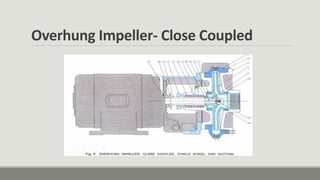
Overhung Impeller Type: The impeller is mounted on the end of a shaft which is “overhung”
from its bearing supports. Example:
– Close Coupled pumps where the impeller is mounted directly on the motor shaft
– Separately coupled or frame mounted where the impeller is mounted on a separate pump shaft
supported by its own bearings.
Impeller Between Bearings Type: The impeller is mounted on a shaft with the bearings at both
ends. The impeller is mounted “between bearings”. Example:
– Axial Split, Horizontal Split Case
– Axial Split Vertical Split Case
Overhung Impeller- Close Coupled
Overhung Impeller, Frame Mounted
Impeller Between Bearings: Horizontal
Split
Impeller Between Bearings: Vertical Split
Centrifugal Pump Classification by Flow
The manner in which fluid flows through the pump is determined by the design of the pump
casing and the impeller.
The three types of flow through a centrifugal pump are
Radial flow,
Axial flow
Mixed flow
Axial and Radial Flow
• Axial Flow Pump
– The impeller pushes the liquid in a direction parallel to the pump shaft.
– Most of the pressure is developed propelling or lifting the vanes on the liquid.
Axial and Radial Flow Continued…..
Radial Flow Pump:
– Pressure is developed principally by centrifugal force action.
– The liquid enters at the center of the impeller and is directed out along the impeller,
perpendicular to the pump shaft.
Operating Principals
As mentioned earlier, Centrifugal pump relies on the centrifugal force.
When you swing a bucket of water around overyour head, you will find that as you increase the
speed, the bucket is pulled harder against your arm. This pull on your arm is the centrifugal force.
It makes no difference if you swing the bucket horizontal or vertical. If the speed is fast enough,
then the water will remain on the bucket.
if you punch a small hole on the bottom of bucket, the water throws a stream and the
distance the water travels is proportional to the centrifugal force.
The same force that kept water in thebucket, is how the simple Centrifugal
pump works.
Operation Principals continued.….
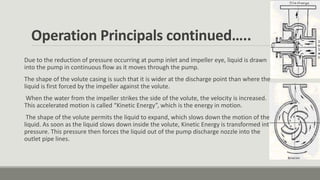
Centrifugal Pump consists of a rotatingimpeller inside a stationary volute (casing).
Liquid enters the pump through the suctioninlet into the eye of the impeller.
The speed of the rotating impeller then forces the liquid out through the discharge
nozzle.
The liquid enters the inlet of the centrifugal pump under atmospheric pressure, and flows
into the eye of the impeller.
The Centrifugal force exerted on the liquid by therotating impeller, moves the liquid away
from the impeller eye and out along the impeller vanes to their extreme tip where the liquid
is then forced against the inside walls of the volute and out through the discharge of the
pump.
Operation Principals continued…..
Due to the reduction of pressure occurring at pump inlet and impeller eye, liquid is drawn
into the pump in continuous flow as it moves through the pump.
The shape of the volute casing is such that it is wider at the discharge point than where the
liquid is first forced by the impeller against the volute.
When the water from the impeller strikes the side of the volute, the velocity is increased.
This accelerated motion is called “Kinetic Energy”, which is the energy in motion.
The shape of the volute permits the liquid to expand, which slows down the motion of the
liquid. As soon as the liquid slows down inside the volute, Kinetic Energy is transformed into
pressure. This pressure then forces the liquid out of the pump discharge nozzle into the
outlet pipe lines.
Different Types of Impeller
The impeller of a Centrifugal Pump can be of three types:
Open Impeller: The vanes are cast free on both sides.
Semi-Open Impeller: The vanes are free on one side and enclosed on the other.
Enclosed Impeller: The vanes are located between the two discs, all in a single casting.
Centrifugal pump Curves- Characteristics
Head and Capacity
– A rating curve indicates the relationshipbetween the head (pressure) developed by the
pump and the flow through the pump based on a particular speed andimpeller diameter
when handling a liquid.
– As the capacity increases, the total headwhich the pump is capable of developing
decreases.
– In general, the highest head the Centrifugal Pump can develop is at the point where there
is no flow through the pump.
Centrifugal pump Curves- Characteristics
Continued…..
BHP (Brake Horsepower) and Capacity
– For the Centrifugal pump to deliverthe capacity we want, we must supply the pump with a
certain HP.
– Generally, the HP increases as weincrease the capacity.
BHP: is the total power required by a pump to do a specified amount of work.
BHP = Q x H x Sp/Gr3960 x Efficiency
Efficiencies
– Efficiency of a pump can be calculated by:
Eff = Q x H x Sp.Gr x 100 /3960 x HP
where, Eff = Efficiency (%)
Q = Capacity delivered by the pump
H = Head developed by the pump
Sp. Gr = Specific Gravity of liquid being pumped
HP = Horsepower required by the pump
3960 is a constant linking a HP (33,000 ft lbs / min) to a US GPM (8.333 lbs).
33000 = 3960/8.333
Problems of centrifugal pumps
These are some difficulties faced in centrifugal pumps:
Play media
Open Type Centrifugal Pump Impeller
Cavitation—the net positive suction head (NPSH) of the system is too low for the selected pump
Wear of the impeller—can be worsened by suspended solids
Corrosion inside the pump caused by the fluid properties
Overheating due to low flow
Leakage along rotating shaft.
Lack of prime—centrifugal pumps must be filled (with the fluid to be pumped) in order to operate
Surge
Advantages and Disadvantages of
Centrifugal Pumps
Centrifugal Pumps are the most widely used type of pump for the transfer of liquids. There are many
advantages and disadvantages associated with Centrifugal Pumps:
Advantages:
– Simple operation.
– Low first cost and maintenance.
– Insignificant excessive pressure build up in casing.
– Impeller and shaft are the only moving parts.
– Quiet operations.
– Wide range of pressure, flow and capacities.
– Utilize small floor space in different positions.
Advantages and Disadvantages of
Centrifugal Pumps Continued…..
Disadvantages:
– High viscous liquids are not handled well.
– Centrifugal Pumps usually don’t have the capabilities of handling high pressure applications in
comparison to other types of pumps, i.e., Regenerative turbines.
– In general, Centrifugal pumps cannot deliver high pressure without changes in design and are
not suitable for high pressure delivery at low volumes except the multistage pumps.
Introduction
Positive displacement pumps were developed long before centrifugal pumps. Liquid is positively
displaced from a fixed-volume container. Positive-displacement pumps are capable of developing high
pressures while operating at low suction pressures. They are commonly referred to as constant-volume
pumps. Unlike centrifugal pumps, their capacity is not affected by the pressure against which they
operate. Flow is usually regulated by varying the speed of the pump or by recycle. Positive-displacement
pumps are divided into two groups: rotary and reciprocating pumps.
Rotary Pumps
Rotary pumps are normally limited to services
in which the fluid viscosity is very high or the
flow rate too small to be handled economically
by other pumps. Rotary pumps are commonly
used to circulate lube oils through engines,
turbines, reduction gears, and process-
machinery bearings. Rotary pumps displace a
fixed quantity of fluid for every revolution of
the driver shaft. They have different pumping
elements such as vanes, lobes, gears, and
screws.
Most manufacturers rate rotary pumps by capacity (i.e., throughout). Capacity is the total liquid
displacement of the pump less slip. Slip is the quantity of fluid that leaks from the higher-pressure
discharge to the lower-pressure suction. Slip occurs because all rotary pumps require clearances
between the rotating elements and pump housing. These clearances provide a leak path between
the discharge and suction sides.
Relationship between speed, volumetric efficiency, and
displacement of a rotary positive-displacement pump.
Types
Sliding vane
A set of vanes is mounted in a rotor in which the vanes slide in and out of the rotor. The rotor is mounted off center in the
casing. As the vanes rotate past the suction port, they slide out of the rotor while maintaining constant contact with the
casing. Springs or sealer rings help hold the vanes against the casing, thus the vanes make a close seal, or fit, against the
casing wall. Trapped fluid is forced from the suction port to the discharge port.
The sliding-vane design is capable of delivering medium capacity and head. They deliver a constant flow rate for a set rotor
speed. They work well with low-viscosity fluids and are somewhat self-compensating for wear. They are not suitable for use
with highly viscous fluids (thicker fluids interfere with the sliding action of the vanes). A large wear area results from the
friction fit between the vanes and the cylinder.
External Gear
The external gear consists of two equal-sized meshing gears, one a driver and the other an idler, that
rotate inside a housing. As the gears unmesh at the suction side of the pump, a vacuum is formed.
Pressure forces the fluid into the pump where the fluid is carried between the gear teeth and the case
to the discharge port. At the discharge, the meshing of the gear teeth creates a boundary that prevents
the fluid from returning to the suction. Gear pumps operate equally well when driven in either
direction. Precautions should be taken to ensure that the shaft rotation is correct when special features,
such as built-in relief valves or a bleed back of the shaft seal, are used.
Internal Gear
The internal-gear pump is similar in principle to the external gear except the drive shaft turns a ring gear
with internal teeth. The external gear tooth (idler) rotates on an offset center and meshes with the drive
gear through only a segmental arc of rotation. A fixed crescent-shaped filter occupies the space between
internal- and external-gear-tooth tips opposite the mesh point. As the gear teeth disengage at the input
port, fluid enters and is trapped in the tooth space of each gear and is carried to the discharge port. The
meshing of the two gears and the elimination of the tooth space forces fluid from the pump.
Single screw
In the single-screw design, the fluid is trapped between the treads of a rotating screw and the treads of
the internal stationary element. These pumps are used for viscous liquids and liquids with high solids
content. They can produce significant suction lift and relatively high pressures. They can handle fluids
ranging from clean water to sludges without changing clearances or components. On the other hand,
they are expensive, bulky, and difficult to maintain, and replacement parts are expensive.
Multiple Screw Pump
In the multiple-screw design, the fluid flows between a central drive screw and one or more idler
screws in a close-fitting housing. In two-screw pumps, both shafts are driven with timing gears. In
three-screw pumps, the screw treads are cut so one screw can drive the other two. The rotation of the
screws produces a vacuum at the inlet, moves the fluid through the pump, and delivers the fluid to the
discharge. In small sizes, they are used to supply lubricating oil to engines and industrial machinery. In
intermediate sizes, they are used in office buildings as a source of hydraulic energy to operate elevators.
In large sizes, they are used to load and unload barges and tankers.
Reciprocating Pumps
Reciprocating pumps move liquid by means of a constant back-and-forth motion of a piston,
plunger, or diaphragm within a fixed volume or cylinder. Reciprocating pumps can handle viscous
and abrasive fluids. They are low-speed machines when compared with centrifugal and rotary
pumps. They offer higher efficiencies, generally 85 to 94%, thus they require less horsepower.
Reciprocating pumps are best suited for high-pressure and low-volume applications. They
frequently require pulsation dampeners because of the pulsating nature of the flow. They have
higher installed costs (usually offset by higher efficiencies) and higher maintenance costs than
centrifugal or rotary pumps.
Installation guidelines
If positive-displacement pumps are properly installed and operated, satisfactory performance
can be realized for a long time. These pumps are manufactured in a variety of designs for many
different services. Each manufacturer’s instructions should be followed carefully for specific
machines or application equipment. The following discussion relates to general installation
guidelines for positive-displacement reciprocating pumps.
Foundations and alignment
Most pump foundations are constructed of reinforced concrete. The pump and driver are bolted
to a cast iron or steel base plate, which is secured to the concrete foundation with anchor bolts.
Small pumps need a foundation large enough to accommodate the base-plate assembly. Large
pumps require a foundation that is three to four times the weight of the pump and driver.
Anchor bolt sleeve installation
Each anchor bolt is fitted with a washer and passed through a pipe sleeve that has a diameter three to four
times greater than the bolt. The bolt-sleeve unit is set into the concrete at the predetermined base-plate hole
positions. The flexibility in the sleeve washer unit allows minor adjustments to be made in the bolt position
before final tightening even after the concrete foundation has set.
Metal shim adjustments
Metal shims are used to position the pump on the foundation. Adjustments are made until the pump shaft and
flanges are completely level. Alignment between the pump and driver is then adjusted before connecting the
pump to the suction and discharge lines. The latter should have been aligned during the initial positioning of the
base plate.
Grouting
Because of pipe strain, the entire pump assembly should be rechecked for alignment once the piping has been
securely bolted. If the drive alignment has not been changed by bolting the piping, the space between the base
plate and concrete foundations is filled with grouting. Grouting should be sufficiently fluid to fill all the available
space under the base plate.
Operating temperature considerations
It is essential that the alignment between the piping, pump, and driver not change. Ideally, alignments should be
made at the operating temperature after initial cold alignment of the pumping system, thus eliminating any
alignment changes because of thermal expansion.
Piping
Next to the selection of operating speeds, proper piping design is the most important consideration in pump-
installation design. Poor piping is often the result of inattention to details, which can lead to more than average
down time, higher maintenance costs, and loss of operating-personnel confidence.
Suction piping should be direct, free of bends, as short as possible, and at least one nominal pipe size larger than
the pump-suction connection. Directional piping changes should be made with long-radius elbows. A full
opening block valve should be installed in the suction piping. The suction vessel should have sufficient retention
time for the evolution of free gas and should be equipped with a vortex breaker at the discharge nozzle. The
suction and bypass lines should enter the vessel below the minimum liquid level.
Suction piping should be large enough so that the velocity limits are not exceeded. Eccentric reducers with
the flat side up should be used instead of concentric reducers. Suction piping should include a suction
strainer and a pulsation dampener. Suction strainers should not be installed unless regular maintenance
can be assured. A fluid-starved condition resulting from a plugged strainer can cause more damage to the
pump than solids ingestion.
The discharge piping should be direct, free of excessive bends, and at least one nominal pipe size larger
than the pump-discharge connection. Directional piping changes should be made with long-radius elbows.
Concentric reducers may be used, but they should be placed as near to the pump as practical. To facilitate
priming and starting, a bypass (recycle) line with check valve and block valve should be installed to the
suction source. If a pulsation dampener is not included in the initial installation, a flanged connection
should be provided if pulsation attenuation may be required. A relief valve should be installed upstream of
the discharge block valve, in case overpressurization in the discharge piping occurs.
INTRODUCTION TO COMPRESSORS
 Compressors are machines that compress air or
gas. Compression is achieved through the reduction
of the volume that the gas (or air) occupies. As a
side effect of the minimization of volume, the
temperature of air or gas increases.
 The act of compression requires power, provided
by drivers such as motors, steam turbines, and gas
turbines, to push the molecules into a smaller
volume forcing them closer together.
CLASSIFICATION
1] POSITIVE DISPLACEMENT
COMPRESSORS
 Positive displacement compressors draw in and capture a volume
of air(for example) in a chamber, then reduce the volume of the
chamber to compress the air.
 The idea is trapping a certain amount of compressible fluid
pressurize it and then discharge it with the gained energy.
This can be divided into two group Rotary types and Reciprocating
types.
ROTARY
(A) Screw Compressor
 Rotary screw compressor is a type of gas
compressor that uses a rotary-type
positive-displacement mechanism. They
are commonly used to replace piston
compressors where large volumes of
high-pressure air are needed. Their
horsepower varies from 5 to 500 HP, and
they are usually employed as
superchargers in automobile engines, in
lubrication systems, large industrial
applications or operating high-power air
tools.
ROTARY
(B) Scroll compressor
 A scroll compressor (also called spiral compressor, scroll pump
and scroll vacuum pump) is a device for compressing air or
refrigerant. It is used in air conditioning equipment, as an
automobile supercharger (where it is known as a scroll-type
supercharger) and as a vacuum pump.
Scroll compressors are not as efficient as rotary screw
compressors
ROTARY
(C) Vane Compressor
 In an air tool, compressed air enters the
inlet port which is plumbed to the smallest
compartment of the vane-housing inside.
The compressed air should be at least at
the minimum operating pressure for that
air tool to work properly.
 The compressed air is moving from an
area of high pressure as it enters the air
tool, to an area of relative low pressure,
that being back to atmospheric pressure
outside the air tool. As the air moves inside
the tool, it too moves the vanes.
 Sliding vane compressors are widely used
as vacuum pumps.
RECIPROCATING
(A) Diaphragm Compressor
 A diaphragm compressor is a variant of the
classic reciprocating compressor with backup and
piston rings and rod seal. The compression of gas
occurs by means of a flexible membrane, instead
of an intake element. The back and forth moving
membrane is driven by a rod and a crankshaft
mechanism.
RECIPROCATING
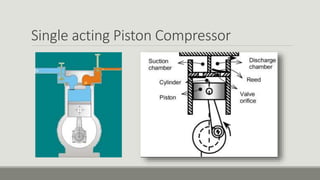
(B) Single/Double act Piston Compressor
 Reciprocating compressors are equipped with a crankshaft, which drives the pistons. They are commonly found
in versions that produce 5 to 30 HP. However, larger ones used for industrial purposes can produce up to 1,000
HP.
 Single Acting means that air is drawn in and compressed on one side of the piston. The other side is exposed to
the crankcase of the compressor. In this case, the downward stroke of the piston draws in the air, and the upward
stroke compresses it.
 Home, hobbyist, and automotive service compressors typically fall in the single acting category, though some
are used for light industrial use as well.
 Double Acting reciprocating compressors have compression chambers on both sides of the piston. On the down
stroke, air is drawn in on the top of the piston while air is compressed on the bottom side. On the upstroke, air is
drawn into the bottom side while air is compressed on the top side. Double acting machines require sealing of
the piston rod, so a crosshead is used to eliminate the angular movement of the rod.
 Very few manufacturers still produce the double acting reciprocating compressor because it is quite expensive
to produce, requires special foundations to handle vibration, and requires frequent extensive maintenance.
Single acting Piston Compressor
Double acting Piston Compressor
2] DYNAMIC DISPLACEMENT
COMPRESSORS
 Dynamic Displacement Compressors. Rather than physically reducing the
volume of a captured pocket of air, dynamic compressors instead speed up the
air to high velocity, and then restrict the air flow so that the reduction in velocity
causes pressure to increase. They are oil-free by nature, and some are oil-less.
 Dynamic compressors include axial and centrifugal types.
(A) AXIAL COMPRESSORS
 Axial compressors use a series of turbine blades, similar in appearance to a jet engine, to force
air into a smaller and smaller area.
 Axial compressors are not commonly used in industry, but commonly used in jet engines.
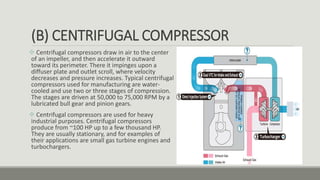
(B) CENTRIFUGAL COMPRESSOR
 Centrifugal compressors draw in air to the center
of an impeller, and then accelerate it outward
toward its perimeter. There it impinges upon a
diffuser plate and outlet scroll, where velocity
decreases and pressure increases. Typical centrifugal
compressors used for manufacturing are water-
cooled and use two or three stages of compression.
The stages are driven at 50,000 to 75,000 RPM by a
lubricated bull gear and pinion gears.
 Centrifugal compressors are used for heavy
industrial purposes. Centrifugal compressors
produce from ~100 HP up to a few thousand HP.
They are usually stationary, and for examples of
their applications are small gas turbine engines and
turbochargers.
Main Elements of Centrifugal Compressor
CONSTRUCTION
 A simple centrifugal compressor has four components: inlet, impeller/rotor,
diffuser, and collector.
 The gas enters the inlet nozzle of the compressor and is guided (often with the
help of guide vanes) to the inlet of the first impeller. An impeller consists of a
number of rotating vanes that impart mechanical energy to the gas. The gas will
leave the impeller with an increased velocity and increased static pressure. In the
diffuser, part of the velocity is converted into static pressure.
THE INLET OF COMPRESSOR
 The inlet to a centrifugal compressor is
typically a simple pipe. It may include features
such as a valve, stationary vanes/airfoils (used
to help swirl the flow) and both pressure and
temperature instrumentation. All of these
additional devices have important uses in the
control of the centrifugal compressor.
 The gas enters the inlet nozzle of the
compressor and is guided (often with the help
of guide vanes) to the inlet of the first impeller.
An impeller consists of a number of rotating
vanes that impart mechanical energy to the
gas. The gas will leave the impeller with an
increased velocity and increased static
pressure. In the diffuser, part of the velocity is
converted into static pressure.
THE CENTRIFUGAL IMPELLER
The key component that makes a compressor
centrifugal is the centrifugal impeller, Figure 0.1,
which contains a rotating set of vanes (or blades)
that gradually raises the energy of the working
gas. This is identical to an axial compressor with
the exception that the gases can reach higher
velocities and energy levels through the
impeller's increasing radius. In many modern
high-efficiency centrifugal compressors the gas
exiting the impeller is traveling near the speed of
sound.
Impellers are designed in many configurations
including "open" (visible blades), "covered or
shrouded", "with splitters" (every other inducer
removed) and "w/o splitters" (all full blades).
Both Figures 0.1 and 3.1 show open impellers
with splitters. Most modern high efficiency
impellers use "backsweep" in the blade shape
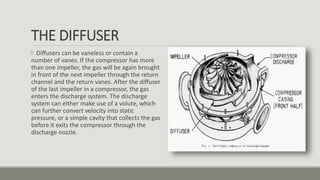
THE DIFFUSER
 Diffusers can be vaneless or contain a
number of vanes. If the compressor has more
than one impeller, the gas will be again brought
in front of the next impeller through the return
channel and the return vanes. After the diffuser
of the last impeller in a compressor, the gas
enters the discharge system. The discharge
system can either make use of a volute, which
can further convert velocity into static
pressure, or a simple cavity that collects the gas
before it exits the compressor through the
discharge nozzle.
THE COLLECTOR
 The collector of a centrifugal compressor can take many
shapes and forms.[7][18] When the diffuser discharges
into a large empty chamber, the collector may be termed a
Plenum. When the diffuser discharges into a device that
looks somewhat like a snail shell, bull's horn or a French
horn, the collector is likely to be termed a volute or scroll.
As the name implies, a collector’s purpose is to gather the
flow from the diffuser discharge annulus and deliver this
flow to a downstream pipe. Either the collector or the pipe
may also contain valves and instrumentation to control the
compressor.
STANDARDS AND CODES
ISO 5389:2005 applies to performance tests on turbocompressors of all types. ISO 5389:2005
does not apply to fans and high-vacuum pumps, or to jet-type compressors with moving drive
components
Turbocompressors comprise machines in which inlet, compression and discharge are continuous
flow processes. The gas is conveyed and compressed in impellers and decelerated with further
increase in pressure in fixed vaned or vaneless stators.
ISO 5389:2005 is intended to provide standard provisions for the preparation, procedure,
evaluation and assessment of performance tests on compressors as specified above. The
acceptance test of the performance is based on this performance test code. Acceptance tests
are intended to demonstrate fulfilment of the order conditions and guarantees specified in the
contract.
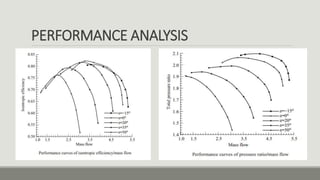
PERFORMANCE ANALYSIS
POWER TO MASS FLOW RATE CURVE
PROTECTING FROM SURGE
 Surge is defined as the operating point at which
centrifugal compressor peak head capability and
minimum flow limits are reached. Actually, the working
principle of a centrifugal compressor is increasing the
kinetic energy of the fluid with a rotating impeller. The
fluid is then slowed down in a volume called the
plenum, where the kinetic energy is converted into
potential energy in form of a pressure rise.
 When the plenum pressure behind the compressor is
higher than the compressor outlet pressure, the fluid
tends to reverse or even flow back in the compressor.
As a consequence, the plenum pressure will decrease,
inlet pressure will increase and the flow reverses again.
This phenomenon, called surge, repeats and occurs in
cycles with frequencies varying from 1 to 2 Hz.
Anti-Surge Control Systems
These systems detect when a process compression
stage is approaching to surge and subsequently
take action to reverse the movement of the
operating point towards the surge line (SL). This
decreases the plenum pressure and increases the
flow through the compressor, resulting in stable
working conditions. It is normally achieved by
opening a control valve in a recycle line (Anti-Surge
Control Valve or ASCV), returning the discharge gas
to the inlet of the compressor via a suction cooler.
The resulting increase in compressor inlet volume
flow moves the operating point away from surge.
Positive Displacement Compressors
Positive-displacement compressors are devices that may use screws, sliding vanes, lobes,
gears, or a piston to deliver a set volume of gas with each stroke. Positive displacement
compressors work by trapping a set amount of gas and forcing it into a smaller volume.
Types of Displacement Compressors
There are two main types of displacement compressors:
1. Reciprocating: is being the most commonly used.
2. rotary
Reciprocating compressors
The term reciprocating refers to the back-and-forth movement of the compression device (a
piston or other device is positioned in a cylinder).
Reciprocating compressors use the inward stroke of a piston to draw (intake) gas into a chamber
and then use an outward stroke to positively displace (discharge) the gas.
A common application for the reciprocating compressor is in an instrument air system.
There is two types of reciprocating compressors:
1. Piston Compressors.
2. Diaphragm compressor.
Reciprocating compressor old model
Piston Compressors
In piston-type reciprocating compressors, the pistons connect to a crankshaft that converts the
rotational motion of a driver to the reciprocating motion of the piston. The piston’s motion pulls
gas into a cylinder from the suction line, and then displaces it from the cylinder through the
discharge line. Check valves (compression valves) on the suction and discharge allow the flow of
the gas in one direction only.
Piston-type compressors can be single- or double-acting.
1. Double-acting compressors trap the gas during the suction stroke on one side of the piston,
while compressing the gas on the discharge side of the piston at the same time.
2. Single Acting compressor consists of a single cylinder which only takes in and discharges fluid
at one end.
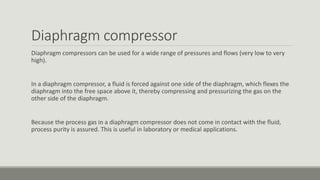
Diaphragm compressor
Diaphragm compressors can be used for a wide range of pressures and flows (very low to very
high).
In a diaphragm compressor, a fluid is forced against one side of the diaphragm, which flexes the
diaphragm into the free space above it, thereby compressing and pressurizing the gas on the
other side of the diaphragm.
Because the process gas in a diaphragm compressor does not come in contact with the fluid,
process purity is assured. This is useful in laboratory or medical applications.
Advantages of Diaphragm compressor
1. Oil-free compression due to hermetic separation between gas and oil
chamber
2. Abrasion-free compression due to static seals in the gas stream.
3. Automatic shutdown in case of a diaphragm failure prevents damage
4. Discharge pressure up to (3,000 bar)
ROTARY COMPRESSORS
Rotary compressors move gases by rotating a set of screws, lobes, or vanes. As these screws,
lobes, or vanes rotate, gas is drawn into the compressor by negative pressure on one side and
forced out of the compressor (discharged) through positive pressure on the other. Rotary
compressors do not require a constant suction pressure to produce discharge pressure.
In other positive displacement compressors, lobes or gears displace the gas from a cavity
created between the rotors and the compressor body. If the suction pressure is lower than the
original compressor design capacity, the compressor will still work, but with lower-than-design
capacity results. Because of this, these compressors are appropriate for processes in which the
inlet pressures change over a wider range than centrifugal compressors can operate.
liquid ring compressor
Another kind of rotary compressor is a liquid ring compressor it uses an eccentric impeller with
vanes to transmit centrifugal force to a sealing fluid (e.g., water), driving it against the wall of a
cylindrical casing. The liquid moves in and out of the vanes as the rotor turns. The liquid is used
in place of a piston that compresses the gas without friction. Gas is drawn into the vane cavities
and is expelled against the discharge pressure.
Advantages of liquid ring compressor:
1. Almost all gases and vapours are compressed, even those containing dust and liquids.
2. there is only a very slight rise in the temperature of the gas.
3. there is a high level of reliability in service with a minimum of maintenance required.
LUBRICATION SYSTEM
Normally, when gases are compressed, the bearings and seals become hotter. Some of the heat
is transmitted to the seals and bearings. This heat is removed by cooling the lubricants.
Lubrication systems circulate and cool sealing and lubricating oils. In some applications, the
sealing and lubricating oils are the same.
SEAL SYSTEM
Seal systems prevent process gases from leaking to the atmosphere where the compressor shaft
exits the casing. Compressor shaft seals can include labyrinth seals, liquid buffered seals, and dry
carbon rings.
A labyrinth seal is designed to restrict flow by requiring the fluid to pass through a series of ridges and
intricate paths. A purge of an inert gas (barrier gas) is provided at an intermediate injection point on the
seal to prevent external leakage of process gas.
A liquid buffered seal is a close-fitting bushing in which a liquid is injected in order to seal the process
from the atmosphere.
Dry carbon rings are a low-leakage type of seal that can be arranged with a buffer gas that separates the
process gas from the atmosphere
SOURCES AND REFERENCES
http://ezinearticles.com/?An-Introduction-To-Compressors&id=252369
http://cascousa.com/compressed-air-101/types-of-compressors/positive-displacement-
compressors/
 https://pgjonline.com/2012/04/02/protecting-a-centrifugal-compressor-from-surge/
‫لورد‬ ‫شركة‬ ‫الي‬ ‫اهداء‬
‫المهندس‬ ‫رعاية‬ ‫تحت‬:‫هشام‬
‫الخطيب‬(‫بالشركة‬ ‫التدريب‬ ‫مدير‬)

Pumps compressors

  • 1.
    ‫لورد‬ ‫شركة‬ ‫الي‬‫اهداء‬ ‫المهندس‬ ‫رعاية‬ ‫تحت‬:‫هشام‬ ‫الخطيب‬(‫بالشركة‬ ‫التدريب‬ ‫مدير‬)
  • 4.
    introduction What are pumpingsystem ? Objectives of pumping system: Transfer liquid from source to destination. Circulate liquid around a system.
  • 5.
    Pumps A pump isa device that moves fluids (liquidsor gases), or sometimes slurries, by mechanical action. Pumps can be classified into three major groups according to the method they use to move the fluid: direct lift,displacement, and gravity pumps. Pumps operate by some mechanism (typicallyreciprocating or rotary), and consume energyto perform mechanical work by moving the fluid. Pumps operate via many energy sources, including manual operation,electricity, engines, or wind power, come in many sizes, from microscopic for use in medical applications to large industrial pumps.
  • 6.
    Mechanical pumps servein a wide range of applications such as pumping water from wells, aquarium filtering, pond filtering andaeration, in the car industry for water- coolingand fuel injection, in the energy industry forpumping oil and natural gas or for operatingcooling towers. In the medical industry, pumps are used for biochemical processes in developing and manufacturing medicine, and as artificial replacements for body parts, in particular the artificial heart and penile prosthesis. Single stage pump – When in a casing only one impeller is revolving then it is called single stage pump. Double/multi-stage pump – When in a casing two or more than two impellers are revolving then it is called double/multi-stage pump
  • 7.
    Types of pumps PumpClassification Classified by operating principle.
  • 8.
    Types of pumps: Mechanicalpumps may be submerged in the fluid they are pumping or be placed externalto the fluid. Pumps can be classified by their method of displacement into positive displacement pumps, impulse pumps, velocity pumps,gravity pumps, steam pumps and valveless pumps. There are two basic types of pumps:positive displacement and centrifugal. Although axial-flow pumps are frequently classified as a separate type, they have essentially the same operating principles as centrifugal pumps. Positive displacement pumps –Operate by forcing a fixed volume of fluid from the inlet pressure section of the pump into the discharge zone of the pump. They add energy directly to a movable boundary, which imparts the energy to the fluid.
  • 9.
    Kinetic Pumps: – Addenergy directly through a rotating part in the form of velocity, and converts the velocity to pressure. Centrifugal Pumps Regenerative Pumps: Unique pump where the impeller is the only moving part. It is used when high head and low flows are required. Special Effects Pumps: Miscellaneous pumps.
  • 10.
    Centrifugal Pumps Are asub-class of dynamic axisymmetric work-absorbing turbomachinery. Centrifugal pumps are used to transport fluids by the conversion of rotational kinetic energy to the hydrodynamic energy of the fluid flow. The rotational energy typically comes from an engine or electric motor. The fluid enters the pump impeller along or near to the rotating axis and is accelerated by the impeller, flowing radially outward into a diffuser or volute chamber (casing), from where it exits. Common uses include water, sewage, petroleum and petrochemical pumping; a centrifugal fan is commonly used to implement a vacuum cleaner. The reverse function of the centrifugal pump is a water turbine converting potential energy of water pressure into mechanical rotational energy.
  • 11.
    How it works? Like most pumps, a centrifugal pump converts rotational energy, often from a motor, to energy in a moving fluid. A portion of the energy goes into kinetic energy of the fluid. Fluid enters axially through eye of the casing, is caught up in the impeller blades, and is whirled tangentially and radially outward until it leaves through all circumferential parts of the impeller into the diffuser part of the casing. The fluid gains both velocity and pressure while passing through the impeller. The doughnut-shaped diffuser, or scroll, section of the casing decelerates the flow and further increases the pressure.
  • 12.
    Vertical centrifugal pumps Verticalcentrifugal pumps are also referred to as cantilever pumps. They utilize a unique shaft and bearing support configuration that allows the volute to hang in the sump while the bearings are outside the sump. This style of pump uses no stuffing box to seal the shaft but instead utilizes a "throttle bushing". A common application for this style of pump is in a parts washer.
  • 13.
    Froth pumps In themineral industry, or in the extraction of oilsand, froth is generated to separate the rich minerals or bitumen from the sand and clays. Froth contains air that tends to block conventional pumps and cause loss of prime. Over history, industry has developed different ways to deal with this problem. In the pulp and paper industry holes are drilled in the impeller. Air escapes to the back of the impeller and a special expeller discharges the air back to the suction tank. The impeller may also feature special small vanes between the primary vanes called split vanes or secondary vanes. Some pumps may feature a large eye, an inducer or recirculation of pressurized froth from the pump discharge back to the suction to break the bubbles.
  • 14.
    Multistage centrifugal pumps Acentrifugal pump containing two or more impellers is called a multistage centrifugal pump. The impellers may be mounted on the same shaft or on different shafts. At each stage, the fluid is directed to the center before making its way to the discharge on the outer diameter. For higher pressures at the outlet, impellers can be connected in series. For higher flow output, impellers can be connected paralle All energy transferred to the fluid is derived from the mechanical energy driving the impeller. This can be measured at isentropiccompression, resulting in a slight temperature increase (in addition to the pressure increase).
  • 15.
    Centrifugal Pumps components Impeller: Mainrotating part that provides centrifugal acceleration to the fluid. Number of impellers =number of pump stages. Impeller classification: direction of flow, suction type and shape/mechanical construction Shaft: Transfers torque from motor to impeller during pump start up and operation
  • 16.
    Casings: Functions Enclose impeller as"pressurevessel" Support and bearing for shaft and impeller Volute case Impellers inside casings. Balances hydraulic pressure on pump shaft Circular casing Vanes surrounds impeller. Used for multi-stage pumps
  • 17.
    Definitions Overhung Impeller Type:The impeller is mounted on the end of a shaft which is “overhung” from its bearing supports. Example: – Close Coupled pumps where the impeller is mounted directly on the motor shaft – Separately coupled or frame mounted where the impeller is mounted on a separate pump shaft supported by its own bearings. Impeller Between Bearings Type: The impeller is mounted on a shaft with the bearings at both ends. The impeller is mounted “between bearings”. Example: – Axial Split, Horizontal Split Case – Axial Split Vertical Split Case
  • 18.
  • 19.
  • 20.
  • 21.
  • 22.
    Centrifugal Pump Classificationby Flow The manner in which fluid flows through the pump is determined by the design of the pump casing and the impeller. The three types of flow through a centrifugal pump are Radial flow, Axial flow Mixed flow
  • 23.
    Axial and RadialFlow • Axial Flow Pump – The impeller pushes the liquid in a direction parallel to the pump shaft. – Most of the pressure is developed propelling or lifting the vanes on the liquid.
  • 24.
    Axial and RadialFlow Continued….. Radial Flow Pump: – Pressure is developed principally by centrifugal force action. – The liquid enters at the center of the impeller and is directed out along the impeller, perpendicular to the pump shaft.
  • 25.
    Operating Principals As mentionedearlier, Centrifugal pump relies on the centrifugal force. When you swing a bucket of water around overyour head, you will find that as you increase the speed, the bucket is pulled harder against your arm. This pull on your arm is the centrifugal force. It makes no difference if you swing the bucket horizontal or vertical. If the speed is fast enough, then the water will remain on the bucket. if you punch a small hole on the bottom of bucket, the water throws a stream and the distance the water travels is proportional to the centrifugal force. The same force that kept water in thebucket, is how the simple Centrifugal pump works.
  • 26.
    Operation Principals continued.…. CentrifugalPump consists of a rotatingimpeller inside a stationary volute (casing). Liquid enters the pump through the suctioninlet into the eye of the impeller. The speed of the rotating impeller then forces the liquid out through the discharge nozzle. The liquid enters the inlet of the centrifugal pump under atmospheric pressure, and flows into the eye of the impeller. The Centrifugal force exerted on the liquid by therotating impeller, moves the liquid away from the impeller eye and out along the impeller vanes to their extreme tip where the liquid is then forced against the inside walls of the volute and out through the discharge of the pump.
  • 27.
    Operation Principals continued….. Dueto the reduction of pressure occurring at pump inlet and impeller eye, liquid is drawn into the pump in continuous flow as it moves through the pump. The shape of the volute casing is such that it is wider at the discharge point than where the liquid is first forced by the impeller against the volute. When the water from the impeller strikes the side of the volute, the velocity is increased. This accelerated motion is called “Kinetic Energy”, which is the energy in motion. The shape of the volute permits the liquid to expand, which slows down the motion of the liquid. As soon as the liquid slows down inside the volute, Kinetic Energy is transformed into pressure. This pressure then forces the liquid out of the pump discharge nozzle into the outlet pipe lines.
  • 28.
    Different Types ofImpeller The impeller of a Centrifugal Pump can be of three types: Open Impeller: The vanes are cast free on both sides. Semi-Open Impeller: The vanes are free on one side and enclosed on the other. Enclosed Impeller: The vanes are located between the two discs, all in a single casting.
  • 29.
    Centrifugal pump Curves-Characteristics Head and Capacity – A rating curve indicates the relationshipbetween the head (pressure) developed by the pump and the flow through the pump based on a particular speed andimpeller diameter when handling a liquid. – As the capacity increases, the total headwhich the pump is capable of developing decreases. – In general, the highest head the Centrifugal Pump can develop is at the point where there is no flow through the pump.
  • 30.
    Centrifugal pump Curves-Characteristics Continued….. BHP (Brake Horsepower) and Capacity – For the Centrifugal pump to deliverthe capacity we want, we must supply the pump with a certain HP. – Generally, the HP increases as weincrease the capacity. BHP: is the total power required by a pump to do a specified amount of work. BHP = Q x H x Sp/Gr3960 x Efficiency
  • 31.
    Efficiencies – Efficiency ofa pump can be calculated by: Eff = Q x H x Sp.Gr x 100 /3960 x HP where, Eff = Efficiency (%) Q = Capacity delivered by the pump H = Head developed by the pump Sp. Gr = Specific Gravity of liquid being pumped HP = Horsepower required by the pump 3960 is a constant linking a HP (33,000 ft lbs / min) to a US GPM (8.333 lbs). 33000 = 3960/8.333
  • 32.
    Problems of centrifugalpumps These are some difficulties faced in centrifugal pumps: Play media Open Type Centrifugal Pump Impeller Cavitation—the net positive suction head (NPSH) of the system is too low for the selected pump Wear of the impeller—can be worsened by suspended solids Corrosion inside the pump caused by the fluid properties Overheating due to low flow Leakage along rotating shaft. Lack of prime—centrifugal pumps must be filled (with the fluid to be pumped) in order to operate Surge
  • 33.
    Advantages and Disadvantagesof Centrifugal Pumps Centrifugal Pumps are the most widely used type of pump for the transfer of liquids. There are many advantages and disadvantages associated with Centrifugal Pumps: Advantages: – Simple operation. – Low first cost and maintenance. – Insignificant excessive pressure build up in casing. – Impeller and shaft are the only moving parts. – Quiet operations. – Wide range of pressure, flow and capacities. – Utilize small floor space in different positions.
  • 34.
    Advantages and Disadvantagesof Centrifugal Pumps Continued….. Disadvantages: – High viscous liquids are not handled well. – Centrifugal Pumps usually don’t have the capabilities of handling high pressure applications in comparison to other types of pumps, i.e., Regenerative turbines. – In general, Centrifugal pumps cannot deliver high pressure without changes in design and are not suitable for high pressure delivery at low volumes except the multistage pumps.
  • 36.
    Introduction Positive displacement pumpswere developed long before centrifugal pumps. Liquid is positively displaced from a fixed-volume container. Positive-displacement pumps are capable of developing high pressures while operating at low suction pressures. They are commonly referred to as constant-volume pumps. Unlike centrifugal pumps, their capacity is not affected by the pressure against which they operate. Flow is usually regulated by varying the speed of the pump or by recycle. Positive-displacement pumps are divided into two groups: rotary and reciprocating pumps.
  • 37.
    Rotary Pumps Rotary pumpsare normally limited to services in which the fluid viscosity is very high or the flow rate too small to be handled economically by other pumps. Rotary pumps are commonly used to circulate lube oils through engines, turbines, reduction gears, and process- machinery bearings. Rotary pumps displace a fixed quantity of fluid for every revolution of the driver shaft. They have different pumping elements such as vanes, lobes, gears, and screws.
  • 38.
    Most manufacturers raterotary pumps by capacity (i.e., throughout). Capacity is the total liquid displacement of the pump less slip. Slip is the quantity of fluid that leaks from the higher-pressure discharge to the lower-pressure suction. Slip occurs because all rotary pumps require clearances between the rotating elements and pump housing. These clearances provide a leak path between the discharge and suction sides. Relationship between speed, volumetric efficiency, and displacement of a rotary positive-displacement pump.
  • 39.
    Types Sliding vane A setof vanes is mounted in a rotor in which the vanes slide in and out of the rotor. The rotor is mounted off center in the casing. As the vanes rotate past the suction port, they slide out of the rotor while maintaining constant contact with the casing. Springs or sealer rings help hold the vanes against the casing, thus the vanes make a close seal, or fit, against the casing wall. Trapped fluid is forced from the suction port to the discharge port. The sliding-vane design is capable of delivering medium capacity and head. They deliver a constant flow rate for a set rotor speed. They work well with low-viscosity fluids and are somewhat self-compensating for wear. They are not suitable for use with highly viscous fluids (thicker fluids interfere with the sliding action of the vanes). A large wear area results from the friction fit between the vanes and the cylinder.
  • 40.
    External Gear The externalgear consists of two equal-sized meshing gears, one a driver and the other an idler, that rotate inside a housing. As the gears unmesh at the suction side of the pump, a vacuum is formed. Pressure forces the fluid into the pump where the fluid is carried between the gear teeth and the case to the discharge port. At the discharge, the meshing of the gear teeth creates a boundary that prevents the fluid from returning to the suction. Gear pumps operate equally well when driven in either direction. Precautions should be taken to ensure that the shaft rotation is correct when special features, such as built-in relief valves or a bleed back of the shaft seal, are used.
  • 41.
    Internal Gear The internal-gearpump is similar in principle to the external gear except the drive shaft turns a ring gear with internal teeth. The external gear tooth (idler) rotates on an offset center and meshes with the drive gear through only a segmental arc of rotation. A fixed crescent-shaped filter occupies the space between internal- and external-gear-tooth tips opposite the mesh point. As the gear teeth disengage at the input port, fluid enters and is trapped in the tooth space of each gear and is carried to the discharge port. The meshing of the two gears and the elimination of the tooth space forces fluid from the pump.
  • 42.
    Single screw In thesingle-screw design, the fluid is trapped between the treads of a rotating screw and the treads of the internal stationary element. These pumps are used for viscous liquids and liquids with high solids content. They can produce significant suction lift and relatively high pressures. They can handle fluids ranging from clean water to sludges without changing clearances or components. On the other hand, they are expensive, bulky, and difficult to maintain, and replacement parts are expensive.
  • 43.
    Multiple Screw Pump Inthe multiple-screw design, the fluid flows between a central drive screw and one or more idler screws in a close-fitting housing. In two-screw pumps, both shafts are driven with timing gears. In three-screw pumps, the screw treads are cut so one screw can drive the other two. The rotation of the screws produces a vacuum at the inlet, moves the fluid through the pump, and delivers the fluid to the discharge. In small sizes, they are used to supply lubricating oil to engines and industrial machinery. In intermediate sizes, they are used in office buildings as a source of hydraulic energy to operate elevators. In large sizes, they are used to load and unload barges and tankers.
  • 44.
    Reciprocating Pumps Reciprocating pumpsmove liquid by means of a constant back-and-forth motion of a piston, plunger, or diaphragm within a fixed volume or cylinder. Reciprocating pumps can handle viscous and abrasive fluids. They are low-speed machines when compared with centrifugal and rotary pumps. They offer higher efficiencies, generally 85 to 94%, thus they require less horsepower. Reciprocating pumps are best suited for high-pressure and low-volume applications. They frequently require pulsation dampeners because of the pulsating nature of the flow. They have higher installed costs (usually offset by higher efficiencies) and higher maintenance costs than centrifugal or rotary pumps.
  • 46.
    Installation guidelines If positive-displacementpumps are properly installed and operated, satisfactory performance can be realized for a long time. These pumps are manufactured in a variety of designs for many different services. Each manufacturer’s instructions should be followed carefully for specific machines or application equipment. The following discussion relates to general installation guidelines for positive-displacement reciprocating pumps. Foundations and alignment Most pump foundations are constructed of reinforced concrete. The pump and driver are bolted to a cast iron or steel base plate, which is secured to the concrete foundation with anchor bolts. Small pumps need a foundation large enough to accommodate the base-plate assembly. Large pumps require a foundation that is three to four times the weight of the pump and driver.
  • 47.
    Anchor bolt sleeveinstallation Each anchor bolt is fitted with a washer and passed through a pipe sleeve that has a diameter three to four times greater than the bolt. The bolt-sleeve unit is set into the concrete at the predetermined base-plate hole positions. The flexibility in the sleeve washer unit allows minor adjustments to be made in the bolt position before final tightening even after the concrete foundation has set. Metal shim adjustments Metal shims are used to position the pump on the foundation. Adjustments are made until the pump shaft and flanges are completely level. Alignment between the pump and driver is then adjusted before connecting the pump to the suction and discharge lines. The latter should have been aligned during the initial positioning of the base plate. Grouting Because of pipe strain, the entire pump assembly should be rechecked for alignment once the piping has been securely bolted. If the drive alignment has not been changed by bolting the piping, the space between the base plate and concrete foundations is filled with grouting. Grouting should be sufficiently fluid to fill all the available space under the base plate.
  • 48.
    Operating temperature considerations Itis essential that the alignment between the piping, pump, and driver not change. Ideally, alignments should be made at the operating temperature after initial cold alignment of the pumping system, thus eliminating any alignment changes because of thermal expansion. Piping Next to the selection of operating speeds, proper piping design is the most important consideration in pump- installation design. Poor piping is often the result of inattention to details, which can lead to more than average down time, higher maintenance costs, and loss of operating-personnel confidence. Suction piping should be direct, free of bends, as short as possible, and at least one nominal pipe size larger than the pump-suction connection. Directional piping changes should be made with long-radius elbows. A full opening block valve should be installed in the suction piping. The suction vessel should have sufficient retention time for the evolution of free gas and should be equipped with a vortex breaker at the discharge nozzle. The suction and bypass lines should enter the vessel below the minimum liquid level.
  • 49.
    Suction piping shouldbe large enough so that the velocity limits are not exceeded. Eccentric reducers with the flat side up should be used instead of concentric reducers. Suction piping should include a suction strainer and a pulsation dampener. Suction strainers should not be installed unless regular maintenance can be assured. A fluid-starved condition resulting from a plugged strainer can cause more damage to the pump than solids ingestion. The discharge piping should be direct, free of excessive bends, and at least one nominal pipe size larger than the pump-discharge connection. Directional piping changes should be made with long-radius elbows. Concentric reducers may be used, but they should be placed as near to the pump as practical. To facilitate priming and starting, a bypass (recycle) line with check valve and block valve should be installed to the suction source. If a pulsation dampener is not included in the initial installation, a flanged connection should be provided if pulsation attenuation may be required. A relief valve should be installed upstream of the discharge block valve, in case overpressurization in the discharge piping occurs.
  • 51.
    INTRODUCTION TO COMPRESSORS Compressors are machines that compress air or gas. Compression is achieved through the reduction of the volume that the gas (or air) occupies. As a side effect of the minimization of volume, the temperature of air or gas increases.  The act of compression requires power, provided by drivers such as motors, steam turbines, and gas turbines, to push the molecules into a smaller volume forcing them closer together.
  • 52.
  • 53.
    1] POSITIVE DISPLACEMENT COMPRESSORS Positive displacement compressors draw in and capture a volume of air(for example) in a chamber, then reduce the volume of the chamber to compress the air.  The idea is trapping a certain amount of compressible fluid pressurize it and then discharge it with the gained energy. This can be divided into two group Rotary types and Reciprocating types.
  • 54.
    ROTARY (A) Screw Compressor Rotary screw compressor is a type of gas compressor that uses a rotary-type positive-displacement mechanism. They are commonly used to replace piston compressors where large volumes of high-pressure air are needed. Their horsepower varies from 5 to 500 HP, and they are usually employed as superchargers in automobile engines, in lubrication systems, large industrial applications or operating high-power air tools.
  • 55.
    ROTARY (B) Scroll compressor A scroll compressor (also called spiral compressor, scroll pump and scroll vacuum pump) is a device for compressing air or refrigerant. It is used in air conditioning equipment, as an automobile supercharger (where it is known as a scroll-type supercharger) and as a vacuum pump. Scroll compressors are not as efficient as rotary screw compressors
  • 56.
    ROTARY (C) Vane Compressor In an air tool, compressed air enters the inlet port which is plumbed to the smallest compartment of the vane-housing inside. The compressed air should be at least at the minimum operating pressure for that air tool to work properly.  The compressed air is moving from an area of high pressure as it enters the air tool, to an area of relative low pressure, that being back to atmospheric pressure outside the air tool. As the air moves inside the tool, it too moves the vanes.  Sliding vane compressors are widely used as vacuum pumps.
  • 57.
    RECIPROCATING (A) Diaphragm Compressor A diaphragm compressor is a variant of the classic reciprocating compressor with backup and piston rings and rod seal. The compression of gas occurs by means of a flexible membrane, instead of an intake element. The back and forth moving membrane is driven by a rod and a crankshaft mechanism.
  • 58.
    RECIPROCATING (B) Single/Double actPiston Compressor  Reciprocating compressors are equipped with a crankshaft, which drives the pistons. They are commonly found in versions that produce 5 to 30 HP. However, larger ones used for industrial purposes can produce up to 1,000 HP.  Single Acting means that air is drawn in and compressed on one side of the piston. The other side is exposed to the crankcase of the compressor. In this case, the downward stroke of the piston draws in the air, and the upward stroke compresses it.  Home, hobbyist, and automotive service compressors typically fall in the single acting category, though some are used for light industrial use as well.  Double Acting reciprocating compressors have compression chambers on both sides of the piston. On the down stroke, air is drawn in on the top of the piston while air is compressed on the bottom side. On the upstroke, air is drawn into the bottom side while air is compressed on the top side. Double acting machines require sealing of the piston rod, so a crosshead is used to eliminate the angular movement of the rod.  Very few manufacturers still produce the double acting reciprocating compressor because it is quite expensive to produce, requires special foundations to handle vibration, and requires frequent extensive maintenance.
  • 59.
  • 60.
  • 61.
    2] DYNAMIC DISPLACEMENT COMPRESSORS Dynamic Displacement Compressors. Rather than physically reducing the volume of a captured pocket of air, dynamic compressors instead speed up the air to high velocity, and then restrict the air flow so that the reduction in velocity causes pressure to increase. They are oil-free by nature, and some are oil-less.  Dynamic compressors include axial and centrifugal types.
  • 62.
    (A) AXIAL COMPRESSORS Axial compressors use a series of turbine blades, similar in appearance to a jet engine, to force air into a smaller and smaller area.  Axial compressors are not commonly used in industry, but commonly used in jet engines.
  • 63.
    (B) CENTRIFUGAL COMPRESSOR Centrifugal compressors draw in air to the center of an impeller, and then accelerate it outward toward its perimeter. There it impinges upon a diffuser plate and outlet scroll, where velocity decreases and pressure increases. Typical centrifugal compressors used for manufacturing are water- cooled and use two or three stages of compression. The stages are driven at 50,000 to 75,000 RPM by a lubricated bull gear and pinion gears.  Centrifugal compressors are used for heavy industrial purposes. Centrifugal compressors produce from ~100 HP up to a few thousand HP. They are usually stationary, and for examples of their applications are small gas turbine engines and turbochargers.
  • 64.
    Main Elements ofCentrifugal Compressor CONSTRUCTION  A simple centrifugal compressor has four components: inlet, impeller/rotor, diffuser, and collector.  The gas enters the inlet nozzle of the compressor and is guided (often with the help of guide vanes) to the inlet of the first impeller. An impeller consists of a number of rotating vanes that impart mechanical energy to the gas. The gas will leave the impeller with an increased velocity and increased static pressure. In the diffuser, part of the velocity is converted into static pressure.
  • 65.
    THE INLET OFCOMPRESSOR  The inlet to a centrifugal compressor is typically a simple pipe. It may include features such as a valve, stationary vanes/airfoils (used to help swirl the flow) and both pressure and temperature instrumentation. All of these additional devices have important uses in the control of the centrifugal compressor.  The gas enters the inlet nozzle of the compressor and is guided (often with the help of guide vanes) to the inlet of the first impeller. An impeller consists of a number of rotating vanes that impart mechanical energy to the gas. The gas will leave the impeller with an increased velocity and increased static pressure. In the diffuser, part of the velocity is converted into static pressure.
  • 66.
    THE CENTRIFUGAL IMPELLER Thekey component that makes a compressor centrifugal is the centrifugal impeller, Figure 0.1, which contains a rotating set of vanes (or blades) that gradually raises the energy of the working gas. This is identical to an axial compressor with the exception that the gases can reach higher velocities and energy levels through the impeller's increasing radius. In many modern high-efficiency centrifugal compressors the gas exiting the impeller is traveling near the speed of sound. Impellers are designed in many configurations including "open" (visible blades), "covered or shrouded", "with splitters" (every other inducer removed) and "w/o splitters" (all full blades). Both Figures 0.1 and 3.1 show open impellers with splitters. Most modern high efficiency impellers use "backsweep" in the blade shape
  • 67.
    THE DIFFUSER  Diffuserscan be vaneless or contain a number of vanes. If the compressor has more than one impeller, the gas will be again brought in front of the next impeller through the return channel and the return vanes. After the diffuser of the last impeller in a compressor, the gas enters the discharge system. The discharge system can either make use of a volute, which can further convert velocity into static pressure, or a simple cavity that collects the gas before it exits the compressor through the discharge nozzle.
  • 68.
    THE COLLECTOR  Thecollector of a centrifugal compressor can take many shapes and forms.[7][18] When the diffuser discharges into a large empty chamber, the collector may be termed a Plenum. When the diffuser discharges into a device that looks somewhat like a snail shell, bull's horn or a French horn, the collector is likely to be termed a volute or scroll. As the name implies, a collector’s purpose is to gather the flow from the diffuser discharge annulus and deliver this flow to a downstream pipe. Either the collector or the pipe may also contain valves and instrumentation to control the compressor.
  • 69.
    STANDARDS AND CODES ISO5389:2005 applies to performance tests on turbocompressors of all types. ISO 5389:2005 does not apply to fans and high-vacuum pumps, or to jet-type compressors with moving drive components Turbocompressors comprise machines in which inlet, compression and discharge are continuous flow processes. The gas is conveyed and compressed in impellers and decelerated with further increase in pressure in fixed vaned or vaneless stators. ISO 5389:2005 is intended to provide standard provisions for the preparation, procedure, evaluation and assessment of performance tests on compressors as specified above. The acceptance test of the performance is based on this performance test code. Acceptance tests are intended to demonstrate fulfilment of the order conditions and guarantees specified in the contract.
  • 70.
  • 71.
    POWER TO MASSFLOW RATE CURVE
  • 72.
    PROTECTING FROM SURGE Surge is defined as the operating point at which centrifugal compressor peak head capability and minimum flow limits are reached. Actually, the working principle of a centrifugal compressor is increasing the kinetic energy of the fluid with a rotating impeller. The fluid is then slowed down in a volume called the plenum, where the kinetic energy is converted into potential energy in form of a pressure rise.  When the plenum pressure behind the compressor is higher than the compressor outlet pressure, the fluid tends to reverse or even flow back in the compressor. As a consequence, the plenum pressure will decrease, inlet pressure will increase and the flow reverses again. This phenomenon, called surge, repeats and occurs in cycles with frequencies varying from 1 to 2 Hz.
  • 73.
    Anti-Surge Control Systems Thesesystems detect when a process compression stage is approaching to surge and subsequently take action to reverse the movement of the operating point towards the surge line (SL). This decreases the plenum pressure and increases the flow through the compressor, resulting in stable working conditions. It is normally achieved by opening a control valve in a recycle line (Anti-Surge Control Valve or ASCV), returning the discharge gas to the inlet of the compressor via a suction cooler. The resulting increase in compressor inlet volume flow moves the operating point away from surge.
  • 75.
    Positive Displacement Compressors Positive-displacementcompressors are devices that may use screws, sliding vanes, lobes, gears, or a piston to deliver a set volume of gas with each stroke. Positive displacement compressors work by trapping a set amount of gas and forcing it into a smaller volume.
  • 76.
    Types of DisplacementCompressors There are two main types of displacement compressors: 1. Reciprocating: is being the most commonly used. 2. rotary
  • 77.
    Reciprocating compressors The termreciprocating refers to the back-and-forth movement of the compression device (a piston or other device is positioned in a cylinder). Reciprocating compressors use the inward stroke of a piston to draw (intake) gas into a chamber and then use an outward stroke to positively displace (discharge) the gas. A common application for the reciprocating compressor is in an instrument air system. There is two types of reciprocating compressors: 1. Piston Compressors. 2. Diaphragm compressor.
  • 78.
  • 79.
    Piston Compressors In piston-typereciprocating compressors, the pistons connect to a crankshaft that converts the rotational motion of a driver to the reciprocating motion of the piston. The piston’s motion pulls gas into a cylinder from the suction line, and then displaces it from the cylinder through the discharge line. Check valves (compression valves) on the suction and discharge allow the flow of the gas in one direction only. Piston-type compressors can be single- or double-acting. 1. Double-acting compressors trap the gas during the suction stroke on one side of the piston, while compressing the gas on the discharge side of the piston at the same time. 2. Single Acting compressor consists of a single cylinder which only takes in and discharges fluid at one end.
  • 80.
    Diaphragm compressor Diaphragm compressorscan be used for a wide range of pressures and flows (very low to very high). In a diaphragm compressor, a fluid is forced against one side of the diaphragm, which flexes the diaphragm into the free space above it, thereby compressing and pressurizing the gas on the other side of the diaphragm. Because the process gas in a diaphragm compressor does not come in contact with the fluid, process purity is assured. This is useful in laboratory or medical applications.
  • 81.
    Advantages of Diaphragmcompressor 1. Oil-free compression due to hermetic separation between gas and oil chamber 2. Abrasion-free compression due to static seals in the gas stream. 3. Automatic shutdown in case of a diaphragm failure prevents damage 4. Discharge pressure up to (3,000 bar)
  • 82.
    ROTARY COMPRESSORS Rotary compressorsmove gases by rotating a set of screws, lobes, or vanes. As these screws, lobes, or vanes rotate, gas is drawn into the compressor by negative pressure on one side and forced out of the compressor (discharged) through positive pressure on the other. Rotary compressors do not require a constant suction pressure to produce discharge pressure. In other positive displacement compressors, lobes or gears displace the gas from a cavity created between the rotors and the compressor body. If the suction pressure is lower than the original compressor design capacity, the compressor will still work, but with lower-than-design capacity results. Because of this, these compressors are appropriate for processes in which the inlet pressures change over a wider range than centrifugal compressors can operate.
  • 83.
    liquid ring compressor Anotherkind of rotary compressor is a liquid ring compressor it uses an eccentric impeller with vanes to transmit centrifugal force to a sealing fluid (e.g., water), driving it against the wall of a cylindrical casing. The liquid moves in and out of the vanes as the rotor turns. The liquid is used in place of a piston that compresses the gas without friction. Gas is drawn into the vane cavities and is expelled against the discharge pressure. Advantages of liquid ring compressor: 1. Almost all gases and vapours are compressed, even those containing dust and liquids. 2. there is only a very slight rise in the temperature of the gas. 3. there is a high level of reliability in service with a minimum of maintenance required.
  • 84.
    LUBRICATION SYSTEM Normally, whengases are compressed, the bearings and seals become hotter. Some of the heat is transmitted to the seals and bearings. This heat is removed by cooling the lubricants. Lubrication systems circulate and cool sealing and lubricating oils. In some applications, the sealing and lubricating oils are the same.
  • 85.
    SEAL SYSTEM Seal systemsprevent process gases from leaking to the atmosphere where the compressor shaft exits the casing. Compressor shaft seals can include labyrinth seals, liquid buffered seals, and dry carbon rings.
  • 86.
    A labyrinth sealis designed to restrict flow by requiring the fluid to pass through a series of ridges and intricate paths. A purge of an inert gas (barrier gas) is provided at an intermediate injection point on the seal to prevent external leakage of process gas. A liquid buffered seal is a close-fitting bushing in which a liquid is injected in order to seal the process from the atmosphere. Dry carbon rings are a low-leakage type of seal that can be arranged with a buffer gas that separates the process gas from the atmosphere
  • 87.
  • 88.
    ‫لورد‬ ‫شركة‬ ‫الي‬‫اهداء‬ ‫المهندس‬ ‫رعاية‬ ‫تحت‬:‫هشام‬ ‫الخطيب‬(‫بالشركة‬ ‫التدريب‬ ‫مدير‬)