Centrifugal Pump
Acentrifugal pump is a mechanical device designed to move fluids (primarily liquids) by
converting mechanical energy into hydraulic energy through the use of centrifugal force.
It is one of the most common types of pumps used in a wide range of applications, including
water supply, industrial processes, and chemical transport.
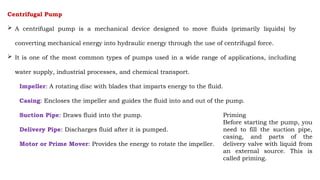
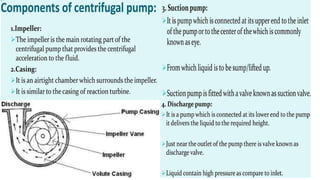
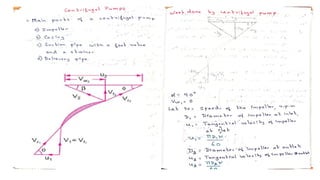
Impeller: A rotating disc with blades that imparts energy to the fluid.
Casing: Encloses the impeller and guides the fluid into and out of the pump.
Suction Pipe: Draws fluid into the pump.
Delivery Pipe: Discharges fluid after it is pumped.
Motor or Prime Mover: Provides the energy to rotate the impeller.
Priming
Before starting the pump, you
need to fill the suction pipe,
casing, and parts of the
delivery valve with liquid from
an external source. This is
called priming.
3.
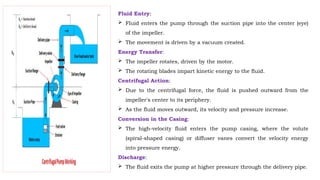
Fluid Entry:
Fluidenters the pump through the suction pipe into the center (eye)
of the impeller.
The movement is driven by a vacuum created.
Energy Transfer:
The impeller rotates, driven by the motor.
The rotating blades impart kinetic energy to the fluid.
Centrifugal Action:
Due to the centrifugal force, the fluid is pushed outward from the
impeller's center to its periphery.
As the fluid moves outward, its velocity and pressure increase.
Conversion in the Casing:
The high-velocity fluid enters the pump casing, where the volute
(spiral-shaped casing) or diffuser vanes convert the velocity energy
into pressure energy.
Discharge:
The fluid exits the pump at higher pressure through the delivery pipe.
4.
Working Principle ofcentrifugal pump:
Fluid Entry:
Fluid enters the pump through the suction pipe into the center (eye) of the impeller.
The movement is driven by a vacuum created.
Energy Transfer:
The impeller rotates, driven by the motor.
The rotating blades impart kinetic energy to the fluid.
Centrifugal Action:
Due to the centrifugal force, the fluid is pushed outward from the impeller's center to its periphery.
As the fluid moves outward, its velocity and pressure increase.
Conversion in the Casing:
The high-velocity fluid enters the pump casing, where the volute (spiral-shaped casing) or diffuser
vanes convert the velocity energy into pressure energy.
Discharge:
The fluid exits the pump at higher pressure through the delivery pipe.
6.
Centrifugal Pump
Advantages:
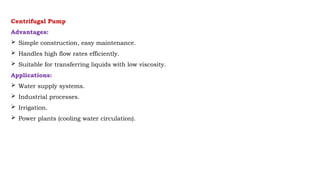
Simpleconstruction, easy maintenance.
Handles high flow rates efficiently.
Suitable for transferring liquids with low viscosity.
Applications:
Water supply systems.
Industrial processes.
Irrigation.
Power plants (cooling water circulation).





![Seminar presentation (2) 24 (2)[1].pptxvftfcutyjbhmjl](https://cdn.slidesharecdn.com/ss_thumbnails/seminarpresentation22421-250326170405-96c80d8c-thumbnail.jpg?width=640&height=640&fit=bounds)


![Seminar presentation (2) 24 (3)v[1].pptx](https://cdn.slidesharecdn.com/ss_thumbnails/seminarpresentation22431-250419171925-bad1f7f9-thumbnail.jpg?width=640&height=640&fit=bounds)


![SBP- Centrifugal and recoprocating pump [Compatibility Mode].pdf](https://cdn.slidesharecdn.com/ss_thumbnails/sbp-centrifugalandrecoprocatingpumpcompatibilitymode-241227102119-6ae861f2-thumbnail.jpg?width=640&height=640&fit=bounds)


