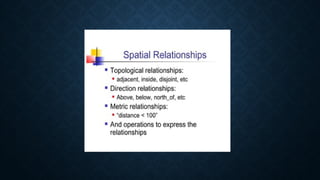
The document discusses spatial relationships in database management systems (DBMS), which explain how geometric or geographical objects interact in space. It details types of spatial relationships, including topological, directional, metric, and proximity relationships, and their importance in applications like GIS, urban planning, and navigation. The document also outlines the advantages and disadvantages of managing spatial relationships, emphasizing their benefits for spatial queries and decision-making, while noting the challenges related to complexity and performance.