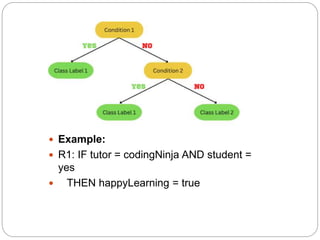
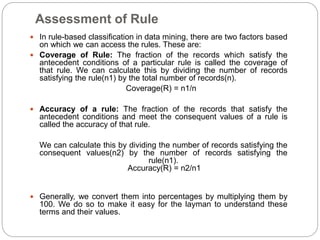
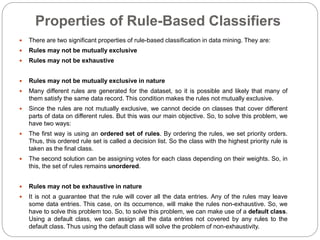
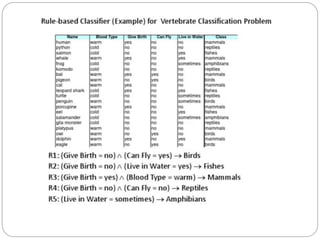
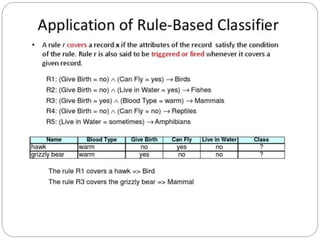
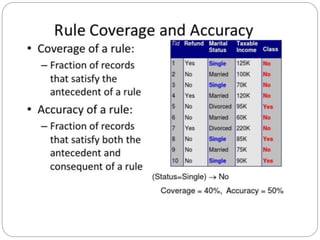
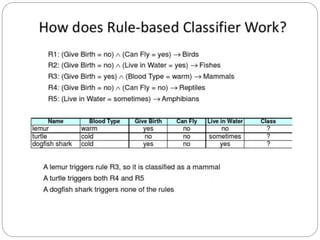
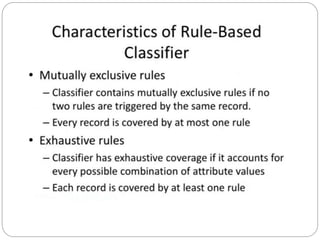
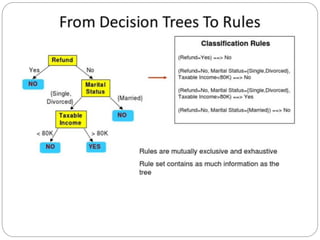
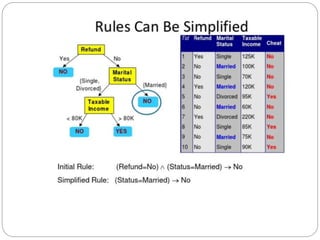
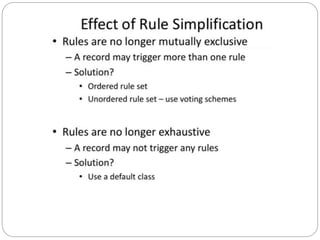
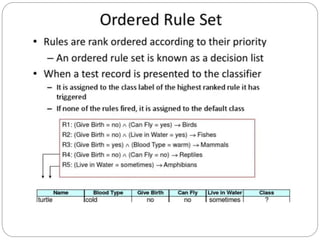
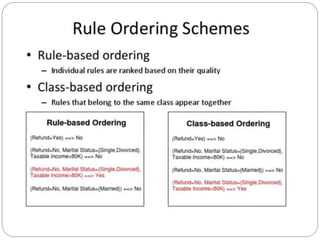
This document discusses rule-based classification in data mining. Rule-based classification uses "if-then" rules to make predictions, where the antecedent is the "if" condition and the consequent is the "then" prediction. An example rule is provided. Rules are assessed based on their coverage, which is the fraction of records satisfying the antecedent, and accuracy, which is the fraction of those records where the consequent is correct. However, rules may not be mutually exclusive or exhaustive. To address this, rules can be ordered as a decision list or votes can be assigned, and a default class can be used for uncovered records.