1
©Silberschatz, Korth and Sudarshan24.1Database System Concepts, 5th
Ed.
Chapter 24: Advanced Data Types and NewChapter 24: Advanced Data Types and New
ApplicationsApplications
Temporal Data
Spatial and Geographic Databases
Multimedia Databases
Mobility and Personal Databases
2
©Silberschatz, Korth and Sudarshan24.2Database System Concepts, 5th
Ed.
Time In DatabasesTime In Databases
While most databases tend to model reality at a point in time (at the
``current'' time), temporal databases model the states of the real world
across time.
Facts in temporal relations have associated times when they are valid,
which can be represented as a union of intervals.
The transaction time for a fact is the time interval during which the fact
is current within the database system.
In a temporal relation, each tuple has an associated time when it is
true; the time may be either valid time or transaction time.
A bi-temporal relation stores both valid and transaction time.
3
©Silberschatz, Korth and Sudarshan24.3Database System Concepts, 5th
Ed.
Time In Databases (Cont.)Time In Databases (Cont.)
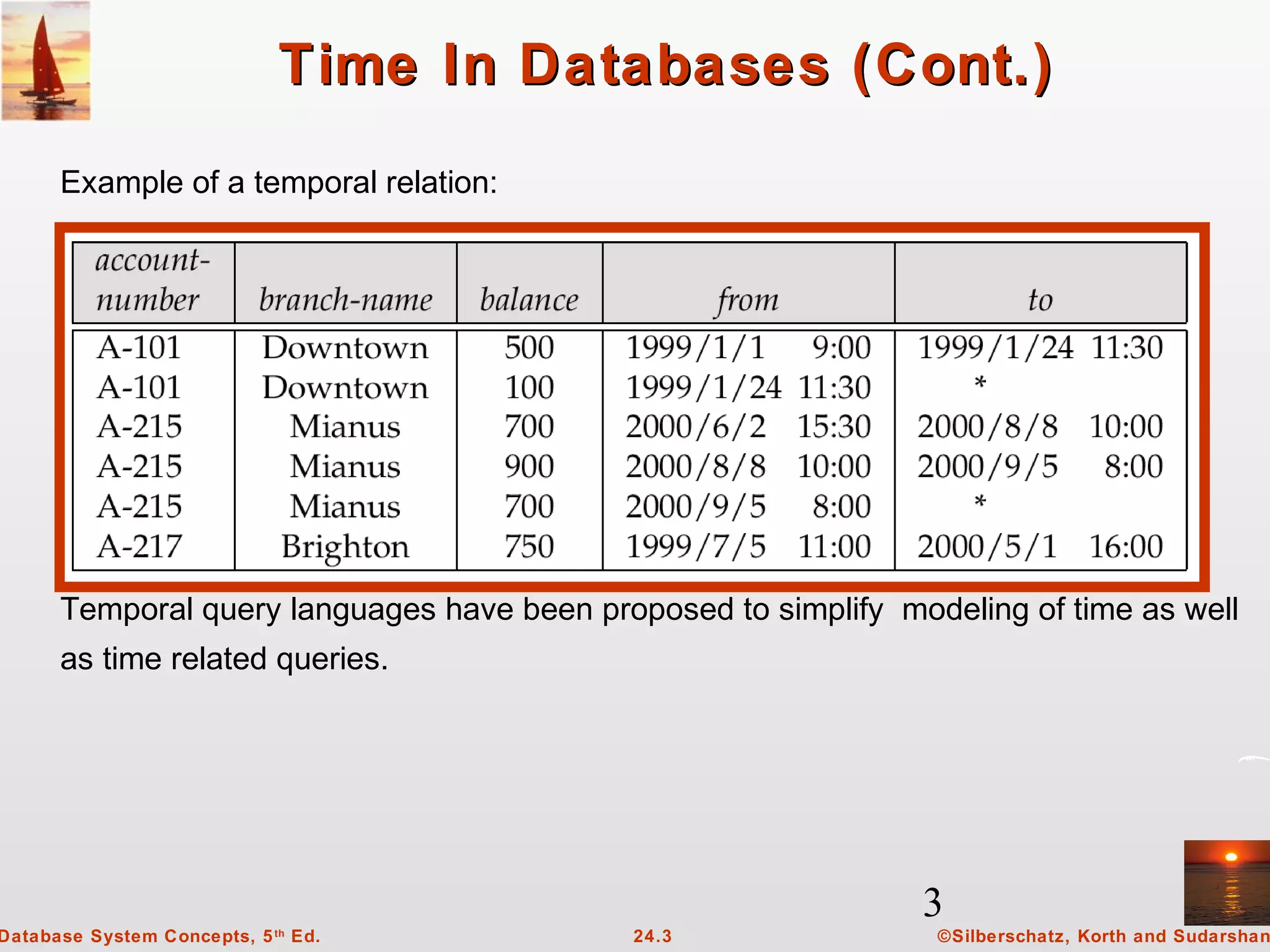
Example of a temporal relation:
Temporal query languages have been proposed to simplify modeling of time as well
as time related queries.
4
©Silberschatz, Korth and Sudarshan24.4Database System Concepts, 5th
Ed.
Time Specification in SQL-92Time Specification in SQL-92
date: four digits for the year (1--9999), two digits for the month (1--
12), and two digits for the date (1--31).
time: two digits for the hour, two digits for the minute, and two digits
for the second, plus optional fractional digits.
timestamp: the fields of date and time, with six fractional digits for
the seconds field.
Times are specified in the Universal Coordinated Time, abbreviated
UTC (from the French); supports time with time zone.
interval: refers to a period of time (e.g., 2 days and 5 hours), without
specifying a particular time when this period starts; could more
accurately be termed a span.
5
©Silberschatz, Korth and Sudarshan24.5Database System Concepts, 5th
Ed.
Temporal Query LanguagesTemporal Query Languages
Predicates precedes, overlaps, and contains on time intervals.
Intersect can be applied on two intervals, to give a single (possibly
empty) interval; the union of two intervals may or may not be a single
interval.
A snapshot of a temporal relation at time t consists of the tuples that
are valid at time t, with the time-interval attributes projected out.
Temporal selection: involves time attributes
Temporal projection: the tuples in the projection inherit their time-
intervals from the tuples in the original relation.
Temporal join: the time-interval of a tuple in the result is the
intersection of the time-intervals of the tuples from which it is derived.
It intersection is empty, tuple is discarded from join.
6
©Silberschatz, Korth and Sudarshan24.6Database System Concepts, 5th
Ed.
Temporal Query Languages (Cont.)Temporal Query Languages (Cont.)
Functional dependencies must be used with care: adding a time field
may invalidate functional dependency
A temporal functional dependency x → Y holds on a relation
schema R if, for all legal instances r of R, all snapshots of r satisfy the
functional dependency X →Y.
SQL:1999 Part 7 (SQL/Temporal) is a proposed extension to
SQL:1999 to improve support of temporal data.
τ
7
Database System Concepts
©Silberschatz, Korth and Sudarshan
See www.db-book.com for conditions on re-use
Spatial and Geographic DatabasesSpatial and Geographic Databases
8
©Silberschatz, Korth and Sudarshan24.8Database System Concepts, 5th
Ed.
Spatial and Geographic DatabasesSpatial and Geographic Databases
Spatial databases store information related to spatial locations, and
support efficient storage, indexing and querying of spatial data.
Special purpose index structures are important for accessing spatial
data, and for processing spatial join queries.
Computer Aided Design (CAD) databases store design
information about how objects are constructed E.g.: designs of
buildings, aircraft, layouts of integrated-circuits
Geographic databases store geographic information (e.g., maps):
often called geographic information systems or GIS.
9
©Silberschatz, Korth and Sudarshan24.9Database System Concepts, 5th
Ed.
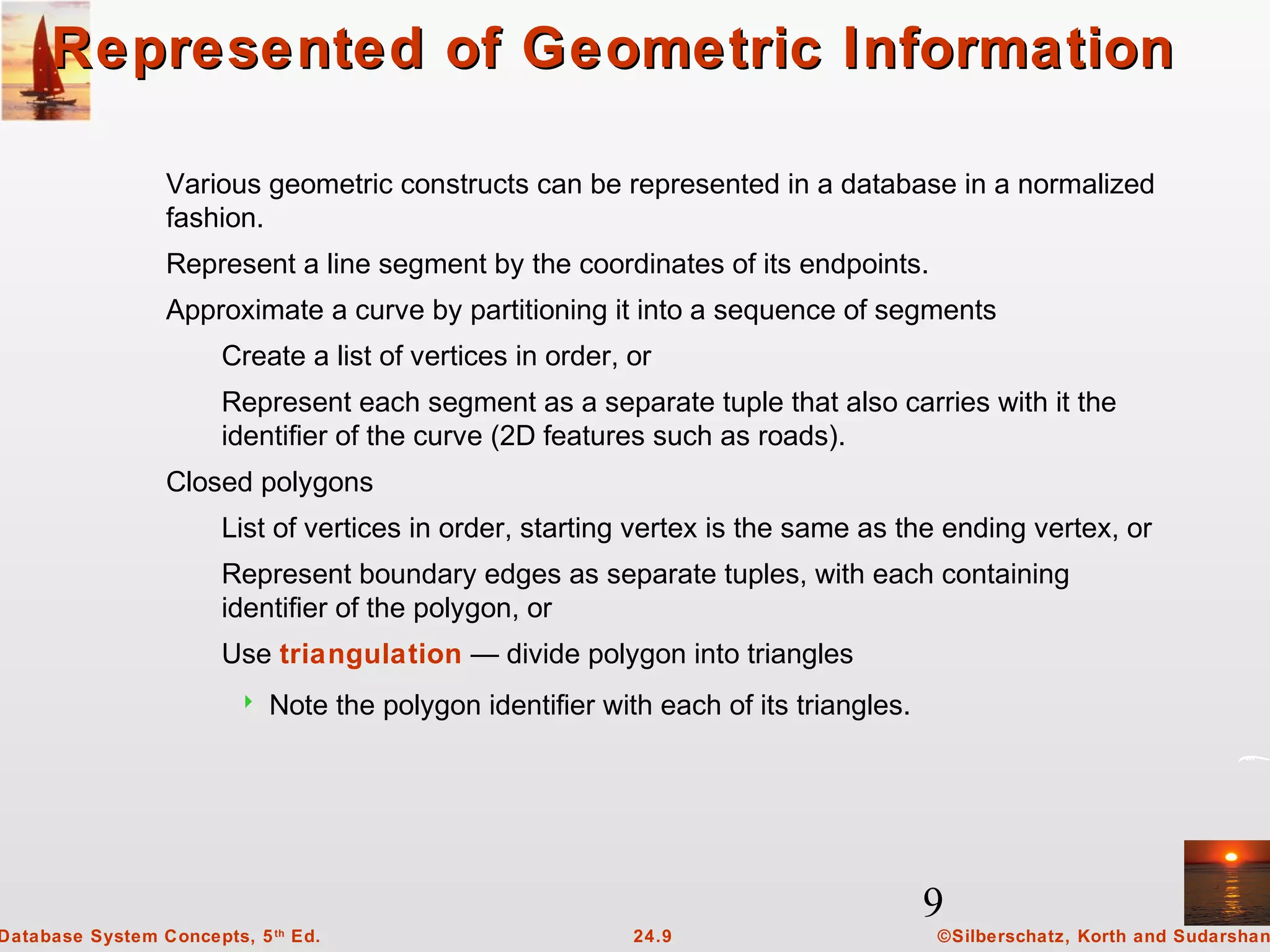
Represented of Geometric InformationRepresented of Geometric Information
Various geometric constructs can be represented in a database in a normalized
fashion.
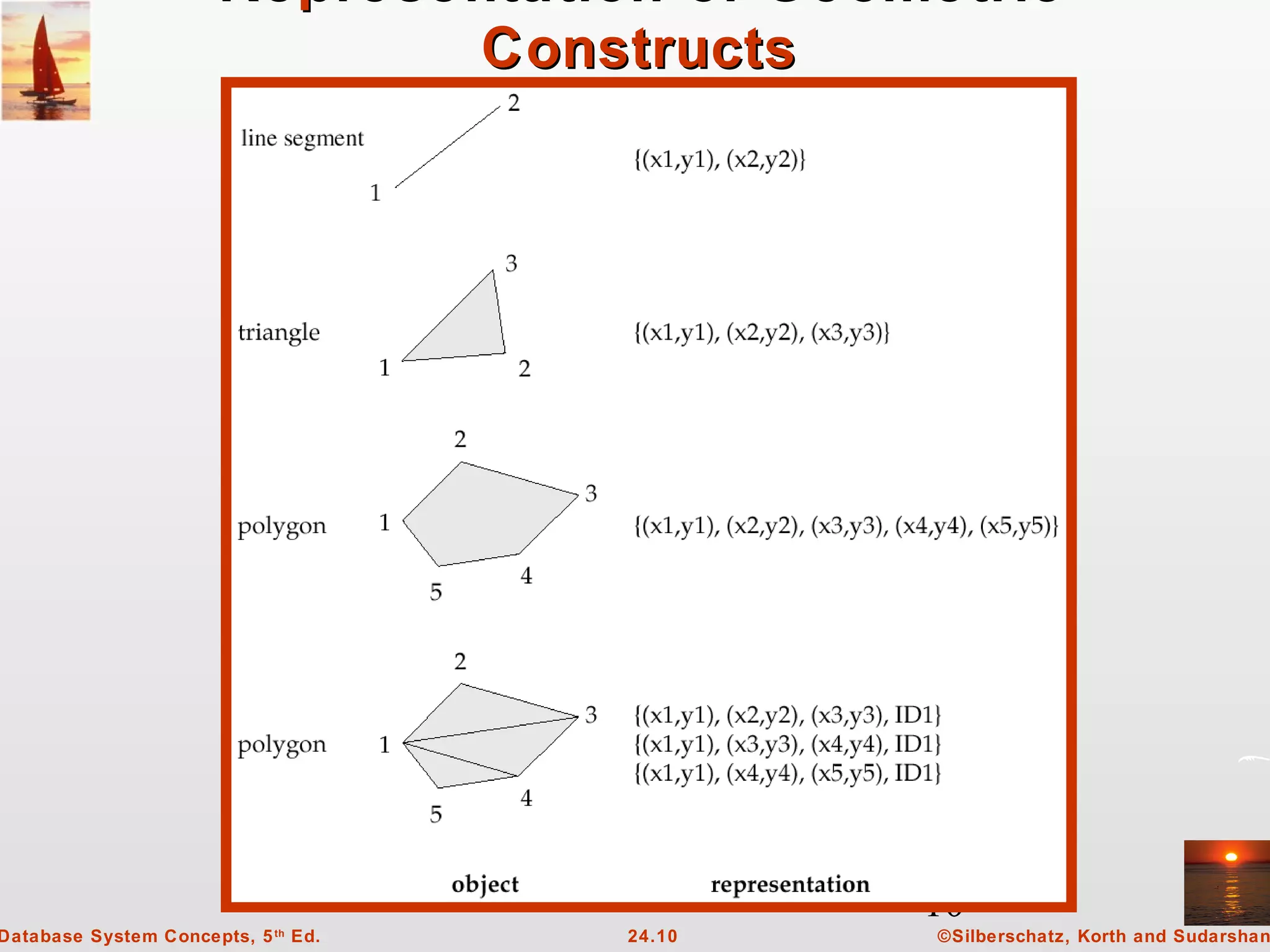
Represent a line segment by the coordinates of its endpoints.
Approximate a curve by partitioning it into a sequence of segments
Create a list of vertices in order, or
Represent each segment as a separate tuple that also carries with it the
identifier of the curve (2D features such as roads).
Closed polygons
List of vertices in order, starting vertex is the same as the ending vertex, or
Represent boundary edges as separate tuples, with each containing
identifier of the polygon, or
Use triangulation — divide polygon into triangles
 Note the polygon identifier with each of its triangles.
10
©Silberschatz, Korth and Sudarshan24.10Database System Concepts, 5th
Ed.
Representation of Geometric
ConstructsConstructs
11
©Silberschatz, Korth and Sudarshan24.11Database System Concepts, 5th
Ed.
Representation of Geometric Information (Cont.)Representation of Geometric Information (Cont.)
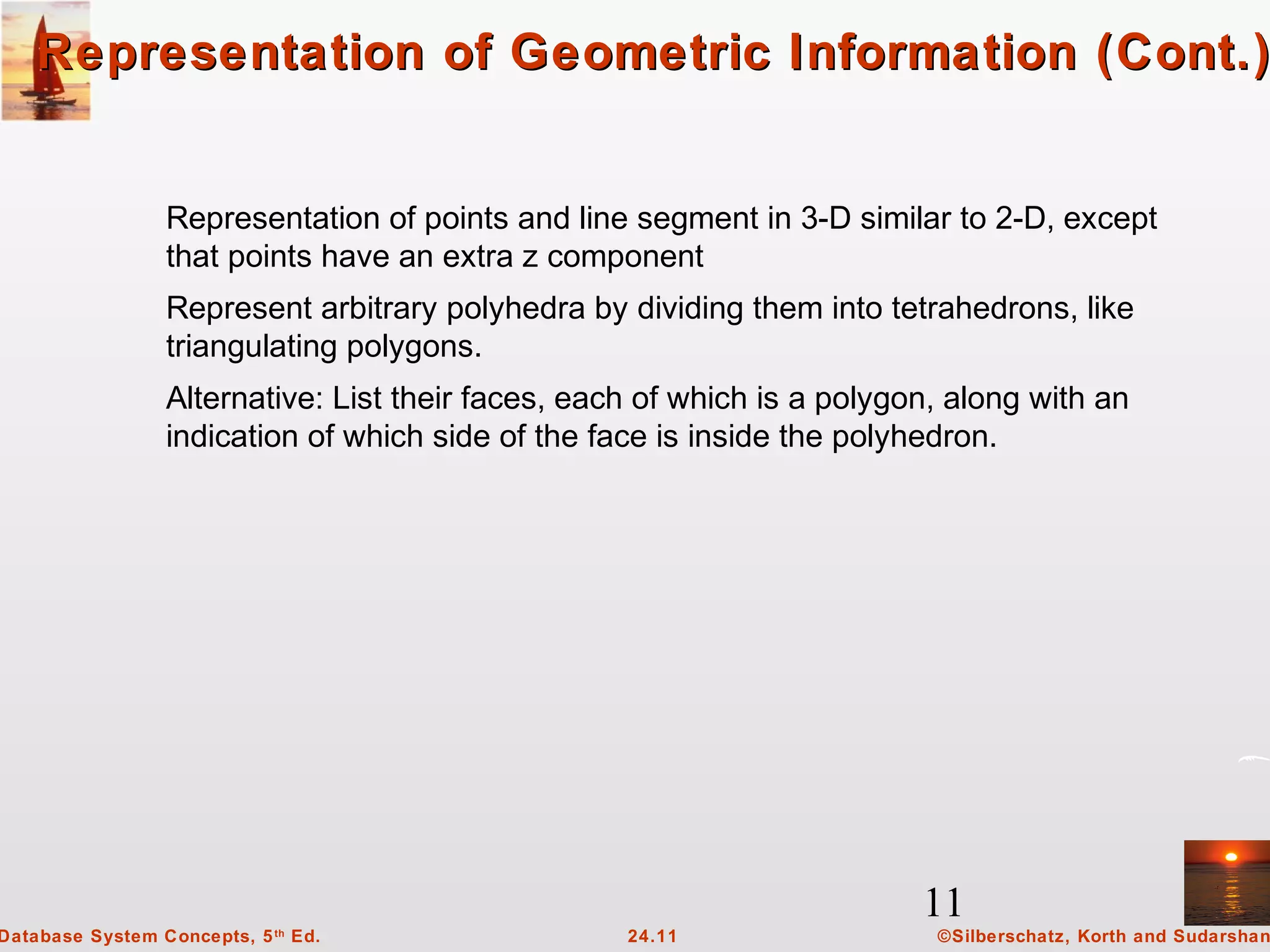
Representation of points and line segment in 3-D similar to 2-D, except
that points have an extra z component
Represent arbitrary polyhedra by dividing them into tetrahedrons, like
triangulating polygons.
Alternative: List their faces, each of which is a polygon, along with an
indication of which side of the face is inside the polyhedron.
12
©Silberschatz, Korth and Sudarshan24.12Database System Concepts, 5th
Ed.
Design DatabasesDesign Databases
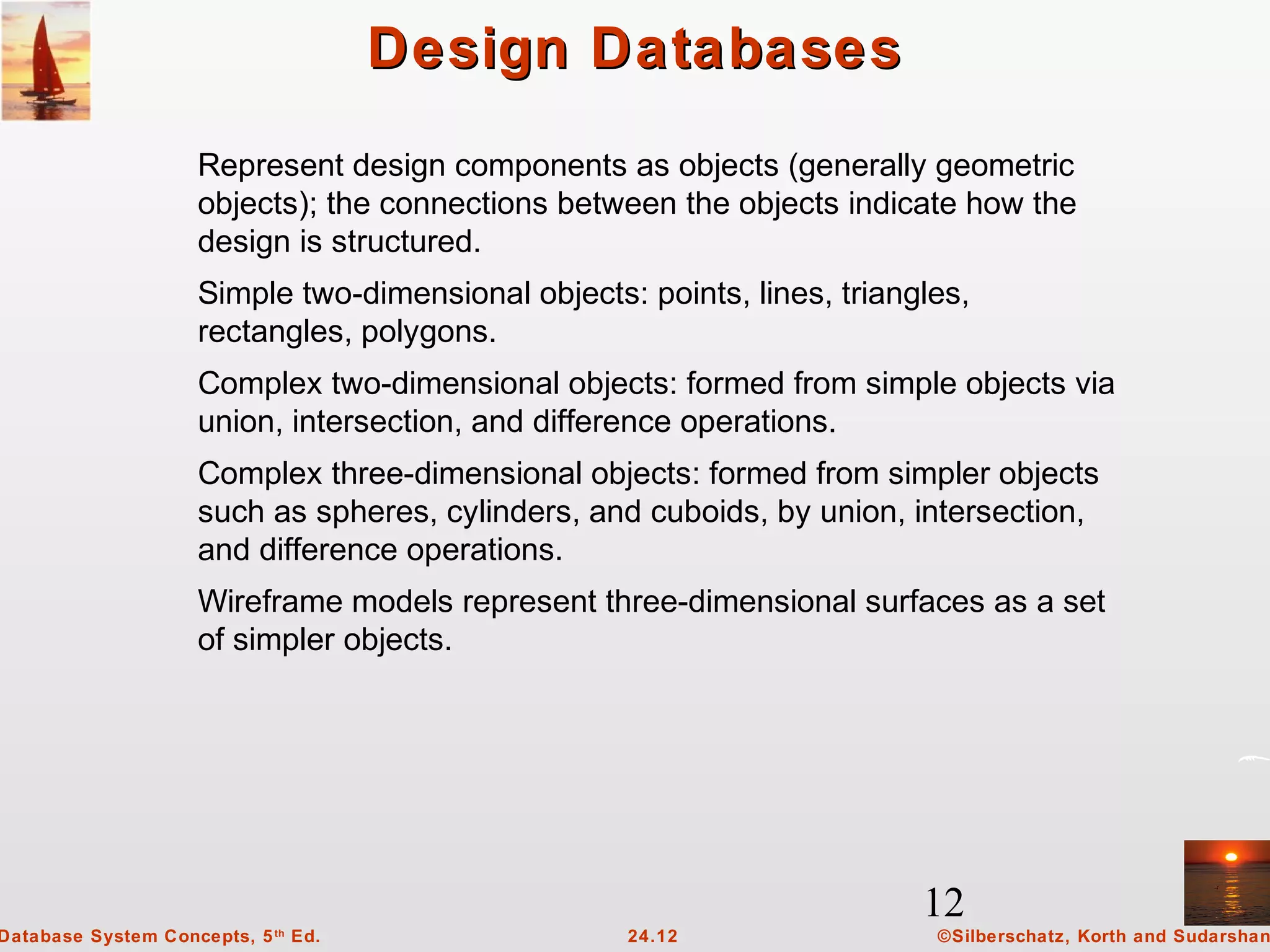
Represent design components as objects (generally geometric
objects); the connections between the objects indicate how the
design is structured.
Simple two-dimensional objects: points, lines, triangles,
rectangles, polygons.
Complex two-dimensional objects: formed from simple objects via
union, intersection, and difference operations.
Complex three-dimensional objects: formed from simpler objects
such as spheres, cylinders, and cuboids, by union, intersection,
and difference operations.
Wireframe models represent three-dimensional surfaces as a set
of simpler objects.
13
©Silberschatz, Korth and Sudarshan24.13Database System Concepts, 5th
Ed.
Representation of Geometric ConstructsRepresentation of Geometric Constructs
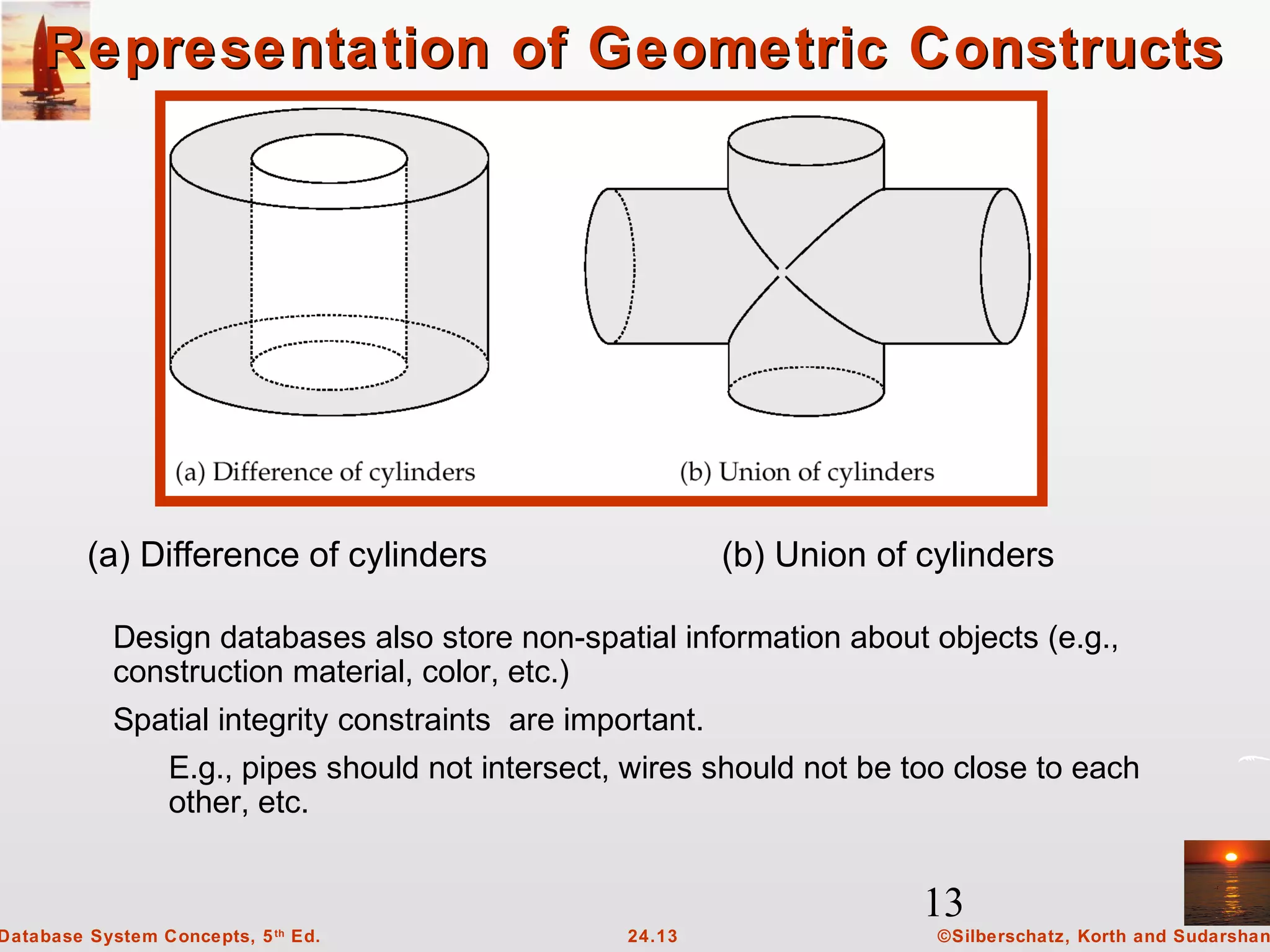
Design databases also store non-spatial information about objects (e.g.,
construction material, color, etc.)
Spatial integrity constraints are important.
E.g., pipes should not intersect, wires should not be too close to each
other, etc.
(a) Difference of cylinders (b) Union of cylinders
14
©Silberschatz, Korth and Sudarshan24.14Database System Concepts, 5th
Ed.
Geographic DataGeographic Data
Raster data consist of bit maps or pixel maps, in two or more
dimensions.
Example 2-D raster image: satellite image of cloud cover,
where each pixel stores the cloud visibility in a particular area.
Additional dimensions might include the temperature at different
altitudes at different regions, or measurements taken at
different points in time.
Design databases generally do not store raster data.
15
©Silberschatz, Korth and Sudarshan24.15Database System Concepts, 5th
Ed.
Geographic Data (Cont.)Geographic Data (Cont.)
Vector data are constructed from basic geometric objects: points,
line segments, triangles, and other polygons in two dimensions, and
cylinders, speheres, cuboids, and other polyhedrons in three
dimensions.
Vector format often used to represent map data.
Roads can be considered as two-dimensional and represented
by lines and curves.
Some features, such as rivers, may be represented either as
complex curves or as complex polygons, depending on whether
their width is relevant.
Features such as regions and lakes can be depicted as
polygons.
16
©Silberschatz, Korth and Sudarshan24.16Database System Concepts, 5th
Ed.
Applications of Geographic DataApplications of Geographic Data
Examples of geographic data
map data for vehicle navigation
distribution network information for power, telephones, water
supply, and sewage
Vehicle navigation systems store information about roads and
services for the use of drivers:
Spatial data: e.g, road/restaurant/gas-station coordinates
Non-spatial data: e.g., one-way streets, speed limits, traffic
congestion
Global Positioning System (GPS) unit - utilizes information
broadcast from GPS satellites to find the current location of user
with an accuracy of tens of meters.
increasingly used in vehicle navigation systems as well as
utility maintenance applications.
17
©Silberschatz, Korth and Sudarshan24.17Database System Concepts, 5th
Ed.
Spatial QueriesSpatial Queries
Nearness queries request objects that lie near a specified location.
Nearest neighbor queries, given a point or an object, find the
nearest object that satisfies given conditions.
Region queries deal with spatial regions. e.g., ask for objects that
lie partially or fully inside a specified region.
Queries that compute intersections or unions of regions.
Spatial join of two spatial relations with the location playing the role
of join attribute.
18
©Silberschatz, Korth and Sudarshan24.18Database System Concepts, 5th
Ed.
Spatial Queries (Cont.)Spatial Queries (Cont.)
Spatial data is typically queried using a graphical query language;
results are also displayed in a graphical manner.
Graphical interface constitutes the front-end
Extensions of SQL with abstract data types, such as lines,
polygons and bit maps, have been proposed to interface with back-
end.
allows relational databases to store and retrieve spatial
information
Queries can use spatial conditions (e.g. contains or overlaps).
queries can mix spatial and nonspatial conditions
19
©Silberschatz, Korth and Sudarshan24.19Database System Concepts, 5th
Ed.
Indexing of Spatial DataIndexing of Spatial Data
k-d tree - early structure used for indexing in multiple dimensions.
Each level of a k-d tree partitions the space into two.
choose one dimension for partitioning at the root level of the tree.
choose another dimensions for partitioning in nodes at the next level
and so on, cycling through the dimensions.
In each node, approximately half of the points stored in the sub-tree fall
on one side and half on the other.
Partitioning stops when a node has less than a given maximum number
of points.
The k-d-B tree extends the k-d tree to allow multiple child nodes for
each internal node; well-suited for secondary storage.
20
©Silberschatz, Korth and Sudarshan24.20Database System Concepts, 5th
Ed.
Division of Space by a k-d TreeDivision of Space by a k-d Tree
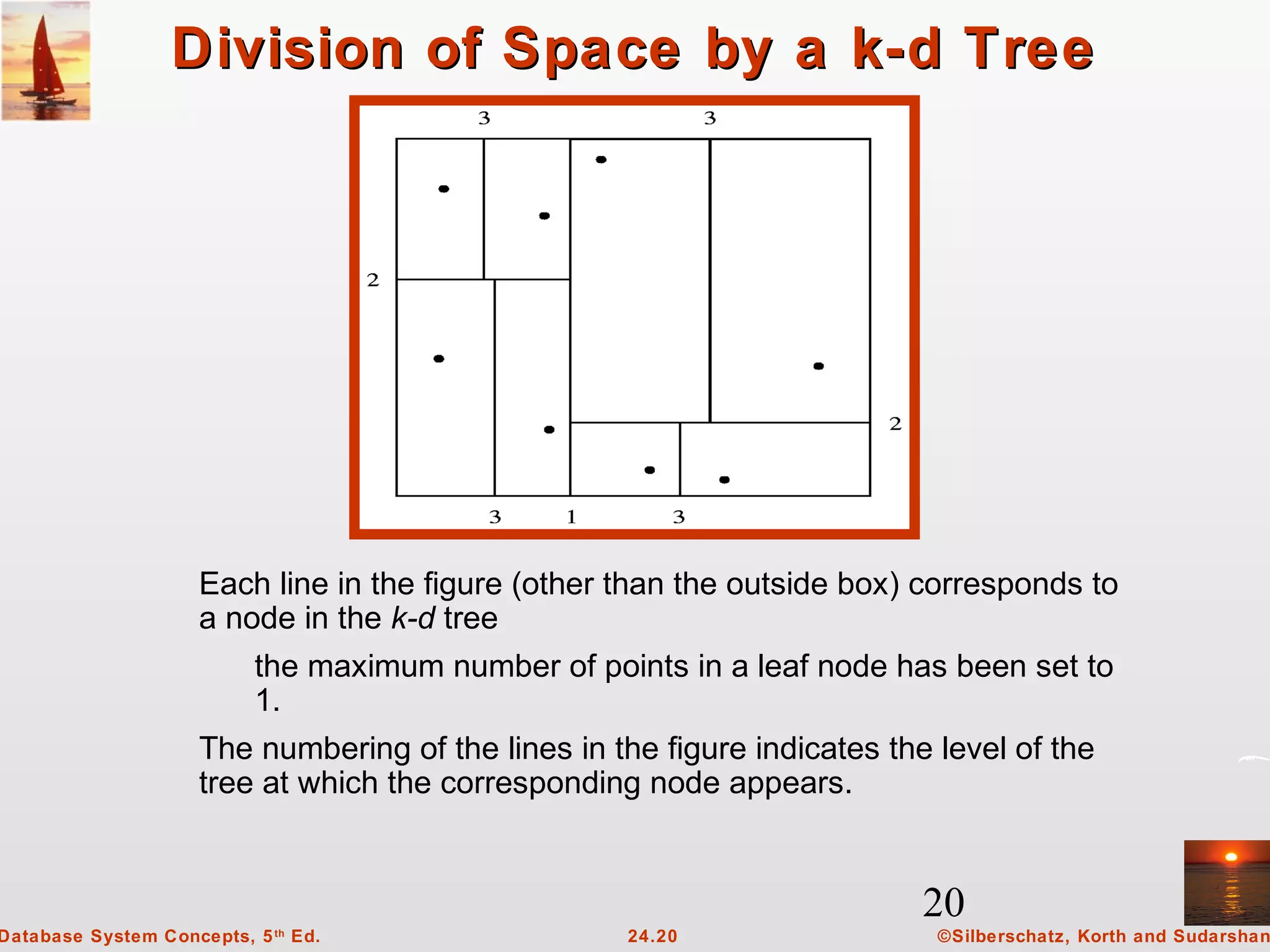
Each line in the figure (other than the outside box) corresponds to
a node in the k-d tree
the maximum number of points in a leaf node has been set to
1.
The numbering of the lines in the figure indicates the level of the
tree at which the corresponding node appears.
21
©Silberschatz, Korth and Sudarshan24.21Database System Concepts, 5th
Ed.
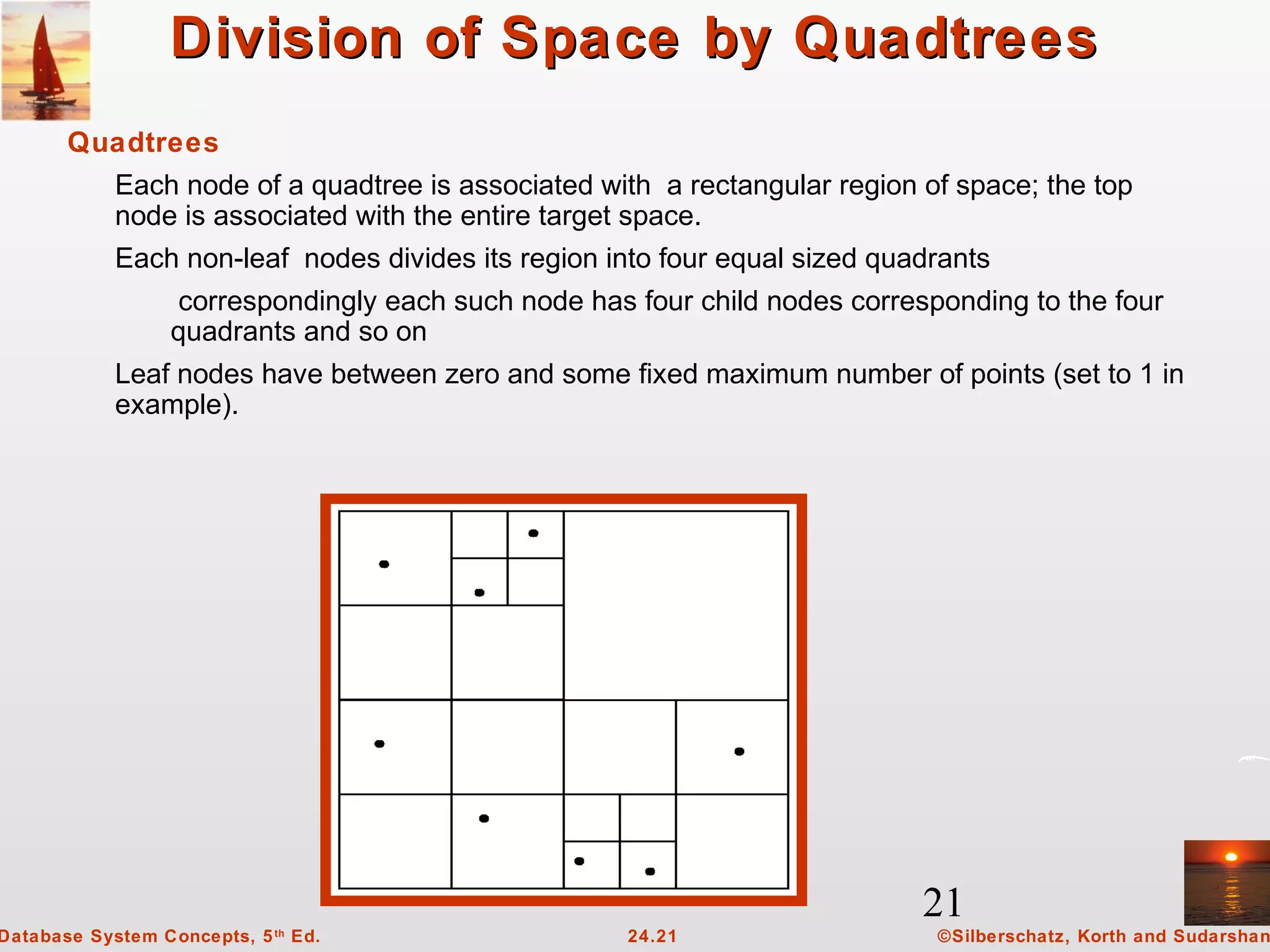
Division of Space by QuadtreesDivision of Space by Quadtrees
Quadtrees
Each node of a quadtree is associated with a rectangular region of space; the top
node is associated with the entire target space.
Each non-leaf nodes divides its region into four equal sized quadrants
correspondingly each such node has four child nodes corresponding to the four
quadrants and so on
Leaf nodes have between zero and some fixed maximum number of points (set to 1 in
example).
22
©Silberschatz, Korth and Sudarshan24.22Database System Concepts, 5th
Ed.
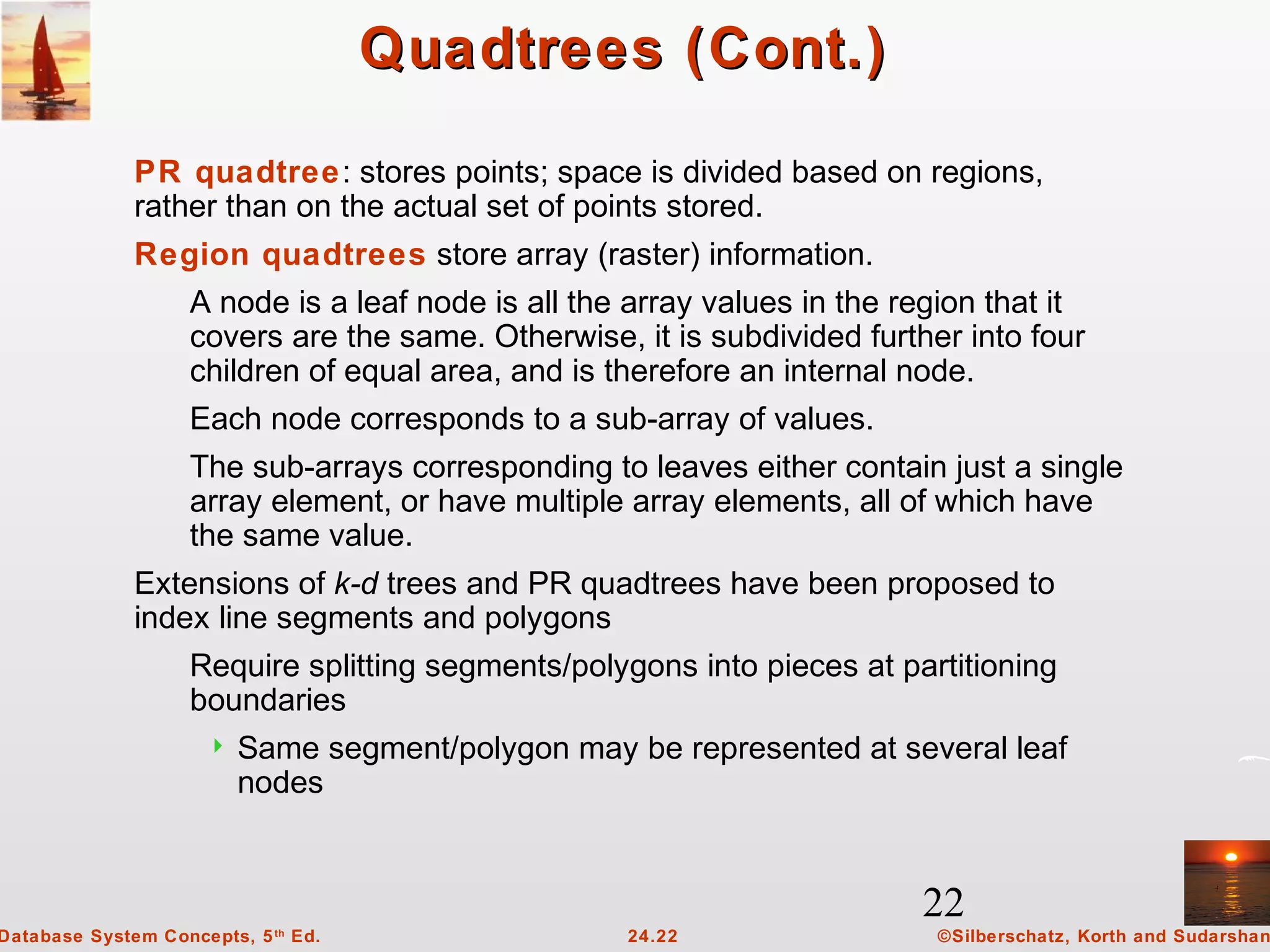
Quadtrees (Cont.)Quadtrees (Cont.)
PR quadtree: stores points; space is divided based on regions,
rather than on the actual set of points stored.
Region quadtrees store array (raster) information.
A node is a leaf node is all the array values in the region that it
covers are the same. Otherwise, it is subdivided further into four
children of equal area, and is therefore an internal node.
Each node corresponds to a sub-array of values.
The sub-arrays corresponding to leaves either contain just a single
array element, or have multiple array elements, all of which have
the same value.
Extensions of k-d trees and PR quadtrees have been proposed to
index line segments and polygons
Require splitting segments/polygons into pieces at partitioning
boundaries
 Same segment/polygon may be represented at several leaf
nodes
23
©Silberschatz, Korth and Sudarshan24.23Database System Concepts, 5th
Ed.
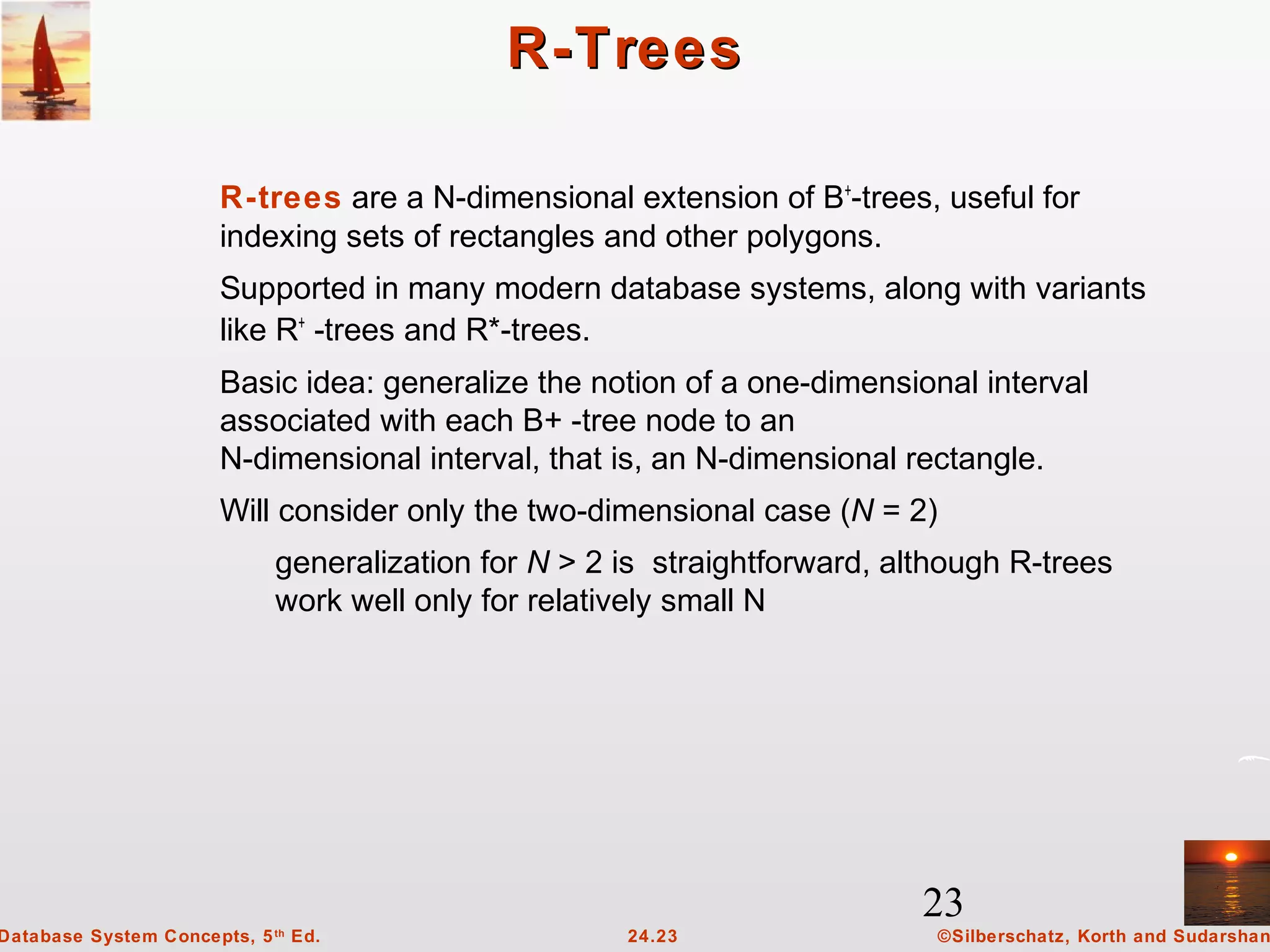
R-TreesR-Trees
R-trees are a N-dimensional extension of B+
-trees, useful for
indexing sets of rectangles and other polygons.
Supported in many modern database systems, along with variants
like R+
-trees and R*-trees.
Basic idea: generalize the notion of a one-dimensional interval
associated with each B+ -tree node to an
N-dimensional interval, that is, an N-dimensional rectangle.
Will consider only the two-dimensional case (N = 2)
generalization for N > 2 is straightforward, although R-trees
work well only for relatively small N
24
©Silberschatz, Korth and Sudarshan24.24Database System Concepts, 5th
Ed.
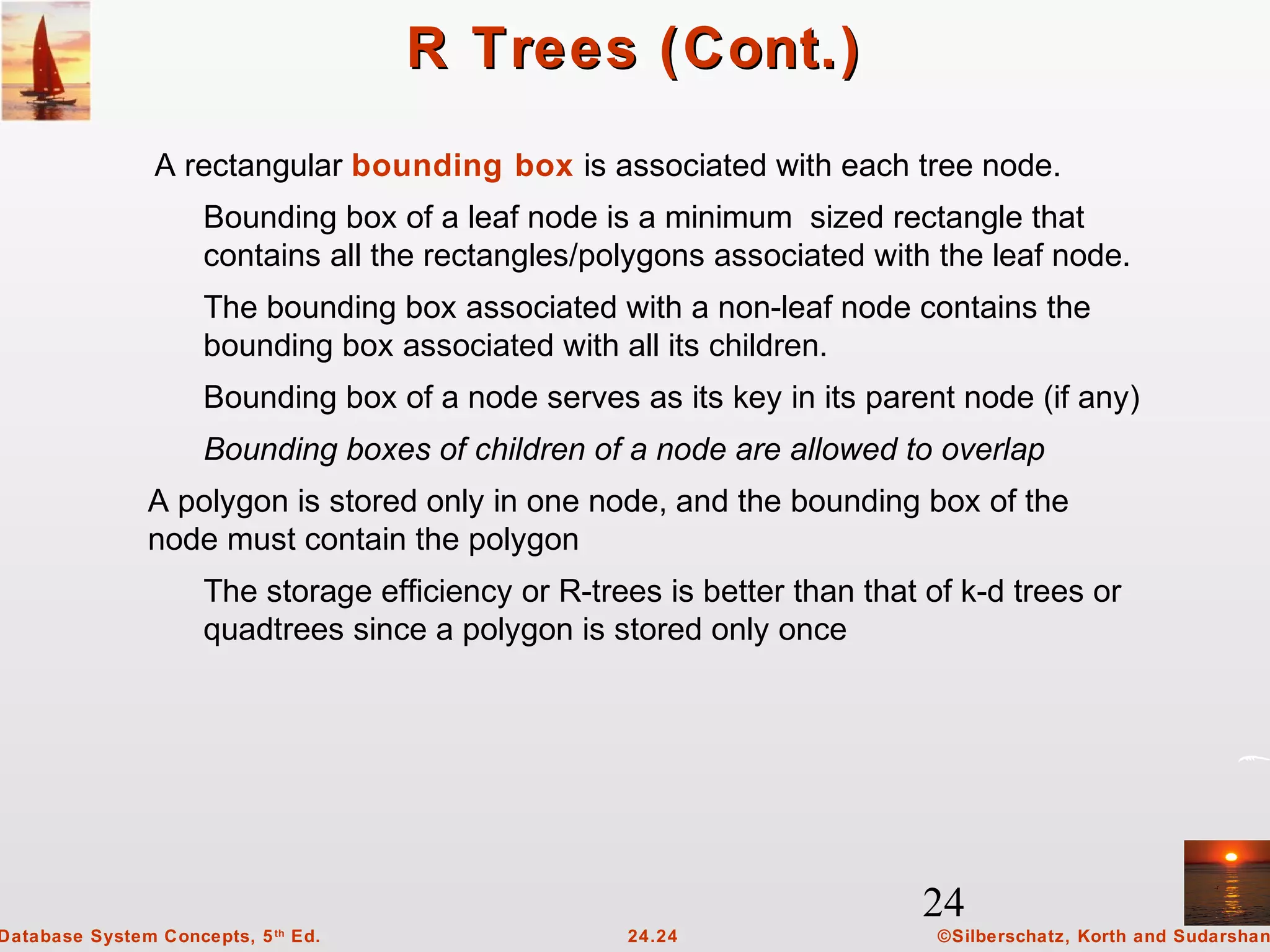
R Trees (Cont.)R Trees (Cont.)
A rectangular bounding box is associated with each tree node.
Bounding box of a leaf node is a minimum sized rectangle that
contains all the rectangles/polygons associated with the leaf node.
The bounding box associated with a non-leaf node contains the
bounding box associated with all its children.
Bounding box of a node serves as its key in its parent node (if any)
Bounding boxes of children of a node are allowed to overlap
A polygon is stored only in one node, and the bounding box of the
node must contain the polygon
The storage efficiency or R-trees is better than that of k-d trees or
quadtrees since a polygon is stored only once
25
©Silberschatz, Korth and Sudarshan24.25Database System Concepts, 5th
Ed.
Example R-TreeExample R-Tree
A set of rectangles (solid line) and the bounding boxes (dashed line) of the nodes of
an R-tree for the rectangles. The R-tree is shown on the right.
26
©Silberschatz, Korth and Sudarshan24.26Database System Concepts, 5th
Ed.
Search in R-TreesSearch in R-Trees
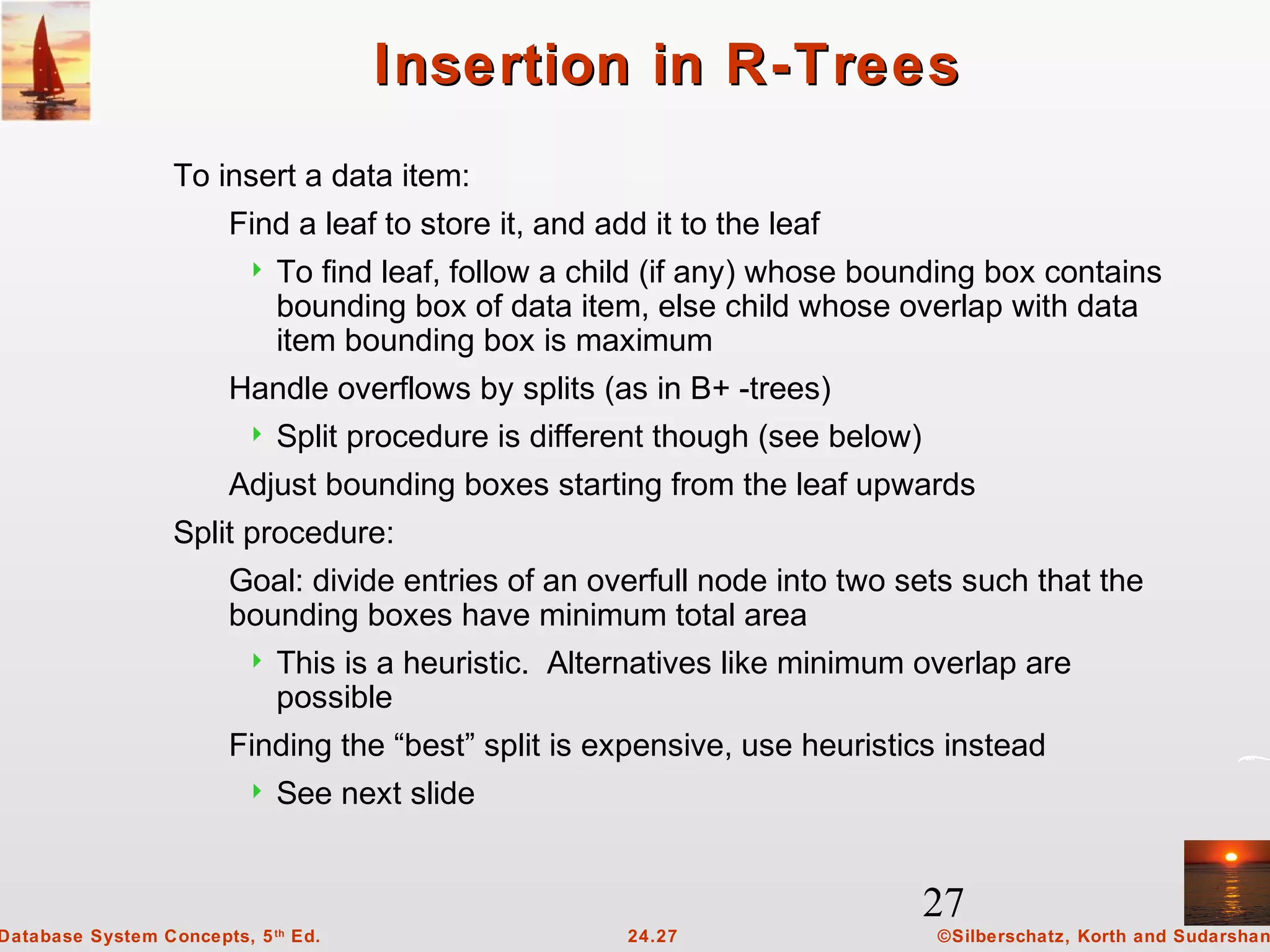
To find data items (rectangles/polygons) intersecting (overlaps) a
given query point/region, do the following, starting from the root
node:
If the node is a leaf node, output the data items whose keys
intersect the given query point/region.
Else, for each child of the current node whose bounding box
overlaps the query point/region, recursively search the child
Can be very inefficient in worst case since multiple paths may need
to be searched
but works acceptably in practice.
Simple extensions of search procedure to handle predicates
contained-in and contains
27
©Silberschatz, Korth and Sudarshan24.27Database System Concepts, 5th
Ed.
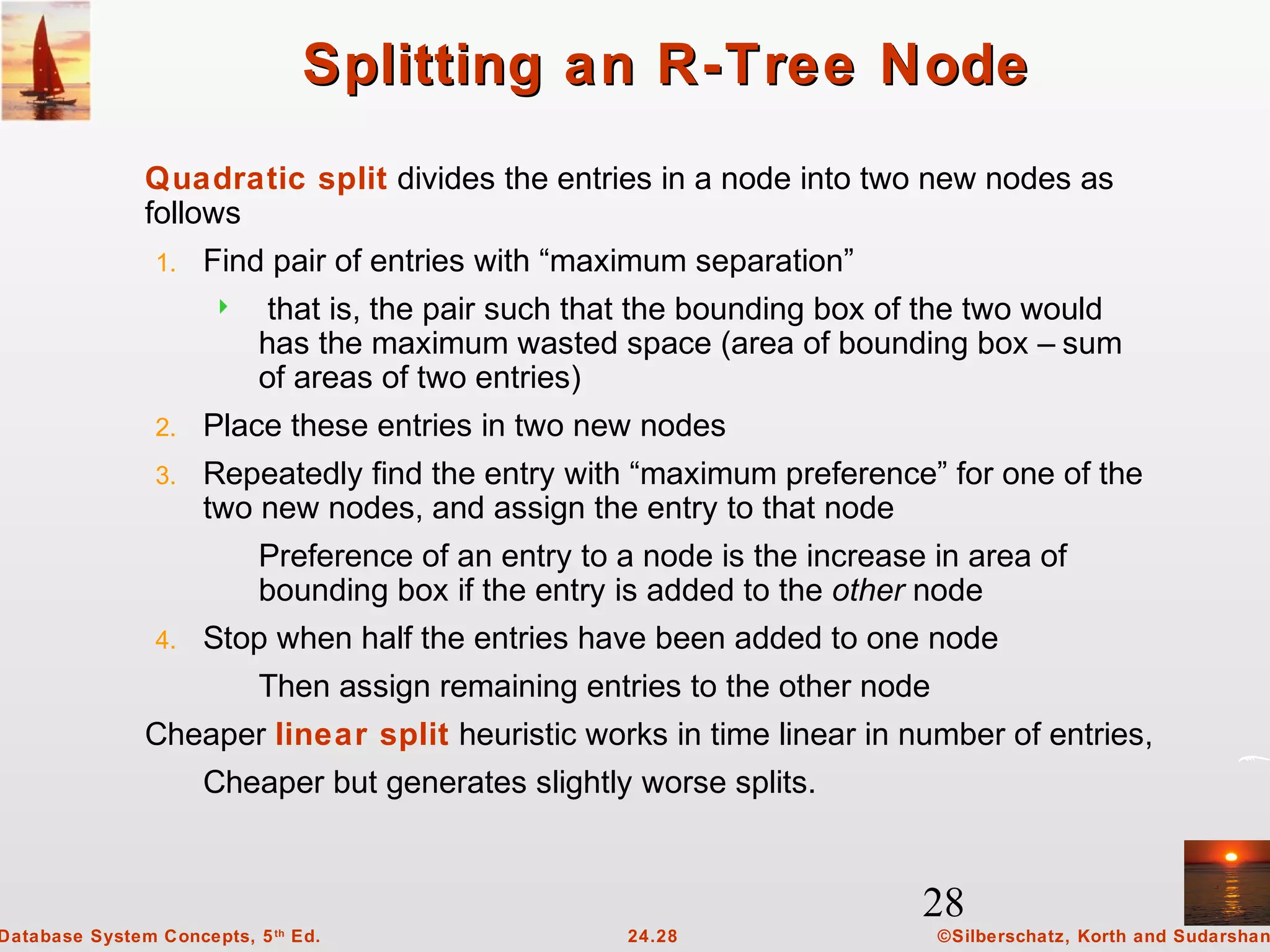
Insertion in R-TreesInsertion in R-Trees
To insert a data item:
Find a leaf to store it, and add it to the leaf
 To find leaf, follow a child (if any) whose bounding box contains
bounding box of data item, else child whose overlap with data
item bounding box is maximum
Handle overflows by splits (as in B+ -trees)
 Split procedure is different though (see below)
Adjust bounding boxes starting from the leaf upwards
Split procedure:
Goal: divide entries of an overfull node into two sets such that the
bounding boxes have minimum total area
 This is a heuristic. Alternatives like minimum overlap are
possible
Finding the “best” split is expensive, use heuristics instead
 See next slide
28
©Silberschatz, Korth and Sudarshan24.28Database System Concepts, 5th
Ed.
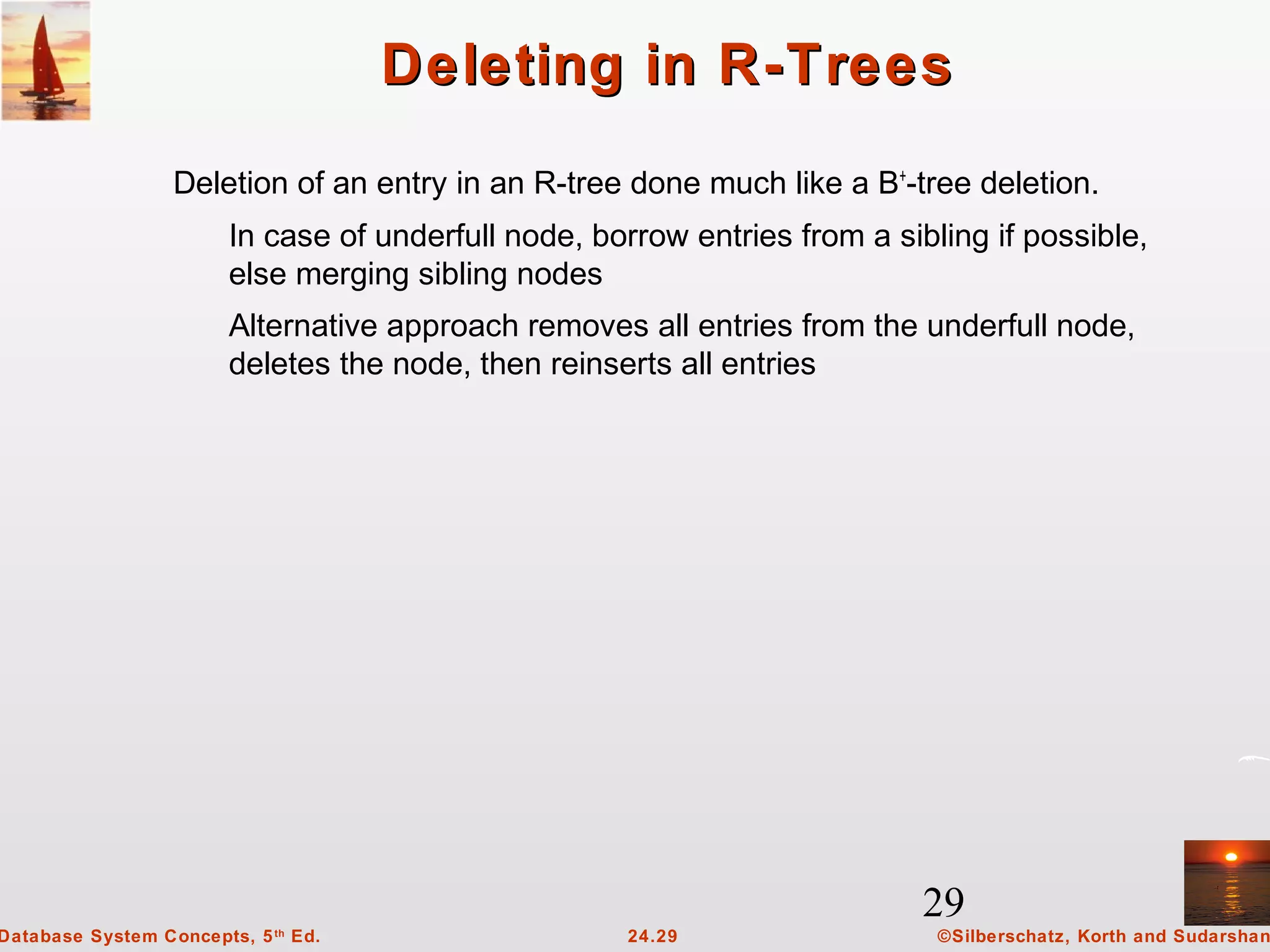
Splitting an R-Tree NodeSplitting an R-Tree Node
Quadratic split divides the entries in a node into two new nodes as
follows
1. Find pair of entries with “maximum separation”
 that is, the pair such that the bounding box of the two would
has the maximum wasted space (area of bounding box – sum
of areas of two entries)
2. Place these entries in two new nodes
3. Repeatedly find the entry with “maximum preference” for one of the
two new nodes, and assign the entry to that node
Preference of an entry to a node is the increase in area of
bounding box if the entry is added to the other node
4. Stop when half the entries have been added to one node
Then assign remaining entries to the other node
Cheaper linear split heuristic works in time linear in number of entries,
Cheaper but generates slightly worse splits.
29
©Silberschatz, Korth and Sudarshan24.29Database System Concepts, 5th
Ed.
Deleting in R-TreesDeleting in R-Trees
Deletion of an entry in an R-tree done much like a B+
-tree deletion.
In case of underfull node, borrow entries from a sibling if possible,
else merging sibling nodes
Alternative approach removes all entries from the underfull node,
deletes the node, then reinserts all entries
30
Database System Concepts
©Silberschatz, Korth and Sudarshan
See www.db-book.com for conditions on re-use
Multimedia DatabasesMultimedia Databases
31
©Silberschatz, Korth and Sudarshan24.31Database System Concepts, 5th
Ed.
Multimedia DatabasesMultimedia Databases
To provide such database functions as indexing and
consistency, it is desirable to store multimedia data in a
database
rather than storing them outside the database, in a file
system
The database must handle large object representation.
Similarity-based retrieval must be provided by special index
structures.
Must provide guaranteed steady retrieval rates for continuous-
media data.
32
©Silberschatz, Korth and Sudarshan24.32Database System Concepts, 5th
Ed.
Multimedia Data FormatsMultimedia Data Formats
Store and transmit multimedia data in compressed form
JPEG and GIF the most widely used formats for image data.
MPEG standard for video data use commonalties among a
sequence of frames to achieve a greater degree of
compression.
MPEG-1 quality comparable to VHS video tape.
stores a minute of 30-frame-per-second video and audio in
approximately 12.5 MB
MPEG-2 designed for digital broadcast systems and digital video
disks; negligible loss of video quality.
Compresses 1 minute of audio-video to approximately 17 MB.
Several alternatives of audio encoding
MPEG-1 Layer 3 (MP3), RealAudio, WindowsMedia format,
etc.
33
©Silberschatz, Korth and Sudarshan24.33Database System Concepts, 5th
Ed.
Continuous-Media DataContinuous-Media Data
Most important types are video and audio data.
Characterized by high data volumes and real-time information-delivery
requirements.
Data must be delivered sufficiently fast that there are no gaps in the
audio or video.
Data must be delivered at a rate that does not cause overflow of
system buffers.
Synchronization among distinct data streams must be maintained
 video of a person speaking must show lips moving
synchronously with the audio
34
©Silberschatz, Korth and Sudarshan24.34Database System Concepts, 5th
Ed.
Video ServersVideo Servers
Video-on-demand systems deliver video from central video servers,
across a network, to terminals
Must guarantee end-to-end delivery rates
Current video-on-demand servers are based on file systems; existing
database systems do not meet real-time response requirements.
Multimedia data are stored on several disks (RAID configuration), or on
tertiary storage for less frequently accessed data.
Head-end terminals - used to view multimedia data
PCs or TVs attached to a small, inexpensive computer called a set-
top box.
35
©Silberschatz, Korth and Sudarshan24.35Database System Concepts, 5th
Ed.
Similarity-Based RetrievalSimilarity-Based Retrieval
Examples of similarity based retrieval
Pictorial data: Two pictures or images that are slightly different as
represented in the database may be considered the same by a user.
E.g., identify similar designs for registering a new trademark.
Audio data: Speech-based user interfaces allow the user to give a
command or identify a data item by speaking.
E.g., test user input against stored commands.
Handwritten data: Identify a handwritten data item or command stored in
the database
36
Database System Concepts
©Silberschatz, Korth and Sudarshan
See www.db-book.com for conditions on re-use
MobilityMobility
37
©Silberschatz, Korth and Sudarshan24.37Database System Concepts, 5th
Ed.
Mobile Computing EnvironmentsMobile Computing Environments
A mobile computing environment consists of mobile computers,
referred to as mobile hosts, and a wired network of computers.
Mobile host may be able to communicate with wired network
through a wireless digital communication network
Wireless local-area networks (within a building)
 E.g. Avaya’s Orinico Wireless LAN
Wide areas networks
 Cellular digital packet networks
– 3 G and 2.5 G cellular networks
38
©Silberschatz, Korth and Sudarshan24.38Database System Concepts, 5th
Ed.
Mobile Computing EnvironmentsMobile Computing Environments
(Cont.)(Cont.)
A model for mobile communication
Mobile hosts communicate to the wired network via computers
referred to as mobile support (or base) stations.
Each mobile support station manages those mobile hosts within its
cell.
When mobile hosts move between cells, there is a handoff of
control from one mobile support station to another.
Direct communication, without going through a mobile support station
is also possible between nearby mobile hosts
Supported, for e.g., by the Bluetooth standard (up to 10 meters,
atup to 721 kbps)
39
©Silberschatz, Korth and Sudarshan24.39Database System Concepts, 5th
Ed.
Database Issues in Mobile ComputingDatabase Issues in Mobile Computing
New issues for query optimization.
Connection time charges and number of bytes transmitted
Energy (battery power) is a scarce resource and its usage must be
minimized
Mobile user’s locations may be a parameter of the query
GIS queries
Techniques to track locations of large numbers of mobile hosts
Broadcast data can enable any number of clients to receive the same data at
no extra cost
leads to interesting querying and data caching issues.
Users may need to be able to perform database updates even while the
mobile computer is disconnected.
e.g., mobile salesman records sale of products on (local copy of)
database.
Can result in conflicts detected on reconnection, which may need to be
resolved manually.
40
©Silberschatz, Korth and Sudarshan24.40Database System Concepts, 5th
Ed.
Routing and Query ProcessingRouting and Query Processing
Must consider these competing costs:
User time.
Communication cost
 Connection time - used to assign monetary charges in
some cellular systems.
 Number of bytes, or packets, transferred - used to
compute charges in digital cellular systems
 Time-of-day based charges - vary based on peak or off-
peak periods
Energy - optimize use of battery power by minimizing
reception and transmission of data.
 Receiving radio signals requires much less energy than
transmitting radio signals.
41
©Silberschatz, Korth and Sudarshan24.41Database System Concepts, 5th
Ed.
Broadcast DataBroadcast Data
Mobile support stations can broadcast frequently-requested data
Allows mobile hosts to wait for needed data, rather than having to
consume energy transmitting a request
Supports mobile hosts without transmission capability
A mobile host may optimize energy costs by determining if a query can be
answered using only cached data
If not then must either;
 Wait for the data to be broadcast
 Transmit a request for data and must know when the relevant data
will be broadcast.
Broadcast data may be transmitted according to a fixed schedule or a
changeable schedule.
For changeable schedule: the broadcast schedule must itself be
broadcast at a well-known radio frequency and at well-known time
intervals
Data reception may be interrupted by noise
Use techniques similar to RAID to transmit redundant data (parity)
42
©Silberschatz, Korth and Sudarshan24.42Database System Concepts, 5th
Ed.
Disconnectivity and ConsistencyDisconnectivity and Consistency
A mobile host may remain in operation during periods of
disconnection.
Problems created if the user of the mobile host issues queries and
updates on data that resides or is cached locally:
Recoverability: Updates entered on a disconnected
machine may be lost if the mobile host fails. Since the mobile
host represents a single point of failure, stable storage cannot
be simulated well.
Consistency : Cached data may become out of date, but the
mobile host cannot discover this until it is reconnected.
43
©Silberschatz, Korth and Sudarshan24.43Database System Concepts, 5th
Ed.
Mobile UpdatesMobile Updates
Partitioning via disconnection is the normal mode of operation in mobile
computing.
For data updated by only one mobile host, simple to propagate update when
mobile host reconnects
in other cases data may become invalid and updates may conflict.
When data are updated by other computers, invalidation reports inform a
reconnected mobile host of out-of-date cache entries
however, mobile host may miss a report.
Version-numbering-based schemes guarantee only that if two hosts
independently update the same version of a document, the clash will be
detected eventually, when the hosts exchange information either directly or
through a common host.
More on this shortly
Automatic reconciliation of inconsistent copies of data is difficult
Manual intervention may be needed
44
©Silberschatz, Korth and Sudarshan24.44Database System Concepts, 5th
Ed.
Detecting Inconsistent UpdatesDetecting Inconsistent Updates
Version vector scheme used to detect inconsistent updates to documents
at different hosts (sites).
Copies of document d at hosts i and j are inconsistent if
1. the copy of document d at i contains updates performed by host k
that have not been propagated to host j (k may be the same as i),
and
2. the copy of d at j contains updates performed by host l that have not
been propagated to host i (l may be the same as j)
Basic idea: each host i stores, with its copy of each document d, a
version vector - a set of version numbers, with an element Vd,i[k] for
every other host k
When a host i updates a document d, it increments the version number Vd,i
[i] by 1
45
©Silberschatz, Korth and Sudarshan24.45Database System Concepts, 5th
Ed.
Detecting Inconsistent Updates (Cont.)Detecting Inconsistent Updates (Cont.)
When two hosts i and j connect to each other they check if the copies of
all documents d that they share are consistent:
1. If the version vectors are the same on both hosts (that is, for each k,
Vd,i[k]= Vd,j [k]) then the copies of d are identical.
2. If, for each k, Vd,i [k] ≤ Vd,j[k], and the version vectors are not
identical, then the copy of document d at host i is older than the one
at host j
 That is, the copy of document d at host j was obtained by one
or more modifications of the copy of d at host i.
 Host i replaces its copy of d, as well as its copy of the version
vector for d, with the copies from host j.
3. If there is a pair of hosts k and m such that Vd,i [k]< Vd,j [k], and
Vd,i [m] > Vd,j [m], then the copies are inconsistent
That is, two or more updates have been performed
46
©Silberschatz, Korth and Sudarshan24.46Database System Concepts, 5th
Ed.
Handling Inconsistent UpdatesHandling Inconsistent Updates
Dealing with inconsistent updates is hard in general. Manual
intervention often required to merge the updates.
Version vector schemes
were developed to deal with failures in a distributed file system,
where inconsistencies are rare.
are used to maintain a unified file system between a fixed host and
a mobile computer, where updates at the two hosts have to be
merged periodically.
 Also used for similar purposes in groupware systems.
are used in database systems where mobile users may need to
perform transactions.
 In this case, a “document” may be a single record.
Inconsistencies must either be very rare, or fall in special cases that are
easy to deal with in most cases
47
Database System Concepts
©Silberschatz, Korth and Sudarshan
See www.db-book.com for conditions on re-use
End of ChapterEnd of Chapter

Ch24

  • 1.
    1 ©Silberschatz, Korth andSudarshan24.1Database System Concepts, 5th Ed. Chapter 24: Advanced Data Types and NewChapter 24: Advanced Data Types and New ApplicationsApplications Temporal Data Spatial and Geographic Databases Multimedia Databases Mobility and Personal Databases
  • 2.
    2 ©Silberschatz, Korth andSudarshan24.2Database System Concepts, 5th Ed. Time In DatabasesTime In Databases While most databases tend to model reality at a point in time (at the ``current'' time), temporal databases model the states of the real world across time. Facts in temporal relations have associated times when they are valid, which can be represented as a union of intervals. The transaction time for a fact is the time interval during which the fact is current within the database system. In a temporal relation, each tuple has an associated time when it is true; the time may be either valid time or transaction time. A bi-temporal relation stores both valid and transaction time.
  • 3.
    3 ©Silberschatz, Korth andSudarshan24.3Database System Concepts, 5th Ed. Time In Databases (Cont.)Time In Databases (Cont.) Example of a temporal relation: Temporal query languages have been proposed to simplify modeling of time as well as time related queries.
  • 4.
    4 ©Silberschatz, Korth andSudarshan24.4Database System Concepts, 5th Ed. Time Specification in SQL-92Time Specification in SQL-92 date: four digits for the year (1--9999), two digits for the month (1-- 12), and two digits for the date (1--31). time: two digits for the hour, two digits for the minute, and two digits for the second, plus optional fractional digits. timestamp: the fields of date and time, with six fractional digits for the seconds field. Times are specified in the Universal Coordinated Time, abbreviated UTC (from the French); supports time with time zone. interval: refers to a period of time (e.g., 2 days and 5 hours), without specifying a particular time when this period starts; could more accurately be termed a span.
  • 5.
    5 ©Silberschatz, Korth andSudarshan24.5Database System Concepts, 5th Ed. Temporal Query LanguagesTemporal Query Languages Predicates precedes, overlaps, and contains on time intervals. Intersect can be applied on two intervals, to give a single (possibly empty) interval; the union of two intervals may or may not be a single interval. A snapshot of a temporal relation at time t consists of the tuples that are valid at time t, with the time-interval attributes projected out. Temporal selection: involves time attributes Temporal projection: the tuples in the projection inherit their time- intervals from the tuples in the original relation. Temporal join: the time-interval of a tuple in the result is the intersection of the time-intervals of the tuples from which it is derived. It intersection is empty, tuple is discarded from join.
  • 6.
    6 ©Silberschatz, Korth andSudarshan24.6Database System Concepts, 5th Ed. Temporal Query Languages (Cont.)Temporal Query Languages (Cont.) Functional dependencies must be used with care: adding a time field may invalidate functional dependency A temporal functional dependency x → Y holds on a relation schema R if, for all legal instances r of R, all snapshots of r satisfy the functional dependency X →Y. SQL:1999 Part 7 (SQL/Temporal) is a proposed extension to SQL:1999 to improve support of temporal data. τ
  • 7.
    7 Database System Concepts ©Silberschatz,Korth and Sudarshan See www.db-book.com for conditions on re-use Spatial and Geographic DatabasesSpatial and Geographic Databases
  • 8.
    8 ©Silberschatz, Korth andSudarshan24.8Database System Concepts, 5th Ed. Spatial and Geographic DatabasesSpatial and Geographic Databases Spatial databases store information related to spatial locations, and support efficient storage, indexing and querying of spatial data. Special purpose index structures are important for accessing spatial data, and for processing spatial join queries. Computer Aided Design (CAD) databases store design information about how objects are constructed E.g.: designs of buildings, aircraft, layouts of integrated-circuits Geographic databases store geographic information (e.g., maps): often called geographic information systems or GIS.
  • 9.
    9 ©Silberschatz, Korth andSudarshan24.9Database System Concepts, 5th Ed. Represented of Geometric InformationRepresented of Geometric Information Various geometric constructs can be represented in a database in a normalized fashion. Represent a line segment by the coordinates of its endpoints. Approximate a curve by partitioning it into a sequence of segments Create a list of vertices in order, or Represent each segment as a separate tuple that also carries with it the identifier of the curve (2D features such as roads). Closed polygons List of vertices in order, starting vertex is the same as the ending vertex, or Represent boundary edges as separate tuples, with each containing identifier of the polygon, or Use triangulation — divide polygon into triangles  Note the polygon identifier with each of its triangles.
  • 10.
    10 ©Silberschatz, Korth andSudarshan24.10Database System Concepts, 5th Ed. Representation of Geometric ConstructsConstructs
  • 11.
    11 ©Silberschatz, Korth andSudarshan24.11Database System Concepts, 5th Ed. Representation of Geometric Information (Cont.)Representation of Geometric Information (Cont.) Representation of points and line segment in 3-D similar to 2-D, except that points have an extra z component Represent arbitrary polyhedra by dividing them into tetrahedrons, like triangulating polygons. Alternative: List their faces, each of which is a polygon, along with an indication of which side of the face is inside the polyhedron.
  • 12.
    12 ©Silberschatz, Korth andSudarshan24.12Database System Concepts, 5th Ed. Design DatabasesDesign Databases Represent design components as objects (generally geometric objects); the connections between the objects indicate how the design is structured. Simple two-dimensional objects: points, lines, triangles, rectangles, polygons. Complex two-dimensional objects: formed from simple objects via union, intersection, and difference operations. Complex three-dimensional objects: formed from simpler objects such as spheres, cylinders, and cuboids, by union, intersection, and difference operations. Wireframe models represent three-dimensional surfaces as a set of simpler objects.
  • 13.
    13 ©Silberschatz, Korth andSudarshan24.13Database System Concepts, 5th Ed. Representation of Geometric ConstructsRepresentation of Geometric Constructs Design databases also store non-spatial information about objects (e.g., construction material, color, etc.) Spatial integrity constraints are important. E.g., pipes should not intersect, wires should not be too close to each other, etc. (a) Difference of cylinders (b) Union of cylinders
  • 14.
    14 ©Silberschatz, Korth andSudarshan24.14Database System Concepts, 5th Ed. Geographic DataGeographic Data Raster data consist of bit maps or pixel maps, in two or more dimensions. Example 2-D raster image: satellite image of cloud cover, where each pixel stores the cloud visibility in a particular area. Additional dimensions might include the temperature at different altitudes at different regions, or measurements taken at different points in time. Design databases generally do not store raster data.
  • 15.
    15 ©Silberschatz, Korth andSudarshan24.15Database System Concepts, 5th Ed. Geographic Data (Cont.)Geographic Data (Cont.) Vector data are constructed from basic geometric objects: points, line segments, triangles, and other polygons in two dimensions, and cylinders, speheres, cuboids, and other polyhedrons in three dimensions. Vector format often used to represent map data. Roads can be considered as two-dimensional and represented by lines and curves. Some features, such as rivers, may be represented either as complex curves or as complex polygons, depending on whether their width is relevant. Features such as regions and lakes can be depicted as polygons.
  • 16.
    16 ©Silberschatz, Korth andSudarshan24.16Database System Concepts, 5th Ed. Applications of Geographic DataApplications of Geographic Data Examples of geographic data map data for vehicle navigation distribution network information for power, telephones, water supply, and sewage Vehicle navigation systems store information about roads and services for the use of drivers: Spatial data: e.g, road/restaurant/gas-station coordinates Non-spatial data: e.g., one-way streets, speed limits, traffic congestion Global Positioning System (GPS) unit - utilizes information broadcast from GPS satellites to find the current location of user with an accuracy of tens of meters. increasingly used in vehicle navigation systems as well as utility maintenance applications.
  • 17.
    17 ©Silberschatz, Korth andSudarshan24.17Database System Concepts, 5th Ed. Spatial QueriesSpatial Queries Nearness queries request objects that lie near a specified location. Nearest neighbor queries, given a point or an object, find the nearest object that satisfies given conditions. Region queries deal with spatial regions. e.g., ask for objects that lie partially or fully inside a specified region. Queries that compute intersections or unions of regions. Spatial join of two spatial relations with the location playing the role of join attribute.
  • 18.
    18 ©Silberschatz, Korth andSudarshan24.18Database System Concepts, 5th Ed. Spatial Queries (Cont.)Spatial Queries (Cont.) Spatial data is typically queried using a graphical query language; results are also displayed in a graphical manner. Graphical interface constitutes the front-end Extensions of SQL with abstract data types, such as lines, polygons and bit maps, have been proposed to interface with back- end. allows relational databases to store and retrieve spatial information Queries can use spatial conditions (e.g. contains or overlaps). queries can mix spatial and nonspatial conditions
  • 19.
    19 ©Silberschatz, Korth andSudarshan24.19Database System Concepts, 5th Ed. Indexing of Spatial DataIndexing of Spatial Data k-d tree - early structure used for indexing in multiple dimensions. Each level of a k-d tree partitions the space into two. choose one dimension for partitioning at the root level of the tree. choose another dimensions for partitioning in nodes at the next level and so on, cycling through the dimensions. In each node, approximately half of the points stored in the sub-tree fall on one side and half on the other. Partitioning stops when a node has less than a given maximum number of points. The k-d-B tree extends the k-d tree to allow multiple child nodes for each internal node; well-suited for secondary storage.
  • 20.
    20 ©Silberschatz, Korth andSudarshan24.20Database System Concepts, 5th Ed. Division of Space by a k-d TreeDivision of Space by a k-d Tree Each line in the figure (other than the outside box) corresponds to a node in the k-d tree the maximum number of points in a leaf node has been set to 1. The numbering of the lines in the figure indicates the level of the tree at which the corresponding node appears.
  • 21.
    21 ©Silberschatz, Korth andSudarshan24.21Database System Concepts, 5th Ed. Division of Space by QuadtreesDivision of Space by Quadtrees Quadtrees Each node of a quadtree is associated with a rectangular region of space; the top node is associated with the entire target space. Each non-leaf nodes divides its region into four equal sized quadrants correspondingly each such node has four child nodes corresponding to the four quadrants and so on Leaf nodes have between zero and some fixed maximum number of points (set to 1 in example).
  • 22.
    22 ©Silberschatz, Korth andSudarshan24.22Database System Concepts, 5th Ed. Quadtrees (Cont.)Quadtrees (Cont.) PR quadtree: stores points; space is divided based on regions, rather than on the actual set of points stored. Region quadtrees store array (raster) information. A node is a leaf node is all the array values in the region that it covers are the same. Otherwise, it is subdivided further into four children of equal area, and is therefore an internal node. Each node corresponds to a sub-array of values. The sub-arrays corresponding to leaves either contain just a single array element, or have multiple array elements, all of which have the same value. Extensions of k-d trees and PR quadtrees have been proposed to index line segments and polygons Require splitting segments/polygons into pieces at partitioning boundaries  Same segment/polygon may be represented at several leaf nodes
  • 23.
    23 ©Silberschatz, Korth andSudarshan24.23Database System Concepts, 5th Ed. R-TreesR-Trees R-trees are a N-dimensional extension of B+ -trees, useful for indexing sets of rectangles and other polygons. Supported in many modern database systems, along with variants like R+ -trees and R*-trees. Basic idea: generalize the notion of a one-dimensional interval associated with each B+ -tree node to an N-dimensional interval, that is, an N-dimensional rectangle. Will consider only the two-dimensional case (N = 2) generalization for N > 2 is straightforward, although R-trees work well only for relatively small N
  • 24.
    24 ©Silberschatz, Korth andSudarshan24.24Database System Concepts, 5th Ed. R Trees (Cont.)R Trees (Cont.) A rectangular bounding box is associated with each tree node. Bounding box of a leaf node is a minimum sized rectangle that contains all the rectangles/polygons associated with the leaf node. The bounding box associated with a non-leaf node contains the bounding box associated with all its children. Bounding box of a node serves as its key in its parent node (if any) Bounding boxes of children of a node are allowed to overlap A polygon is stored only in one node, and the bounding box of the node must contain the polygon The storage efficiency or R-trees is better than that of k-d trees or quadtrees since a polygon is stored only once
  • 25.
    25 ©Silberschatz, Korth andSudarshan24.25Database System Concepts, 5th Ed. Example R-TreeExample R-Tree A set of rectangles (solid line) and the bounding boxes (dashed line) of the nodes of an R-tree for the rectangles. The R-tree is shown on the right.
  • 26.
    26 ©Silberschatz, Korth andSudarshan24.26Database System Concepts, 5th Ed. Search in R-TreesSearch in R-Trees To find data items (rectangles/polygons) intersecting (overlaps) a given query point/region, do the following, starting from the root node: If the node is a leaf node, output the data items whose keys intersect the given query point/region. Else, for each child of the current node whose bounding box overlaps the query point/region, recursively search the child Can be very inefficient in worst case since multiple paths may need to be searched but works acceptably in practice. Simple extensions of search procedure to handle predicates contained-in and contains
  • 27.
    27 ©Silberschatz, Korth andSudarshan24.27Database System Concepts, 5th Ed. Insertion in R-TreesInsertion in R-Trees To insert a data item: Find a leaf to store it, and add it to the leaf  To find leaf, follow a child (if any) whose bounding box contains bounding box of data item, else child whose overlap with data item bounding box is maximum Handle overflows by splits (as in B+ -trees)  Split procedure is different though (see below) Adjust bounding boxes starting from the leaf upwards Split procedure: Goal: divide entries of an overfull node into two sets such that the bounding boxes have minimum total area  This is a heuristic. Alternatives like minimum overlap are possible Finding the “best” split is expensive, use heuristics instead  See next slide
  • 28.
    28 ©Silberschatz, Korth andSudarshan24.28Database System Concepts, 5th Ed. Splitting an R-Tree NodeSplitting an R-Tree Node Quadratic split divides the entries in a node into two new nodes as follows 1. Find pair of entries with “maximum separation”  that is, the pair such that the bounding box of the two would has the maximum wasted space (area of bounding box – sum of areas of two entries) 2. Place these entries in two new nodes 3. Repeatedly find the entry with “maximum preference” for one of the two new nodes, and assign the entry to that node Preference of an entry to a node is the increase in area of bounding box if the entry is added to the other node 4. Stop when half the entries have been added to one node Then assign remaining entries to the other node Cheaper linear split heuristic works in time linear in number of entries, Cheaper but generates slightly worse splits.
  • 29.
    29 ©Silberschatz, Korth andSudarshan24.29Database System Concepts, 5th Ed. Deleting in R-TreesDeleting in R-Trees Deletion of an entry in an R-tree done much like a B+ -tree deletion. In case of underfull node, borrow entries from a sibling if possible, else merging sibling nodes Alternative approach removes all entries from the underfull node, deletes the node, then reinserts all entries
  • 30.
    30 Database System Concepts ©Silberschatz,Korth and Sudarshan See www.db-book.com for conditions on re-use Multimedia DatabasesMultimedia Databases
  • 31.
    31 ©Silberschatz, Korth andSudarshan24.31Database System Concepts, 5th Ed. Multimedia DatabasesMultimedia Databases To provide such database functions as indexing and consistency, it is desirable to store multimedia data in a database rather than storing them outside the database, in a file system The database must handle large object representation. Similarity-based retrieval must be provided by special index structures. Must provide guaranteed steady retrieval rates for continuous- media data.
  • 32.
    32 ©Silberschatz, Korth andSudarshan24.32Database System Concepts, 5th Ed. Multimedia Data FormatsMultimedia Data Formats Store and transmit multimedia data in compressed form JPEG and GIF the most widely used formats for image data. MPEG standard for video data use commonalties among a sequence of frames to achieve a greater degree of compression. MPEG-1 quality comparable to VHS video tape. stores a minute of 30-frame-per-second video and audio in approximately 12.5 MB MPEG-2 designed for digital broadcast systems and digital video disks; negligible loss of video quality. Compresses 1 minute of audio-video to approximately 17 MB. Several alternatives of audio encoding MPEG-1 Layer 3 (MP3), RealAudio, WindowsMedia format, etc.
  • 33.
    33 ©Silberschatz, Korth andSudarshan24.33Database System Concepts, 5th Ed. Continuous-Media DataContinuous-Media Data Most important types are video and audio data. Characterized by high data volumes and real-time information-delivery requirements. Data must be delivered sufficiently fast that there are no gaps in the audio or video. Data must be delivered at a rate that does not cause overflow of system buffers. Synchronization among distinct data streams must be maintained  video of a person speaking must show lips moving synchronously with the audio
  • 34.
    34 ©Silberschatz, Korth andSudarshan24.34Database System Concepts, 5th Ed. Video ServersVideo Servers Video-on-demand systems deliver video from central video servers, across a network, to terminals Must guarantee end-to-end delivery rates Current video-on-demand servers are based on file systems; existing database systems do not meet real-time response requirements. Multimedia data are stored on several disks (RAID configuration), or on tertiary storage for less frequently accessed data. Head-end terminals - used to view multimedia data PCs or TVs attached to a small, inexpensive computer called a set- top box.
  • 35.
    35 ©Silberschatz, Korth andSudarshan24.35Database System Concepts, 5th Ed. Similarity-Based RetrievalSimilarity-Based Retrieval Examples of similarity based retrieval Pictorial data: Two pictures or images that are slightly different as represented in the database may be considered the same by a user. E.g., identify similar designs for registering a new trademark. Audio data: Speech-based user interfaces allow the user to give a command or identify a data item by speaking. E.g., test user input against stored commands. Handwritten data: Identify a handwritten data item or command stored in the database
  • 36.
    36 Database System Concepts ©Silberschatz,Korth and Sudarshan See www.db-book.com for conditions on re-use MobilityMobility
  • 37.
    37 ©Silberschatz, Korth andSudarshan24.37Database System Concepts, 5th Ed. Mobile Computing EnvironmentsMobile Computing Environments A mobile computing environment consists of mobile computers, referred to as mobile hosts, and a wired network of computers. Mobile host may be able to communicate with wired network through a wireless digital communication network Wireless local-area networks (within a building)  E.g. Avaya’s Orinico Wireless LAN Wide areas networks  Cellular digital packet networks – 3 G and 2.5 G cellular networks
  • 38.
    38 ©Silberschatz, Korth andSudarshan24.38Database System Concepts, 5th Ed. Mobile Computing EnvironmentsMobile Computing Environments (Cont.)(Cont.) A model for mobile communication Mobile hosts communicate to the wired network via computers referred to as mobile support (or base) stations. Each mobile support station manages those mobile hosts within its cell. When mobile hosts move between cells, there is a handoff of control from one mobile support station to another. Direct communication, without going through a mobile support station is also possible between nearby mobile hosts Supported, for e.g., by the Bluetooth standard (up to 10 meters, atup to 721 kbps)
  • 39.
    39 ©Silberschatz, Korth andSudarshan24.39Database System Concepts, 5th Ed. Database Issues in Mobile ComputingDatabase Issues in Mobile Computing New issues for query optimization. Connection time charges and number of bytes transmitted Energy (battery power) is a scarce resource and its usage must be minimized Mobile user’s locations may be a parameter of the query GIS queries Techniques to track locations of large numbers of mobile hosts Broadcast data can enable any number of clients to receive the same data at no extra cost leads to interesting querying and data caching issues. Users may need to be able to perform database updates even while the mobile computer is disconnected. e.g., mobile salesman records sale of products on (local copy of) database. Can result in conflicts detected on reconnection, which may need to be resolved manually.
  • 40.
    40 ©Silberschatz, Korth andSudarshan24.40Database System Concepts, 5th Ed. Routing and Query ProcessingRouting and Query Processing Must consider these competing costs: User time. Communication cost  Connection time - used to assign monetary charges in some cellular systems.  Number of bytes, or packets, transferred - used to compute charges in digital cellular systems  Time-of-day based charges - vary based on peak or off- peak periods Energy - optimize use of battery power by minimizing reception and transmission of data.  Receiving radio signals requires much less energy than transmitting radio signals.
  • 41.
    41 ©Silberschatz, Korth andSudarshan24.41Database System Concepts, 5th Ed. Broadcast DataBroadcast Data Mobile support stations can broadcast frequently-requested data Allows mobile hosts to wait for needed data, rather than having to consume energy transmitting a request Supports mobile hosts without transmission capability A mobile host may optimize energy costs by determining if a query can be answered using only cached data If not then must either;  Wait for the data to be broadcast  Transmit a request for data and must know when the relevant data will be broadcast. Broadcast data may be transmitted according to a fixed schedule or a changeable schedule. For changeable schedule: the broadcast schedule must itself be broadcast at a well-known radio frequency and at well-known time intervals Data reception may be interrupted by noise Use techniques similar to RAID to transmit redundant data (parity)
  • 42.
    42 ©Silberschatz, Korth andSudarshan24.42Database System Concepts, 5th Ed. Disconnectivity and ConsistencyDisconnectivity and Consistency A mobile host may remain in operation during periods of disconnection. Problems created if the user of the mobile host issues queries and updates on data that resides or is cached locally: Recoverability: Updates entered on a disconnected machine may be lost if the mobile host fails. Since the mobile host represents a single point of failure, stable storage cannot be simulated well. Consistency : Cached data may become out of date, but the mobile host cannot discover this until it is reconnected.
  • 43.
    43 ©Silberschatz, Korth andSudarshan24.43Database System Concepts, 5th Ed. Mobile UpdatesMobile Updates Partitioning via disconnection is the normal mode of operation in mobile computing. For data updated by only one mobile host, simple to propagate update when mobile host reconnects in other cases data may become invalid and updates may conflict. When data are updated by other computers, invalidation reports inform a reconnected mobile host of out-of-date cache entries however, mobile host may miss a report. Version-numbering-based schemes guarantee only that if two hosts independently update the same version of a document, the clash will be detected eventually, when the hosts exchange information either directly or through a common host. More on this shortly Automatic reconciliation of inconsistent copies of data is difficult Manual intervention may be needed
  • 44.
    44 ©Silberschatz, Korth andSudarshan24.44Database System Concepts, 5th Ed. Detecting Inconsistent UpdatesDetecting Inconsistent Updates Version vector scheme used to detect inconsistent updates to documents at different hosts (sites). Copies of document d at hosts i and j are inconsistent if 1. the copy of document d at i contains updates performed by host k that have not been propagated to host j (k may be the same as i), and 2. the copy of d at j contains updates performed by host l that have not been propagated to host i (l may be the same as j) Basic idea: each host i stores, with its copy of each document d, a version vector - a set of version numbers, with an element Vd,i[k] for every other host k When a host i updates a document d, it increments the version number Vd,i [i] by 1
  • 45.
    45 ©Silberschatz, Korth andSudarshan24.45Database System Concepts, 5th Ed. Detecting Inconsistent Updates (Cont.)Detecting Inconsistent Updates (Cont.) When two hosts i and j connect to each other they check if the copies of all documents d that they share are consistent: 1. If the version vectors are the same on both hosts (that is, for each k, Vd,i[k]= Vd,j [k]) then the copies of d are identical. 2. If, for each k, Vd,i [k] ≤ Vd,j[k], and the version vectors are not identical, then the copy of document d at host i is older than the one at host j  That is, the copy of document d at host j was obtained by one or more modifications of the copy of d at host i.  Host i replaces its copy of d, as well as its copy of the version vector for d, with the copies from host j. 3. If there is a pair of hosts k and m such that Vd,i [k]< Vd,j [k], and Vd,i [m] > Vd,j [m], then the copies are inconsistent That is, two or more updates have been performed
  • 46.
    46 ©Silberschatz, Korth andSudarshan24.46Database System Concepts, 5th Ed. Handling Inconsistent UpdatesHandling Inconsistent Updates Dealing with inconsistent updates is hard in general. Manual intervention often required to merge the updates. Version vector schemes were developed to deal with failures in a distributed file system, where inconsistencies are rare. are used to maintain a unified file system between a fixed host and a mobile computer, where updates at the two hosts have to be merged periodically.  Also used for similar purposes in groupware systems. are used in database systems where mobile users may need to perform transactions.  In this case, a “document” may be a single record. Inconsistencies must either be very rare, or fall in special cases that are easy to deal with in most cases
  • 47.
    47 Database System Concepts ©Silberschatz,Korth and Sudarshan See www.db-book.com for conditions on re-use End of ChapterEnd of Chapter