1

Abstract— over the last half-century, there is a growing
interest in the space frame structures. The need for a structure
to accommodate large unobstructed areas resulted in the
development of space frame structures. Also it satisfies the
requirements of lightness, economy and speedy construction.
There was significant progress in its development due to its
great structural potential and visual beauty.
I. INTRODUCTION
Many extraordinary projects have been designed and
constructed all overthe world using a variety of configurations.
The need for large indoor space for public interaction, human
activities is one of the reason. Therefore, sport tournaments,
cultural performances, mass assemblies, and exhibitions could
be held under one roof by means of space frames. There is also
demand for a space that has minimum interference from internal
supports.
They are highly statically indeterminate, but due to its
complicated analysis, it is been limited. The space frame has
large number of members connected togetherat different angles
at a single point. But due to several connecting methods, it has
greater efficiency.
Alexander Graham Bell, the inventor of the telephone,was one
of the first to appreciate the merits of space frames and apply
them in actual construction. In fact, he built one of the early
versions of a flying machine using a multi-layered space frame
concept. Also due to its lightness and structural efficiency that
would add as an advantage in aircraft structures than in
buildings.
II. HISTORY
Space frames were independently developed by Alexander
Graham Bell around 1900 and Buckminster Fuller in the 1950s.
Bell's interest was primarily in using themto make rigid frames
for nautical and aeronautical engineering, with the tetrahedral
truss being one of his inventions. However few of his designs
were realized. Buckminster Fuller's focus
was architectural structures; his work had greater influence.
Introduction ofthe first space grid systemcalled MERO in 1943
in Germany initiated the use of space trusses in architecture.
III. DEFINING SPACE FRAME STRUCTURES
A Space frame is a structural system, assembled of linear
elements so arranged that the loads are transferred in a three-
dimensional manner. In some cases, the constituent elements
may be two-dimensional. Macroscopically, a space frame often
takes the form of a flat or curved surface.
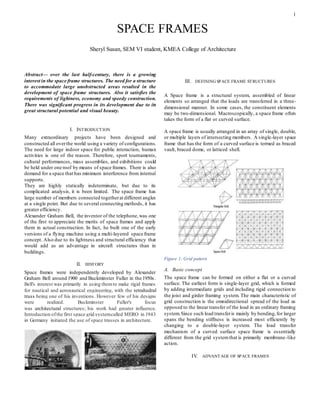
A space frame is usually arranged in an array of single, double,
or multiple layers of intersecting members. A single-layer space
frame that has the form of a curved surface is termed as braced
vault, braced dome, or latticed shell.
Figure 1: Grid pattern
A. Basic concept
The space frame can be formed on either a flat or a curved
surface. The earliest form is single-layer grid, which is formed
by adding intermediate grids and including rigid connection to
the joist and girder framing system. The main characteristic of
grid construction is the omnidirectional spread of the load as
opposed to the linear transfer of the load in an ordinary framing
system.Since such load transferis mainly by bending,for larger
spans the bending stiffness is increased most efficiently by
changing to a double-layer system. The load transfer
mechanism of a curved surface space frame is essentially
different from the grid systemthat is primarily membrane-like
action.
IV. ADVANTAGE OF SPACE FRAMES
SPACE FRAMES
Sheryl Susan, SEM VI student, KMEA College of Architecture
2
The space frames are light, structural efficient and use materials
optimally. They are an elegant and economical means of
covering large column-free spaces of hangars and assembly
halls. They carry loads by three-dimensional action. Deflections
are small because ofthe high inherent stiffness.Space frame are
joined using precise, factory-made components, unskilled
labour is adequate for their assembly and action. Services such
as lighting and air conditioning can be integrated with space
frames. Also these save construction time. They are light which
facilitates transportation. Dead loads are very much less and
there are consequent savings in columns and substructures.
V. COMPONENTS OF A SPACE FRAME
A space frame consists ofaxial members, which are preferably
tubes, also known as circular hollow sections or rectangular
hollow sections and connectors, which join the members
together.
Figure 2: different connections
A. Members
The members of a space frame are either of aluminium or steel.
Aluminium members are of light weight but are more
expensive. The large majority of space frames use members of
steel with a yield strength ranging from 210 to 450 MPa. The
tubes may be electrically resistance welded or seamless.
B. Node connectors
Figure 3: Mero
C. Mero
The Mero connector, introduced some 50 years ago, proved to
be extremely popular and has been used for numerous
temporary and permanent buildings. Its joint consists ofa node
that is a spherical hot-pressed steel forging with flat facets and
tapped holes. Members are circular hollow sections with cone-
shaped steel forgings welded at the ends, which accommodate
connecting bolts. Upto 18 members can be connected at a joint
with no eccentricity.
VI. DIFFERENT TYPES OF SPACE FRAMES
A. Flat covers
These spatial structures are composed of planar substructures.
Their behaviour is similar to that of a plate in which the
deflections in the plane are channeled through the horizontal
bars and the shear forces are supported by the diagonals.
B. Barrel vaults
This type of vault has a cross section of a simple arch. Usually
this type of space frame does not need to use tetrahedral
modules or pyramids as a part of its backing.
3
C. Spherical domes
Usually require the use of tetrahedral modules or pyramids and
additional support froma skin.
Figure 4: Plane covers
Figure 5: Barrel vault
Figure 6: Spherical dome
VII. DIFFERENT TYPESOF SPACE FRAMES ACCORDING TO THE
NUMBER OF LAYERS
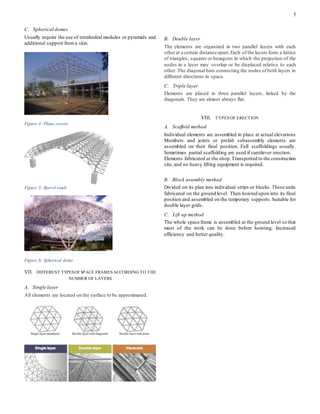
A. Single layer
All elements are located on the surface to be approximated.
B. Double layer
The elements are organized in two parallel layers with each
otherat a certain distance apart.Each of the layers form a lattice
of triangles, squares or hexagons in which the projection of the
nodes in a layer may overlap or be displaced relative to each
other. The diagonal bars connecting the nodes of both layers in
different directions in space.
C. Triple layer
Elements are placed in three parallel layers, linked by the
diagonals. They are almost always flat.
VIII. TYPES OF ERECTION
A. Scaffold method
Individual elements are assembled in place at actual elevations
Members and joints or prefab subassembly elements are
assembled on their final position. Full scaffoldings usually.
Sometimes partial scaffolding are used if cantilever erection.
Elements fabricated at the shop.Transported to the construction
site, and no heavy lifting equipment is required.
B. Block assembly method
Divided on its plan into individual strips or blocks. These units
fabricated on the ground level. Then hoisted upon into its final
position and assembled on the temporary supports.Suitable for
double layer grids.
C. Lift up method
The whole space frame is assembled at the ground level so that
most of the work can be done before hoisting. Increased
efficiency and better quality.

Space frames

  • 1.
    1  Abstract— over thelast half-century, there is a growing interest in the space frame structures. The need for a structure to accommodate large unobstructed areas resulted in the development of space frame structures. Also it satisfies the requirements of lightness, economy and speedy construction. There was significant progress in its development due to its great structural potential and visual beauty. I. INTRODUCTION Many extraordinary projects have been designed and constructed all overthe world using a variety of configurations. The need for large indoor space for public interaction, human activities is one of the reason. Therefore, sport tournaments, cultural performances, mass assemblies, and exhibitions could be held under one roof by means of space frames. There is also demand for a space that has minimum interference from internal supports. They are highly statically indeterminate, but due to its complicated analysis, it is been limited. The space frame has large number of members connected togetherat different angles at a single point. But due to several connecting methods, it has greater efficiency. Alexander Graham Bell, the inventor of the telephone,was one of the first to appreciate the merits of space frames and apply them in actual construction. In fact, he built one of the early versions of a flying machine using a multi-layered space frame concept. Also due to its lightness and structural efficiency that would add as an advantage in aircraft structures than in buildings. II. HISTORY Space frames were independently developed by Alexander Graham Bell around 1900 and Buckminster Fuller in the 1950s. Bell's interest was primarily in using themto make rigid frames for nautical and aeronautical engineering, with the tetrahedral truss being one of his inventions. However few of his designs were realized. Buckminster Fuller's focus was architectural structures; his work had greater influence. Introduction ofthe first space grid systemcalled MERO in 1943 in Germany initiated the use of space trusses in architecture. III. DEFINING SPACE FRAME STRUCTURES A Space frame is a structural system, assembled of linear elements so arranged that the loads are transferred in a three- dimensional manner. In some cases, the constituent elements may be two-dimensional. Macroscopically, a space frame often takes the form of a flat or curved surface. A space frame is usually arranged in an array of single, double, or multiple layers of intersecting members. A single-layer space frame that has the form of a curved surface is termed as braced vault, braced dome, or latticed shell. Figure 1: Grid pattern A. Basic concept The space frame can be formed on either a flat or a curved surface. The earliest form is single-layer grid, which is formed by adding intermediate grids and including rigid connection to the joist and girder framing system. The main characteristic of grid construction is the omnidirectional spread of the load as opposed to the linear transfer of the load in an ordinary framing system.Since such load transferis mainly by bending,for larger spans the bending stiffness is increased most efficiently by changing to a double-layer system. The load transfer mechanism of a curved surface space frame is essentially different from the grid systemthat is primarily membrane-like action. IV. ADVANTAGE OF SPACE FRAMES SPACE FRAMES Sheryl Susan, SEM VI student, KMEA College of Architecture
  • 2.
    2 The space framesare light, structural efficient and use materials optimally. They are an elegant and economical means of covering large column-free spaces of hangars and assembly halls. They carry loads by three-dimensional action. Deflections are small because ofthe high inherent stiffness.Space frame are joined using precise, factory-made components, unskilled labour is adequate for their assembly and action. Services such as lighting and air conditioning can be integrated with space frames. Also these save construction time. They are light which facilitates transportation. Dead loads are very much less and there are consequent savings in columns and substructures. V. COMPONENTS OF A SPACE FRAME A space frame consists ofaxial members, which are preferably tubes, also known as circular hollow sections or rectangular hollow sections and connectors, which join the members together. Figure 2: different connections A. Members The members of a space frame are either of aluminium or steel. Aluminium members are of light weight but are more expensive. The large majority of space frames use members of steel with a yield strength ranging from 210 to 450 MPa. The tubes may be electrically resistance welded or seamless. B. Node connectors Figure 3: Mero C. Mero The Mero connector, introduced some 50 years ago, proved to be extremely popular and has been used for numerous temporary and permanent buildings. Its joint consists ofa node that is a spherical hot-pressed steel forging with flat facets and tapped holes. Members are circular hollow sections with cone- shaped steel forgings welded at the ends, which accommodate connecting bolts. Upto 18 members can be connected at a joint with no eccentricity. VI. DIFFERENT TYPES OF SPACE FRAMES A. Flat covers These spatial structures are composed of planar substructures. Their behaviour is similar to that of a plate in which the deflections in the plane are channeled through the horizontal bars and the shear forces are supported by the diagonals. B. Barrel vaults This type of vault has a cross section of a simple arch. Usually this type of space frame does not need to use tetrahedral modules or pyramids as a part of its backing.
  • 3.
    3 C. Spherical domes Usuallyrequire the use of tetrahedral modules or pyramids and additional support froma skin. Figure 4: Plane covers Figure 5: Barrel vault Figure 6: Spherical dome VII. DIFFERENT TYPESOF SPACE FRAMES ACCORDING TO THE NUMBER OF LAYERS A. Single layer All elements are located on the surface to be approximated. B. Double layer The elements are organized in two parallel layers with each otherat a certain distance apart.Each of the layers form a lattice of triangles, squares or hexagons in which the projection of the nodes in a layer may overlap or be displaced relative to each other. The diagonal bars connecting the nodes of both layers in different directions in space. C. Triple layer Elements are placed in three parallel layers, linked by the diagonals. They are almost always flat. VIII. TYPES OF ERECTION A. Scaffold method Individual elements are assembled in place at actual elevations Members and joints or prefab subassembly elements are assembled on their final position. Full scaffoldings usually. Sometimes partial scaffolding are used if cantilever erection. Elements fabricated at the shop.Transported to the construction site, and no heavy lifting equipment is required. B. Block assembly method Divided on its plan into individual strips or blocks. These units fabricated on the ground level. Then hoisted upon into its final position and assembled on the temporary supports.Suitable for double layer grids. C. Lift up method The whole space frame is assembled at the ground level so that most of the work can be done before hoisting. Increased efficiency and better quality.