SPACE FRAME STRUCTURE
PRESENTED BY HAMNAAHSAN
FA13-BAR-008
Analysis, Design and Construction of Steel Space Frames
By G. S. Ramaswamy, Mick Eekhout
Handbook of Structural Engineering
Copyright 2005 by CRC Press
What are space frame structures?
In literal meanings its three-dimensional structure.
In a more restricted sense, space frame means some type of special structural
action in three dimensions.
It is a structure system assembled of linear elements so arranged that forces
are transferred in a three-dimensional manner.
A space frame is usually arranged in an array of single, double, or multiple
layers of intersecting members.
Some authors define space frames only as double-layer grids.
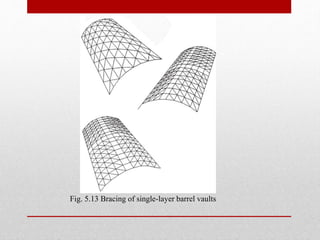
A single-layer space frame that has the form of a curved surface is termed as
braced vault, braced dome, or latticed shell.
The space frame can be formed on either a flat or a curved surface. The earliest
form of space frame structure is single-layer grid. By adding intermediate
grids and including rigid connection to the joist and girder framing system,
the single-layer grid is formed.
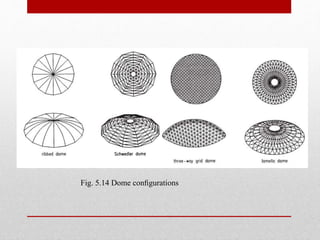
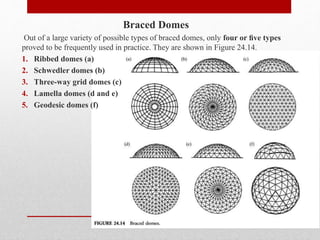
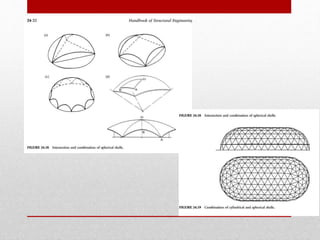
Fig. 5.14 Dome configurations
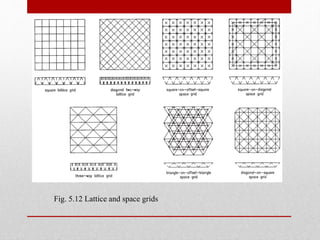
Fig. 5.12 Lattice and space grids
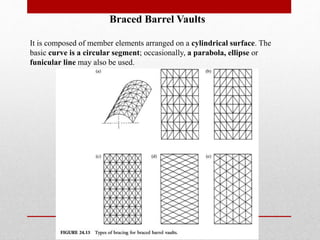
Fig. 5.13 Bracing of single-layer barrel vaults
Double-Layer Grids
Types and Geometry
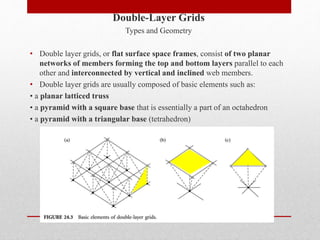
• Double layer grids, or flat surface space frames, consist of two planar
networks of members forming the top and bottom layers parallel to each
other and interconnected by vertical and inclined web members.
• Double layer grids are usually composed of basic elements such as:
• a planar latticed truss
• a pyramid with a square base that is essentially a part of an octahedron
• a pyramid with a triangular base (tetrahedron)
Different types of double-layer grids are grouped and named
according to their composition, and the names
Group 1: composed of latticed trusses
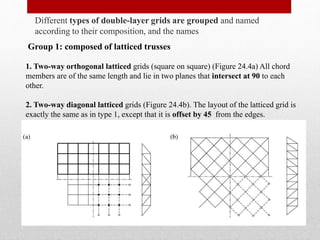
1. Two-way orthogonal latticed grids (square on square) (Figure 24.4a) All chord
members are of the same length and lie in two planes that intersect at 90 to each
other.
2. Two-way diagonal latticed grids (Figure 24.4b). The layout of the latticed grid is
exactly the same as in type 1, except that it is offset by 45 from the edges.
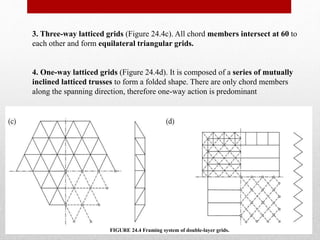
3. Three-way latticed grids (Figure 24.4c). All chord members intersect at 60 to
each other and form equilateral triangular grids.
4. One-way latticed grids (Figure 24.4d). It is composed of a series of mutually
inclined latticed trusses to form a folded shape. There are only chord members
along the spanning direction, therefore one-way action is predominant
FIGURE 24.4 Framing system of double-layer grids.
Group 2A: composed of square pyramids
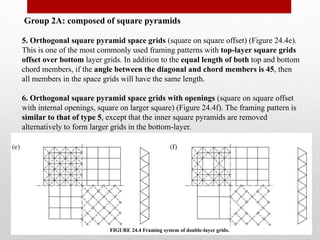
5. Orthogonal square pyramid space grids (square on square offset) (Figure 24.4e).
This is one of the most commonly used framing patterns with top-layer square grids
offset over bottom layer grids. In addition to the equal length of both top and bottom
chord members, if the angle between the diagonal and chord members is 45, then
all members in the space grids will have the same length.
6. Orthogonal square pyramid space grids with openings (square on square offset
with internal openings, square on larger square) (Figure 24.4f). The framing pattern is
similar to that of type 5, except that the inner square pyramids are removed
alternatively to form larger grids in the bottom-layer.
FIGURE 24.4 Framing system of double-layer grids.
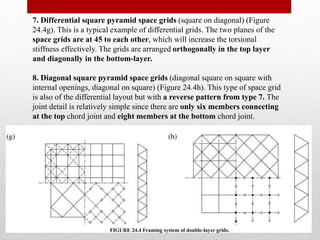
7. Differential square pyramid space grids (square on diagonal) (Figure
24.4g). This is a typical example of differential grids. The two planes of the
space grids are at 45 to each other, which will increase the torsional
stiffness effectively. The grids are arranged orthogonally in the top layer
and diagonally in the bottom-layer.
8. Diagonal square pyramid space grids (diagonal square on square with
internal openings, diagonal on square) (Figure 24.4h). This type of space grid
is also of the differential layout but with a reverse pattern from type 7. The
joint detail is relatively simple since there are only six members connecting
at the top chord joint and eight members at the bottom chord joint.
FIGURE 24.4 Framing system of double-layer grids.
Group 2A: composed of square pyramids
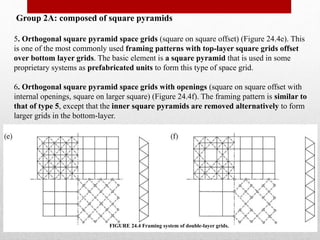
5. Orthogonal square pyramid space grids (square on square offset) (Figure 24.4e). This
is one of the most commonly used framing patterns with top-layer square grids offset
over bottom layer grids. The basic element is a square pyramid that is used in some
proprietary systems as prefabricated units to form this type of space grid.
6. Orthogonal square pyramid space grids with openings (square on square offset with
internal openings, square on larger square) (Figure 24.4f). The framing pattern is similar to
that of type 5, except that the inner square pyramids are removed alternatively to form
larger grids in the bottom-layer.
FIGURE 24.4 Framing system of double-layer grids.
Group 2B: composed of triangular pyramids
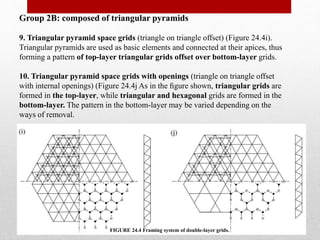
9. Triangular pyramid space grids (triangle on triangle offset) (Figure 24.4i).
Triangular pyramids are used as basic elements and connected at their apices, thus
forming a pattern of top-layer triangular grids offset over bottom-layer grids.
10. Triangular pyramid space grids with openings (triangle on triangle offset
with internal openings) (Figure 24.4j As in the figure shown, triangular grids are
formed in the top-layer, while triangular and hexagonal grids are formed in the
bottom-layer. The pattern in the bottom-layer may be varied depending on the
ways of removal.
FIGURE 24.4 Framing system of double-layer grids.
Braced Barrel Vaults
It is composed of member elements arranged on a cylindrical surface. The
basic curve is a circular segment; occasionally, a parabola, ellipse or
funicular line may also be used.
Braced Domes
Out of a large variety of possible types of braced domes, only four or five types
proved to be frequently used in practice. They are shown in Figure 24.14.
1. Ribbed domes (a)
2. Schwedler domes (b)
3. Three-way grid domes (c)
4. Lamella domes (d and e)
5. Geodesic domes (f)
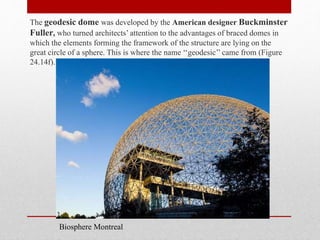
The geodesic dome was developed by the American designer Buckminster
Fuller, who turned architects’ attention to the advantages of braced domes in
which the elements forming the framework of the structure are lying on the
great circle of a sphere. This is where the name ‘‘geodesic’’ came from (Figure
24.14f).
Biosphere Montreal
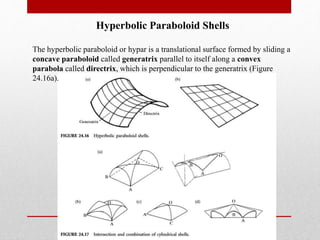
Hyperbolic Paraboloid Shells
The hyperbolic paraboloid or hypar is a translational surface formed by sliding a
concave paraboloid called generatrix parallel to itself along a convex
parabola called directrix, which is perpendicular to the generatrix (Figure
24.16a).
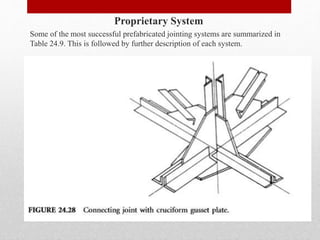
Proprietary System
Some of the most successful prefabricated jointing systems are summarized in
Table 24.9. This is followed by further description of each system.
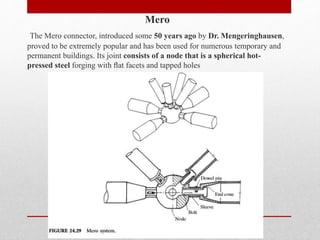
Mero
The Mero connector, introduced some 50 years ago by Dr. Mengeringhausen,
proved to be extremely popular and has been used for numerous temporary and
permanent buildings. Its joint consists of a node that is a spherical hot-
pressed steel forging with flat facets and tapped holes
Advantages of Space Frames
• Light weight: most space frames are now constructed with steel or
aluminum, which decreases considerably their self-weight.
• Space frames can be built from simple prefabricated units, which are often
of standard size and shape.
• Units can be easily transported and rapidly assembled on site by semi-
skilled labor.
• Space frames can be built at a lower cost.
• Light in weight
• Flexible structure due to its three dimensional character and to the full
participation of its constituent elements.
• Space frames possess a versatility of shape and form and can utilize a
standard module to generate various flat space grids, latticed shell, or
even free-form shapes.
Disadvantages of Space Frames
• Difficult to engineer
• Not easy to determine forces distribution throughout the structure.
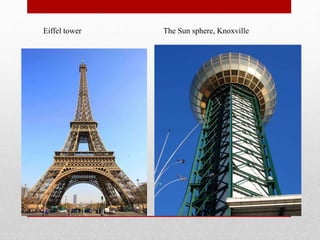
Eiffel tower The Sun sphere, Knoxville
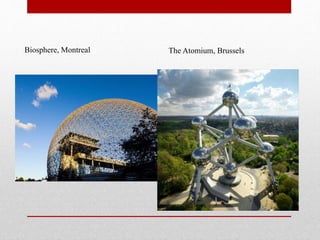
The Atomium, Brussels
Biosphere, Montreal
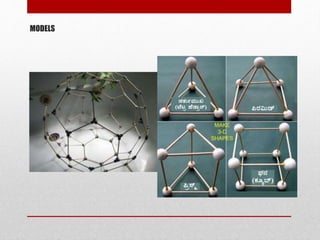
MODELS
• https://www.google.com/patents/US4070847
• https://www.google.com/patents/US5338080
• https://www.google.com/patents/US5079890
• https://books.google.com.pk/books?id=X2S96Nra6PcC&printsec=frontcover&dq=space+frame+structures
&hl=en&sa=X&redir_esc=y#v=onepage&q=space%20frame%20structures&f=false
REFRENCES

Space_Frame_Structures.pptxtttttttttttttt

  • 1.
    SPACE FRAME STRUCTURE PRESENTEDBY HAMNAAHSAN FA13-BAR-008 Analysis, Design and Construction of Steel Space Frames By G. S. Ramaswamy, Mick Eekhout Handbook of Structural Engineering Copyright 2005 by CRC Press
  • 2.
    What are spaceframe structures? In literal meanings its three-dimensional structure. In a more restricted sense, space frame means some type of special structural action in three dimensions. It is a structure system assembled of linear elements so arranged that forces are transferred in a three-dimensional manner.
  • 3.
    A space frameis usually arranged in an array of single, double, or multiple layers of intersecting members. Some authors define space frames only as double-layer grids. A single-layer space frame that has the form of a curved surface is termed as braced vault, braced dome, or latticed shell. The space frame can be formed on either a flat or a curved surface. The earliest form of space frame structure is single-layer grid. By adding intermediate grids and including rigid connection to the joist and girder framing system, the single-layer grid is formed.
  • 4.
    Fig. 5.14 Domeconfigurations
  • 5.
    Fig. 5.12 Latticeand space grids
  • 6.
    Fig. 5.13 Bracingof single-layer barrel vaults
  • 7.
    Double-Layer Grids Types andGeometry • Double layer grids, or flat surface space frames, consist of two planar networks of members forming the top and bottom layers parallel to each other and interconnected by vertical and inclined web members. • Double layer grids are usually composed of basic elements such as: • a planar latticed truss • a pyramid with a square base that is essentially a part of an octahedron • a pyramid with a triangular base (tetrahedron)
  • 8.
    Different types ofdouble-layer grids are grouped and named according to their composition, and the names Group 1: composed of latticed trusses 1. Two-way orthogonal latticed grids (square on square) (Figure 24.4a) All chord members are of the same length and lie in two planes that intersect at 90 to each other. 2. Two-way diagonal latticed grids (Figure 24.4b). The layout of the latticed grid is exactly the same as in type 1, except that it is offset by 45 from the edges.
  • 9.
    3. Three-way latticedgrids (Figure 24.4c). All chord members intersect at 60 to each other and form equilateral triangular grids. 4. One-way latticed grids (Figure 24.4d). It is composed of a series of mutually inclined latticed trusses to form a folded shape. There are only chord members along the spanning direction, therefore one-way action is predominant FIGURE 24.4 Framing system of double-layer grids.
  • 10.
    Group 2A: composedof square pyramids 5. Orthogonal square pyramid space grids (square on square offset) (Figure 24.4e). This is one of the most commonly used framing patterns with top-layer square grids offset over bottom layer grids. In addition to the equal length of both top and bottom chord members, if the angle between the diagonal and chord members is 45, then all members in the space grids will have the same length. 6. Orthogonal square pyramid space grids with openings (square on square offset with internal openings, square on larger square) (Figure 24.4f). The framing pattern is similar to that of type 5, except that the inner square pyramids are removed alternatively to form larger grids in the bottom-layer. FIGURE 24.4 Framing system of double-layer grids.
  • 11.
    7. Differential squarepyramid space grids (square on diagonal) (Figure 24.4g). This is a typical example of differential grids. The two planes of the space grids are at 45 to each other, which will increase the torsional stiffness effectively. The grids are arranged orthogonally in the top layer and diagonally in the bottom-layer. 8. Diagonal square pyramid space grids (diagonal square on square with internal openings, diagonal on square) (Figure 24.4h). This type of space grid is also of the differential layout but with a reverse pattern from type 7. The joint detail is relatively simple since there are only six members connecting at the top chord joint and eight members at the bottom chord joint. FIGURE 24.4 Framing system of double-layer grids.
  • 12.
    Group 2A: composedof square pyramids 5. Orthogonal square pyramid space grids (square on square offset) (Figure 24.4e). This is one of the most commonly used framing patterns with top-layer square grids offset over bottom layer grids. The basic element is a square pyramid that is used in some proprietary systems as prefabricated units to form this type of space grid. 6. Orthogonal square pyramid space grids with openings (square on square offset with internal openings, square on larger square) (Figure 24.4f). The framing pattern is similar to that of type 5, except that the inner square pyramids are removed alternatively to form larger grids in the bottom-layer. FIGURE 24.4 Framing system of double-layer grids.
  • 13.
    Group 2B: composedof triangular pyramids 9. Triangular pyramid space grids (triangle on triangle offset) (Figure 24.4i). Triangular pyramids are used as basic elements and connected at their apices, thus forming a pattern of top-layer triangular grids offset over bottom-layer grids. 10. Triangular pyramid space grids with openings (triangle on triangle offset with internal openings) (Figure 24.4j As in the figure shown, triangular grids are formed in the top-layer, while triangular and hexagonal grids are formed in the bottom-layer. The pattern in the bottom-layer may be varied depending on the ways of removal. FIGURE 24.4 Framing system of double-layer grids.
  • 14.
    Braced Barrel Vaults Itis composed of member elements arranged on a cylindrical surface. The basic curve is a circular segment; occasionally, a parabola, ellipse or funicular line may also be used.
  • 15.
    Braced Domes Out ofa large variety of possible types of braced domes, only four or five types proved to be frequently used in practice. They are shown in Figure 24.14. 1. Ribbed domes (a) 2. Schwedler domes (b) 3. Three-way grid domes (c) 4. Lamella domes (d and e) 5. Geodesic domes (f)
  • 16.
    The geodesic domewas developed by the American designer Buckminster Fuller, who turned architects’ attention to the advantages of braced domes in which the elements forming the framework of the structure are lying on the great circle of a sphere. This is where the name ‘‘geodesic’’ came from (Figure 24.14f). Biosphere Montreal
  • 17.
    Hyperbolic Paraboloid Shells Thehyperbolic paraboloid or hypar is a translational surface formed by sliding a concave paraboloid called generatrix parallel to itself along a convex parabola called directrix, which is perpendicular to the generatrix (Figure 24.16a).
  • 19.
    Proprietary System Some ofthe most successful prefabricated jointing systems are summarized in Table 24.9. This is followed by further description of each system.
  • 20.
    Mero The Mero connector,introduced some 50 years ago by Dr. Mengeringhausen, proved to be extremely popular and has been used for numerous temporary and permanent buildings. Its joint consists of a node that is a spherical hot- pressed steel forging with flat facets and tapped holes
  • 21.
    Advantages of SpaceFrames • Light weight: most space frames are now constructed with steel or aluminum, which decreases considerably their self-weight. • Space frames can be built from simple prefabricated units, which are often of standard size and shape. • Units can be easily transported and rapidly assembled on site by semi- skilled labor. • Space frames can be built at a lower cost. • Light in weight • Flexible structure due to its three dimensional character and to the full participation of its constituent elements. • Space frames possess a versatility of shape and form and can utilize a standard module to generate various flat space grids, latticed shell, or even free-form shapes.
  • 22.
    Disadvantages of SpaceFrames • Difficult to engineer • Not easy to determine forces distribution throughout the structure.
  • 23.
    Eiffel tower TheSun sphere, Knoxville
  • 24.
  • 25.
  • 26.
    • https://www.google.com/patents/US4070847 • https://www.google.com/patents/US5338080 •https://www.google.com/patents/US5079890 • https://books.google.com.pk/books?id=X2S96Nra6PcC&printsec=frontcover&dq=space+frame+structures &hl=en&sa=X&redir_esc=y#v=onepage&q=space%20frame%20structures&f=false REFRENCES