
GERMAN EXPRESSIONISM
Dr. J. JANARDHAN
EXPRESSIONISM
• Its an artistic style
• Depict not objective reality, but the subjective emotions
• The artist accomplishes this aim through
Distortion
Exaggeration
Primitivism and fantasy
• It is one of the main currents of art in the later 19th and
the 20th Centuries
• It is considered as one of the artistic movement
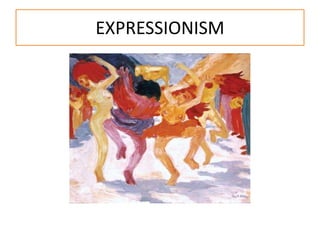
EXPRESSIONISM
• These artists used the expressive possibilities of
colour and line to explore dramatic
and emotion-laden themes,
to convey the qualities of fear, horror & ugly…
• They broke away from the literal representation of
nature in order to express more subjective outlooks
EXPRESSIONISM
• The period of expressionism is also called Weimar period
• Captured the emotions and sufferings of nation & people
• German expressionism filmed the reality of daily life.
• German Expressionism roots lay in the works of
Vincent van Gogh,
Edvard Munch, and
James Ensor
EXPRESSIONISM
GERMAN EXPRESSIONISM
• The German Expressionists soon developed a style
notable for its Harshness,
Boldness,
visual intensity
• This style in films set out to convey the subjective
mental state of the protagonist
GERMAN EXPRESSIONISM
• The film’s use of expressionistic elements to establish a
narrative
• That creates a disconnect between subjectivity and
reality
• In scenes throughout the film, sidewalks lead nowhere,
walls appear warped
Creating strange shapes
• Buildings rise at distorted angles in the background
STYLE OF GERMAN EXPRESSIONISM
• It captured the emotions and sufferings of the
broken nation and its people.
• The films made were weird, distorted with heavy
shadows to make the story look gloomy and
depressing
• The movement expressed the depression in the
people’s minds caused by the war
CHARACTERISTICS OF EXPRESSIONISM
• It used mise-en-scene and heavy atmosphere
• Long shadow effects
• Artificial sets with realistic details
• The details in the sets bring out the emotional,
CHARACTERISTICS OF EXPRESSIONISM
• Camera set in unexpected angles gives audience a
different perception
• Aims in evoking mystery, hallucinations and
extreme emotional stress
• Slow pace than other regular movies
END OF EXPRESSIONISM
• German expressionism came to an end in 1923
• It was named that expressionism was degenerated art
• German expressionists moved to Hollywood
• Expressionism was fade away gradually with disinterest
in the topic.
MUST WATCH FILMS
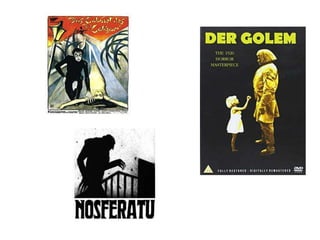
Robert Wiene’s The Cabinet of Dr. Caligari (1920)
Paul Wegener’s The Golem (1920)
F.W. Murnau’s Nosferatu (1922)
Fritz Lang’s Metropolis (1927)
THANK YOU

German expressionism

  • 1.
  • 2.
    EXPRESSIONISM • Its anartistic style • Depict not objective reality, but the subjective emotions • The artist accomplishes this aim through Distortion Exaggeration Primitivism and fantasy • It is one of the main currents of art in the later 19th and the 20th Centuries • It is considered as one of the artistic movement
  • 3.
    EXPRESSIONISM • These artistsused the expressive possibilities of colour and line to explore dramatic and emotion-laden themes, to convey the qualities of fear, horror & ugly… • They broke away from the literal representation of nature in order to express more subjective outlooks
  • 4.
    EXPRESSIONISM • The periodof expressionism is also called Weimar period • Captured the emotions and sufferings of nation & people • German expressionism filmed the reality of daily life. • German Expressionism roots lay in the works of Vincent van Gogh, Edvard Munch, and James Ensor
  • 5.
  • 6.
    GERMAN EXPRESSIONISM • TheGerman Expressionists soon developed a style notable for its Harshness, Boldness, visual intensity • This style in films set out to convey the subjective mental state of the protagonist
  • 7.
    GERMAN EXPRESSIONISM • Thefilm’s use of expressionistic elements to establish a narrative • That creates a disconnect between subjectivity and reality • In scenes throughout the film, sidewalks lead nowhere, walls appear warped Creating strange shapes • Buildings rise at distorted angles in the background
  • 8.
    STYLE OF GERMANEXPRESSIONISM • It captured the emotions and sufferings of the broken nation and its people. • The films made were weird, distorted with heavy shadows to make the story look gloomy and depressing • The movement expressed the depression in the people’s minds caused by the war
  • 9.
    CHARACTERISTICS OF EXPRESSIONISM •It used mise-en-scene and heavy atmosphere • Long shadow effects • Artificial sets with realistic details • The details in the sets bring out the emotional,
  • 10.
    CHARACTERISTICS OF EXPRESSIONISM •Camera set in unexpected angles gives audience a different perception • Aims in evoking mystery, hallucinations and extreme emotional stress • Slow pace than other regular movies
  • 11.
    END OF EXPRESSIONISM •German expressionism came to an end in 1923 • It was named that expressionism was degenerated art • German expressionists moved to Hollywood • Expressionism was fade away gradually with disinterest in the topic.
  • 13.
    MUST WATCH FILMS RobertWiene’s The Cabinet of Dr. Caligari (1920) Paul Wegener’s The Golem (1920) F.W. Murnau’s Nosferatu (1922) Fritz Lang’s Metropolis (1927)
  • 14.