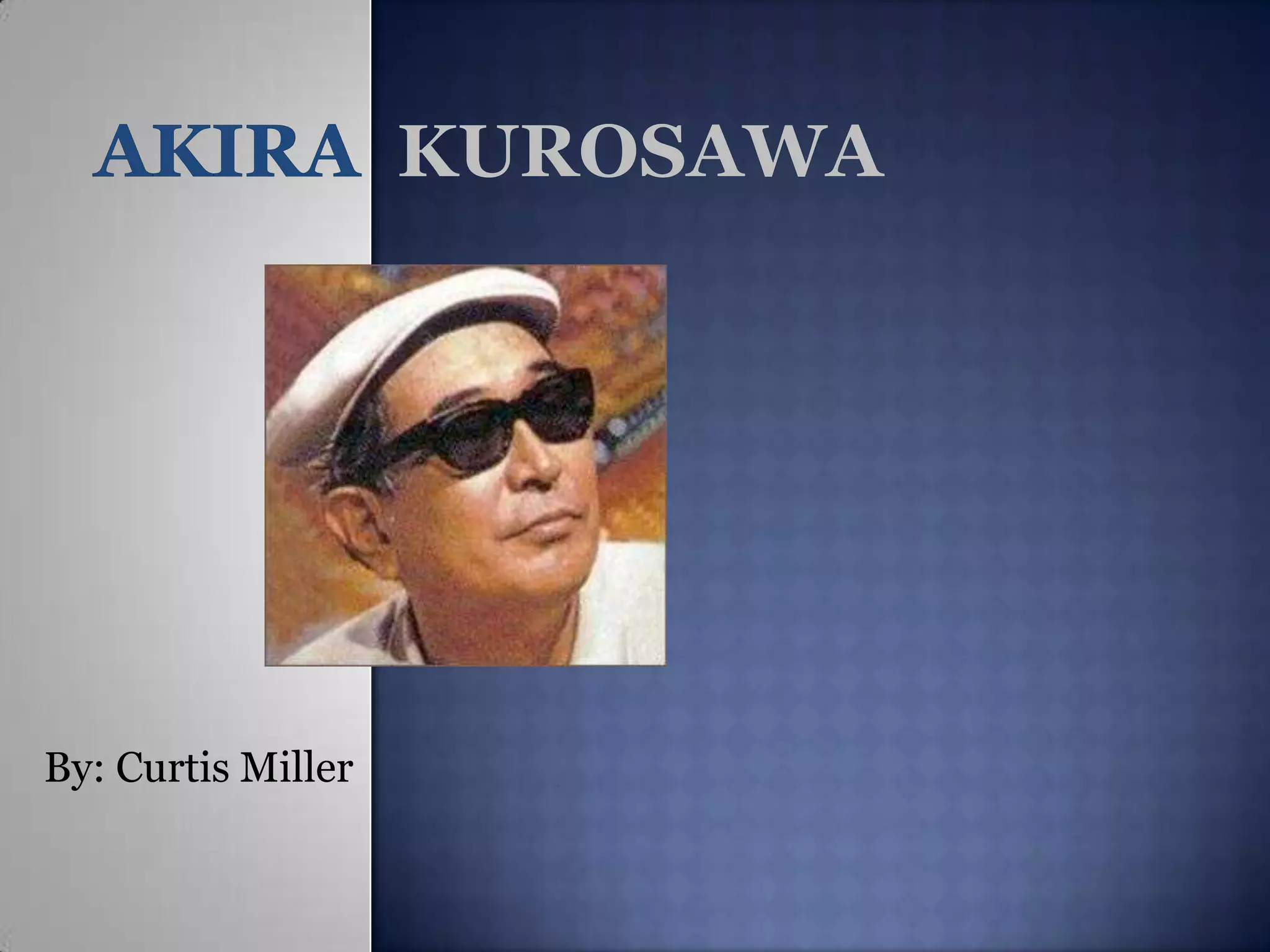
By: Curtis Miller
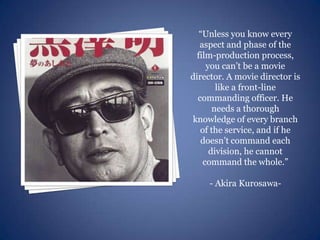
“Unless you know every
   aspect and phase of the
  film-production process,
     you can’t be a movie
director. A movie director is
        like a front-line
  commanding officer. He
       needs a thorough
knowledge of every branch
   of the service, and if he
   doesn’t command each
      division, he cannot
    command the whole.”

     - Akira Kurosawa-
BIOGRAPHY
   Born March 23, 1910 in Tokyo            Drunken Angel was his first
    Japan.                                   personal expressive work (1948).
   Nicknames: The Emporer, Wind            His film Rashomon introduced
    Man.                                     Japanese cinema to the western
   At over 6 ft. tall, he was               culture (1950).
    extremely large by Japanese             Continued to direct films well
    standards.                               into his eighties.
   Started as a talented painter.          Died September 6, 1998 in Tokyo
   Enrolled in an art school which          Japan.
    emphasized Western styles.
   Began directing career in 1930
    as an assistant director to Kajiro
    Yamamoto.
FILM TECHNIQUES & TRADE MARKS
   Frequently used the “wipe effect” to fade from one scene to another.
    -This effect later became famous due to its usage in the Star Wars
    trilogy.

   Use of weather to heighten mood, especially rain.

   Known for doing Shakespearean plays in Feudal Japanese settings.

   Portrays female characters as either sweet but weak and submissive or
    deceitful, evil and conniving.

   Portrays driven characters who frequently end up failing in the goals but
    ultimately learn hard won life lessons.
MAJOR INFLUENCES
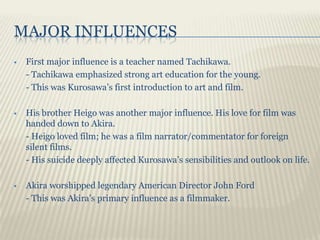
   First major influence is a teacher named Tachikawa.
    - Tachikawa emphasized strong art education for the young.
    - This was Kurosawa’s first introduction to art and film.

   His brother Heigo was another major influence. His love for film was
    handed down to Akira.
    - Heigo loved film; he was a film narrator/commentator for foreign
    silent films.
    - His suicide deeply affected Kurosawa’s sensibilities and outlook on life.

   Akira worshipped legendary American Director John Ford
    - This was Akira’s primary influence as a filmmaker.
TOP KUROSAWA FILMS
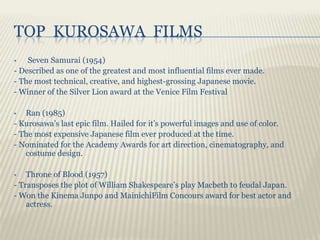
   Seven Samurai (1954)
- Described as one of the greatest and most influential films ever made.
- The most technical, creative, and highest-grossing Japanese movie.
- Winner of the Silver Lion award at the Venice Film Festival

  Ran (1985)
- Kurosawa’s last epic film. Hailed for it’s powerful images and use of color.
- The most expensive Japanese film ever produced at the time.
- Nominated for the Academy Awards for art direction, cinematography, and
   costume design.

   Throne of Blood (1957)
- Transposes the plot of William Shakespeare’s play Macbeth to feudal Japan.
- Won the Kinema Junpo and MainichiFilm Concours award for best actor and
    actress.
OTHER TOP KUROSAWA FILMS

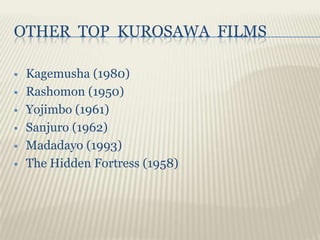
   Kagemusha (1980)
   Rashomon (1950)
   Yojimbo (1961)
   Sanjuro (1962)
   Madadayo (1993)
   The Hidden Fortress (1958)
OTHER ACCOMPLISHMENTS
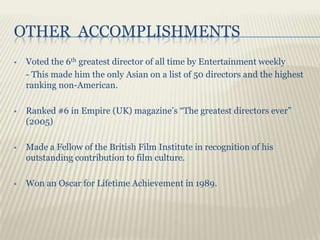
   Voted the 6th greatest director of all time by Entertainment weekly
    - This made him the only Asian on a list of 50 directors and the highest
    ranking non-American.

   Ranked #6 in Empire (UK) magazine’s “The greatest directors ever”
    (2005)

   Made a Fellow of the British Film Institute in recognition of his
    outstanding contribution to film culture.

   Won an Oscar for Lifetime Achievement in 1989.
RASHOMON TRAILER
   http://www.youtube.com/watch?v=xCZ9TguVOIA
WORKS CITED
   “Akira Kurosawa School of Film.” Anaheim University. Anaheim
    University, 2012. Web. 21 Mar. 2012.
    <http://www.anaheim.edu/schools-and-institutes/akira-
    kurosawa-school-of-film/225-schools-institutes/akira-kurosawa-
    school-of-film/750-akira-kurosawa-biography>.

   IMDb. IMDb.com, Inc., 2012. Web. 23 Mar. 2012.
    <http://www.imdb.com/name/nm0000041/bio>.

   Top 10 Akira Kurosawa Films. Japan Cinema, 2012. Web. 21
    Mar. 2012. <http://japancinema.net/2010/11/13/top-10-akira-
    kurosawa-films/>.

Akira kurosawa power point

  • 1.
  • 2.
    “Unless you knowevery aspect and phase of the film-production process, you can’t be a movie director. A movie director is like a front-line commanding officer. He needs a thorough knowledge of every branch of the service, and if he doesn’t command each division, he cannot command the whole.” - Akira Kurosawa-
  • 3.
    BIOGRAPHY  Born March 23, 1910 in Tokyo  Drunken Angel was his first Japan. personal expressive work (1948).  Nicknames: The Emporer, Wind  His film Rashomon introduced Man. Japanese cinema to the western  At over 6 ft. tall, he was culture (1950). extremely large by Japanese  Continued to direct films well standards. into his eighties.  Started as a talented painter.  Died September 6, 1998 in Tokyo  Enrolled in an art school which Japan. emphasized Western styles.  Began directing career in 1930 as an assistant director to Kajiro Yamamoto.
  • 4.
    FILM TECHNIQUES &TRADE MARKS  Frequently used the “wipe effect” to fade from one scene to another. -This effect later became famous due to its usage in the Star Wars trilogy.  Use of weather to heighten mood, especially rain.  Known for doing Shakespearean plays in Feudal Japanese settings.  Portrays female characters as either sweet but weak and submissive or deceitful, evil and conniving.  Portrays driven characters who frequently end up failing in the goals but ultimately learn hard won life lessons.
  • 5.
    MAJOR INFLUENCES  First major influence is a teacher named Tachikawa. - Tachikawa emphasized strong art education for the young. - This was Kurosawa’s first introduction to art and film.  His brother Heigo was another major influence. His love for film was handed down to Akira. - Heigo loved film; he was a film narrator/commentator for foreign silent films. - His suicide deeply affected Kurosawa’s sensibilities and outlook on life.  Akira worshipped legendary American Director John Ford - This was Akira’s primary influence as a filmmaker.
  • 6.
    TOP KUROSAWA FILMS  Seven Samurai (1954) - Described as one of the greatest and most influential films ever made. - The most technical, creative, and highest-grossing Japanese movie. - Winner of the Silver Lion award at the Venice Film Festival  Ran (1985) - Kurosawa’s last epic film. Hailed for it’s powerful images and use of color. - The most expensive Japanese film ever produced at the time. - Nominated for the Academy Awards for art direction, cinematography, and costume design.  Throne of Blood (1957) - Transposes the plot of William Shakespeare’s play Macbeth to feudal Japan. - Won the Kinema Junpo and MainichiFilm Concours award for best actor and actress.
  • 7.
    OTHER TOP KUROSAWAFILMS  Kagemusha (1980)  Rashomon (1950)  Yojimbo (1961)  Sanjuro (1962)  Madadayo (1993)  The Hidden Fortress (1958)
  • 8.
    OTHER ACCOMPLISHMENTS  Voted the 6th greatest director of all time by Entertainment weekly - This made him the only Asian on a list of 50 directors and the highest ranking non-American.  Ranked #6 in Empire (UK) magazine’s “The greatest directors ever” (2005)  Made a Fellow of the British Film Institute in recognition of his outstanding contribution to film culture.  Won an Oscar for Lifetime Achievement in 1989.
  • 9.
    RASHOMON TRAILER  http://www.youtube.com/watch?v=xCZ9TguVOIA
  • 10.
    WORKS CITED  “Akira Kurosawa School of Film.” Anaheim University. Anaheim University, 2012. Web. 21 Mar. 2012. <http://www.anaheim.edu/schools-and-institutes/akira- kurosawa-school-of-film/225-schools-institutes/akira-kurosawa- school-of-film/750-akira-kurosawa-biography>.  IMDb. IMDb.com, Inc., 2012. Web. 23 Mar. 2012. <http://www.imdb.com/name/nm0000041/bio>.  Top 10 Akira Kurosawa Films. Japan Cinema, 2012. Web. 21 Mar. 2012. <http://japancinema.net/2010/11/13/top-10-akira- kurosawa-films/>.