Dr. J.JANARDHAN
JAPANESE CINEMA-1904-2019
JAPANESE CINEMA
• It has been strong from the beginning days
• The first studios were established in 1904-1905
• The development continued until Tokyo earthquake in 1923
• Talkies were slow in coming to Japan because of benshi
• Kenji Mizoguchi’s Fujiwara Yoshie no Furusato (Home
Town) was the first feature film in 1930s
• Heinosuke Gosho’s Madamu to nyobo, 1931 (The
Neighbour’s Wife and Mine)
JAPANESE CINEMA
• WW-II brought another pause
• Subsequently, US dominated from 1945 to 1952
• Censorship cramped the major Japanese film makers
• It notable not only for quantity and also high quality
• Because of its rich tradition, Japanese films were not popular
in outside the country as its counter part.
JAPANESE CINEMA
• Six major production companies controlled distribution and
the theater circuits
• It also has its own popular genres mainly,
Jidai-geki- historical films
Gendai-geki- contemporary films
• Studios, directors and actors tended to specialize in one or the
other of the two modes
• Jidai-geki- accounted for only 40% of production
JAPANESE CINEMA
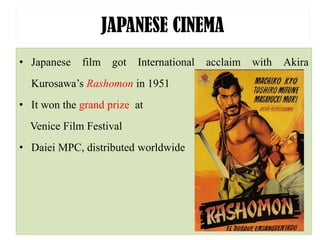
• Japanese film got International acclaim with Akira
Kurosawa’s Rashomon in 1951
• It won the grand prize at
Venice Film Festival
• Daiei MPC, distributed worldwide
JAPANESE CINEMA
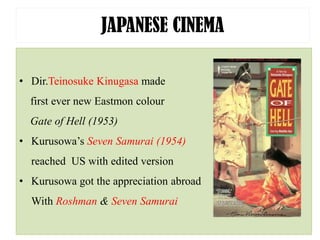
• Dir.Teinosuke Kinugasa made
first ever new Eastmon colour
Gate of Hell (1953)
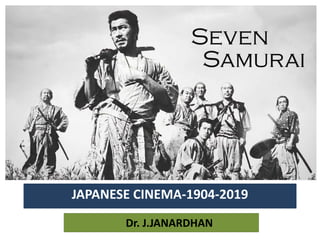
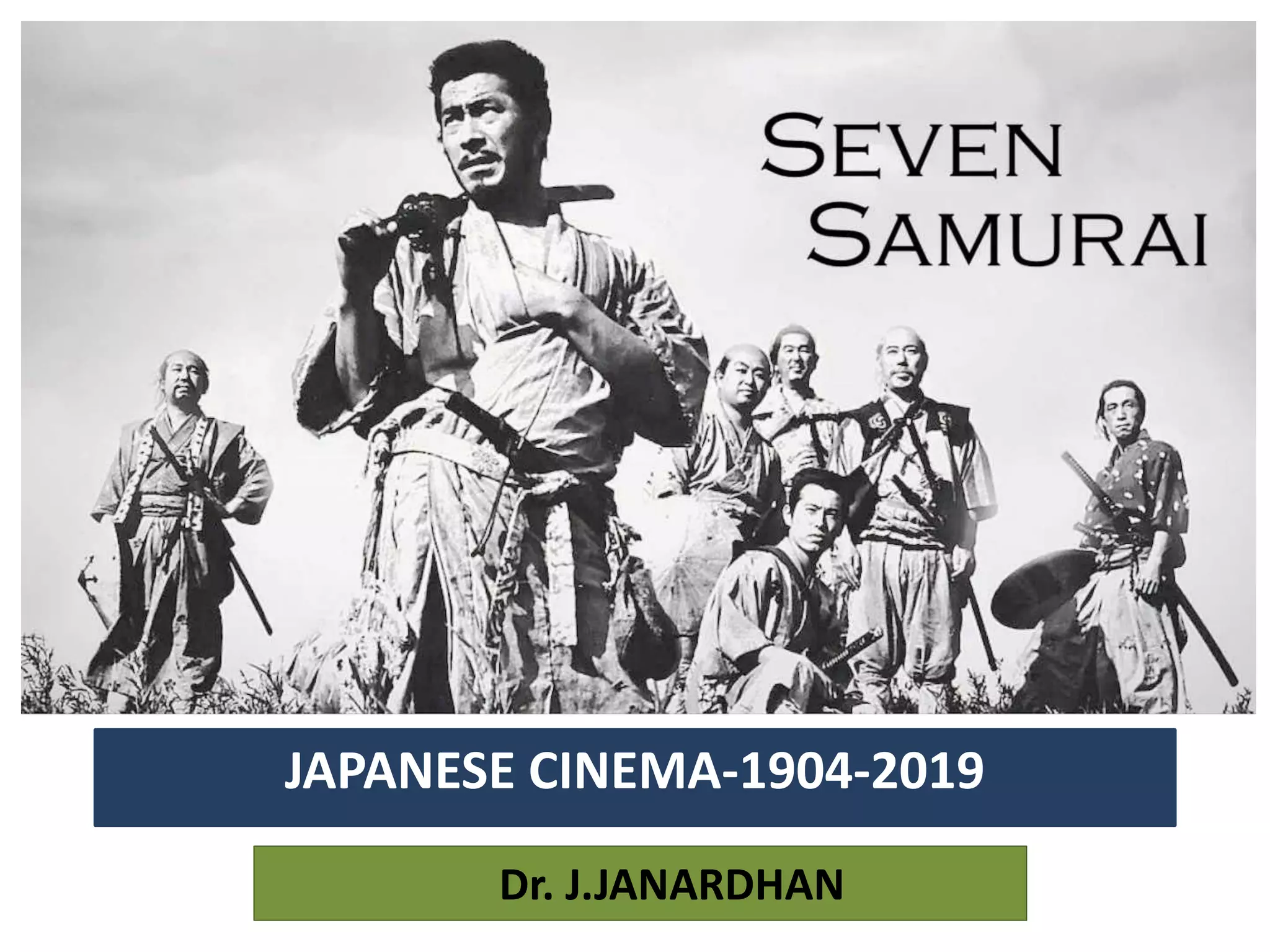
• Kurusowa’s Seven Samurai (1954)
reached US with edited version
• Kurusowa got the appreciation abroad
With Roshman & Seven Samurai
JAPANESE STYLE
• Until the 1950s, World hadn’t seen the Japanese films
• But, Japan had been seeing the world films since late 1890s
• They developed their own medium parallel to the west
• Where as Americans made action films, Europeans with the
Psychological characters
• Japanese interested in overall mood
• Their themes are Universal
JAPANESE STYLE
• Many of the Japanese film are beautiful and visually elegant
• They give more importance to visual art
• These visual qualities are especially striking in Ugestu
JAPANESE MASTERS
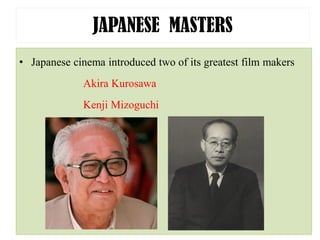
• Japanese cinema introduced two of its greatest film makers
Akira Kurosawa
Kenji Mizoguchi
JAPANESE MASTERS
• Both carried their personal concerns from film to film
• Kurosawa is the most easily appreciated by westerns
• Most of his film were adaptation of European literary classics
Dostoyevsky’s The Idiot (1951)
Gogol’s The Lower Depths (1957)
Shakespeare’s Macbeth (The throne of blood, 1957)
• Some of the Kurosawa’s production have inspired Hollywood
notably Rashomon, (The Outrage-1964) & Seven Samurai
(The Magnificent Seven-1960)
JAPANESE MASTERS
• Kurosawa’s films set in contemporary times
• He keeps audience to on the social problems
• He died in 1998,
• In his later years he produced some of the notable Jidai-Geki-
historical films
• Kagemush (The shadow warior, 1981), Ran (1985)
• Numerous virtuoso battle sequences punctuate the action of
the film
JAPANESE MASTERS
• Kenji Mizoguchi favored the jidai-geki genre
• His attitudes, subjects and style are more traditional
• He began his career in 1923 and died in 1957
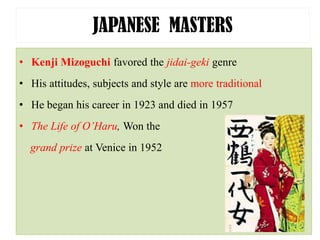
• The Life of O’Haru, Won the
grand prize at Venice in 1952
JAPANESE MASTERS
• Kenji Mizoguchi frequently focused on the plight of women
• Mizoguchi dealt with social problems
Osaka Elegy (1936)
Sisters of the Gion (1936)
Women of the Night (1957)
Street of the Shame (1956)
Princess Yang Kwei Fei (1955)
• He often presents leisurely tracking shots
JAPANESE MASTERS
• His film Ugestu is even more “painterly”
• Composition is always conceived in depth
• Music is extremely important
• Yasujiro Ozu is marked by the most rigorous austerity
• He rarely moved the camera, then slightly, slowly solely to
accommodate the action
• His camera sits eye level
• His career began in 1922, died in 1963
JAPANESE MASTERS
• All his films is an awareness of the extraordinary cultural
dislocation
• Ozu observed the changes and tensions not on broad social
scale
• But, within the intimacy of the family- parents and children,
husband and wife.
• Late spring (1949), Early Summer (1951), Late autumn
(1960), An Autumn Afternoon (1962)
JAPANESE NEW WAVE
• A group of innovative directors emerged during 1960-70s
• Japanese films developed new formulas-youth, action films
• Toho made monster movies and Sci-fiction spectacles
Godzill (Ishiro Honda, 1954)
Yakuza-gangster films
• In 1970s, Nikkatsu Studion began to specialize in soft-core
pornography
• Dir. Shohei Imamura and Nagisa Oshima produced films with
modernist bent.
JAPANESE NEW WAVE
• Oshima received his greatest international attention with In
the Realm of the Senses (1976)
• The golden era of Japanese cinema of 1950-60s came to end
by mid 1970s
• Television broadcasting began in 1954
• By 1980s, 99% of the homes had colour TV sets
• The old studio system broke down
JAPANESE NEW WAVE
• In 21st century , Japanese popular taste had changed
• A new kind of film export-Anime, started
• Japanese amines’ is flat and rough, visual design is
indisputable
• Mamoru Oshii’s Ghost in the shell got more popular
• Now, Japanese films are more popular in US
• Film Festivals being organized around the world
• New English language studios in Japan highlight the native
history
THANK YOU

Japanese cinema 2019-converted (1)

  • 1.
  • 2.
    JAPANESE CINEMA • Ithas been strong from the beginning days • The first studios were established in 1904-1905 • The development continued until Tokyo earthquake in 1923 • Talkies were slow in coming to Japan because of benshi • Kenji Mizoguchi’s Fujiwara Yoshie no Furusato (Home Town) was the first feature film in 1930s • Heinosuke Gosho’s Madamu to nyobo, 1931 (The Neighbour’s Wife and Mine)
  • 3.
    JAPANESE CINEMA • WW-IIbrought another pause • Subsequently, US dominated from 1945 to 1952 • Censorship cramped the major Japanese film makers • It notable not only for quantity and also high quality • Because of its rich tradition, Japanese films were not popular in outside the country as its counter part.
  • 4.
    JAPANESE CINEMA • Sixmajor production companies controlled distribution and the theater circuits • It also has its own popular genres mainly, Jidai-geki- historical films Gendai-geki- contemporary films • Studios, directors and actors tended to specialize in one or the other of the two modes • Jidai-geki- accounted for only 40% of production
  • 5.
    JAPANESE CINEMA • Japanesefilm got International acclaim with Akira Kurosawa’s Rashomon in 1951 • It won the grand prize at Venice Film Festival • Daiei MPC, distributed worldwide
  • 6.
    JAPANESE CINEMA • Dir.TeinosukeKinugasa made first ever new Eastmon colour Gate of Hell (1953) • Kurusowa’s Seven Samurai (1954) reached US with edited version • Kurusowa got the appreciation abroad With Roshman & Seven Samurai
  • 7.
    JAPANESE STYLE • Untilthe 1950s, World hadn’t seen the Japanese films • But, Japan had been seeing the world films since late 1890s • They developed their own medium parallel to the west • Where as Americans made action films, Europeans with the Psychological characters • Japanese interested in overall mood • Their themes are Universal
  • 8.
    JAPANESE STYLE • Manyof the Japanese film are beautiful and visually elegant • They give more importance to visual art • These visual qualities are especially striking in Ugestu
  • 9.
    JAPANESE MASTERS • Japanesecinema introduced two of its greatest film makers Akira Kurosawa Kenji Mizoguchi
  • 10.
    JAPANESE MASTERS • Bothcarried their personal concerns from film to film • Kurosawa is the most easily appreciated by westerns • Most of his film were adaptation of European literary classics Dostoyevsky’s The Idiot (1951) Gogol’s The Lower Depths (1957) Shakespeare’s Macbeth (The throne of blood, 1957) • Some of the Kurosawa’s production have inspired Hollywood notably Rashomon, (The Outrage-1964) & Seven Samurai (The Magnificent Seven-1960)
  • 11.
    JAPANESE MASTERS • Kurosawa’sfilms set in contemporary times • He keeps audience to on the social problems • He died in 1998, • In his later years he produced some of the notable Jidai-Geki- historical films • Kagemush (The shadow warior, 1981), Ran (1985) • Numerous virtuoso battle sequences punctuate the action of the film
  • 12.
    JAPANESE MASTERS • KenjiMizoguchi favored the jidai-geki genre • His attitudes, subjects and style are more traditional • He began his career in 1923 and died in 1957 • The Life of O’Haru, Won the grand prize at Venice in 1952
  • 13.
    JAPANESE MASTERS • KenjiMizoguchi frequently focused on the plight of women • Mizoguchi dealt with social problems Osaka Elegy (1936) Sisters of the Gion (1936) Women of the Night (1957) Street of the Shame (1956) Princess Yang Kwei Fei (1955) • He often presents leisurely tracking shots
  • 14.
    JAPANESE MASTERS • Hisfilm Ugestu is even more “painterly” • Composition is always conceived in depth • Music is extremely important • Yasujiro Ozu is marked by the most rigorous austerity • He rarely moved the camera, then slightly, slowly solely to accommodate the action • His camera sits eye level • His career began in 1922, died in 1963
  • 15.
    JAPANESE MASTERS • Allhis films is an awareness of the extraordinary cultural dislocation • Ozu observed the changes and tensions not on broad social scale • But, within the intimacy of the family- parents and children, husband and wife. • Late spring (1949), Early Summer (1951), Late autumn (1960), An Autumn Afternoon (1962)
  • 16.
    JAPANESE NEW WAVE •A group of innovative directors emerged during 1960-70s • Japanese films developed new formulas-youth, action films • Toho made monster movies and Sci-fiction spectacles Godzill (Ishiro Honda, 1954) Yakuza-gangster films • In 1970s, Nikkatsu Studion began to specialize in soft-core pornography • Dir. Shohei Imamura and Nagisa Oshima produced films with modernist bent.
  • 17.
    JAPANESE NEW WAVE •Oshima received his greatest international attention with In the Realm of the Senses (1976) • The golden era of Japanese cinema of 1950-60s came to end by mid 1970s • Television broadcasting began in 1954 • By 1980s, 99% of the homes had colour TV sets • The old studio system broke down
  • 18.
    JAPANESE NEW WAVE •In 21st century , Japanese popular taste had changed • A new kind of film export-Anime, started • Japanese amines’ is flat and rough, visual design is indisputable • Mamoru Oshii’s Ghost in the shell got more popular • Now, Japanese films are more popular in US • Film Festivals being organized around the world • New English language studios in Japan highlight the native history
  • 19.