Western Blotting
Presented By
Bhupendra Regmi
M sc. Med Biochemistry
2nd Year, JSSMC
Mentor
Dr. Anjali Devi
Professor, Dept. of Biochemistry
JSSMC
02-05-2019 Western Blotting 1
Contents
Introduction
Procedure
Applications
Limitations
Conclusion
References
02-05-2019 Western Blotting 2
Introduction
02-05-2019 Western Blotting 3
Blotting
Blotting is the techniques for transferring DNA , RNA and proteins
onto a carrier so they can be separated, and often follows the use of a
gel electrophoresis.
02-05-2019 Western Blotting 4
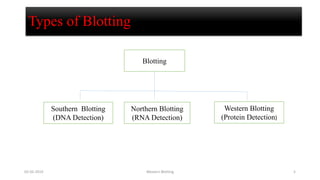
Types of Blotting
Blotting
Southern Blotting
(DNA Detection)
Northern Blotting
(RNA Detection)
Western Blotting
(Protein Detection)
02-05-2019 Western Blotting 5
Western Blotting
Principle: The method is characterized by
transferring the protein which run on a gel by
electrophoresis on to a nitro cellulose membrane.
• It is widely used analytical technique in
molecular biology to detect specific proteins in a
sample of tissue homogenate or extracts.
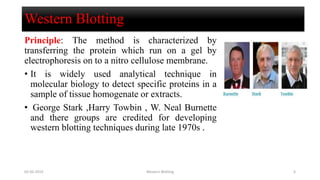
• George Stark ,Harry Towbin , W. Neal Burnette
and there groups are credited for developing
western blotting techniques during late 1970s .
02-05-2019 Western Blotting 6
Procedure
02-05-2019 Western Blotting 7
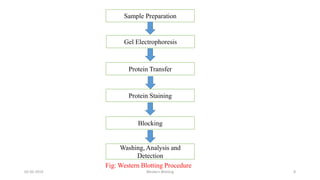
Sample Preparation
Gel Electrophoresis
Protein Transfer
Protein Staining
Blocking
Washing, Analysis and
Detection
02-05-2019 Western Blotting 8
Fig: Western Blotting Procedure
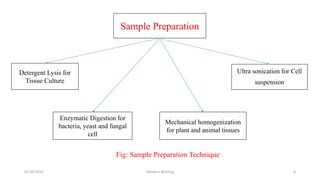
Sample Preparation
Detergent Lysis for
Tissue Culture
Enzymatic Digestion for
bacteria, yeast and fungal
cell
Ultra sonication for Cell
suspension
Mechanical homogenization
for plant and animal tissues
02-05-2019 Western Blotting 9
Fig: Sample Preparation Technique
Electrophoresis
 Native gel
 SDS page
02-05-2019 Western Blotting 10
02-05-2019 Western Blotting 11
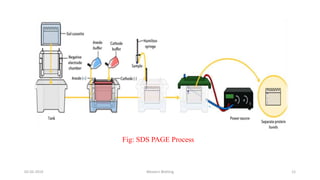
Sample loading into wells
of electrophoretic
chamber
Loading buffer into
empty wells
Place the safety lid on the
unit
Plug the color coded leads
into the jacks in power
supply
Run the gel under the
appropriate condition
When the tracking gel
reaches the bottom of the
gel, turn off the power
supply
Disconnect the leads and
remove the safety leads
and remove the safety lids
Remove the gel from the
electrophoretic apparatus
Process the protein
transfer
Fig : Page Protocol
02-05-2019 Western Blotting 12
Fig: SDS PAGE Process
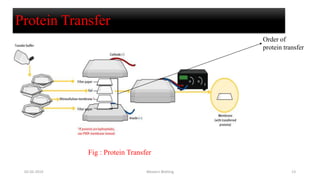
Protein Transfer
Order of
protein transfer
02-05-2019 Western Blotting 13
Fig : Protein Transfer
Protein Staining
 All the protein in the gel should be completely eluted
As protein are not directly visible in the gel, the gel must be stained
 Protein are usually stained by Ponceau S, stain-free techniques, Sypro
Ruby, Epicocconone, Coomassie R-350, Amido Black, and Cy5.
02-05-2019 Western Blotting 14
Blocking
 The meaningful result the antibodies must bind only to the protein of interest not to the
membrane.
Non specific binding (NSB) of antibodies can be reduced by blocking the unoccupied site
of membrane with an inert protein or non ionic detergent
Blocking agent should posses greater affinity towards membrane then the antibodies
Blocking Agents
 BSA
 Non Fat meal
 Casein
 Gelatin
 Dilute solution of Tween 20
 Colloidal carbon Western Blotting 15
Detection
• During the detection process the membrane is probed for the protein
interest with antibodies and links them to reporter enzyme, which
drives a colorimetric or photometric signal.
• There are two methods for detection
 Two steps detection
Primary Antibody
Secondary Antibody
One step detection
Probe Antibody
02-05-2019 Western Blotting 16
Washing
• Unbound antibodies can cause high background and poor detection
• Hence washing the blot removes unbound antibodies from the
membrane
• A dilute solution of Tween 20 in TBS or PBS buffer is commonly used
for washing
02-05-2019 Western Blotting 17
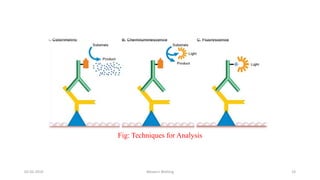
Analysis
Techniques for Analysis
Colorimetric Detection
Chemiluminescent
Radio active Detection
Fluorescent Detection
02-05-2019 Western Blotting 18
02-05-2019 Western Blotting 19
Fig: Techniques for Analysis
02-05-2019 Western Blotting 20
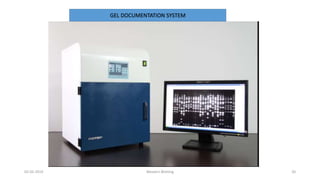
GEL DOCUMENTATION SYSTEM
Applications
• Analysis of IGg fraction purified from human plasma
• Diagnosis of HIV by ELISA, involves western blotting technique
• Western blotting technique is also used to detect some form of lyme
disease
• Confirmatory test for Hepatitis B involves western blotting technique
• Western blotting test is use in the analysis of bio markers such as
hormone, growth factors and cytokine
• This technique is also employed in gene expression technique
02-05-2019 Western Blotting 21
Limitations
• Very delicate and time consuming techniques, a minute imbalance at
any level of procedure can skew the result of entire process
• Incorrect labelling of protein can happen due to reaction of secondary
antibody
• Causes erroneous in bands or no bands due to insufficient transfer
• Well trained technicians are required for this technique
• Primary antibody availability is crucial
• It is just a semi quantitative at best, only an approx. estimation and not
a precise measurements of molecular weight of protein is possible.
02-05-2019 Western Blotting 22
Conclusion
• WB technique is simply a way to identify unknown protein on a
polyacrylamide gel
• It is sometime called as protein blotting or immune blotting
• It is widely used analytical technique in the field of molecular biology,
immunogenetics and other biochemistry disciplines
• A part from the limitation of WB it is more helpful nowadays hence a
discovery of western blotting technique has become boon in the field
of science and technology .
02-05-2019 Western Blotting 23
References
• Yang Y, Ma H. Western blotting and ELISA techniques. Researcher.
2009;1(2):67-86.
• Mahmood T, Yang PC. Western blot: technique, theory, and trouble
shooting. North American journal of medical sciences. 2012
Sep;4(9):429.
• Dressler F, Whalen JA, Reinhardt BN, Steere AC. Western blotting in
the serodiagnosis of Lyme disease. Journal of Infectious Diseases.
1993 Feb 1;167(2):392-400.
• Techniques in Biochemistry by T.Devasena and G.Rajagopal.
02-05-2019 Western Blotting 24
THANK YOU
02-05-2019 Western Blotting 25