Nure Alam Siddiky
(Bangladesh Livestock Research Institute)
Livestock in South Asia: Challenges,
Priorities and Way Forward
ILRI Workshop on transforming livelihoods in South Asia through
sustainable livestock research and development
Kathmandu, Nepal, 13-14 November 2018
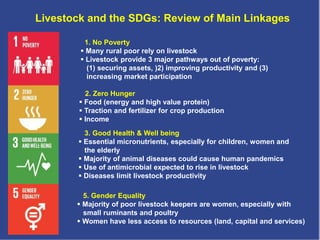
1. No Poverty
 Many rural poor rely on livestock
 Livestock provide 3 major pathways out of poverty:
(1) securing assets, )2) improving productivity and (3)
increasing market participation
2. Zero Hunger
 Food (energy and high value protein)
 Traction and fertilizer for crop production
 Income
3. Good Health & Well being
 Essential micronutrients, especially for children, women and
the elderly
 Majority of animal diseases could cause human pandemics
 Use of antimicrobial expected to rise in livestock
 Diseases limit livestock productivity
5. Gender Equality
 Majority of poor livestock keepers are women, especially with
small ruminants and poultry
 Women have less access to resources (land, capital and services)
Livestock and the SDGs: Review of Main Linkages
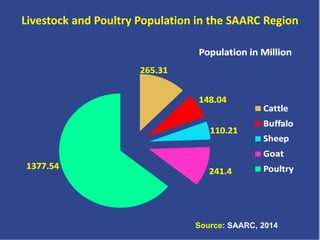
Livestock and Poultry Population in the SAARC Region
Source: SAARC, 2014
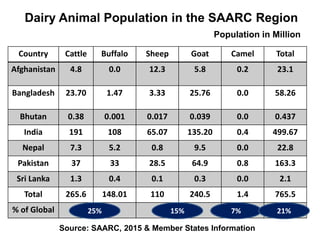
Dairy Animal Population in the SAARC Region
Population in Million
Country Cattle Buffalo Sheep Goat Camel Total
Afghanistan 4.8 0.0 12.3 5.8 0.2 23.1
Bangladesh 23.70 1.47 3.33 25.76 0.0 58.26
Bhutan 0.38 0.001 0.017 0.039 0.0 0.437
India 191 108 65.07 135.20 0.4 499.67
Nepal 7.3 5.2 0.8 9.5 0.0 22.8
Pakistan 37 33 28.5 64.9 0.8 163.3
Sri Lanka 1.3 0.4 0.1 0.3 0.0 2.1
Total 265.6 148.01 110 240.5 1.4 765.5
% of Global 25% 15% 7% 21%
Source: SAARC, 2015 & Member States Information
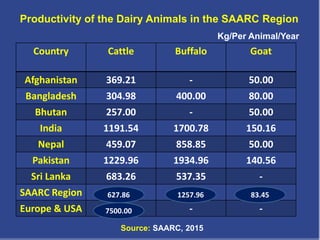
Productivity of the Dairy Animals in the SAARC Region
Kg/Per Animal/Year
Country Cattle Buffalo Goat
Afghanistan 369.21 - 50.00
Bangladesh 304.98 400.00 80.00
Bhutan 257.00 - 50.00
India 1191.54 1700.78 150.16
Nepal 459.07 858.85 50.00
Pakistan 1229.96 1934.96 140.56
Sri Lanka 683.26 537.35 -
SAARC Region
Europe & USA - -
Source: SAARC, 2015
627.86 1257.96 83.45
7500.00
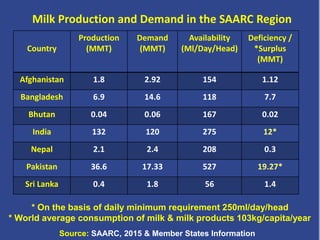
Milk Production and Demand in the SAARC Region
Country
Production
(MMT)
Demand
(MMT)
Availability
(Ml/Day/Head)
Deficiency /
*Surplus
(MMT)
Afghanistan 1.8 2.92 154 1.12
Bangladesh 6.9 14.6 118 7.7
Bhutan 0.04 0.06 167 0.02
India 132 120 275 12*
Nepal 2.1 2.4 208 0.3
Pakistan 36.6 17.33 527 19.27*
Sri Lanka 0.4 1.8 56 1.4
* On the basis of daily minimum requirement 250ml/day/head
* World average consumption of milk & milk products 103kg/capita/year
Source: SAARC, 2015 & Member States Information
p
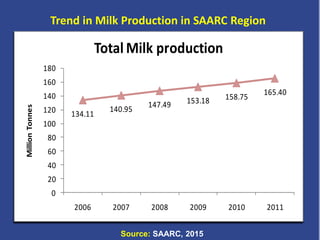
Trend in Milk Production in SAARC Region
134.11
140.95
147.49 153.18 158.75
165.40
0
20
40
60
80
100
120
140
160
180
2006 2007 2008 2009 2010 2011
MillionTonnes
Total Milk production
Source: SAARC, 2015
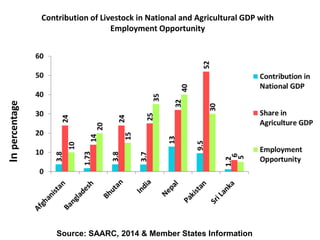
Contribution of Livestock in National and Agricultural GDP with
Employment Opportunity
Source: SAARC, 2014 & Member States Information
Inpercentage
p
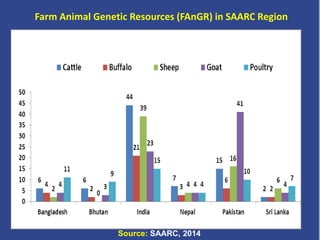
Farm Animal Genetic Resources (FAnGR) in SAARC Region
Source: SAARC, 2014
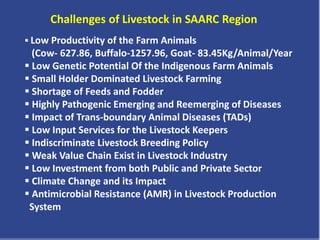
Challenges of Livestock in SAARC Region
 Low Productivity of the Farm Animals
(Cow- 627.86, Buffalo-1257.96, Goat- 83.45Kg/Animal/Year
 Low Genetic Potential Of the Indigenous Farm Animals
 Small Holder Dominated Livestock Farming
 Shortage of Feeds and Fodder
 Highly Pathogenic Emerging and Reemerging of Diseases
 Impact of Trans-boundary Animal Diseases (TADs)
 Low Input Services for the Livestock Keepers
 Indiscriminate Livestock Breeding Policy
 Weak Value Chain Exist in Livestock Industry
 Low Investment from both Public and Private Sector
 Climate Change and its Impact
 Antimicrobial Resistance (AMR) in Livestock Production
System
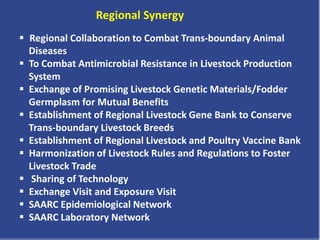
Regional Synergy
 Regional Collaboration to Combat Trans-boundary Animal
Diseases
 To Combat Antimicrobial Resistance in Livestock Production
System
 Exchange of Promising Livestock Genetic Materials/Fodder
Germplasm for Mutual Benefits
 Establishment of Regional Livestock Gene Bank to Conserve
Trans-boundary Livestock Breeds
 Establishment of Regional Livestock and Poultry Vaccine Bank
 Harmonization of Livestock Rules and Regulations to Foster
Livestock Trade
 Sharing of Technology
 Exchange Visit and Exposure Visit
 SAARC Epidemiological Network
 SAARC Laboratory Network
Forging Regional & International Partnership
for Livestock Research & Development in
South Asia

Livestock in South Asia: Challenges, priorities and way forward

  • 1.
    Nure Alam Siddiky (BangladeshLivestock Research Institute) Livestock in South Asia: Challenges, Priorities and Way Forward ILRI Workshop on transforming livelihoods in South Asia through sustainable livestock research and development Kathmandu, Nepal, 13-14 November 2018
  • 2.
    1. No Poverty Many rural poor rely on livestock  Livestock provide 3 major pathways out of poverty: (1) securing assets, )2) improving productivity and (3) increasing market participation 2. Zero Hunger  Food (energy and high value protein)  Traction and fertilizer for crop production  Income 3. Good Health & Well being  Essential micronutrients, especially for children, women and the elderly  Majority of animal diseases could cause human pandemics  Use of antimicrobial expected to rise in livestock  Diseases limit livestock productivity 5. Gender Equality  Majority of poor livestock keepers are women, especially with small ruminants and poultry  Women have less access to resources (land, capital and services) Livestock and the SDGs: Review of Main Linkages
  • 3.
    Livestock and PoultryPopulation in the SAARC Region Source: SAARC, 2014
  • 4.
    Dairy Animal Populationin the SAARC Region Population in Million Country Cattle Buffalo Sheep Goat Camel Total Afghanistan 4.8 0.0 12.3 5.8 0.2 23.1 Bangladesh 23.70 1.47 3.33 25.76 0.0 58.26 Bhutan 0.38 0.001 0.017 0.039 0.0 0.437 India 191 108 65.07 135.20 0.4 499.67 Nepal 7.3 5.2 0.8 9.5 0.0 22.8 Pakistan 37 33 28.5 64.9 0.8 163.3 Sri Lanka 1.3 0.4 0.1 0.3 0.0 2.1 Total 265.6 148.01 110 240.5 1.4 765.5 % of Global 25% 15% 7% 21% Source: SAARC, 2015 & Member States Information
  • 5.
    Productivity of theDairy Animals in the SAARC Region Kg/Per Animal/Year Country Cattle Buffalo Goat Afghanistan 369.21 - 50.00 Bangladesh 304.98 400.00 80.00 Bhutan 257.00 - 50.00 India 1191.54 1700.78 150.16 Nepal 459.07 858.85 50.00 Pakistan 1229.96 1934.96 140.56 Sri Lanka 683.26 537.35 - SAARC Region Europe & USA - - Source: SAARC, 2015 627.86 1257.96 83.45 7500.00
  • 6.
    Milk Production andDemand in the SAARC Region Country Production (MMT) Demand (MMT) Availability (Ml/Day/Head) Deficiency / *Surplus (MMT) Afghanistan 1.8 2.92 154 1.12 Bangladesh 6.9 14.6 118 7.7 Bhutan 0.04 0.06 167 0.02 India 132 120 275 12* Nepal 2.1 2.4 208 0.3 Pakistan 36.6 17.33 527 19.27* Sri Lanka 0.4 1.8 56 1.4 * On the basis of daily minimum requirement 250ml/day/head * World average consumption of milk & milk products 103kg/capita/year Source: SAARC, 2015 & Member States Information
  • 7.
    p Trend in MilkProduction in SAARC Region 134.11 140.95 147.49 153.18 158.75 165.40 0 20 40 60 80 100 120 140 160 180 2006 2007 2008 2009 2010 2011 MillionTonnes Total Milk production Source: SAARC, 2015
  • 8.
    Contribution of Livestockin National and Agricultural GDP with Employment Opportunity Source: SAARC, 2014 & Member States Information Inpercentage
  • 9.
    p Farm Animal GeneticResources (FAnGR) in SAARC Region Source: SAARC, 2014
  • 10.
    Challenges of Livestockin SAARC Region  Low Productivity of the Farm Animals (Cow- 627.86, Buffalo-1257.96, Goat- 83.45Kg/Animal/Year  Low Genetic Potential Of the Indigenous Farm Animals  Small Holder Dominated Livestock Farming  Shortage of Feeds and Fodder  Highly Pathogenic Emerging and Reemerging of Diseases  Impact of Trans-boundary Animal Diseases (TADs)  Low Input Services for the Livestock Keepers  Indiscriminate Livestock Breeding Policy  Weak Value Chain Exist in Livestock Industry  Low Investment from both Public and Private Sector  Climate Change and its Impact  Antimicrobial Resistance (AMR) in Livestock Production System
  • 11.
    Regional Synergy  RegionalCollaboration to Combat Trans-boundary Animal Diseases  To Combat Antimicrobial Resistance in Livestock Production System  Exchange of Promising Livestock Genetic Materials/Fodder Germplasm for Mutual Benefits  Establishment of Regional Livestock Gene Bank to Conserve Trans-boundary Livestock Breeds  Establishment of Regional Livestock and Poultry Vaccine Bank  Harmonization of Livestock Rules and Regulations to Foster Livestock Trade  Sharing of Technology  Exchange Visit and Exposure Visit  SAARC Epidemiological Network  SAARC Laboratory Network
  • 12.
    Forging Regional &International Partnership for Livestock Research & Development in South Asia