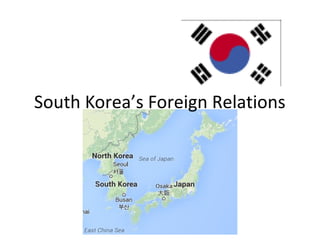
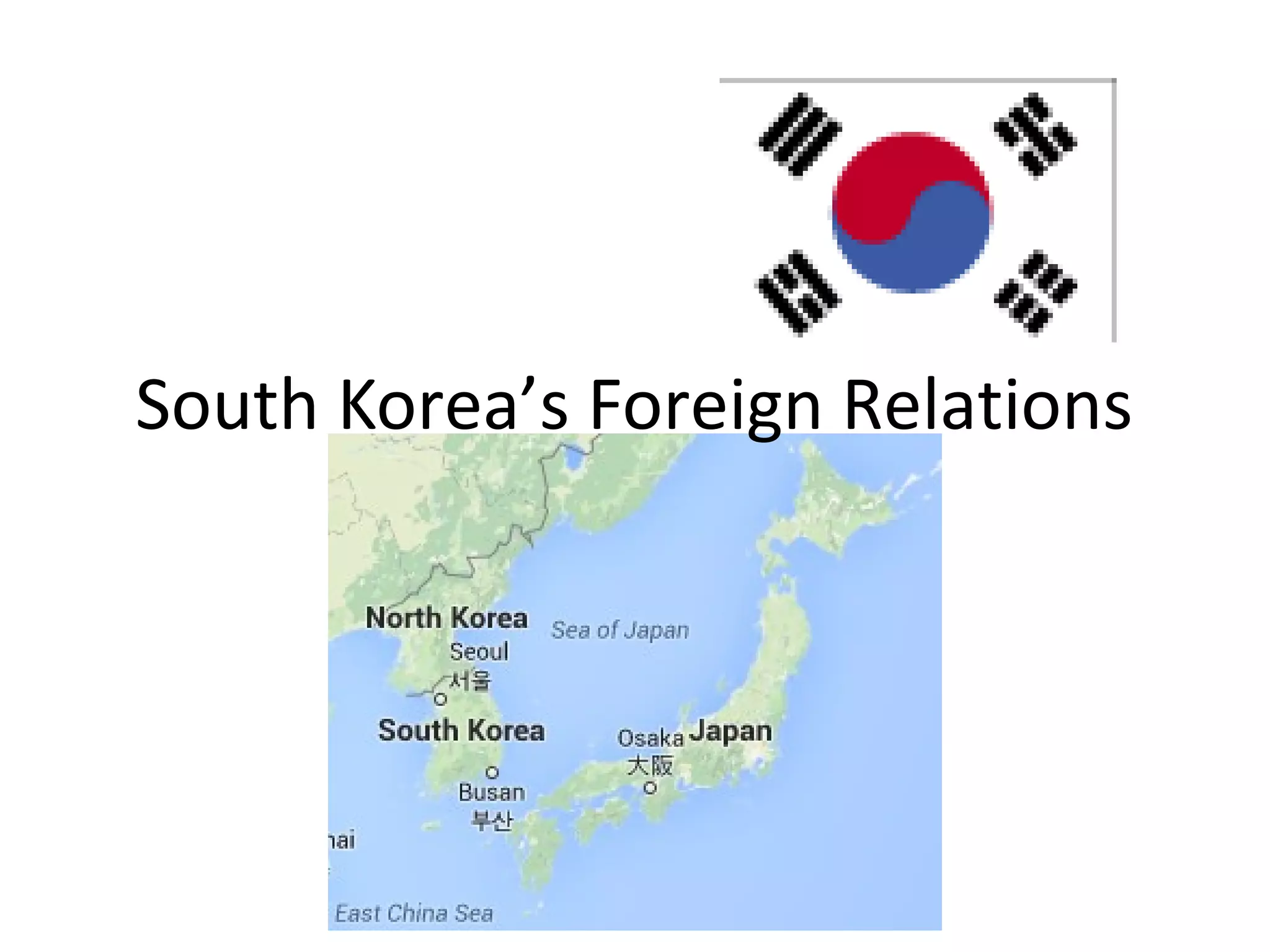
South Korea’s Foreign Relations
South Korea’s Strategic Posture
• Political and security alliance with U.S. since
the end of the Korean War in 1953
• The major issue is overwhelmingly North
Korea
– The “Sunshine Policy” of active engagement under
President Kim Dae-Jung (1998-2003)
– Higher tensions under President Lee Myung-Bak
(2008-2013)
U.S.-Korea Free Trade Agreement
• The “biggest trade deal since NAFTA” was
passed by U.S. Congress in 2011.
• During the negotiation process, both
administrations faced opposition from strong
domestic agricultural lobbies.
– Korean rice farmers
– U.S. cattle farmers
• U.S. automobile industry
Korea-Japan Relations
• Historical legacies date back two millennia
• Cultural proximity
– Language family
– Written characters
– Confucianism
– Buddhism
– ...
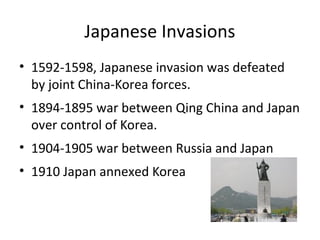
Japanese Invasions
• 1592-1598, Japanese invasion was defeated
by joint China-Korea forces.
• 1894-1895 war between Qing China and Japan
over control of Korea.
• 1904-1905 war between Russia and Japan
• 1910 Japan annexed Korea
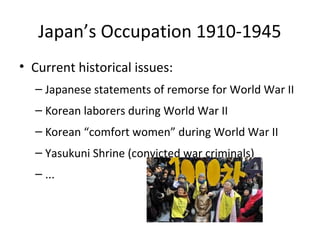
Japan’s Occupation 1910-1945
• Current historical issues:
– Japanese statements of remorse for World War II
– Korean laborers during World War II
– Korean “comfort women” during World War II
– Yasukuni Shrine (convicted war criminals)
– ...
Wartime Atrocities in the Relations
• Kono Statement of 1993
– The statement, named after then Chief Cabinet
Secretary Yohei Kono, contained a landmark
apology to the sex slaves known euphemistically in
Japan as “comfort women.”
• Murayama Statement of 1995
– Then socialist Prime Minister Tomiichi Murayama
(1994-1996) apologized for wartime suffering
inflicted by Japan on its Asian neighbors.
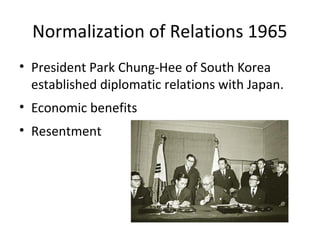
Normalization of Relations 1965
• President Park Chung-Hee of South Korea
established diplomatic relations with Japan.
• Economic benefits
• Resentment
Territorial Dispute
• Dokdo (in Korean) / Takeshima (in Japanese)
• South Korean government position:
– “Dokdo ... is an integral part of Korean territory
historically, geographically, and under international
law.”
• Japanese government position:
– “Takeshima is clearly an inherent territory of Japan, in
the light of historical facts and based upon
international law.”
Trading Partners
• South Korea is Japan’s
– 3rd largest export market (8%)
– 6th largest source of imports (5%)
• As South Korea’s export destination, Japan
dropped from 3rd place (7%) to 5th (4.9%)
• As South Korea’s 2nd largest import source,
Japan’s share dropped from 12% to 10.5% in
2015.
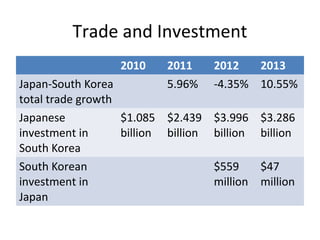
Trade and Investment
2010 2011 2012 2013
Japan-South Korea
total trade growth
5.96% -4.35% 10.55%
Japanese
investment in
South Korea
$1.085
billion
$2.439
billion
$3.996
billion
$3.286
billion
South Korean
investment in
Japan
$559
million
$47
million
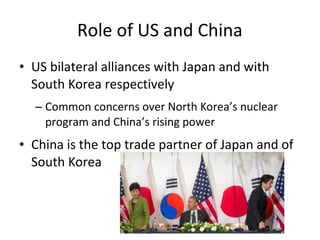
Role of US and China
• US bilateral alliances with Japan and with
South Korea respectively
– Common concerns over North Korea’s nuclear
program and China’s rising power
• China is the top trade partner of Japan and of
South Korea
South Korea’s Ties with China
• Growing economic relationship with China
• China passed the U.S. in 2003 to become
South Korea’s largest trading partner
• In 2015, 26% of South Korea’s exports went to
China, nearly double the share for the U.S.
• In 2015, 21% of South Korea’s imports came
from China, more than the shares of Japan and
U.S. combined.
South Korea’s New Role in Asia
• Playing a “balancing” or mediating role in regional
disputes
– territorial disputes between China and Japan
– nuclear standoff between North Korea and U.S.
• Building Seoul into a logistics and business hub for
the region
• However, actual ability seems limited
Thank you!
Marcelo Gomes Freire Partner

South Korea’s Foreign Relations

  • 1.
  • 2.
    South Korea’s StrategicPosture • Political and security alliance with U.S. since the end of the Korean War in 1953 • The major issue is overwhelmingly North Korea – The “Sunshine Policy” of active engagement under President Kim Dae-Jung (1998-2003) – Higher tensions under President Lee Myung-Bak (2008-2013)
  • 3.
    U.S.-Korea Free TradeAgreement • The “biggest trade deal since NAFTA” was passed by U.S. Congress in 2011. • During the negotiation process, both administrations faced opposition from strong domestic agricultural lobbies. – Korean rice farmers – U.S. cattle farmers • U.S. automobile industry
  • 4.
    Korea-Japan Relations • Historicallegacies date back two millennia • Cultural proximity – Language family – Written characters – Confucianism – Buddhism – ...
  • 5.
    Japanese Invasions • 1592-1598,Japanese invasion was defeated by joint China-Korea forces. • 1894-1895 war between Qing China and Japan over control of Korea. • 1904-1905 war between Russia and Japan • 1910 Japan annexed Korea
  • 6.
    Japan’s Occupation 1910-1945 •Current historical issues: – Japanese statements of remorse for World War II – Korean laborers during World War II – Korean “comfort women” during World War II – Yasukuni Shrine (convicted war criminals) – ...
  • 7.
    Wartime Atrocities inthe Relations • Kono Statement of 1993 – The statement, named after then Chief Cabinet Secretary Yohei Kono, contained a landmark apology to the sex slaves known euphemistically in Japan as “comfort women.” • Murayama Statement of 1995 – Then socialist Prime Minister Tomiichi Murayama (1994-1996) apologized for wartime suffering inflicted by Japan on its Asian neighbors.
  • 8.
    Normalization of Relations1965 • President Park Chung-Hee of South Korea established diplomatic relations with Japan. • Economic benefits • Resentment
  • 9.
    Territorial Dispute • Dokdo(in Korean) / Takeshima (in Japanese) • South Korean government position: – “Dokdo ... is an integral part of Korean territory historically, geographically, and under international law.” • Japanese government position: – “Takeshima is clearly an inherent territory of Japan, in the light of historical facts and based upon international law.”
  • 10.
    Trading Partners • SouthKorea is Japan’s – 3rd largest export market (8%) – 6th largest source of imports (5%) • As South Korea’s export destination, Japan dropped from 3rd place (7%) to 5th (4.9%) • As South Korea’s 2nd largest import source, Japan’s share dropped from 12% to 10.5% in 2015.
  • 11.
    Trade and Investment 20102011 2012 2013 Japan-South Korea total trade growth 5.96% -4.35% 10.55% Japanese investment in South Korea $1.085 billion $2.439 billion $3.996 billion $3.286 billion South Korean investment in Japan $559 million $47 million
  • 12.
    Role of USand China • US bilateral alliances with Japan and with South Korea respectively – Common concerns over North Korea’s nuclear program and China’s rising power • China is the top trade partner of Japan and of South Korea
  • 13.
    South Korea’s Tieswith China • Growing economic relationship with China • China passed the U.S. in 2003 to become South Korea’s largest trading partner • In 2015, 26% of South Korea’s exports went to China, nearly double the share for the U.S. • In 2015, 21% of South Korea’s imports came from China, more than the shares of Japan and U.S. combined.
  • 14.
    South Korea’s NewRole in Asia • Playing a “balancing” or mediating role in regional disputes – territorial disputes between China and Japan – nuclear standoff between North Korea and U.S. • Building Seoul into a logistics and business hub for the region • However, actual ability seems limited Thank you! Marcelo Gomes Freire Partner