SUMAIRA FATIMA
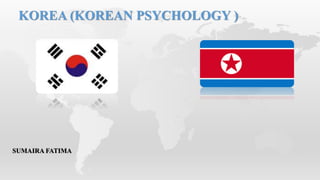
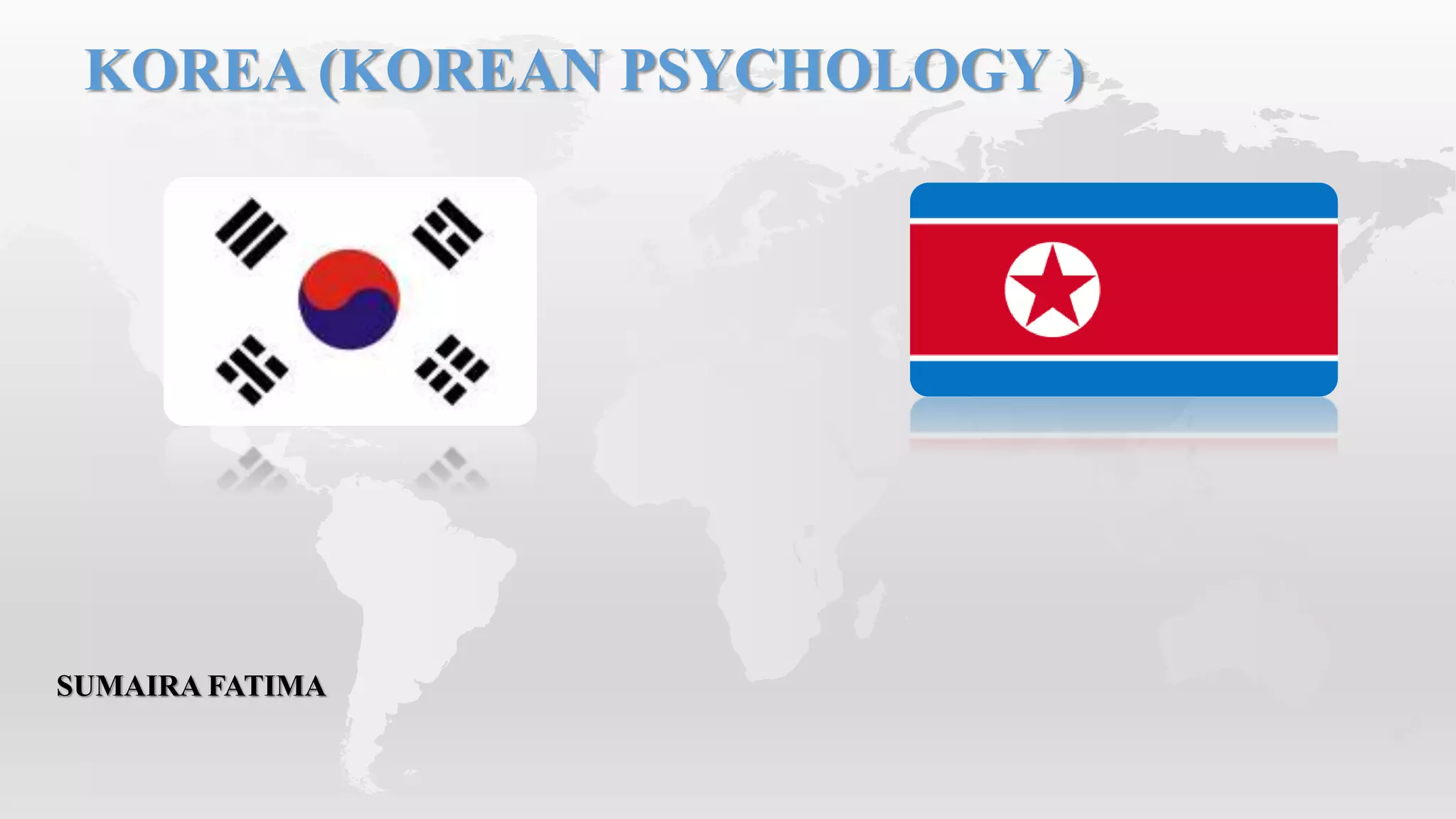
KOREA (KOREAN PSYCHOLOGY )
 "The Land of the Morning Calm" for Korea, which parallels the
expression "The Land of the Rising Sun" for Japan.
 The Korean Peninsula first divided along the 38th parallel, later
along the demarcation line. The division of Korea between North
and South Korea was the result of the Allied victory in World War
II in 1945, ending the Empire of Japan's 35-year rule of Korea.
 With the onset of the Cold War, negotiations between the United
States and the Soviet Union failed to lead to an independent,
unified Korea.
 In 1948, UN-supervised elections were held in the US-occupied
south only. This led to the establishment of the Republic of Korea
in South Korea, which was promptly followed by the
establishment of the Democratic People's Republic of Korea in
North Korea.
 The Korean War (1950–53) left the two Koreas separated by the
Korean Demilitarized Zone in the later part of the Cold War and
beyond.
KOREA
 "Korean War"; in North Korean , "Fatherland Liberation War"; 25 June 1950 – 27
July 1953 began when North Korea invaded South Korea. The United Nations,
with the United States as the principal force, came to the aid of South Korea.
China, with assistance from the Soviet Union, came to the aid of North Korea.
 This division of Korea, after more than a millennium of being unified, was seen
as controversial and temporary by both regimes. From 1948 until the start of the
civil war on June 25, 1950, the armed forces of each side engaged in a series of
bloody conflicts along the border.
 Korea was ruled by Japan from 1910 until the closing days of World War II. In
August 1945, the Soviet Union declared war on Japan, as a result of an agreement
with the United States, and liberated Korea north of the 38th parallel.
 By 1948, as a product of the Cold War between the Soviet Union and the United
States, Korea was split into two regions, with separate governments. Both
governments claimed to be the legitimate government of Korea, and neither side
accepted the border as permanent.
 The civil war escalated into open warfare when North Korean forces—supported
by the Soviet Union and China—moved to the south to unite the country on 25
June 1950.
THE KOREAN WAR (1950–53)
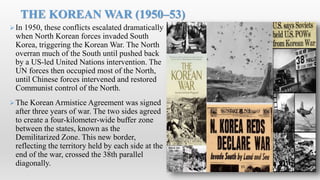
In 1950, these conflicts escalated dramatically
when North Korean forces invaded South
Korea, triggering the Korean War. The North
overran much of the South until pushed back
by a US-led United Nations intervention. The
UN forces then occupied most of the North,
until Chinese forces intervened and restored
Communist control of the North.
The Korean Armistice Agreement was signed
after three years of war. The two sides agreed
to create a four-kilometer-wide buffer zone
between the states, known as the
Demilitarized Zone. This new border,
reflecting the territory held by each side at the
end of the war, crossed the 38th parallel
diagonally.
THE KOREAN WAR (1950–53)
 South Korea , officially the Republic of Korea , is a sovereign state in East Asia,
constituting the southern part of the Korean Peninsula. There are various names
of Korea in use today, derived from ancient kingdoms and dynasties.
 Capital and largest city is Seoul.
 South Korea has seventh most powerful military in the world
 The modern English name Korea is an exonym derived from the Goryeo period
and is used by both North Korea and South Korea in international contexts.
Hanguk (한국) in South Korea.
 Highly urbanized at 92%,South Koreans lead a distinctive urban lifestyle; half
of them live in high-rises concentrated in the Seoul Capital Area with 25 million
residents and the world's sixth leading global city with the fourth largest
economy and seventh most sustainable city in the world.
 Conscription, also known as mandatory military service or compulsory
national service, is legislated in South Korea, with military service stated in
Chapter II Article 39 of the Constitution of the Republic of Korea for all
citizens. The current Conscription Law, enacted in 1965, however, applies only
to males, aged between 18 and 35,although women are allowed to enroll in the
Reserve Officers' Training Corps as of 2010.
SOUTH KOREA
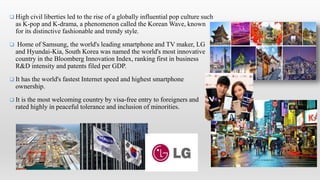
 High civil liberties led to the rise of a globally influential pop culture such
as K-pop and K-drama, a phenomenon called the Korean Wave, known
for its distinctive fashionable and trendy style.
 Home of Samsung, the world's leading smartphone and TV maker, LG
and Hyundai-Kia, South Korea was named the world's most innovative
country in the Bloomberg Innovation Index, ranking first in business
R&D intensity and patents filed per GDP.
 It has the world's fastest Internet speed and highest smartphone
ownership.
 It is the most welcoming country by visa-free entry to foreigners and
rated highly in peaceful tolerance and inclusion of minorities.
 After three year Korean war ,the South Korean return back to their
normal routine life's but the hatred towards north Korean increased.
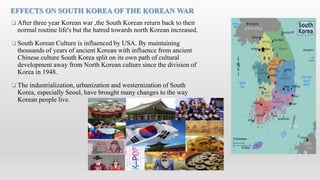
 South Korean Culture is influenced by USA. By maintaining
thousands of years of ancient Korean with influence from ancient
Chinese culture South Korea split on its own path of cultural
development away from North Korean culture since the division of
Korea in 1948.
 The industrialization, urbanization and westernization of South
Korea, especially Seoul, have brought many changes to the way
Korean people live.
EFFECTS ON SOUTH KOREA OF THE KOREAN WAR
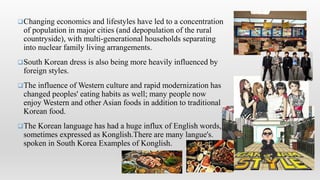
Changing economics and lifestyles have led to a concentration
of population in major cities (and depopulation of the rural
countryside), with multi-generational households separating
into nuclear family living arrangements.
South Korean dress is also being more heavily influenced by
foreign styles.
The influence of Western culture and rapid modernization has
changed peoples' eating habits as well; many people now
enjoy Western and other Asian foods in addition to traditional
Korean food.
The Korean language has had a huge influx of English words,
sometimes expressed as Konglish.There are many langue's.
spoken in South Korea Examples of Konglish.
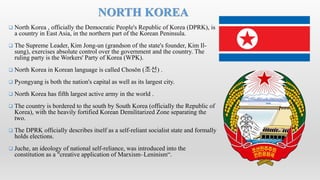
 North Korea , officially the Democratic People's Republic of Korea (DPRK), is
a country in East Asia, in the northern part of the Korean Peninsula.
 The Supreme Leader, Kim Jong-un (grandson of the state's founder, Kim Il-
sung), exercises absolute control over the government and the country. The
ruling party is the Workers' Party of Korea (WPK).
 North Korea in Korean language is called Chosŏn (조선) .
 Pyongyang is both the nation's capital as well as its largest city.
 North Korea has fifth largest active army in the world .
 The country is bordered to the south by South Korea (officially the Republic of
Korea), with the heavily fortified Korean Demilitarized Zone separating the
two.
 The DPRK officially describes itself as a self-reliant socialist state and formally
holds elections.
 Juche, an ideology of national self-reliance, was introduced into the
constitution as a "creative application of Marxism–Leninism“.
NORTH KOREA
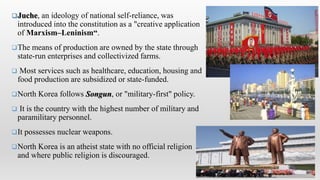
Juche, an ideology of national self-reliance, was
introduced into the constitution as a "creative application
of Marxism–Leninism“.
The means of production are owned by the state through
state-run enterprises and collectivized farms.
 Most services such as healthcare, education, housing and
food production are subsidized or state-funded.
North Korea follows Songun, or "military-first" policy.
 It is the country with the highest number of military and
paramilitary personnel.
It possesses nuclear weapons.
North Korea is an atheist state with no official religion
and where public religion is discouraged.
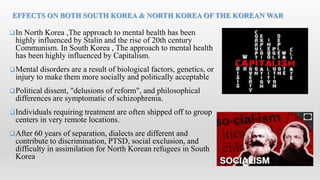
In North Korea ,The approach to mental health has been
highly influenced by Stalin and the rise of 20th century
Communism. In South Korea , The approach to mental health
has been highly influenced by Capitalism.
Mental disorders are a result of biological factors, genetics, or
injury to make them more socially and politically acceptable
Political dissent, "delusions of reform", and philosophical
differences are symptomatic of schizophrenia.
Individuals requiring treatment are often shipped off to group
centers in very remote locations.
After 60 years of separation, dialects are different and
contribute to discrimination, PTSD, social exclusion, and
difficulty in assimilation for North Korean refugees in South
Korea
EFFECTS ON BOTH SOUTH KOREA & NORTH KOREA OF THE KOREAN WAR
1) The struggle for survival followed by assimilation into a new
society.
2) Unexpected stress including feelings of shock and chaos.
3) Reconsidering the reasons for relocating.
4) Trauma recovery.
5) Rebuilding of [one's] meaning.
6) Post-traumatic growth (e.g., employment of coping strategies;
16).
POST-TRAUMATIC STRESS DISORDER (PTSD)
Mood and Anxiety Disorders: In addition to trauma- and stressor-related disorders, have also been
reported to experience major depression and anxiety disorders. Exhibit clinically significant depressive
symptoms and that these symptoms are linked to feelings of loneliness, social exclusion, guilt related to
loved ones left behind, and acclimation into a competitive. Further, reported that increased depressive
symptoms was associated with poorer assimilation into a new culture as well as an increased perception
of discrimination upon relocation.
The Problems of Korean Societal Integration: Despite sharing a common ancestry and racial
identity, North Korean and South Korean citizens differ substantially at the sociocultural level and these
differences have spurred a sense of contempt and discriminatory behaviors .
Stressed and Depressed, Koreans Avoid Therapy: It can sometimes feel as if South Korea,
overworked, overstressed and ever anxious, is on the verge of a national nervous breakdown, with a
rising divorce rate, students who feel suffocated by academic pressures, a suicide rate among the highest
in the world and a macho corporate culture that still encourages blackout drinking sessions after work.
 Suicides Rates: More than 30 South Koreans kill themselves every day, and the suicides of
entertainers, politicians, athletes and business leaders have become almost commonplace. The recent
suicides of four students and a professor at Korea’s leading university shocked the nation, and in recent
weeks a TV baseball announcer, two professional soccer players, a university president and the former
lead singer in a popular boy band killed themselves.
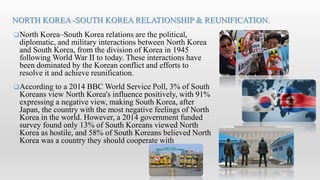
North Korea–South Korea relations are the political,
diplomatic, and military interactions between North Korea
and South Korea, from the division of Korea in 1945
following World War II to today. These interactions have
been dominated by the Korean conflict and efforts to
resolve it and achieve reunification.
According to a 2014 BBC World Service Poll, 3% of South
Koreans view North Korea's influence positively, with 91%
expressing a negative view, making South Korea, after
Japan, the country with the most negative feelings of North
Korea in the world. However, a 2014 government funded
survey found only 13% of South Koreans viewed North
Korea as hostile, and 58% of South Koreans believed North
Korea was a country they should cooperate with
NORTH KOREA–SOUTH KOREA RELATIONSHIP & REUNIFICATION.
THE END

Korea (korean psychology ) final

  • 1.
  • 2.
     "The Landof the Morning Calm" for Korea, which parallels the expression "The Land of the Rising Sun" for Japan.  The Korean Peninsula first divided along the 38th parallel, later along the demarcation line. The division of Korea between North and South Korea was the result of the Allied victory in World War II in 1945, ending the Empire of Japan's 35-year rule of Korea.  With the onset of the Cold War, negotiations between the United States and the Soviet Union failed to lead to an independent, unified Korea.  In 1948, UN-supervised elections were held in the US-occupied south only. This led to the establishment of the Republic of Korea in South Korea, which was promptly followed by the establishment of the Democratic People's Republic of Korea in North Korea.  The Korean War (1950–53) left the two Koreas separated by the Korean Demilitarized Zone in the later part of the Cold War and beyond. KOREA
  • 3.
     "Korean War";in North Korean , "Fatherland Liberation War"; 25 June 1950 – 27 July 1953 began when North Korea invaded South Korea. The United Nations, with the United States as the principal force, came to the aid of South Korea. China, with assistance from the Soviet Union, came to the aid of North Korea.  This division of Korea, after more than a millennium of being unified, was seen as controversial and temporary by both regimes. From 1948 until the start of the civil war on June 25, 1950, the armed forces of each side engaged in a series of bloody conflicts along the border.  Korea was ruled by Japan from 1910 until the closing days of World War II. In August 1945, the Soviet Union declared war on Japan, as a result of an agreement with the United States, and liberated Korea north of the 38th parallel.  By 1948, as a product of the Cold War between the Soviet Union and the United States, Korea was split into two regions, with separate governments. Both governments claimed to be the legitimate government of Korea, and neither side accepted the border as permanent.  The civil war escalated into open warfare when North Korean forces—supported by the Soviet Union and China—moved to the south to unite the country on 25 June 1950. THE KOREAN WAR (1950–53)
  • 4.
    In 1950, theseconflicts escalated dramatically when North Korean forces invaded South Korea, triggering the Korean War. The North overran much of the South until pushed back by a US-led United Nations intervention. The UN forces then occupied most of the North, until Chinese forces intervened and restored Communist control of the North. The Korean Armistice Agreement was signed after three years of war. The two sides agreed to create a four-kilometer-wide buffer zone between the states, known as the Demilitarized Zone. This new border, reflecting the territory held by each side at the end of the war, crossed the 38th parallel diagonally. THE KOREAN WAR (1950–53)
  • 5.
     South Korea, officially the Republic of Korea , is a sovereign state in East Asia, constituting the southern part of the Korean Peninsula. There are various names of Korea in use today, derived from ancient kingdoms and dynasties.  Capital and largest city is Seoul.  South Korea has seventh most powerful military in the world  The modern English name Korea is an exonym derived from the Goryeo period and is used by both North Korea and South Korea in international contexts. Hanguk (한국) in South Korea.  Highly urbanized at 92%,South Koreans lead a distinctive urban lifestyle; half of them live in high-rises concentrated in the Seoul Capital Area with 25 million residents and the world's sixth leading global city with the fourth largest economy and seventh most sustainable city in the world.  Conscription, also known as mandatory military service or compulsory national service, is legislated in South Korea, with military service stated in Chapter II Article 39 of the Constitution of the Republic of Korea for all citizens. The current Conscription Law, enacted in 1965, however, applies only to males, aged between 18 and 35,although women are allowed to enroll in the Reserve Officers' Training Corps as of 2010. SOUTH KOREA
  • 6.
     High civilliberties led to the rise of a globally influential pop culture such as K-pop and K-drama, a phenomenon called the Korean Wave, known for its distinctive fashionable and trendy style.  Home of Samsung, the world's leading smartphone and TV maker, LG and Hyundai-Kia, South Korea was named the world's most innovative country in the Bloomberg Innovation Index, ranking first in business R&D intensity and patents filed per GDP.  It has the world's fastest Internet speed and highest smartphone ownership.  It is the most welcoming country by visa-free entry to foreigners and rated highly in peaceful tolerance and inclusion of minorities.
  • 7.
     After threeyear Korean war ,the South Korean return back to their normal routine life's but the hatred towards north Korean increased.  South Korean Culture is influenced by USA. By maintaining thousands of years of ancient Korean with influence from ancient Chinese culture South Korea split on its own path of cultural development away from North Korean culture since the division of Korea in 1948.  The industrialization, urbanization and westernization of South Korea, especially Seoul, have brought many changes to the way Korean people live. EFFECTS ON SOUTH KOREA OF THE KOREAN WAR
  • 8.
    Changing economics andlifestyles have led to a concentration of population in major cities (and depopulation of the rural countryside), with multi-generational households separating into nuclear family living arrangements. South Korean dress is also being more heavily influenced by foreign styles. The influence of Western culture and rapid modernization has changed peoples' eating habits as well; many people now enjoy Western and other Asian foods in addition to traditional Korean food. The Korean language has had a huge influx of English words, sometimes expressed as Konglish.There are many langue's. spoken in South Korea Examples of Konglish.
  • 9.
     North Korea, officially the Democratic People's Republic of Korea (DPRK), is a country in East Asia, in the northern part of the Korean Peninsula.  The Supreme Leader, Kim Jong-un (grandson of the state's founder, Kim Il- sung), exercises absolute control over the government and the country. The ruling party is the Workers' Party of Korea (WPK).  North Korea in Korean language is called Chosŏn (조선) .  Pyongyang is both the nation's capital as well as its largest city.  North Korea has fifth largest active army in the world .  The country is bordered to the south by South Korea (officially the Republic of Korea), with the heavily fortified Korean Demilitarized Zone separating the two.  The DPRK officially describes itself as a self-reliant socialist state and formally holds elections.  Juche, an ideology of national self-reliance, was introduced into the constitution as a "creative application of Marxism–Leninism“. NORTH KOREA
  • 10.
    Juche, an ideologyof national self-reliance, was introduced into the constitution as a "creative application of Marxism–Leninism“. The means of production are owned by the state through state-run enterprises and collectivized farms.  Most services such as healthcare, education, housing and food production are subsidized or state-funded. North Korea follows Songun, or "military-first" policy.  It is the country with the highest number of military and paramilitary personnel. It possesses nuclear weapons. North Korea is an atheist state with no official religion and where public religion is discouraged.
  • 11.
    In North Korea,The approach to mental health has been highly influenced by Stalin and the rise of 20th century Communism. In South Korea , The approach to mental health has been highly influenced by Capitalism. Mental disorders are a result of biological factors, genetics, or injury to make them more socially and politically acceptable Political dissent, "delusions of reform", and philosophical differences are symptomatic of schizophrenia. Individuals requiring treatment are often shipped off to group centers in very remote locations. After 60 years of separation, dialects are different and contribute to discrimination, PTSD, social exclusion, and difficulty in assimilation for North Korean refugees in South Korea EFFECTS ON BOTH SOUTH KOREA & NORTH KOREA OF THE KOREAN WAR
  • 12.
    1) The strugglefor survival followed by assimilation into a new society. 2) Unexpected stress including feelings of shock and chaos. 3) Reconsidering the reasons for relocating. 4) Trauma recovery. 5) Rebuilding of [one's] meaning. 6) Post-traumatic growth (e.g., employment of coping strategies; 16). POST-TRAUMATIC STRESS DISORDER (PTSD)
  • 13.
    Mood and AnxietyDisorders: In addition to trauma- and stressor-related disorders, have also been reported to experience major depression and anxiety disorders. Exhibit clinically significant depressive symptoms and that these symptoms are linked to feelings of loneliness, social exclusion, guilt related to loved ones left behind, and acclimation into a competitive. Further, reported that increased depressive symptoms was associated with poorer assimilation into a new culture as well as an increased perception of discrimination upon relocation. The Problems of Korean Societal Integration: Despite sharing a common ancestry and racial identity, North Korean and South Korean citizens differ substantially at the sociocultural level and these differences have spurred a sense of contempt and discriminatory behaviors . Stressed and Depressed, Koreans Avoid Therapy: It can sometimes feel as if South Korea, overworked, overstressed and ever anxious, is on the verge of a national nervous breakdown, with a rising divorce rate, students who feel suffocated by academic pressures, a suicide rate among the highest in the world and a macho corporate culture that still encourages blackout drinking sessions after work.  Suicides Rates: More than 30 South Koreans kill themselves every day, and the suicides of entertainers, politicians, athletes and business leaders have become almost commonplace. The recent suicides of four students and a professor at Korea’s leading university shocked the nation, and in recent weeks a TV baseball announcer, two professional soccer players, a university president and the former lead singer in a popular boy band killed themselves.
  • 14.
    North Korea–South Korearelations are the political, diplomatic, and military interactions between North Korea and South Korea, from the division of Korea in 1945 following World War II to today. These interactions have been dominated by the Korean conflict and efforts to resolve it and achieve reunification. According to a 2014 BBC World Service Poll, 3% of South Koreans view North Korea's influence positively, with 91% expressing a negative view, making South Korea, after Japan, the country with the most negative feelings of North Korea in the world. However, a 2014 government funded survey found only 13% of South Koreans viewed North Korea as hostile, and 58% of South Koreans believed North Korea was a country they should cooperate with NORTH KOREA–SOUTH KOREA RELATIONSHIP & REUNIFICATION.
  • 15.

Editor's Notes

  • #3 Insert a map of your country.
  • #4 Insert a picture of one of the geographic features of your country.
  • #5 Insert a picture illustrating a season in your country.
  • #8 Insert a picture of an animal and or plant found in your country.