






Immigration 101
The Advocates for Human Rights is pleased
to involve your class or community group in a day to
learn about immigration to the United States.
© The Advocates for Human Rights 2008
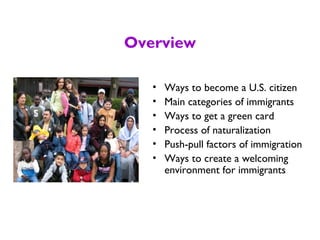
Overview
• Ways to become a U.S. citizen
• Main categories of immigrants
• Ways to get a green card
• Process of naturalization
• Push-pull factors of immigration
• Ways to create a welcoming
environment for immigrants
Terms to be Covered
• Asylee
• Citizen
• Green card
• Immigrant
• Lawful Permanent Resident
• Undocumented
• Naturalization
• Visa
• Non-immigrant
• Refugee
Why Is It Important to
Stay Informed About Immigration?
• To approach a front-page issue
sensitively and with accuracy
• To create a more inclusive classroom
• To establish dialogue and connections
between diverse groups
• To effectively advocate for immigrants
and refugees in the community
• To encourage positive understanding
about immigrants
clipartreview.com
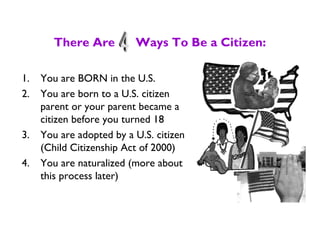
There Are Ways To Be a Citizen:
1. You are BORN in the U.S.
2. You are born to a U.S. citizen
parent or your parent became a
citizen before you turned 18
3. You are adopted by a U.S. citizen
(Child Citizenship Act of 2000)
4. You are naturalized (more about
this process later)
Someone In the U.S.
Who is Not a Citizen is Either An
Immigrant
or a
Non-immigrant
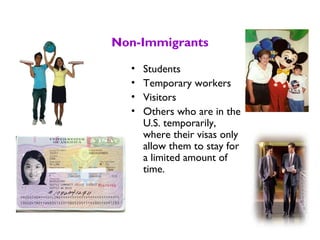
Non-Immigrants
• Students
• Temporary workers
• Visitors
• Others who are in the
U.S. temporarily,
where their visas only
allow them to stay for
a limited amount of
time.
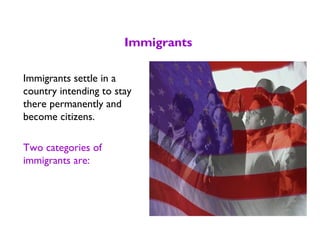
Immigrants
Immigrants settle in a
country intending to stay
there permanently and
become citizens.
Two categories of
immigrants are:
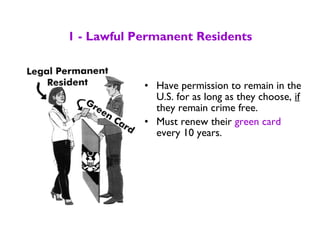
1 - Lawful Permanent Residents
• Have permission to remain in the
U.S. for as long as they choose, if
they remain crime free.
• Must renew their green card
every 10 years.
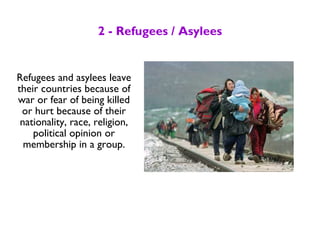
2 - Refugees / Asylees
Refugees and asylees leave
their countries because of
war or fear of being killed
or hurt because of their
nationality, race, religion,
political opinion or
membership in a group.
What Is The Difference
Between a Refugee and an Asylee?
• A refugee receives
permission to come to the
U.S. from outside of the
country.
• Refugees are resettled with
the help of a refugee
resettlement agency.
• An asylee is already in the
U.S. when s/he applies for
protection.
• Asylees have to prove that
they have reason to fear
persecution in their home
country.
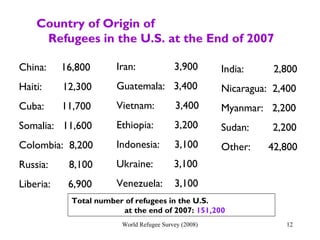
World Refugee Survey (2008) 12
Iran: 3,900
Guatemala: 3,400
Vietnam: 3,400
Ethiopia: 3,200
Indonesia: 3,100
Ukraine: 3,100
Venezuela: 3,100
Country of Origin of
Refugees in the U.S. at the End of 2007
China: 16,800
Haiti: 12,300
Cuba: 11,700
Somalia: 11,600
Colombia: 8,200
Russia: 8,100
Liberia: 6,900
Total number of refugees in the U.S.
at the end of 2007: 151,200
India: 2,800
Nicaragua: 2,400
Myanmar: 2,200
Sudan: 2,200
Other: 42,800
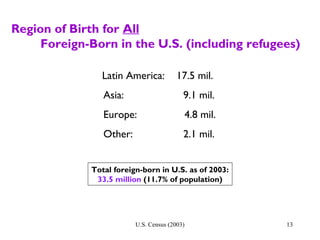
U.S. Census (2003) 13
Region of Birth for All
Foreign-Born in the U.S. (including refugees)
Latin America: 17.5 mil.
Asia: 9.1 mil.
Europe: 4.8 mil.
Other: 2.1 mil.
Total foreign-born in U.S. as of 2003:
33.5 million (11.7% of population)
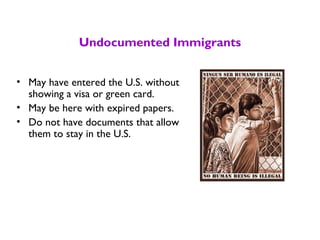
Undocumented Immigrants
• May have entered the U.S. without
showing a visa or green card.
• May be here with expired papers.
• Do not have documents that allow
them to stay in the U.S.
Can anyone who wants to become a citizen become one?
No, first somebody has to have a green card.
Then how do you get a green card?
Here are the main ways to obtain a green card…
Only a few ways, and not everybody is eligible for one.
Becoming a U.S. Citizen
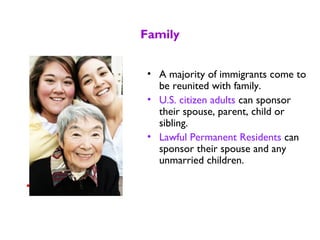
Family
• A majority of immigrants come to
be reunited with family.
• U.S. citizen adults can sponsor
their spouse, parent, child or
sibling.
• Lawful Permanent Residents can
sponsor their spouse and any
unmarried children.
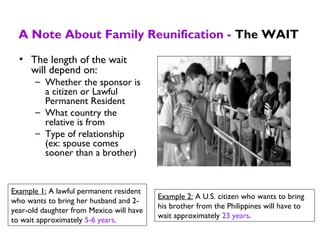
A Note About Family Reunification - The WAIT
• The length of the wait
will depend on:
– Whether the sponsor is
a citizen or Lawful
Permanent Resident
– What country the
relative is from
– Type of relationship
(ex: spouse comes
sooner than a brother)
Example 1: A lawful permanent resident
who wants to bring her husband and 2-
year-old daughter from Mexico will have
to wait approximately 5-6 years.
Example 2: A U.S. citizen who wants to bring
his brother from the Philippines will have to
wait approximately 23 years.
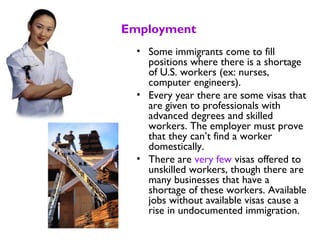
Employment
• Some immigrants come to fill
positions where there is a shortage
of U.S. workers (ex: nurses,
computer engineers).
• Every year there are some visas that
are given to professionals with
advanced degrees and skilled
workers. The employer must prove
that they can’t find a worker
domestically.
• There are very few visas offered to
unskilled workers, though there are
many businesses that have a
shortage of these workers. Available
jobs without available visas cause a
rise in undocumented immigration.
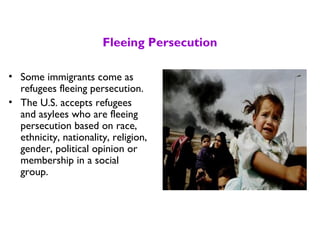
Fleeing Persecution
• Some immigrants come as
refugees fleeing persecution.
• The U.S. accepts refugees
and asylees who are fleeing
persecution based on race,
ethnicity, nationality, religion,
gender, political opinion or
membership in a social
group.
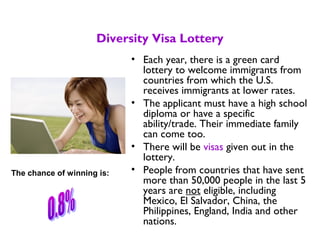
Diversity Visa Lottery
• Each year, there is a green card
lottery to welcome immigrants from
countries from which the U.S.
receives immigrants at lower rates.
• The applicant must have a high school
diploma or have a specific
ability/trade. Their immediate family
can come too.
• There will be visas given out in the
lottery.
• People from countries that have sent
more than 50,000 people in the last 5
years are not eligible, including
Mexico, El Salvador, China, the
Philippines, England, India and other
nations.
The chance of winning is:
Q: What Are Some of the
Ways You Can Obtain a Green Card?
(Click for the answers)
• Family
• Employment
• Fleeing persecution
• Diversity visa lottery
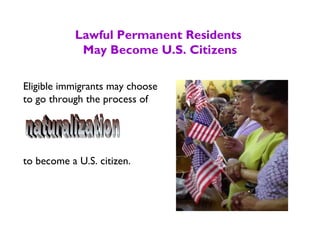
Lawful Permanent Residents
May Become U.S. Citizens
Eligible immigrants may choose
to go through the process of
to become a U.S. citizen.
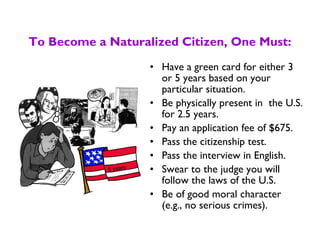
To Become a Naturalized Citizen, One Must:
• Have a green card for either 3
or 5 years based on your
particular situation.
• Be physically present in the U.S.
for 2.5 years.
• Pay an application fee of $675.
• Pass the citizenship test.
• Pass the interview in English.
• Swear to the judge you will
follow the laws of the U.S.
• Be of good moral character
(e.g., no serious crimes).
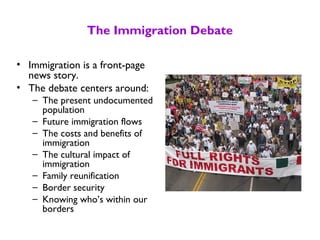
The Immigration Debate
• Immigration is a front-page
news story.
• The debate centers around:
– The present undocumented
population
– Future immigration flows
– The costs and benefits of
immigration
– The cultural impact of
immigration
– Family reunification
– Border security
– Knowing who’s within our
borders
Push-Pull Factors of Immigration
“Push factors” are the reasons
compelling a migrant to leave
his/her home country.
“Pull factors” draw or
attract a person to his/her
destination.
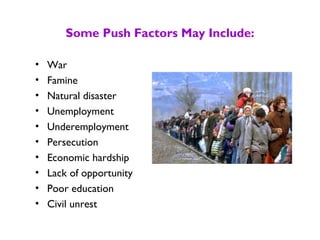
Some Push Factors May Include:
• War
• Famine
• Natural disaster
• Unemployment
• Underemployment
• Persecution
• Economic hardship
• Lack of opportunity
• Poor education
• Civil unrest
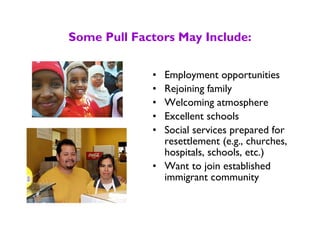
• Employment opportunities
• Rejoining family
• Welcoming atmosphere
• Excellent schools
• Social services prepared for
resettlement (e.g., churches,
hospitals, schools, etc.)
• Want to join established
immigrant community
Some Pull Factors May Include:
QUIZ TIME!
Q: What are Some of the Factors That
“Push” People Out of Their Countries of
Origin, and “Pull” Them to a Country of
Destination?
(Click for the answers)
Push Factors
• War
• Famine
• Natural disaster
• Unemployment
• Persecution
• Economic hardship
• Lack of opportunity
• Poor education
• Civil unrest
Pull Factors
• Employment opportunities
• Rejoining family
• Welcoming atmosphere
• Excellent schools
• Social services prepared for
resettlement (e.g., churches,
hospitals, schools, etc.)
• Want to join established
immigrant community
Contributions of Immigrants
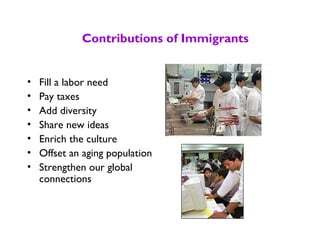
• Fill a labor need
• Pay taxes
• Add diversity
• Share new ideas
• Enrich the culture
• Offset an aging population
• Strengthen our global
connections
• Write articles for your school or community
newspaper about the immigration issue.
• Advocate by sending letters to legislators about
current immigration issues.
• Reach out to refugees and immigrants in your
local area.
• Befriend a newcomer at your school.
• Increase awareness of refugee and immigrant
issues.
• Form a club in your school with others
interested in these issues.
• Raise money, or do a food/clothing drive for a
local or national organization that serves
immigrants and refugees.
Ways to Create a
Welcoming Environment for Immigrants
For More Information,
Visit Energy of a Nation on the Web!
• Obtain accurate and up-to-
date information.
• Learn about current legislation.
• Take action by contacting leaders
and lawmakers.
• Participate in community events.
• Learn about the issues.
• Access reports and resources on
state and national immigration.
All Free and Downloadable at: www.energyofanation.org!
© The Advocates for Human Rights 2008
Marcelo Gomes Freire

Immigration

  • 1.
    Immigration 101 The Advocatesfor Human Rights is pleased to involve your class or community group in a day to learn about immigration to the United States. © The Advocates for Human Rights 2008
  • 2.
    Overview • Ways tobecome a U.S. citizen • Main categories of immigrants • Ways to get a green card • Process of naturalization • Push-pull factors of immigration • Ways to create a welcoming environment for immigrants
  • 3.
    Terms to beCovered • Asylee • Citizen • Green card • Immigrant • Lawful Permanent Resident • Undocumented • Naturalization • Visa • Non-immigrant • Refugee
  • 4.
    Why Is ItImportant to Stay Informed About Immigration? • To approach a front-page issue sensitively and with accuracy • To create a more inclusive classroom • To establish dialogue and connections between diverse groups • To effectively advocate for immigrants and refugees in the community • To encourage positive understanding about immigrants clipartreview.com
  • 5.
    There Are WaysTo Be a Citizen: 1. You are BORN in the U.S. 2. You are born to a U.S. citizen parent or your parent became a citizen before you turned 18 3. You are adopted by a U.S. citizen (Child Citizenship Act of 2000) 4. You are naturalized (more about this process later)
  • 6.
    Someone In theU.S. Who is Not a Citizen is Either An Immigrant or a Non-immigrant
  • 7.
    Non-Immigrants • Students • Temporaryworkers • Visitors • Others who are in the U.S. temporarily, where their visas only allow them to stay for a limited amount of time.
  • 8.
    Immigrants Immigrants settle ina country intending to stay there permanently and become citizens. Two categories of immigrants are:
  • 9.
    1 - LawfulPermanent Residents • Have permission to remain in the U.S. for as long as they choose, if they remain crime free. • Must renew their green card every 10 years.
  • 10.
    2 - Refugees/ Asylees Refugees and asylees leave their countries because of war or fear of being killed or hurt because of their nationality, race, religion, political opinion or membership in a group.
  • 11.
    What Is TheDifference Between a Refugee and an Asylee? • A refugee receives permission to come to the U.S. from outside of the country. • Refugees are resettled with the help of a refugee resettlement agency. • An asylee is already in the U.S. when s/he applies for protection. • Asylees have to prove that they have reason to fear persecution in their home country.
  • 12.
    World Refugee Survey(2008) 12 Iran: 3,900 Guatemala: 3,400 Vietnam: 3,400 Ethiopia: 3,200 Indonesia: 3,100 Ukraine: 3,100 Venezuela: 3,100 Country of Origin of Refugees in the U.S. at the End of 2007 China: 16,800 Haiti: 12,300 Cuba: 11,700 Somalia: 11,600 Colombia: 8,200 Russia: 8,100 Liberia: 6,900 Total number of refugees in the U.S. at the end of 2007: 151,200 India: 2,800 Nicaragua: 2,400 Myanmar: 2,200 Sudan: 2,200 Other: 42,800
  • 13.
    U.S. Census (2003)13 Region of Birth for All Foreign-Born in the U.S. (including refugees) Latin America: 17.5 mil. Asia: 9.1 mil. Europe: 4.8 mil. Other: 2.1 mil. Total foreign-born in U.S. as of 2003: 33.5 million (11.7% of population)
  • 14.
    Undocumented Immigrants • Mayhave entered the U.S. without showing a visa or green card. • May be here with expired papers. • Do not have documents that allow them to stay in the U.S.
  • 15.
    Can anyone whowants to become a citizen become one? No, first somebody has to have a green card. Then how do you get a green card? Here are the main ways to obtain a green card… Only a few ways, and not everybody is eligible for one. Becoming a U.S. Citizen
  • 16.
    Family • A majorityof immigrants come to be reunited with family. • U.S. citizen adults can sponsor their spouse, parent, child or sibling. • Lawful Permanent Residents can sponsor their spouse and any unmarried children.
  • 17.
    A Note AboutFamily Reunification - The WAIT • The length of the wait will depend on: – Whether the sponsor is a citizen or Lawful Permanent Resident – What country the relative is from – Type of relationship (ex: spouse comes sooner than a brother) Example 1: A lawful permanent resident who wants to bring her husband and 2- year-old daughter from Mexico will have to wait approximately 5-6 years. Example 2: A U.S. citizen who wants to bring his brother from the Philippines will have to wait approximately 23 years.
  • 18.
    Employment • Some immigrantscome to fill positions where there is a shortage of U.S. workers (ex: nurses, computer engineers). • Every year there are some visas that are given to professionals with advanced degrees and skilled workers. The employer must prove that they can’t find a worker domestically. • There are very few visas offered to unskilled workers, though there are many businesses that have a shortage of these workers. Available jobs without available visas cause a rise in undocumented immigration.
  • 19.
    Fleeing Persecution • Someimmigrants come as refugees fleeing persecution. • The U.S. accepts refugees and asylees who are fleeing persecution based on race, ethnicity, nationality, religion, gender, political opinion or membership in a social group.
  • 20.
    Diversity Visa Lottery •Each year, there is a green card lottery to welcome immigrants from countries from which the U.S. receives immigrants at lower rates. • The applicant must have a high school diploma or have a specific ability/trade. Their immediate family can come too. • There will be visas given out in the lottery. • People from countries that have sent more than 50,000 people in the last 5 years are not eligible, including Mexico, El Salvador, China, the Philippines, England, India and other nations. The chance of winning is:
  • 22.
    Q: What AreSome of the Ways You Can Obtain a Green Card? (Click for the answers) • Family • Employment • Fleeing persecution • Diversity visa lottery
  • 23.
    Lawful Permanent Residents MayBecome U.S. Citizens Eligible immigrants may choose to go through the process of to become a U.S. citizen.
  • 24.
    To Become aNaturalized Citizen, One Must: • Have a green card for either 3 or 5 years based on your particular situation. • Be physically present in the U.S. for 2.5 years. • Pay an application fee of $675. • Pass the citizenship test. • Pass the interview in English. • Swear to the judge you will follow the laws of the U.S. • Be of good moral character (e.g., no serious crimes).
  • 25.
    The Immigration Debate •Immigration is a front-page news story. • The debate centers around: – The present undocumented population – Future immigration flows – The costs and benefits of immigration – The cultural impact of immigration – Family reunification – Border security – Knowing who’s within our borders
  • 26.
    Push-Pull Factors ofImmigration “Push factors” are the reasons compelling a migrant to leave his/her home country. “Pull factors” draw or attract a person to his/her destination.
  • 27.
    Some Push FactorsMay Include: • War • Famine • Natural disaster • Unemployment • Underemployment • Persecution • Economic hardship • Lack of opportunity • Poor education • Civil unrest
  • 28.
    • Employment opportunities •Rejoining family • Welcoming atmosphere • Excellent schools • Social services prepared for resettlement (e.g., churches, hospitals, schools, etc.) • Want to join established immigrant community Some Pull Factors May Include:
  • 29.
  • 30.
    Q: What areSome of the Factors That “Push” People Out of Their Countries of Origin, and “Pull” Them to a Country of Destination? (Click for the answers) Push Factors • War • Famine • Natural disaster • Unemployment • Persecution • Economic hardship • Lack of opportunity • Poor education • Civil unrest Pull Factors • Employment opportunities • Rejoining family • Welcoming atmosphere • Excellent schools • Social services prepared for resettlement (e.g., churches, hospitals, schools, etc.) • Want to join established immigrant community
  • 31.
    Contributions of Immigrants •Fill a labor need • Pay taxes • Add diversity • Share new ideas • Enrich the culture • Offset an aging population • Strengthen our global connections
  • 32.
    • Write articlesfor your school or community newspaper about the immigration issue. • Advocate by sending letters to legislators about current immigration issues. • Reach out to refugees and immigrants in your local area. • Befriend a newcomer at your school. • Increase awareness of refugee and immigrant issues. • Form a club in your school with others interested in these issues. • Raise money, or do a food/clothing drive for a local or national organization that serves immigrants and refugees. Ways to Create a Welcoming Environment for Immigrants
  • 33.
    For More Information, VisitEnergy of a Nation on the Web! • Obtain accurate and up-to- date information. • Learn about current legislation. • Take action by contacting leaders and lawmakers. • Participate in community events. • Learn about the issues. • Access reports and resources on state and national immigration. All Free and Downloadable at: www.energyofanation.org!
  • 34.
    © The Advocatesfor Human Rights 2008 Marcelo Gomes Freire

Editor's Notes

  • #13 Countries which generated the greatest #s of refugees and asylum seekers (total as of Dec 31, 2005) Total number worldwide as of Dec 31, 2007: 14,047,300 Does NOT include those who have received permanent residency in the country to which they have relocated
  • #14 Other = Those from Africa, Oceania (mostly islands in the Pacific Ocean and the vicinity), and Northern America