Thailand: an overview
Marcelo Gomes Freire
University of Hawaii
July 10, 2003
AsialPacificEd Institute
 The place
 The people
 Brief history
 Thai worldviews
 Buddhism
 Culture and social organization
 Social values
 Key events and persons
 Challenges of modern Thailand
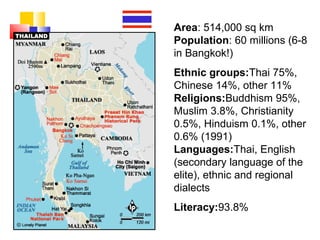
Area: 514,000 sq km
Population: 60 millions (6-8
in Bangkok!)
Ethnic groups:Thai 75%,
Chinese 14%, other 11%
Religions:Buddhism 95%,
Muslim 3.8%, Christianity
0.5%, Hinduism 0.1%, other
0.6% (1991)
Languages:Thai, English
(secondary language of the
elite), ethnic and regional
dialects
Literacy:93.8%
Prime Minister: Thaksin
Government: democratic constitutional monarchy
Executive branch:chief of state: H.R.H. King Bhumibol
Adulyadej (Rama IX of the Chakri Dynasty)(since 9 June
1946)
note: there is also a Privy Council
head of government: Prime Minister Thaksin Shinawatra
(since 9 February 2001) (No. 31st)
Legislative branch:bicameral National Assembly consists of
1. the Senate (200 seats; members elected)
2. the House of Representatives (500 seats; members
elected)
Both serve four year terms.
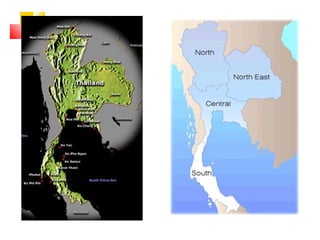
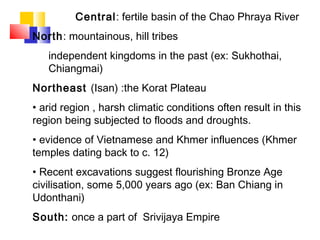
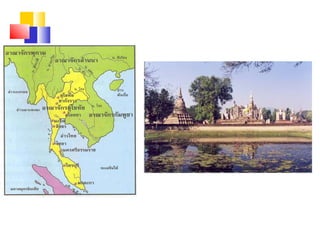
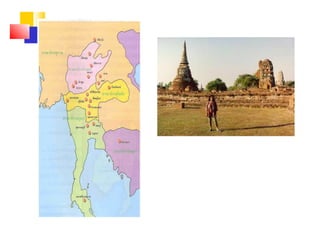
Central: fertile basin of the Chao Phraya River
North: mountainous, hill tribes
independent kingdoms in the past (ex: Sukhothai,
Chiangmai)
Northeast (Isan) :the Korat Plateau
• arid region , harsh climatic conditions often result in this
region being subjected to floods and droughts.
• evidence of Vietnamese and Khmer influences (Khmer
temples dating back to c. 12)
• Recent excavations suggest flourishing Bronze Age
civilisation, some 5,000 years ago (ex: Ban Chiang in
Udonthani)
South: once a part of Srivijaya Empire
The People
 settlement and cohabitation of diverse ethnic
groups in the Chao Phya basin (past, present):
Dvaravati (Mon speaking) c.6- c. 12
Khmer c.11-c. 19
Thai c. 13 on
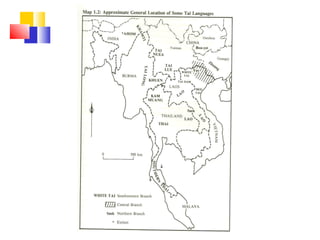
 Thai: Tai speaking group
 ethnic, cultural, linguistic group spread from
southern China to northeastern India and
most of the peninsula.
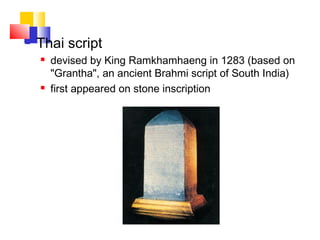
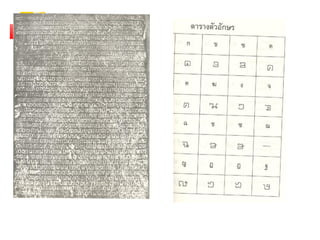
 Thai script
 devised by King Ramkhamhaeng in 1283 (based on
"Grantha", an ancient Brahmi script of South India)
 first appeared on stone inscription
Brief History
 Sukhothai: first established Thai Kingdom
in c. 13 (1253-1350)
 paternal monarchy in accordance with Buddhist
political philosophy
 King as protector and promoter of Buddhism
 King Luthai compiled: Traiphumikatha (Three
Worlds)- Buddhist cosmology in 1345
Brief History (2)
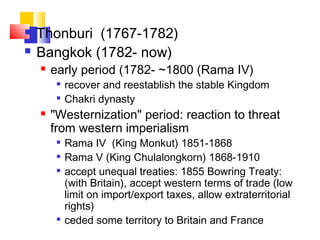
 Ayuthaya (1350-1767) 417 years
 adopted Khmer administration model
influenced by Brahminism and Hinduism
 King as "deva raja" (God King)
 "sakdina system": social stratification system,
everyone assigned a numerical ranking
 international trade, contacts with western
traders, establish relations with western
nations.

King Narai (1656-1688)
 expansion of territory
 Thonburi (1767-1782)
 Bangkok (1782- now)
 early period (1782- ~1800 (Rama IV)

recover and reestablish the stable Kingdom

Chakri dynasty
 "Westernization" period: reaction to threat
from western imperialism

Rama IV (King Monkut) 1851-1868

Rama V (King Chulalongkorn) 1868-1910

accept unequal treaties: 1855 Bowring Treaty:
(with Britain), accept western terms of trade (low
limit on import/export taxes, allow extraterritorial
rights)

ceded some territory to Britain and France
 Modern period (1932- now)
 June 24, 1932, coup d'tat
 overthrow of absolute monarchy (Rama VII) by junior
military officer and civil servants (western educated)
 the struggle for "true" democracy, lack of strong
base for new democratic government, conflicts
among elite groups
 under military led governments

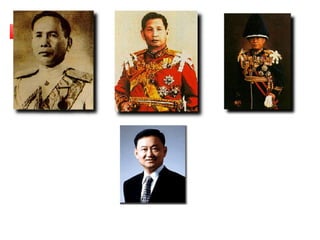
1938-1944, 1948-1957: P. Pibunsongkram

1957-1973: Sarit, Thanom

Cold War, anti-communist, Vietnam War, US aids,
economic development

"Despotic Paternalism"
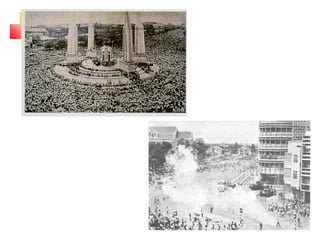
 Constitution movements:
 Student(and intellects) Uprising in October,
1973 : confrontation of people's movement
and government force
 May 1992 demonstration demand for
parliamentary government
 1997 constitution
 from 1932-1997: 56 govts. (15 civiliam PMs
leading 29 govts, 17 years in office; 7 military
PM leading 27 govts, 46 years in office
Thai social system
 agrarian society
 village as basic community unit
 habits and customs based on agriculture
and religion
Thai world views
 shaped by ("popular") Buddhism
(Theravada/Hinayana)+ animistic +
Brahminism/Hinduism
 the law of "karma" (volitional acts)

every action has consequences

state of one's existence now is an outcome of one's
"karma" (deed) in the previous life
 cycles of rebirths, reincarnations
 uncertainty and transiency of all things
 tolerance, accepting fate ( "plong")
 belief of supernatural powers
 social values and social relations
 social hierarchy (rank and authority): patron-
client, senior-junior, etc..

hierarchy is believed to result from accumulated
past "karma":- the higher the merit, the higher
one's status
 reciprocity of favors and responsibilities,
"gratefulness" (bunkhun) [social obligation]
 avoid conflict and confrontation
 avoid the loss of "face" (one's honor)
 forgiving nature "mai pen rai"
 fun loving ("sanuk")
Social problems
 Migration to city
 prostitution/AIDS
 sex industry as result of unequal rural/urban
economic development (rural women marginalized in
Thai society)
 sex tourism/women trafficking
 corruption (high level bureaucrats, politicians)
 "black" economy: gambling, sex industry, drugs,
smuggling, arms dealing, illegal migrant workers:
generate 15-18% of GNP (Gross National Product)
 Environment
---------------
Thai Monarchy
 in late 1950, Sarit reemphasized the role
of monarchy as cornerstone of Thai
identity and legitimacy of the government
 foster the tradition of " Lord father" (semi-
deity)
 Also, Buddhist scripture: 10 duties of
Kingship
 alms giving, morality, generosity, honesty,
gentleness, self-restriction,non-anger, non-
violence, forbearance, non- obstruction
 merit and righteousness
 role of present King
 perform rituals
 make contact with his subjects
 concerned in the welfare of the people
 initiated many royal sponsored development
projects
 a focus for national unity, thus created
political "influence"
 a forum for mediation and compromise
between political forces, "umpire" in the
game of politics
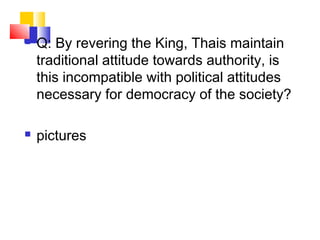
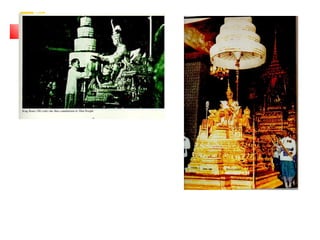
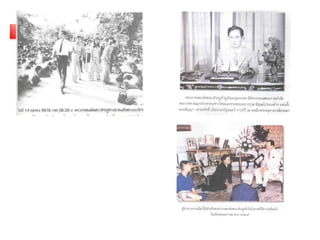
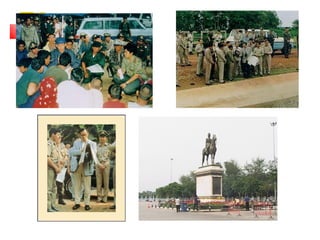
 Q: By revering the King, Thais maintain
traditional attitude towards authority, is
this incompatible with political attitudes
necessary for democracy of the society?
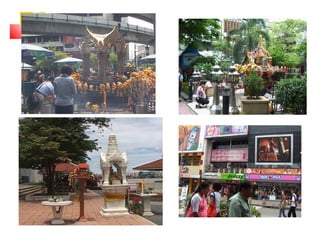
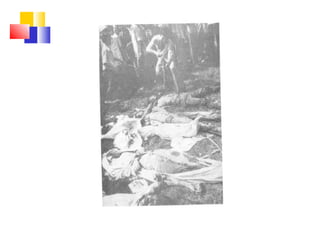
 pictures
Buddhism in Thailand
 in the past, Thai monarchs use Buddhism
as unifying principle of society and
legitimator of monarchic power esp. in
times of transition.
 Buddhism has weakened over the past
century:
 now as rites and ceremonies only ?
 commercialism of Buddhism(using animistic
beliefs/magic, merit-making etc..)
 But, reform movement too

Buddhadasa: dharma is nature and duty

roles of monks: community development, social
activism, social/community service (in addition to
spiritual leader)
 For laypeople, Buddhist teachings can be
antedote to consumerism (neo-colonialism)
 abandon greed, desire which are the root of
sufferings
 self-sufficiency
 middle path
 Ideology based on Buddhist thoughts can be a
tool to work through the crisis
WEBSITES
 CIA Fact Book:
http://www.cia.gov/cia/publications/factbo
ok/geos/th.html
 Thai Government:
http://www.thaigov.go.th/
 Golden Jubilee Network:
http://www.kanchanapisek.or.th/

Thailand: an overview

  • 1.
    Thailand: an overview MarceloGomes Freire University of Hawaii July 10, 2003 AsialPacificEd Institute
  • 2.
     The place The people  Brief history  Thai worldviews  Buddhism  Culture and social organization  Social values  Key events and persons  Challenges of modern Thailand
  • 3.
    Area: 514,000 sqkm Population: 60 millions (6-8 in Bangkok!) Ethnic groups:Thai 75%, Chinese 14%, other 11% Religions:Buddhism 95%, Muslim 3.8%, Christianity 0.5%, Hinduism 0.1%, other 0.6% (1991) Languages:Thai, English (secondary language of the elite), ethnic and regional dialects Literacy:93.8% Prime Minister: Thaksin
  • 4.
    Government: democratic constitutionalmonarchy Executive branch:chief of state: H.R.H. King Bhumibol Adulyadej (Rama IX of the Chakri Dynasty)(since 9 June 1946) note: there is also a Privy Council head of government: Prime Minister Thaksin Shinawatra (since 9 February 2001) (No. 31st) Legislative branch:bicameral National Assembly consists of 1. the Senate (200 seats; members elected) 2. the House of Representatives (500 seats; members elected) Both serve four year terms.
  • 6.
    Central: fertile basinof the Chao Phraya River North: mountainous, hill tribes independent kingdoms in the past (ex: Sukhothai, Chiangmai) Northeast (Isan) :the Korat Plateau • arid region , harsh climatic conditions often result in this region being subjected to floods and droughts. • evidence of Vietnamese and Khmer influences (Khmer temples dating back to c. 12) • Recent excavations suggest flourishing Bronze Age civilisation, some 5,000 years ago (ex: Ban Chiang in Udonthani) South: once a part of Srivijaya Empire
  • 7.
    The People  settlementand cohabitation of diverse ethnic groups in the Chao Phya basin (past, present): Dvaravati (Mon speaking) c.6- c. 12 Khmer c.11-c. 19 Thai c. 13 on  Thai: Tai speaking group  ethnic, cultural, linguistic group spread from southern China to northeastern India and most of the peninsula.
  • 9.
     Thai script devised by King Ramkhamhaeng in 1283 (based on "Grantha", an ancient Brahmi script of South India)  first appeared on stone inscription
  • 11.
    Brief History  Sukhothai:first established Thai Kingdom in c. 13 (1253-1350)  paternal monarchy in accordance with Buddhist political philosophy  King as protector and promoter of Buddhism  King Luthai compiled: Traiphumikatha (Three Worlds)- Buddhist cosmology in 1345
  • 13.
    Brief History (2) Ayuthaya (1350-1767) 417 years  adopted Khmer administration model influenced by Brahminism and Hinduism  King as "deva raja" (God King)  "sakdina system": social stratification system, everyone assigned a numerical ranking  international trade, contacts with western traders, establish relations with western nations.  King Narai (1656-1688)  expansion of territory
  • 15.
     Thonburi (1767-1782) Bangkok (1782- now)  early period (1782- ~1800 (Rama IV)  recover and reestablish the stable Kingdom  Chakri dynasty  "Westernization" period: reaction to threat from western imperialism  Rama IV (King Monkut) 1851-1868  Rama V (King Chulalongkorn) 1868-1910  accept unequal treaties: 1855 Bowring Treaty: (with Britain), accept western terms of trade (low limit on import/export taxes, allow extraterritorial rights)  ceded some territory to Britain and France
  • 16.
     Modern period(1932- now)  June 24, 1932, coup d'tat  overthrow of absolute monarchy (Rama VII) by junior military officer and civil servants (western educated)  the struggle for "true" democracy, lack of strong base for new democratic government, conflicts among elite groups  under military led governments  1938-1944, 1948-1957: P. Pibunsongkram  1957-1973: Sarit, Thanom  Cold War, anti-communist, Vietnam War, US aids, economic development  "Despotic Paternalism"
  • 17.
     Constitution movements: Student(and intellects) Uprising in October, 1973 : confrontation of people's movement and government force  May 1992 demonstration demand for parliamentary government  1997 constitution  from 1932-1997: 56 govts. (15 civiliam PMs leading 29 govts, 17 years in office; 7 military PM leading 27 govts, 46 years in office
  • 20.
    Thai social system agrarian society  village as basic community unit  habits and customs based on agriculture and religion
  • 21.
    Thai world views shaped by ("popular") Buddhism (Theravada/Hinayana)+ animistic + Brahminism/Hinduism  the law of "karma" (volitional acts)  every action has consequences  state of one's existence now is an outcome of one's "karma" (deed) in the previous life  cycles of rebirths, reincarnations  uncertainty and transiency of all things  tolerance, accepting fate ( "plong")  belief of supernatural powers
  • 22.
     social valuesand social relations  social hierarchy (rank and authority): patron- client, senior-junior, etc..  hierarchy is believed to result from accumulated past "karma":- the higher the merit, the higher one's status  reciprocity of favors and responsibilities, "gratefulness" (bunkhun) [social obligation]  avoid conflict and confrontation  avoid the loss of "face" (one's honor)  forgiving nature "mai pen rai"  fun loving ("sanuk")
  • 23.
    Social problems  Migrationto city  prostitution/AIDS  sex industry as result of unequal rural/urban economic development (rural women marginalized in Thai society)  sex tourism/women trafficking  corruption (high level bureaucrats, politicians)  "black" economy: gambling, sex industry, drugs, smuggling, arms dealing, illegal migrant workers: generate 15-18% of GNP (Gross National Product)  Environment ---------------
  • 24.
    Thai Monarchy  inlate 1950, Sarit reemphasized the role of monarchy as cornerstone of Thai identity and legitimacy of the government  foster the tradition of " Lord father" (semi- deity)  Also, Buddhist scripture: 10 duties of Kingship  alms giving, morality, generosity, honesty, gentleness, self-restriction,non-anger, non- violence, forbearance, non- obstruction  merit and righteousness
  • 25.
     role ofpresent King  perform rituals  make contact with his subjects  concerned in the welfare of the people  initiated many royal sponsored development projects  a focus for national unity, thus created political "influence"  a forum for mediation and compromise between political forces, "umpire" in the game of politics
  • 26.
     Q: Byrevering the King, Thais maintain traditional attitude towards authority, is this incompatible with political attitudes necessary for democracy of the society?  pictures
  • 30.
    Buddhism in Thailand in the past, Thai monarchs use Buddhism as unifying principle of society and legitimator of monarchic power esp. in times of transition.  Buddhism has weakened over the past century:  now as rites and ceremonies only ?  commercialism of Buddhism(using animistic beliefs/magic, merit-making etc..)
  • 31.
     But, reformmovement too  Buddhadasa: dharma is nature and duty  roles of monks: community development, social activism, social/community service (in addition to spiritual leader)  For laypeople, Buddhist teachings can be antedote to consumerism (neo-colonialism)  abandon greed, desire which are the root of sufferings  self-sufficiency  middle path  Ideology based on Buddhist thoughts can be a tool to work through the crisis
  • 34.
    WEBSITES  CIA FactBook: http://www.cia.gov/cia/publications/factbo ok/geos/th.html  Thai Government: http://www.thaigov.go.th/  Golden Jubilee Network: http://www.kanchanapisek.or.th/

Editor's Notes

  • #4 Points out neigboring countries. Mekong river, Chao Phya river, etc. Ethnic Thai form the majority, though the area has historically beem a migrator crossroads, and has produced a degree of ethnic diversity. However, there is unity and
  • #5 1997 constitution No. 16th since 1932
  • #22 agrarian, village life