
Evolution of Temples
DRAVIDIAN ARCHITECTURE
Part - 2 : Pandya Style, Vijayanagara Style, Nayak/Madura Style
Temple Architecture in India
• Introduction
• Dravidian Architecture
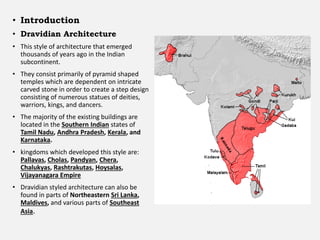
• This style of architecture that emerged
thousands of years ago in the Indian
subcontinent.
• They consist primarily of pyramid shaped
temples which are dependent on intricate
carved stone in order to create a step design
consisting of numerous statues of deities,
warriors, kings, and dancers.
• The majority of the existing buildings are
located in the Southern Indian states of
Tamil Nadu, Andhra Pradesh, Kerala, and
Karnataka.
• kingdoms which developed this style are:
Pallavas, Cholas, Pandyan, Chera,
Chalukyas, Rashtrakutas, Hoysalas,
Vijayanagara Empire
• Dravidian styled architecture can also be
found in parts of Northeastern Sri Lanka,
Maldives, and various parts of Southeast
Asia.
DIFFERENT PHASES IN DRAVIDIAN ARCHITECTURE
• The Dravidian Style of architecture can be categorized as a distinct Evolution in Temple
architecture through the various phases
• There is a marked evolution in the planning of the temple and the architectural treatment
• Complexity in planning due to the complexity in the rituals arose by the 12th c. AD (Pandya)
Broadly the classifications would be as follows:
• Pallavan - Rock cut and Structural Temples
• Chola - Development of the Vimana (Shikhara),
Walled enclosures, Gopurams.
• Pandya - Evolution of the Gopuram – number, height, embellishment High walls for
enclosure for security( Muslim invasion)
• Vijayanagara - Addition of Mandapas, Secondary halls and Gopurams
• Nayaks - Temple cities, addition of Gopurams to existing temples
• Pallavan Style 600AD – 900AD
• Chola Style 900AD – 1150AD
• Pandya Style 1100AD – 1350AD
• Vijayanagara Style 1350AD – 1565AD
• Nayak/Madura Style 1600 AD onwards
PANDYAS
(1100 AD - 1350 AD)
DRAVIDIAN STYLE
After the Cholas- architecture was at its peak with the
concentration being on the Vimana
Changes during the Pandya period:
• Vimana ceased to be the centre of concentration
• The supplementary and outlying portions were
developed
• Reasons were sentimental- do not touch God
• Walls were built/Pylons were the centre of
concentration for architecture
• Became the main feature of South Indian Temples
• Derivation of the Cow gate- City gate- Temple gate-
Gopuram
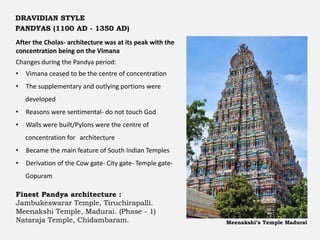
Finest Pandya architecture :
Jambukeswarar Temple, Tiruchirapalli.
Meenakshi Temple, Madurai. (Phase - 1)
Nataraja Temple, Chidambaram. Meenakshi’s Temple Madurai
DRAVIDIAN STYLE
PANDYAS (1100 AD - 1350 AD)
• Considerable political changes were taking
place. The most threatening force was
from the north -conquering hordes of
Islam.
• This threat made the Pandya rulers
hurriedly throw up makeshift battlements
around their cities and the heart of their
towns -the temples. This called for
modifying the Temple to a Fortress which
was unacceptable
• The solution was hence to raise the gates
of the fortress to the level of architecture.
This was the genesis of the famous
gopurams, or entrance gateways of the
temple cities of the south.
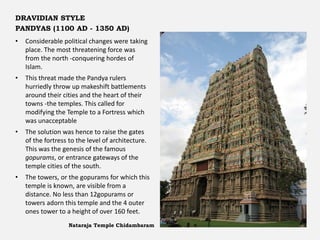
• The towers, or the gopurams for which this
temple is known, are visible from a
distance. No less than 12gopurams or
towers adorn this temple and the 4 outer
ones tower to a height of over 160 feet.
Nataraja Temple Chidambaram
DRAVIDIAN STYLE
PANDYAS (1100 AD - 1350 AD)
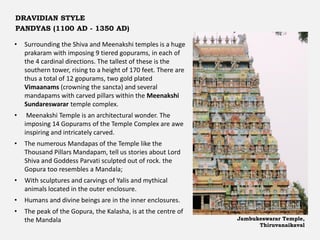
• Surrounding the Shiva and Meenakshi temples is a huge
prakaram with imposing 9 tiered gopurams, in each of
the 4 cardinal directions. The tallest of these is the
southern tower, rising to a height of 170 feet. There are
thus a total of 12 gopurams, two gold plated
Vimaanams (crowning the sancta) and several
mandapams with carved pillars within the Meenakshi
Sundareswarar temple complex.
• Meenakshi Temple is an architectural wonder. The
imposing 14 Gopurams of the Temple Complex are awe
inspiring and intricately carved.
• The numerous Mandapas of the Temple like the
Thousand Pillars Mandapam, tell us stories about Lord
Shiva and Goddess Parvati sculpted out of rock. the
Gopura too resembles a Mandala;
• With sculptures and carvings of Yalis and mythical
animals located in the outer enclosure.
• Humans and divine beings are in the inner enclosures.
• The peak of the Gopura, the Kalasha, is at the centre of
the Mandala Jambukeswarar Temple,
Thiruvanaikaval
DRAVIDIAN STYLE
PANDYAS (1100 AD - 1350 AD)
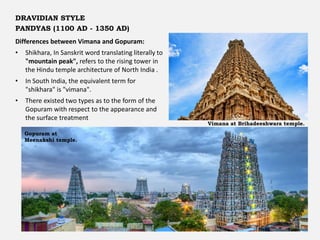
Differences between Vimana and Gopuram:
• Shikhara, In Sanskrit word translating literally to
"mountain peak", refers to the rising tower in
the Hindu temple architecture of North India .
• In South India, the equivalent term for
"shikhara" is "vimana".
• There existed two types as to the form of the
Gopuram with respect to the appearance and
the surface treatment
DRAVIDIAN STYLE
PANDYAS (1100 AD - 1350 AD)
Vimana at Brihadeeshwara temple.
Gopuram at
Meenakshi temple.
DRAVIDIAN STYLE
PANDYAS (1100 AD - 1350 AD)
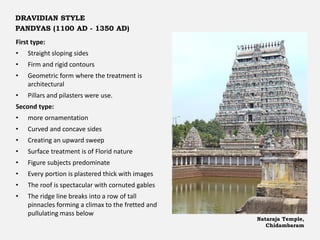
First type:
• Straight sloping sides
• Firm and rigid contours
• Geometric form where the treatment is
architectural
• Pillars and pilasters were use.
Second type:
• more ornamentation
• Curved and concave sides
• Creating an upward sweep
• Surface treatment is of Florid nature
• Figure subjects predominate
• Every portion is plastered thick with images
• The roof is spectacular with cornuted gables
• The ridge line breaks into a row of tall
pinnacles forming a climax to the fretted and
pullulating mass below
Nataraja Temple,
Chidambaram
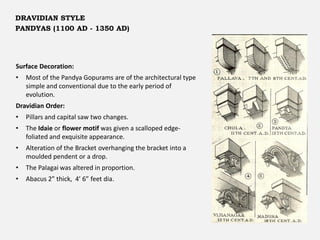
Surface Decoration:
• Most of the Pandya Gopurams are of the architectural type
simple and conventional due to the early period of
evolution.
Dravidian Order:
• Pillars and capital saw two changes.
• The Idaie or flower motif was given a scalloped edge-
foliated and exquisite appearance.
• Alteration of the Bracket overhanging the bracket into a
moulded pendent or a drop.
• The Palagai was altered in proportion.
• Abacus 2” thick, 4’ 6” feet dia.
DRAVIDIAN STYLE
PANDYAS (1100 AD - 1350 AD)
VIJAYANAGARA STYLE
(1350 AD - 1565 AD)
DRAVIDIAN STYLE
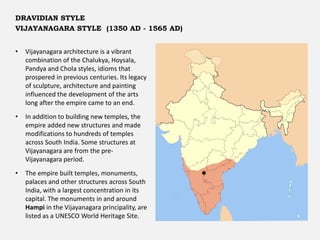
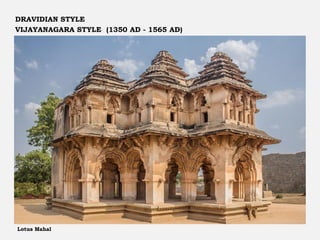
• Vijayanagara architecture is a vibrant
combination of the Chalukya, Hoysala,
Pandya and Chola styles, idioms that
prospered in previous centuries. Its legacy
of sculpture, architecture and painting
influenced the development of the arts
long after the empire came to an end.
• In addition to building new temples, the
empire added new structures and made
modifications to hundreds of temples
across South India. Some structures at
Vijayanagara are from the pre-
Vijayanagara period.
• The empire built temples, monuments,
palaces and other structures across South
India, with a largest concentration in its
capital. The monuments in and around
Hampi in the Vijayanagara principality, are
listed as a UNESCO World Heritage Site.
DRAVIDIAN STYLE
VIJAYANAGARA STYLE (1350 AD - 1565 AD)
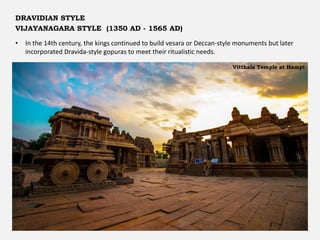
• In the 14th century, the kings continued to
build vesara or Deccan-style monuments
but later incorporated Dravida-style
gopuras to meet their ritualistic needs.
• Vijayanagara architecture can be broadly
classified into religious, courtly and civic
architecture, as can the associated
sculptures and paintings.
• The Vijayanagara style is a combination of
the Chalukya, Hoysala, Pandya and Chola
styles which evolved earlier in the
centuries when these empires ruled and is
characterized by a return to the simplistic
and serene art of the past
• Vijayanagara architecture can be broadly
classified into religious, courtly and civic
architecture, as can the associated
sculptures and paintings.
DRAVIDIAN STYLE
VIJAYANAGARA STYLE (1350 AD - 1565 AD)
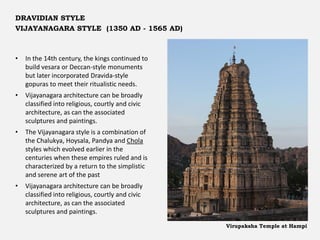
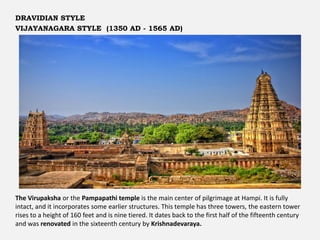
Virupaksha Temple at Hampi
• In the 14th century, the kings continued to build vesara or Deccan-style monuments but later
incorporated Dravida-style gopuras to meet their ritualistic needs.
DRAVIDIAN STYLE
VIJAYANAGARA STYLE (1350 AD - 1565 AD)
Vitthala Temple at Hampi
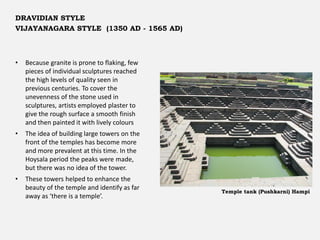
• Because granite is prone to flaking, few
pieces of individual sculptures reached
the high levels of quality seen in
previous centuries. To cover the
unevenness of the stone used in
sculptures, artists employed plaster to
give the rough surface a smooth finish
and then painted it with lively colours
• The idea of building large towers on the
front of the temples has become more
and more prevalent at this time. In the
Hoysala period the peaks were made,
but there was no idea of the tower.
• These towers helped to enhance the
beauty of the temple and identify as far
away as ‘there is a temple’.
Temple tank (Pushkarni) Hampi
DRAVIDIAN STYLE
VIJAYANAGARA STYLE (1350 AD - 1565 AD)
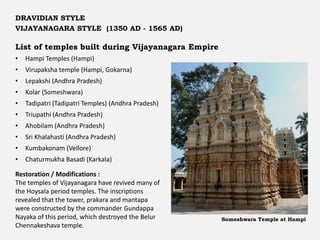
List of temples built during Vijayanagara Empire
• Hampi Temples (Hampi)
• Virupaksha temple (Hampi, Gokarna)
• Lepakshi (Andhra Pradesh)
• Kolar (Someshwara)
• Tadipatri (Tadipatri Temples) (Andhra Pradesh)
• Triupathi (Andhra Pradesh)
• Ahobilam (Andhra Pradesh)
• Sri Khalahasti (Andhra Pradesh)
• Kumbakonam (Vellore)
• Chaturmukha Basadi (Karkala)
Someshwara Temple at Hampi
DRAVIDIAN STYLE
VIJAYANAGARA STYLE (1350 AD - 1565 AD)
Restoration / Modifications :
The temples of Vijayanagara have revived many of
the Hoysala period temples. The inscriptions
revealed that the tower, prakara and mantapa
were constructed by the commander Gundappa
Nayaka of this period, which destroyed the Belur
Chennakeshava temple.
Temples of Hampi
Someshwara Temple at Hampi
DRAVIDIAN STYLE
VIJAYANAGARA STYLE
(1350 AD - 1565 AD)
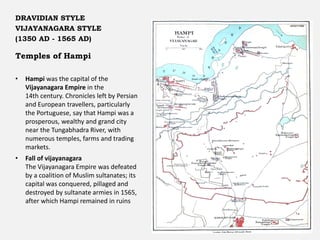
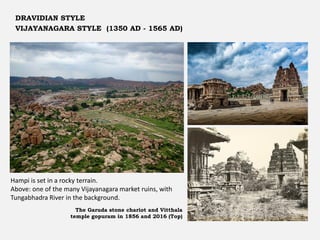
• Hampi was the capital of the
Vijayanagara Empire in the
14th century. Chronicles left by Persian
and European travellers, particularly
the Portuguese, say that Hampi was a
prosperous, wealthy and grand city
near the Tungabhadra River, with
numerous temples, farms and trading
markets.
• Fall of vijayanagara
The Vijayanagara Empire was defeated
by a coalition of Muslim sultanates; its
capital was conquered, pillaged and
destroyed by sultanate armies in 1565,
after which Hampi remained in ruins
The Garuda stone chariot and Vitthala
temple gopuram in 1856 and 2016 (Top)
DRAVIDIAN STYLE
VIJAYANAGARA STYLE (1350 AD - 1565 AD)
Hampi is set in a rocky terrain.
Above: one of the many Vijayanagara market ruins, with
Tungabhadra River in the background.
The Virupaksha or the Pampapathi temple is the main center of pilgrimage at Hampi. It is fully
intact, and it incorporates some earlier structures. This temple has three towers, the eastern tower
rises to a height of 160 feet and is nine tiered. It dates back to the first half of the fifteenth century
and was renovated in the sixteenth century by Krishnadevaraya.
DRAVIDIAN STYLE
VIJAYANAGARA STYLE (1350 AD - 1565 AD)
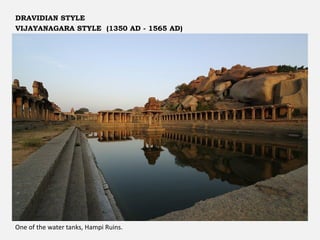
One of the water tanks, Hampi Ruins.
DRAVIDIAN STYLE
VIJAYANAGARA STYLE (1350 AD - 1565 AD)
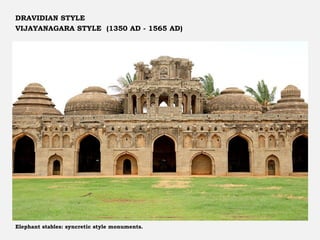
Elephant stables: syncretic style monuments.
DRAVIDIAN STYLE
VIJAYANAGARA STYLE (1350 AD - 1565 AD)
Lotus Mahal
DRAVIDIAN STYLE
VIJAYANAGARA STYLE (1350 AD - 1565 AD)
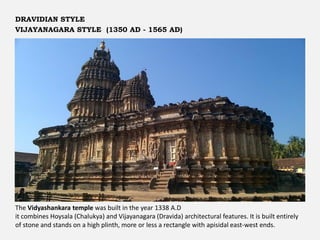
The Vidyashankara temple was built in the year 1338 A.D
it combines Hoysala (Chalukya) and Vijayanagara (Dravida) architectural features. It is built entirely
of stone and stands on a high plinth, more or less a rectangle with apisidal east-west ends.
DRAVIDIAN STYLE
VIJAYANAGARA STYLE (1350 AD - 1565 AD)
NAYAK/MADURA STYLE
(1600 AD - ONWARDS)
DRAVIDIAN STYLE
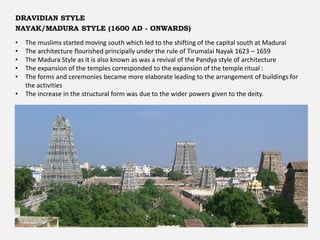
• The muslims started moving south which led to the shifting of the capital south at Madurai
• The architecture flourished principally under the rule of Tirumalai Nayak 1623 – 1659
• The Madura Style as it is also known as was a revival of the Pandya style of architecture
• The expansion of the temples corresponded to the expansion of the temple ritual :
• The forms and ceremonies became more elaborate leading to the arrangement of buildings for
the activities
• The increase in the structural form was due to the wider powers given to the deity.
DRAVIDIAN STYLE
NAYAK/MADURA STYLE (1600 AD - ONWARDS)
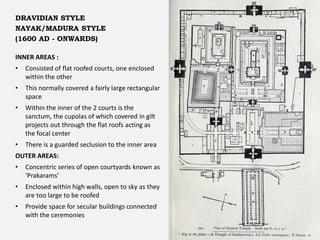
INNER AREAS :
• Consisted of flat roofed courts, one enclosed
within the other
• This normally covered a fairly large rectangular
space
• Within the inner of the 2 courts is the
sanctum, the cupolas of which covered in gilt
projects out through the flat roofs acting as
the focal center
• There is a guarded seclusion to the inner area
OUTER AREAS:
• Concentric series of open courtyards known as
‘Prakarams’
• Enclosed within high walls, open to sky as they
are too large to be roofed
• Provide space for secular buildings connected
with the ceremonies
DRAVIDIAN STYLE
NAYAK/MADURA STYLE
(1600 AD - ONWARDS)
Temple City Madurai
DRAVIDIAN STYLE
NAYAK/MADURA STYLE
(1600 AD - ONWARDS)
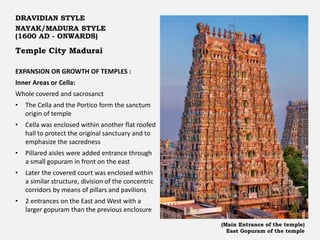
EXPANSION OR GROWTH OF TEMPLES :
Inner Areas or Cella:
Whole covered and sacrosanct
• The Cella and the Portico form the sanctum
origin of temple
• Cella was enclosed within another flat roofed
hall to protect the original sanctuary and to
emphasize the sacredness
• Pillared aisles were added entrance through
a small gopuram in front on the east
• Later the covered court was enclosed within
a similar structure, division of the concentric
corridors by means of pillars and pavilions
• 2 entrances on the East and West with a
larger gopuram than the previous enclosure
(Main Entrance of the temple)
East Gopuram of the temple
Temple City Madurai
DRAVIDIAN STYLE
NAYAK/MADURA STYLE
(1600 AD - ONWARDS)
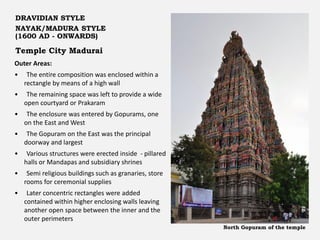
Outer Areas:
• The entire composition was enclosed within a
rectangle by means of a high wall
• The remaining space was left to provide a wide
open courtyard or Prakaram
• The enclosure was entered by Gopurams, one
on the East and West
• The Gopuram on the East was the principal
doorway and largest
• Various structures were erected inside - pillared
halls or Mandapas and subsidiary shrines
• Semi religious buildings such as granaries, store
rooms for ceremonial supplies
• Later concentric rectangles were added
contained within higher enclosing walls leaving
another open space between the inner and the
outer perimeters
North Gopuram of the temple
Temple City Madurai
DRAVIDIAN STYLE
NAYAK/MADURA STYLE
(1600 AD - ONWARDS)
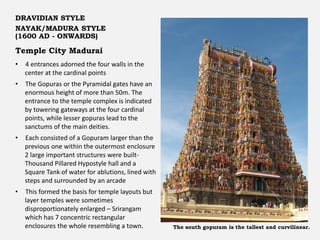
• 4 entrances adorned the four walls in the
center at the cardinal points
• The Gopuras or the Pyramidal gates have an
enormous height of more than 50m. The
entrance to the temple complex is indicated
by towering gateways at the four cardinal
points, while lesser gopuras lead to the
sanctums of the main deities.
• Each consisted of a Gopuram larger than the
previous one within the outermost enclosure
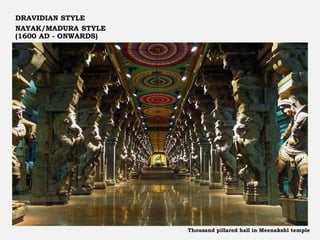
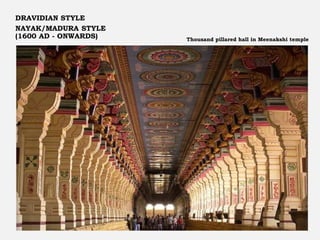
2 large important structures were built-
Thousand Pillared Hypostyle hall and a
Square Tank of water for ablutions, lined with
steps and surrounded by an arcade
• This formed the basis for temple layouts but
layer temples were sometimes
disproportionately enlarged – Srirangam
which has 7 concentric rectangular
enclosures the whole resembling a town. The south gopuram is the tallest and curvilinear.
Temple City Madurai
DRAVIDIAN STYLE
NAYAK/MADURA STYLE
(1600 AD - ONWARDS)
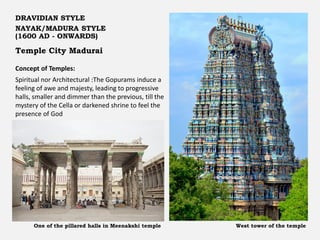
Concept of Temples:
Spiritual nor Architectural :The Gopurams induce a
feeling of awe and majesty, leading to progressive
halls, smaller and dimmer than the previous, till the
mystery of the Cella or darkened shrine to feel the
presence of God
West tower of the temple
One of the pillared halls in Meenakshi temple
DRAVIDIAN STYLE
NAYAK/MADURA STYLE
(1600 AD - ONWARDS)
Thousand pillared hall in Meenakshi temple
DRAVIDIAN STYLE
NAYAK/MADURA STYLE
(1600 AD - ONWARDS) Thousand pillared hall in Meenakshi temple
DRAVIDIAN STYLE
NAYAK/MADURA STYLE
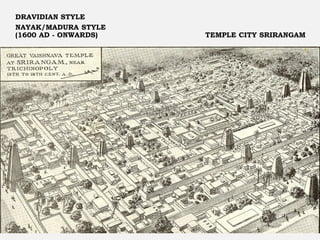
(1600 AD - ONWARDS) TEMPLE CITY SRIRANGAM
TEMPLE CITY SRIRANGAM
DRAVIDIAN STYLE
NAYAK/MADURA STYLE
(1600 AD - ONWARDS)
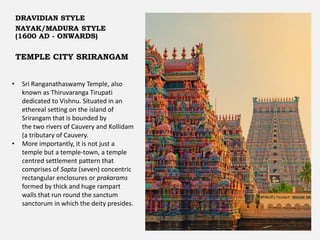
• Sri Ranganathaswamy Temple, also
known as Thiruvaranga Tirupati
dedicated to Vishnu. Situated in an
ethereal setting on the island of
Srirangam that is bounded by
the two rivers of Cauvery and Kollidam
(a tributary of Cauvery.
• More importantly, it is not just a
temple but a temple-town, a temple
centred settlement pattern that
comprises of Sapta (seven) concentric
rectangular enclosures or prakarams
formed by thick and huge rampart
walls that run round the sanctum
sanctorum in which the deity presides.
TEMPLE CITY SRIRANGAM
DRAVIDIAN STYLE
NAYAK/MADURA STYLE
(1600 AD - ONWARDS)
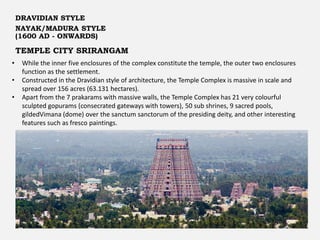
• While the inner five enclosures of the complex constitute the temple, the outer two enclosures
function as the settlement.
• Constructed in the Dravidian style of architecture, the Temple Complex is massive in scale and
spread over 156 acres (63.131 hectares).
• Apart from the 7 prakarams with massive walls, the Temple Complex has 21 very colourful
sculpted gopurams (consecrated gateways with towers), 50 sub shrines, 9 sacred pools,
gildedVimana (dome) over the sanctum sanctorum of the presiding deity, and other interesting
features such as fresco paintings.
DRAVIDIAN STYLE
NAYAK/MADURA STYLE
(1600 AD – ONWARDS)
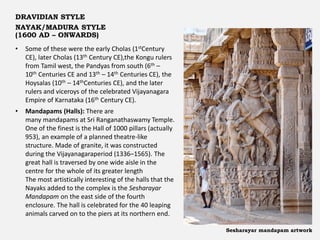
Sesharayar mandapam artwork
• Some of these were the early Cholas (1stCentury
CE), later Cholas (13th Century CE),the Kongu rulers
from Tamil west, the Pandyas from south (6th –
10th Centuries CE and 13th – 14th Centuries CE), the
Hoysalas (10th – 14thCenturies CE), and the later
rulers and viceroys of the celebrated Vijayanagara
Empire of Karnataka (16th Century CE).
• Mandapams (Halls): There are
many mandapams at Sri Ranganathaswamy Temple.
One of the finest is the Hall of 1000 pillars (actually
953), an example of a planned theatre-like
structure. Made of granite, it was constructed
during the Vijayanagaraperiod (1336–1565). The
great hall is traversed by one wide aisle in the
centre for the whole of its greater length
The most artistically interesting of the halls that the
Nayaks added to the complex is the Sesharayar
Mandapam on the east side of the fourth
enclosure. The hall is celebrated for the 40 leaping
animals carved on to the piers at its northern end.
DRAVIDIAN STYLE
NAYAK/MADURA STYLE
(1600 AD – ONWARDS)
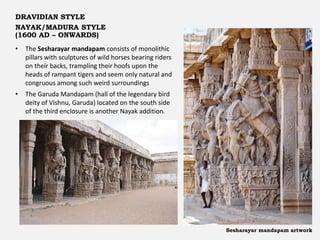
Sesharayar mandapam artwork
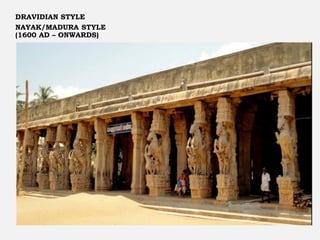
• The Sesharayar mandapam consists of monolithic
pillars with sculptures of wild horses bearing riders
on their backs, trampling their hoofs upon the
heads of rampant tigers and seem only natural and
congruous among such weird surroundings
• The Garuda Mandapam (hall of the legendary bird
deity of Vishnu, Garuda) located on the south side
of the third enclosure is another Nayak addition.
DRAVIDIAN STYLE
NAYAK/MADURA STYLE
(1600 AD – ONWARDS)
DRAVIDIAN STYLE
NAYAK/MADURA STYLE
(1600 AD – ONWARDS)
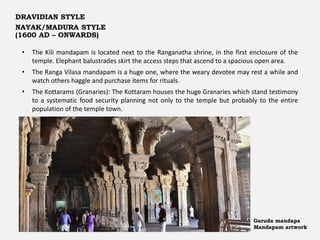
Garuda mandapa
Mandapam artwork
• The Kili mandapam is located next to the Ranganatha shrine, in the first enclosure of the
temple. Elephant balustrades skirt the access steps that ascend to a spacious open area.
• The Ranga Vilasa mandapam is a huge one, where the weary devotee may rest a while and
watch others haggle and purchase items for rituals.
• The Kottarams (Granaries): The Kottaram houses the huge Granaries which stand testimony
to a systematic food security planning not only to the temple but probably to the entire
population of the temple town.

History of Architecture - Evolution of temples - Dravidian Architecture Part - 2

  • 1.
    Evolution of Temples DRAVIDIANARCHITECTURE Part - 2 : Pandya Style, Vijayanagara Style, Nayak/Madura Style Temple Architecture in India
  • 2.
    • Introduction • DravidianArchitecture • This style of architecture that emerged thousands of years ago in the Indian subcontinent. • They consist primarily of pyramid shaped temples which are dependent on intricate carved stone in order to create a step design consisting of numerous statues of deities, warriors, kings, and dancers. • The majority of the existing buildings are located in the Southern Indian states of Tamil Nadu, Andhra Pradesh, Kerala, and Karnataka. • kingdoms which developed this style are: Pallavas, Cholas, Pandyan, Chera, Chalukyas, Rashtrakutas, Hoysalas, Vijayanagara Empire • Dravidian styled architecture can also be found in parts of Northeastern Sri Lanka, Maldives, and various parts of Southeast Asia.
  • 3.
    DIFFERENT PHASES INDRAVIDIAN ARCHITECTURE • The Dravidian Style of architecture can be categorized as a distinct Evolution in Temple architecture through the various phases • There is a marked evolution in the planning of the temple and the architectural treatment • Complexity in planning due to the complexity in the rituals arose by the 12th c. AD (Pandya) Broadly the classifications would be as follows: • Pallavan - Rock cut and Structural Temples • Chola - Development of the Vimana (Shikhara), Walled enclosures, Gopurams. • Pandya - Evolution of the Gopuram – number, height, embellishment High walls for enclosure for security( Muslim invasion) • Vijayanagara - Addition of Mandapas, Secondary halls and Gopurams • Nayaks - Temple cities, addition of Gopurams to existing temples • Pallavan Style 600AD – 900AD • Chola Style 900AD – 1150AD • Pandya Style 1100AD – 1350AD • Vijayanagara Style 1350AD – 1565AD • Nayak/Madura Style 1600 AD onwards
  • 4.
    PANDYAS (1100 AD -1350 AD) DRAVIDIAN STYLE
  • 5.
    After the Cholas-architecture was at its peak with the concentration being on the Vimana Changes during the Pandya period: • Vimana ceased to be the centre of concentration • The supplementary and outlying portions were developed • Reasons were sentimental- do not touch God • Walls were built/Pylons were the centre of concentration for architecture • Became the main feature of South Indian Temples • Derivation of the Cow gate- City gate- Temple gate- Gopuram Finest Pandya architecture : Jambukeswarar Temple, Tiruchirapalli. Meenakshi Temple, Madurai. (Phase - 1) Nataraja Temple, Chidambaram. Meenakshi’s Temple Madurai DRAVIDIAN STYLE PANDYAS (1100 AD - 1350 AD)
  • 6.
    • Considerable politicalchanges were taking place. The most threatening force was from the north -conquering hordes of Islam. • This threat made the Pandya rulers hurriedly throw up makeshift battlements around their cities and the heart of their towns -the temples. This called for modifying the Temple to a Fortress which was unacceptable • The solution was hence to raise the gates of the fortress to the level of architecture. This was the genesis of the famous gopurams, or entrance gateways of the temple cities of the south. • The towers, or the gopurams for which this temple is known, are visible from a distance. No less than 12gopurams or towers adorn this temple and the 4 outer ones tower to a height of over 160 feet. Nataraja Temple Chidambaram DRAVIDIAN STYLE PANDYAS (1100 AD - 1350 AD)
  • 7.
    • Surrounding theShiva and Meenakshi temples is a huge prakaram with imposing 9 tiered gopurams, in each of the 4 cardinal directions. The tallest of these is the southern tower, rising to a height of 170 feet. There are thus a total of 12 gopurams, two gold plated Vimaanams (crowning the sancta) and several mandapams with carved pillars within the Meenakshi Sundareswarar temple complex. • Meenakshi Temple is an architectural wonder. The imposing 14 Gopurams of the Temple Complex are awe inspiring and intricately carved. • The numerous Mandapas of the Temple like the Thousand Pillars Mandapam, tell us stories about Lord Shiva and Goddess Parvati sculpted out of rock. the Gopura too resembles a Mandala; • With sculptures and carvings of Yalis and mythical animals located in the outer enclosure. • Humans and divine beings are in the inner enclosures. • The peak of the Gopura, the Kalasha, is at the centre of the Mandala Jambukeswarar Temple, Thiruvanaikaval DRAVIDIAN STYLE PANDYAS (1100 AD - 1350 AD)
  • 8.
    Differences between Vimanaand Gopuram: • Shikhara, In Sanskrit word translating literally to "mountain peak", refers to the rising tower in the Hindu temple architecture of North India . • In South India, the equivalent term for "shikhara" is "vimana". • There existed two types as to the form of the Gopuram with respect to the appearance and the surface treatment DRAVIDIAN STYLE PANDYAS (1100 AD - 1350 AD) Vimana at Brihadeeshwara temple. Gopuram at Meenakshi temple.
  • 9.
    DRAVIDIAN STYLE PANDYAS (1100AD - 1350 AD) First type: • Straight sloping sides • Firm and rigid contours • Geometric form where the treatment is architectural • Pillars and pilasters were use. Second type: • more ornamentation • Curved and concave sides • Creating an upward sweep • Surface treatment is of Florid nature • Figure subjects predominate • Every portion is plastered thick with images • The roof is spectacular with cornuted gables • The ridge line breaks into a row of tall pinnacles forming a climax to the fretted and pullulating mass below Nataraja Temple, Chidambaram
  • 10.
    Surface Decoration: • Mostof the Pandya Gopurams are of the architectural type simple and conventional due to the early period of evolution. Dravidian Order: • Pillars and capital saw two changes. • The Idaie or flower motif was given a scalloped edge- foliated and exquisite appearance. • Alteration of the Bracket overhanging the bracket into a moulded pendent or a drop. • The Palagai was altered in proportion. • Abacus 2” thick, 4’ 6” feet dia. DRAVIDIAN STYLE PANDYAS (1100 AD - 1350 AD)
  • 11.
    VIJAYANAGARA STYLE (1350 AD- 1565 AD) DRAVIDIAN STYLE
  • 12.
    • Vijayanagara architectureis a vibrant combination of the Chalukya, Hoysala, Pandya and Chola styles, idioms that prospered in previous centuries. Its legacy of sculpture, architecture and painting influenced the development of the arts long after the empire came to an end. • In addition to building new temples, the empire added new structures and made modifications to hundreds of temples across South India. Some structures at Vijayanagara are from the pre- Vijayanagara period. • The empire built temples, monuments, palaces and other structures across South India, with a largest concentration in its capital. The monuments in and around Hampi in the Vijayanagara principality, are listed as a UNESCO World Heritage Site. DRAVIDIAN STYLE VIJAYANAGARA STYLE (1350 AD - 1565 AD)
  • 13.
    • In the14th century, the kings continued to build vesara or Deccan-style monuments but later incorporated Dravida-style gopuras to meet their ritualistic needs. • Vijayanagara architecture can be broadly classified into religious, courtly and civic architecture, as can the associated sculptures and paintings. • The Vijayanagara style is a combination of the Chalukya, Hoysala, Pandya and Chola styles which evolved earlier in the centuries when these empires ruled and is characterized by a return to the simplistic and serene art of the past • Vijayanagara architecture can be broadly classified into religious, courtly and civic architecture, as can the associated sculptures and paintings. DRAVIDIAN STYLE VIJAYANAGARA STYLE (1350 AD - 1565 AD) Virupaksha Temple at Hampi
  • 14.
    • In the14th century, the kings continued to build vesara or Deccan-style monuments but later incorporated Dravida-style gopuras to meet their ritualistic needs. DRAVIDIAN STYLE VIJAYANAGARA STYLE (1350 AD - 1565 AD) Vitthala Temple at Hampi
  • 15.
    • Because graniteis prone to flaking, few pieces of individual sculptures reached the high levels of quality seen in previous centuries. To cover the unevenness of the stone used in sculptures, artists employed plaster to give the rough surface a smooth finish and then painted it with lively colours • The idea of building large towers on the front of the temples has become more and more prevalent at this time. In the Hoysala period the peaks were made, but there was no idea of the tower. • These towers helped to enhance the beauty of the temple and identify as far away as ‘there is a temple’. Temple tank (Pushkarni) Hampi DRAVIDIAN STYLE VIJAYANAGARA STYLE (1350 AD - 1565 AD)
  • 16.
    List of templesbuilt during Vijayanagara Empire • Hampi Temples (Hampi) • Virupaksha temple (Hampi, Gokarna) • Lepakshi (Andhra Pradesh) • Kolar (Someshwara) • Tadipatri (Tadipatri Temples) (Andhra Pradesh) • Triupathi (Andhra Pradesh) • Ahobilam (Andhra Pradesh) • Sri Khalahasti (Andhra Pradesh) • Kumbakonam (Vellore) • Chaturmukha Basadi (Karkala) Someshwara Temple at Hampi DRAVIDIAN STYLE VIJAYANAGARA STYLE (1350 AD - 1565 AD) Restoration / Modifications : The temples of Vijayanagara have revived many of the Hoysala period temples. The inscriptions revealed that the tower, prakara and mantapa were constructed by the commander Gundappa Nayaka of this period, which destroyed the Belur Chennakeshava temple.
  • 17.
    Temples of Hampi SomeshwaraTemple at Hampi DRAVIDIAN STYLE VIJAYANAGARA STYLE (1350 AD - 1565 AD) • Hampi was the capital of the Vijayanagara Empire in the 14th century. Chronicles left by Persian and European travellers, particularly the Portuguese, say that Hampi was a prosperous, wealthy and grand city near the Tungabhadra River, with numerous temples, farms and trading markets. • Fall of vijayanagara The Vijayanagara Empire was defeated by a coalition of Muslim sultanates; its capital was conquered, pillaged and destroyed by sultanate armies in 1565, after which Hampi remained in ruins
  • 18.
    The Garuda stonechariot and Vitthala temple gopuram in 1856 and 2016 (Top) DRAVIDIAN STYLE VIJAYANAGARA STYLE (1350 AD - 1565 AD) Hampi is set in a rocky terrain. Above: one of the many Vijayanagara market ruins, with Tungabhadra River in the background.
  • 19.
    The Virupaksha orthe Pampapathi temple is the main center of pilgrimage at Hampi. It is fully intact, and it incorporates some earlier structures. This temple has three towers, the eastern tower rises to a height of 160 feet and is nine tiered. It dates back to the first half of the fifteenth century and was renovated in the sixteenth century by Krishnadevaraya. DRAVIDIAN STYLE VIJAYANAGARA STYLE (1350 AD - 1565 AD)
  • 20.
    One of thewater tanks, Hampi Ruins. DRAVIDIAN STYLE VIJAYANAGARA STYLE (1350 AD - 1565 AD)
  • 21.
    Elephant stables: syncreticstyle monuments. DRAVIDIAN STYLE VIJAYANAGARA STYLE (1350 AD - 1565 AD)
  • 22.
  • 23.
    The Vidyashankara templewas built in the year 1338 A.D it combines Hoysala (Chalukya) and Vijayanagara (Dravida) architectural features. It is built entirely of stone and stands on a high plinth, more or less a rectangle with apisidal east-west ends. DRAVIDIAN STYLE VIJAYANAGARA STYLE (1350 AD - 1565 AD)
  • 24.
    NAYAK/MADURA STYLE (1600 AD- ONWARDS) DRAVIDIAN STYLE
  • 25.
    • The muslimsstarted moving south which led to the shifting of the capital south at Madurai • The architecture flourished principally under the rule of Tirumalai Nayak 1623 – 1659 • The Madura Style as it is also known as was a revival of the Pandya style of architecture • The expansion of the temples corresponded to the expansion of the temple ritual : • The forms and ceremonies became more elaborate leading to the arrangement of buildings for the activities • The increase in the structural form was due to the wider powers given to the deity. DRAVIDIAN STYLE NAYAK/MADURA STYLE (1600 AD - ONWARDS)
  • 26.
    INNER AREAS : •Consisted of flat roofed courts, one enclosed within the other • This normally covered a fairly large rectangular space • Within the inner of the 2 courts is the sanctum, the cupolas of which covered in gilt projects out through the flat roofs acting as the focal center • There is a guarded seclusion to the inner area OUTER AREAS: • Concentric series of open courtyards known as ‘Prakarams’ • Enclosed within high walls, open to sky as they are too large to be roofed • Provide space for secular buildings connected with the ceremonies DRAVIDIAN STYLE NAYAK/MADURA STYLE (1600 AD - ONWARDS)
  • 27.
    Temple City Madurai DRAVIDIANSTYLE NAYAK/MADURA STYLE (1600 AD - ONWARDS) EXPANSION OR GROWTH OF TEMPLES : Inner Areas or Cella: Whole covered and sacrosanct • The Cella and the Portico form the sanctum origin of temple • Cella was enclosed within another flat roofed hall to protect the original sanctuary and to emphasize the sacredness • Pillared aisles were added entrance through a small gopuram in front on the east • Later the covered court was enclosed within a similar structure, division of the concentric corridors by means of pillars and pavilions • 2 entrances on the East and West with a larger gopuram than the previous enclosure (Main Entrance of the temple) East Gopuram of the temple
  • 28.
    Temple City Madurai DRAVIDIANSTYLE NAYAK/MADURA STYLE (1600 AD - ONWARDS) Outer Areas: • The entire composition was enclosed within a rectangle by means of a high wall • The remaining space was left to provide a wide open courtyard or Prakaram • The enclosure was entered by Gopurams, one on the East and West • The Gopuram on the East was the principal doorway and largest • Various structures were erected inside - pillared halls or Mandapas and subsidiary shrines • Semi religious buildings such as granaries, store rooms for ceremonial supplies • Later concentric rectangles were added contained within higher enclosing walls leaving another open space between the inner and the outer perimeters North Gopuram of the temple
  • 29.
    Temple City Madurai DRAVIDIANSTYLE NAYAK/MADURA STYLE (1600 AD - ONWARDS) • 4 entrances adorned the four walls in the center at the cardinal points • The Gopuras or the Pyramidal gates have an enormous height of more than 50m. The entrance to the temple complex is indicated by towering gateways at the four cardinal points, while lesser gopuras lead to the sanctums of the main deities. • Each consisted of a Gopuram larger than the previous one within the outermost enclosure 2 large important structures were built- Thousand Pillared Hypostyle hall and a Square Tank of water for ablutions, lined with steps and surrounded by an arcade • This formed the basis for temple layouts but layer temples were sometimes disproportionately enlarged – Srirangam which has 7 concentric rectangular enclosures the whole resembling a town. The south gopuram is the tallest and curvilinear.
  • 30.
    Temple City Madurai DRAVIDIANSTYLE NAYAK/MADURA STYLE (1600 AD - ONWARDS) Concept of Temples: Spiritual nor Architectural :The Gopurams induce a feeling of awe and majesty, leading to progressive halls, smaller and dimmer than the previous, till the mystery of the Cella or darkened shrine to feel the presence of God West tower of the temple One of the pillared halls in Meenakshi temple
  • 31.
    DRAVIDIAN STYLE NAYAK/MADURA STYLE (1600AD - ONWARDS) Thousand pillared hall in Meenakshi temple
  • 32.
    DRAVIDIAN STYLE NAYAK/MADURA STYLE (1600AD - ONWARDS) Thousand pillared hall in Meenakshi temple
  • 33.
    DRAVIDIAN STYLE NAYAK/MADURA STYLE (1600AD - ONWARDS) TEMPLE CITY SRIRANGAM
  • 34.
    TEMPLE CITY SRIRANGAM DRAVIDIANSTYLE NAYAK/MADURA STYLE (1600 AD - ONWARDS) • Sri Ranganathaswamy Temple, also known as Thiruvaranga Tirupati dedicated to Vishnu. Situated in an ethereal setting on the island of Srirangam that is bounded by the two rivers of Cauvery and Kollidam (a tributary of Cauvery. • More importantly, it is not just a temple but a temple-town, a temple centred settlement pattern that comprises of Sapta (seven) concentric rectangular enclosures or prakarams formed by thick and huge rampart walls that run round the sanctum sanctorum in which the deity presides.
  • 35.
    TEMPLE CITY SRIRANGAM DRAVIDIANSTYLE NAYAK/MADURA STYLE (1600 AD - ONWARDS) • While the inner five enclosures of the complex constitute the temple, the outer two enclosures function as the settlement. • Constructed in the Dravidian style of architecture, the Temple Complex is massive in scale and spread over 156 acres (63.131 hectares). • Apart from the 7 prakarams with massive walls, the Temple Complex has 21 very colourful sculpted gopurams (consecrated gateways with towers), 50 sub shrines, 9 sacred pools, gildedVimana (dome) over the sanctum sanctorum of the presiding deity, and other interesting features such as fresco paintings.
  • 36.
    DRAVIDIAN STYLE NAYAK/MADURA STYLE (1600AD – ONWARDS) Sesharayar mandapam artwork • Some of these were the early Cholas (1stCentury CE), later Cholas (13th Century CE),the Kongu rulers from Tamil west, the Pandyas from south (6th – 10th Centuries CE and 13th – 14th Centuries CE), the Hoysalas (10th – 14thCenturies CE), and the later rulers and viceroys of the celebrated Vijayanagara Empire of Karnataka (16th Century CE). • Mandapams (Halls): There are many mandapams at Sri Ranganathaswamy Temple. One of the finest is the Hall of 1000 pillars (actually 953), an example of a planned theatre-like structure. Made of granite, it was constructed during the Vijayanagaraperiod (1336–1565). The great hall is traversed by one wide aisle in the centre for the whole of its greater length The most artistically interesting of the halls that the Nayaks added to the complex is the Sesharayar Mandapam on the east side of the fourth enclosure. The hall is celebrated for the 40 leaping animals carved on to the piers at its northern end.
  • 37.
    DRAVIDIAN STYLE NAYAK/MADURA STYLE (1600AD – ONWARDS) Sesharayar mandapam artwork • The Sesharayar mandapam consists of monolithic pillars with sculptures of wild horses bearing riders on their backs, trampling their hoofs upon the heads of rampant tigers and seem only natural and congruous among such weird surroundings • The Garuda Mandapam (hall of the legendary bird deity of Vishnu, Garuda) located on the south side of the third enclosure is another Nayak addition.
  • 38.
  • 39.
    DRAVIDIAN STYLE NAYAK/MADURA STYLE (1600AD – ONWARDS) Garuda mandapa Mandapam artwork • The Kili mandapam is located next to the Ranganatha shrine, in the first enclosure of the temple. Elephant balustrades skirt the access steps that ascend to a spacious open area. • The Ranga Vilasa mandapam is a huge one, where the weary devotee may rest a while and watch others haggle and purchase items for rituals. • The Kottarams (Granaries): The Kottaram houses the huge Granaries which stand testimony to a systematic food security planning not only to the temple but probably to the entire population of the temple town.