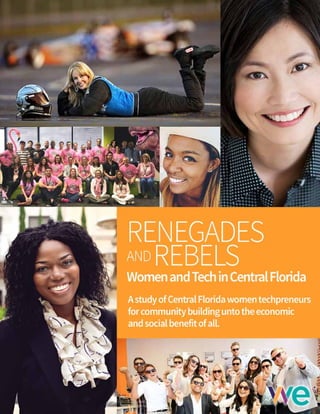
RENEGADES AND REBELS, W OMEN AND T ECH IN CENTRAL FL OR ID A • D E CE M BE R , 2 0 1 52
Designed and illustrated by Jill Shargaa • Shargaa Illustration & Design • www.shargaa.com • Orlando, Florida
This report was prepared by
Leslie Hielema
Vice President, Orlando Center
Florida Institue of Technology
@lhielema • lhielema@fit.edu
Danya Shea Glenny
Director, weVENTURE
Florida Institue of Technology
Founder, Fervr
@danyashea • dglenny@fit.edu
Special thanks to…
Necole Pynn
Landfall Creative
@necolepynn
STILL NEED
SHEA’S PHOTO
HERE
1
1. Setting the Stage:.................................................................2
	 Opening Context
	 Why We Did This Study................................................................... 2
	 Why Our Study Matters.................................................................. 3
		 Economic impact
		 New products and services
		 Innovative new business models
		 Cultures that matter to women
		 Realize full potential
		 Scale with digital tech
	 How We Studied............................................................................ 7
	 Who We Studied............................................................................. 8
2. Key Findings:........................................................................10
	Impact........................................................................................ 10
		 Revenue
		 Employees
		 Degrees
		 Universities
		 Mentors
		 Awards
	 Their Path to Tech........................................................................ 15
		 Interests & Passions are Starting Point
		 Problem-Solving is The Prize
		 Early and Consistent Exposure is Key
		 Self-belief Cultivates Confidence
		 Combine Left and Right Brain Thinking
3. Community Insights & Opportunities.................................21.
	 Embrace The New Power & The New Economy
	 Address Unconscious Gender Bias
	 Redefine Our Conversation with Girls
	 Prepare Women to Pursue Capital
	 Harness Shared Leadership and Collective Intelligence
	 Start A New Conversation
4. New Initiatives for Central FLorida...................................27
contents
RENEGADES AND REBELS, W OMEN AND T ECH IN CENTRAL FL ORIDA • NOVEMBER, 2015
RENEGADES AND REBELS, W OMEN AND T ECH IN CENTRAL FL OR ID A • D E CE M BE R , 2 0 1 5
Opening Context
T
o make data meaningful and actionable, context is key. Here we hope to
share the purpose behind initiating this study and the framework that guided
us through the process. For quick reference, here are the parameters of our
research project:
Study Timeframe: 4 months, July thru October 2015
Sample Pool: 100 women owners, founders, executives and technologists 		
		 identified with 40% response rate
Region: Orange, Seminole and Brevard Counties
Company age: early-stage startup to decades in business
Company Size: 1 employee to 500 employees
Revenue Range: pre-revenue to over $65mm in annual revenue
Industries: advanced manufacturing, aerospace, civil engineering, data analytics,
		 electronics, hardware development, IT, medical, mobile and web 	
		 development, modeling and simulation, nanotech, sensors, 		
		 software development, virtual reality
Why We Did This Study
S
ince Florida Institute of Technology launched weVENTURE Orlando in March
2015, we’ve been asked to provide many community partners, policy-makers
and media sources insight into the women techpreneurs in our region.
To provide the most accurate picture possible, we knew we needed to formally
address the collection of this information in a way many of us can leverage as we
make Orlando and the surrounding area the #1 choice for women to start and grow
companies, and participate fully in the tech boom, unto the economic benefit of all.
	 Additionally, there was a prevailing perception at many levels of our
community that “there aren’t a lot of women in tech.” Personally we know many
women in tech, but weren’t sure how indicative our perspective really was of the
reality of women in tech across Central Florida. We needed to do more research on
the demographics of women techpreneurs across Central Florida.
	 We are also often asked “Why does it matter to have more women in tech?”
National economic studies confirm that women-owned companies may be the
settingthestage
It seems clear
that the future
of American
entrepreneurship
and growth is
in the hands of
women.
— Kauffman Foundation
report, 2014
“
”
2
key to economic security in the years to come while local
studies confirm that the technology industry is the second
most important industry to our local economy. Therefore, we
investigated to see if there was a compelling case to justify a
community-wide imperative that we support women in tech
to have greater business success while also encouraging more
girls and young women to pursue futures in tech locally.
	
National Economic Insights Favoring Women Entrepreneurs
	 “Everyone, then, is in search of those future economic
tailwinds or “shocks” that will give a boost to twenty-first-
century growth in the same way that women’s labor force entry
and rising educational attainment did during the twentieth
century. One potential boost is a crucial economic area where
women continue to be underrepresented: entrepreneurship,
especially high-growth entrepreneurship.” - Kauffman, 2014
	 A study of U.S. Census data found that growth in women-
owned businesses with more than $10 million in revenue is
47% higher than among all companies with similar revenue.
A seed-stage investment firm recently reviewed its portfolio
and found that companies with at least one woman founder
performed 63% better, based on increase in company
valuation. In another study, the Kauffman foundation
found that women-led technology companies have a 35%
higher return on investment. With venture funding, those
companies have revenues 12% higher. Women are finding
success in building high-growth, venture-funded companies.
Local Economic Insights Favoring Technology Industry
In Central Florida, technology and science is the second-
largest industry after tourism, and it is one of the fastest-
growing, mirroring national and global trends. The area’s
primary industry sectors include modeling and simulation,
optics and photonics, interactive entertainment tech
and digital media, advanced manufacturing, information
technology, aviation and aerospace, and medical technology.
	 Learning about these companies and the entrepreneurs
who are building them provides us with a closer look at
a cluster of innovative businesses in our community and
provides insight into the experience of the entrepreneurs
who have built them. Through this information, we can see
the deep impact women have on the technology industry
in our region and gain a better understanding of future
opportunities for our community and the world.
Why Our Study Matters
W
e know that it is important to have more women
involved in technology and science. It is part of
the national dialog and can be seen in numerous
state and local initiatives. But we need to clearly understand
the reasons why it is important. By having a common
understanding of these reasons, we can leverage untapped
potential and implement the most impactful programs,
dialogs, and policy.
	 Technology is the thread that runs through a competitive
economy, driving multiple and diverse industries and
impacting myriad policy issues that are vital to commerce
and communication. Technology-based industries and
businesses create tremendous growth and opportunity
in the U.S. economy and are essential to competing in an
interconnected world. U.S.Chamber of Commerce
The potential to advance women economically may be the most exciting
transformative feature of technology.
— Center for the Advancement of Women, 2010
“
3RENEG ADES AND REBELS, W OMEN AND T ECH IN CENTRAL FL ORIDA • NOVEMBER, 2015
”
RENEGADES AND REBELS, W OMEN AND T ECH IN CENTRAL FL OR ID A • D E CE M BE R , 2 0 1 54
Six Reasons Why it is Important
to Have Women Engaged in Tech and Science
	
1) Economic Impact		
Women-owned businesses already are serious players in 	
this nation’s economy. However, women-owned businesses
continue to lag men-owned businesses in the top revenue
categories. Only 3% of majority women-owned firms have 	
revenues over $1 million compared to 6% of majority men-
owned businesses. The average revenue of women-owned
businesses is less than 30% of the average revenue of
majority men-owned businesses.
	 National Women’s Business Council
		 This means there is tremendous untapped and
unrealized potential for women-owned businesses to make
an even greater contribution to the nation’s economic health.
One way to realize this potential is to better support women
who are building businesses in industries with high revenue
potential which can be found in tech and science sectors.
2) New Products and Services
We recognize that a diverse set of experiences, perspectives,
and backgrounds is crucial to innovation and the development
of new ideas. It is crucial that women engage in devising
products or services that affect areas such as health, wealth,
safety, and wellbeing, to name a few. There is also opportunity
to enhance and increase the products and services that
address the needs of women as a market segment.
3) Innovative New Business Models
There is a growing trend toward transacting business on
the basis of authenticity and personal passion, solving
meaningful problems and creating sustainable, equitable,
and profitable enterprises. Increasingly, people are choosing
to do business on the basis of purpose and a vision of a
better world. These types of business models are resonating
with women and open the door to new types of businesses.
4) Cultures that Matter to Women
One of the hottest topics in business now is culture.
Companies with strong positive cultures are now the most in-
demand. You can feel a company's culture because it is evident
in people’s behavior, enthusiasm, and the space itself. Women
are creating cultures that are inclusive, respectful of diversity
and cultivateshared leadership and most important, they are
creating environments that are supportive for women.
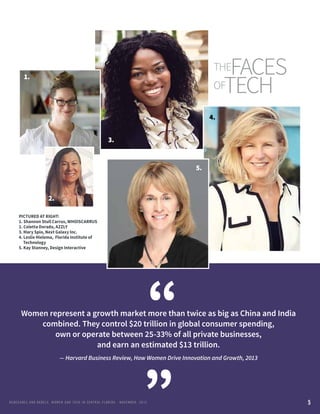
PICTURED AT RIGHT:
1. Tu-Hien Le, BeauGen
2. Suneera Madhani, Fattmerchant
3. Rachel Baker, Servos & Simulation
4. Shalyn Dever, Chatter Buzz
4.
2.
3.
1.
Continued on page 6
	 We’d like to introduce you to the women who are building and managing
tech companies and organizations in Central Florida. They’re solving problems
on a global scale, reshaping industries, and changing what we think of as
possible. Here’s a snapshot of some of the women and their companies
involved in this study.
theFACES
OFTECH
Women represent a growth market more than twice as big as China and India
combined. They control $20 trillion in global consumer spending,
own or operate between 25-33% of all private businesses,
and earn an estimated $13 trillion.
— Harvard Business Review, How Women Drive Innovation and Growth, 2013
“
” 5RENEG ADES AND REBELS, W OMEN AND T ECH IN CENTRAL FL ORIDA • NOVEMBER, 2015
theFACES
OFTECH
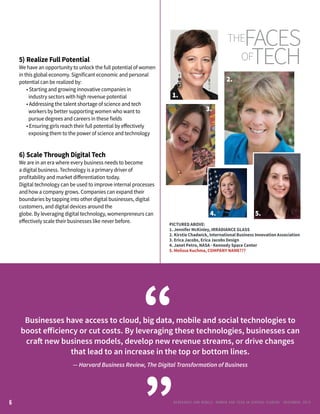
PICTURED AT RIGHT:
1. Shannon Stull Carrus, WHOISCARRUS
2. Coletta Dorado, AZZLY
3. Mary Spio, Next Galaxy Inc.
4. Leslie Hielema, Florida Institute of 		
Technology
5. Kay Stanney, Design Interactive
1.
2.
3.
4.
5.
5)	Realize Full Potential
We have an opportunity to unlock the full potential of women
in this global economy. Significant economic and personal
potential can be realized by:
	 • Starting and growing innovative companies in 		
		 industry sectors with high revenue potential
	 • Addressing the talent shortage of science and tech 		
		 workers by better supporting women who want to 		
		 pursue degrees and careers in these fields
	 • Ensuring girls reach their full potential by effectively 		
		 exposing them to the power of science and technology
6)	Scale Through Digital Tech
We are in an era where every business needs to become
a digital business. Technology is a primary driver of
profitability and market differentiation today. 		
Digital technology can be used to improve internal processes
and	how a company grows. Companies can expand their
boundaries by tapping into other digital businesses, digital
customers, and digital devices around the 		
globe. By leveraging digital technology, womenpreneurs can
effectively scale their businesses like never before.
PICTURED ABOVE:
1. Jennifer McKinley, IRRADIANCE GLASS
2. Kirstie Chadwick, International Business Innovation Association
3. Erica Jacobs, Erica Jacobs Design
4. Janet Petro, NASA - Kennedy Space Center
5. Melissa Kuchma, COMPANY NAME???
1.
2.
1.
3.
4.
theFACES
OFTECH
RENEGADES AND REBELS, W OMEN AND T ECH IN CENTRAL FL OR ID A • D E CE M BE R , 2 0 1 56
Businesses have access to cloud, big data, mobile and social technologies to
boost efficiency or cut costs. By leveraging these technologies, businesses can
craft new business models, develop new revenue streams, or drive changes
that lead to an increase in the top or bottom lines.
— Harvard Business Review, The Digital Transformation of Business
“
”
5.
RENEG ADES AND REBELS, W OMEN AND T ECH IN CENTRAL FL ORIDA • DECEMBER, 2015
	 1. Define what we want to achieve and the end goals.
	 2. Validate goals with stakeholders and subject matters experts.
	 3. Identify members of the target market.
	 4. Take time to develop the RIGHT questions. Test questions to ensure that they
		 elicit necessary data points.
	 5. Listen closely and immerse ourselves in the target market’s environment.
	 6. Watch carefully to see what bubbles up. Identify trends, commonalities, gaps 	
		 and opportunities.
	 7. Develop a common and meaningful vocabulary that 	describes results.
	 8. Convene stakeholders around the opportunities and gaps that matter most 	
		 to the community.
	 9. Together, define solutions and programs that align with market needs.
	 10. Ensure synergy among stakeholder’s offerings and cultivate initiatives that 	
		 span the entire continuum of needs.
	 11. Nurture on-going collaboration, as a community, to ensure long-term 	
		 economic development benefits.
HOW We Studied
W
e took an entrepreneurial approach to this study. Our goal was to
understand women in tech in the region and then develop the appropriate
response to their needs. This response may be in the form of a community
initiative, entrepreneurial programs, or even a new area for discussion. The end
goal of the study is to identify how we, as a community, could be the most
impactful to the success of women in tech and science.
	 WeutilizedastructuredapproachdevelopedbyLeslieHielematoconductthis
studywhichincludedprinciplesfromleanstartupandnewproductdevelopment
processesandappliedthemtocivicdevelopment.Thestepstothisapproachinclude:
It is through
this type of
“immersive
and objective
listening” that
we are able to
clearly identify
root issues and
most importantly,
launch targeted
initiatives that
will resonate best
with the market
and propel us all
to success.
—Leslie Hielema,
Florida Institute of
Technology
“
”
7
RENEGADES AND REBELS, W OMEN AND T ECH IN CENTRAL FL OR ID A • D E CE M BE R , 2 0 1 58
	 To begin our research study, we needed good access
to representatives of the population we wished to study.
When we began to ask colleagues for referrals to women
in tech we were surprised to discover an unconscious bias
affecting our region: the mental picture we hold of someone
in tech doesn’t connect to the actual women in tech. Society
holds and subtly perpetuates an outdated and stereotypical
image of a person in tech: male, antisocial, genius IQ, single
minded, with low emotional intelligence. No wonder it
was difficult for many of us to call to mind a woman in tech
who fit this subconscious picture! So first on our list was to
redefine the picture of a woman in tech in order to find the
representatives we sought.
	 We knew inherently that there is a natural blending of
creativity, artistry and entrepreneurship with technology
pursuits by women. Art and science are complementary rather
than distinct and different. Through our study, we discovered
our participants confirmed this knowledge. Their hobbies and
interests as children or adults ranged from reading at the top
of the list all the way to aquatic snails and Irish whistles. Each
individual had their own unique interests and curiosity. There
was a balance of the whole person in their daily life.
	 In addition to collecting economic data, we wanted
to hear the stories of the women building technology
companies in our community. We wanted to learn more
about how they approached science and engineering and
how their interest grew. We wanted to find the points in
their lives when they struggled with their choice of industry,
as we hear so many women do, and how they were able to
overcome those challenges. We try to partly tell this story in
their own voices – we’ve includes quotes from many of the
women we spoke to.
	 In interviews and surveys, we asked women about
their approach to business, their creative pursuits, and their
opinions on how we can reach more girls and women to get
them interested in careers in science and technology. We think
this information has implications for everyone working in tech,
men and women, and gives us great insight into the mind of
an entrepreneur. Here’s what we found out about who these
women are and how they’ve accomplished so much.
PICTURED AT RIGHT:
1. Elizabeth Burch,
DIGNITAS Technologies
2. Carol Cox,
InterMedia Solutions
3. Beverly Seay, SAIC and UCF
4. Diana LaTour,
COMPANY NAME
5. Carol Ann Dykes,
COMPANY NAME
1.
2.
WHO We Studied
W
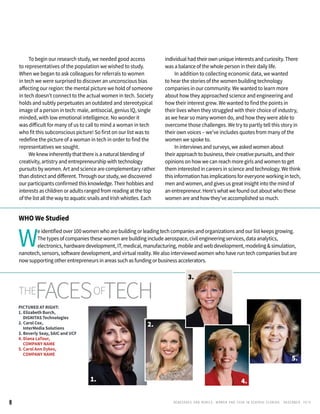
e identified over 100 women who are building or leading tech companies and organizations and our list keeps growing.
The types of companies these women are building include aerospace, civil engineering services, data analytics,
electronics, hardware development, IT, medical, manufacturing, mobile and web development, modeling & simulation,
nanotech, sensors, software development, and virtual reality. We also interviewed women who have run tech companies but are
now supporting other entrepreneurs in areas such as funding or business accelerators.
theFACESOFTECH
3.
5.
4.
RENEG ADES AND REBELS, W OMEN AND T ECH IN CENTRAL FL ORIDA • DECEMBER, 2015
I can honestly say
that I was never a
conformist. I didn't
follow the “norm” and
I certainly made sure
that I received all the
facts before I made any
decision. There were
many times I refused to
do things just because
they were the “popular”
things to do.
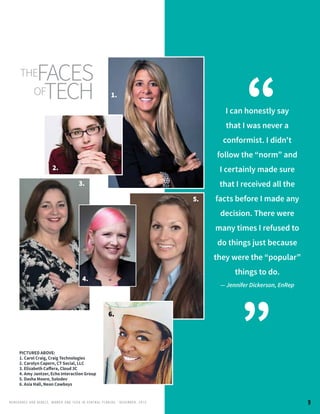
— Jennifer Dickerson, EnRep
“
”PICTURED ABOVE:
1. Carol Craig, Craig Technologies
2. Carolyn Capern, CT Social, LLC
3. Elizabeth Caffera, Cloud 3C
4. Amy Jantzer, Echo Interaction Group
5. Dasha Moore, Solodev
6. Asia Hall, Neon Cowboys
theFACES
OFTECH 1.
2.
3.
5.
9
4.
6.
10
keyfindings
W
e wanted to understand the impact of these women from both an
economic and civic perspective. It was important to create a snapshot of
their companies and background. From this picture, we can gain deeper
insights into the people making a difference in our community and the world. In
this study, we explored:
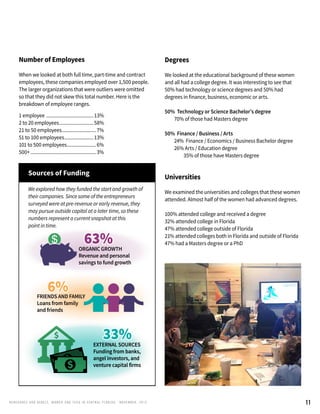
	 • Revenues
	 • Employees
	 • Funding
	 • Professional, civic and social engagement
	 • Degrees and universities
	 • Mentors and role models
	 • Awards
Revenue
When we analyzed revenues from the survey respondents, it equated to over
$150M in revenue. This does not include a few outliers that were several hundred
million in revenue.
Revenue ranges were collected across various ranges.
It seems clear
that the future
of American
entrepreneurship
and growth is
in the hands of
women.
— Kauffman Foundation
report, 2014
“
” Under $250K = 36%
$251K to $500K = 4%
$501K to $1M = 25%
$1 to $5 M = 14%
over $5M = 14%
over $20 M = 7%
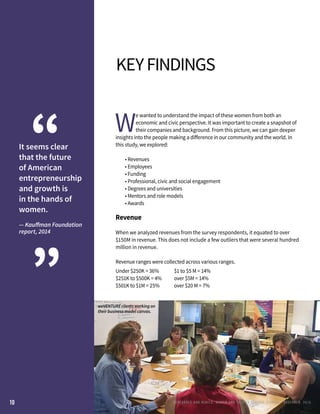
weVENTURE clients working on
their business model canvas.
RENEGADES AND REBELS, W OMEN AND T ECH IN CENTRAL FL OR ID A • D E CE M BE R , 2 0 1 5
RENEG ADES AND REBELS, W OMEN AND T ECH IN CENTRAL FL ORIDA • NOVEMBER, 2015 11
Number of Employees
When we looked at both full time, part-time and contract
employees, these companies employed over 1,500 people.
The larger organizations that were outliers were omitted
so that they did not skew this total number. Here is the
breakdown of employee ranges.
1 employee .....................................13%
2 to 20 employees...........................58%
21 to 50 employees...........................7%
51 to 100 employees.......................13%
101 to 500 employees.......................6%
500+...................................................3%
Degrees
We looked at the educational background of these women
and all had a college degree. It was interesting to see that
50% had technology or science degrees and 50% had
degrees in finance, business, economic or arts.
50% Technology or Science Bachelor’s degree
	 70% of those had Masters degree
50% Finance / Business / Arts
	 24% Finance / Economics / Business Bachelor degree
	 26% Arts / Education degree
		 35% of those have Masters degree
Universities
We examined the universities and colleges that these women
attended. Almost half of the women had advanced degrees.
100% attended college and received a degree
32% attended college in Florida
47% attended college outside of Florida
21% attended colleges both in Florida and outside of Florida
47% had a Masters degree or a PhD
Sources of Funding
We explored how they funded the start and growth of
their companies. Since some of the entrepreneurs
surveyed were at pre-revenue or early revenue, they
may pursue outside capital at a later time, so these
numbers represent a current snapshot at this
point in time.
ORGANIC GROWTH
Revenue and personal
savings to fund growth
63%63%
FRIENDS AND FAMILY
Loans from family
and friends
6%6%
EXTERNAL SOURCES
Funding from banks,
angel investors, and
venture capital firms
EXTERNAL SOURCES
Funding from banks,
angel investors, and
venture capital firms
33%33%
RENEGADES AND REBELS, W OMEN AND T ECH IN CENTRAL FL OR ID A • D E CE M BE R , 2 0 1 512
Athena NextGen
Athena PowerLink
Association of US Army
Brevard County Schools
Business Executives Network
Business and Professional Women’s 	
	 Foundation
CANVS
CareerSource Central Florida
Center for Advanced Entrepreneurship 	
	 at Rollins
Central Florida Navy League
Chamber of Commerce,
	 East Orlando & Oviedo
Citrus Club Young Executives
Committee Member
Camaraderie Foundation Mentor
Camaraderie PTSD
Coalition for the Homeless
Compassionate Hearts
Crooms Academy of IT
BAC
The Central Florida Partnership
Child Rescue Network
Dodge Ball for Charity
Early Learning Leaders
Executive Association
	 of Greater Orlando
FireStarter
First United Methodist Church Oviedo
Florida Chamber of Commerce
Florida Citrus Sports Bowl Scout and 	
	 Chair of Military Affairs Committee
Foundation for OCPS
Girl Scouts
Habitat for Humanity
Heroes Commons (Homes for Vets)
History Center Valencia College
Human Factors and Ergonomics, CAI
IOA Run
National Center for Simulation
Northland Church
MACF
Melbourne Chamber of Commerce
Melbourne Regional Tech Council
Mentor at UCF for WISE program
Member of NDIA
Metropolitan Business Association
	 of Orlando Member
Mills50 Business Association
Mission United
NAEYC
NBIA
Orange County Regional Board
	 of Director
Orlando Crime Stopper Board Director
Orlando, Inc. Board of Directors
Orlando Sports Foundation
	 (raising funds to fight breast 		
	 cancer)
Orlando Tech Association (OTA)
Orlando Tech Meetup
CureBowl
Project Management Institute
Project Management Professional
Rotary Club of Orlando Foundation
Board Center for Advanced 		
	 Entrepreneurship at Rollins Board 	
	 of Directors
Rotary Club of Orlando
Rucksack for Wounded Warrior
Samaritan Resource Center
SBRN of Central Florida
	 Steering Committee
Seminole County Democratic
	 Executive Committee
Small Business Development Council
South East Regional Internet Society
Space Coast EDC’s Innovation Council
Starter Studio
Startup Florida
STEM Alliance
Summit Church Youth Ministries
Society of Women Engineers
UCF
UCF Incubator
UCP of Central Florida
University Club Board of Directors
	 and head of Charitable Works 	
	 Committee
weVENTURE
Winter Park Tech
Women Business Enterprise Council
Women in Defense
Women’s Chamber of Commerce
Women Impacting Public Policy
USWCC-U.S.
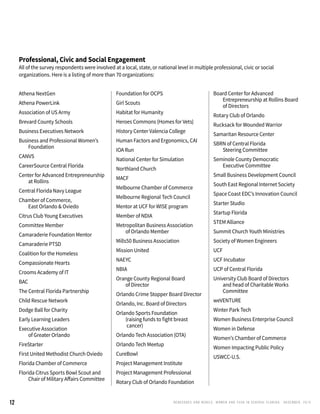
Professional, Civic and Social Engagement
All of the survey respondents were involved at a local, state, or national level in multiple professional, civic or social
organizations. Here is a listing of more than 70 organizations:
13
1.
3.
It’s time to start
reframing the
conversation
around women
in tech in terms
of potential.
“
”
2.
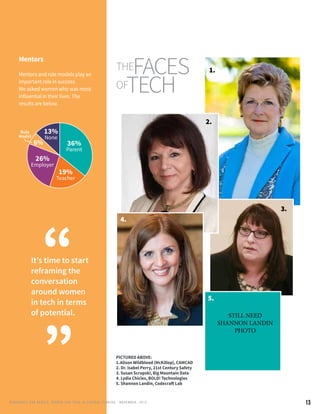
PICTURED ABOVE:
1.Alison Wildblood (McKillop), CAMCAD
2. Dr. Isabel Perry, 21st Century Safety
3. Susan Scrupski, Big Mountain Data
4. Lydia Chicles, BOLD! Technologies
5. Shannon Landin, Codecraft Lab
Mentors
Mentors and role models play an
important role in success.
We asked women who was most
influential in their lives. The
results are below.
36%
Parent
19%
Teacher
26%
Employer
6%
Role
Model
13%
None
theFACES
OFTECH
4.
5.
RENEG ADES AND REBELS, W OMEN AND T ECH IN CENTRAL FL ORIDA • NOVEMBER, 2015
STILL NEED
SHANNON LANDIN
PHOTO
RENEGADES AND REBELS, W OMEN AND T ECH IN CENTRAL FL OR ID A • D E CE M BE R , 2 0 1 514
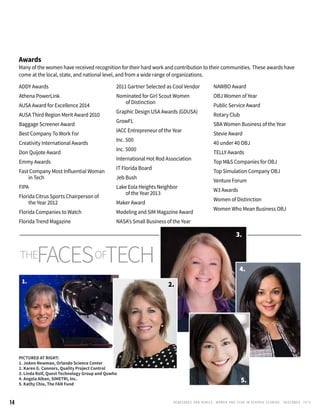
Awards
Many of the women have received recognition for their hard work and contribution to their communities. These awards have
come at the local, state, and national level, and from a wide range of organizations.
ADDY Awards
Athena PowerLink
AUSA Award for Excellence 2014
AUSA Third Region Merit Award 2010
Baggage Screener Award
Best Company To Work For
Creativity International Awards
Don Quijote Award
Emmy Awards
Fast Company Most Influential Woman 	
	 in Tech
FIPA
Florida Citrus Sports Chairperson of 	
	 the Year 2012
Florida Companies to Watch
Florida Trend Magazine
2011 Gartner Selected as Cool Vendor
Nominated for Girl Scout Women
	 of Distinction
Graphic Design USA Awards (GDUSA)
GrowFL
IACC Entrepreneur of the Year
Inc. 500
Inc. 5000
International Hot Rod Association
IT Florida Board
Jeb Bush
Lake Eola Heights Neighbor
	 of the Year 2013
Maker Award
Modeling and SIM Magazine Award
NASA’s Small Business of the Year
NAWBO Award
OBJ Women of Year
Public Service Award
Rotary Club
SBA Women Business of the Year
Stevie Award
40 under 40 OBJ
TELLY Awards
Top M&S Companies for OBJ
Top Simulation Company OBJ
Venture Forum
W3 Awards
Women of Distinction
Women Who Mean Business OBJ
3.
theFACESOFTECH 4.
5.
1.
PICTURED AT RIGHT:
1. JoAnn Newman, Orlando Science Center
2. Karen G. Connors, Quality Project Control
3. Linda Rolf, Quest Technology Group and Quwho
4. Angela Alban, SIMETRI, Inc.
5. Kathy Chiu, The FAN Fund
2.
15RENEG ADES AND REBELS, W OMEN AND T ECH IN CENTRAL FL ORIDA • DECEMBER, 2015
Their Path to Tech
We wanted to understand how and why they become
involved with technology or science. This is what we heard.
Interests and Passion is the Starting Point
Inmostcases,thepathtoscienceortechdidnotstartfromthe
technologyitself,butbeganwithapersonalinterestsuchas:
	 • Entrepreneurship
	 • Curiosity about how things worked
	 • Desire to solve a meaningful problem
	 • Enjoyment of games or puzzles
	 • Desire to invent something new
	 • Desire to make a difference in the world
	 I would read through encyclopedias or books about
greatest inventions like the telephone, automobile, golf clubs,
boats, etc. I also took a great interest in sports and learned
about the strategy and science behind the analytics and
probabilities to strategize games.
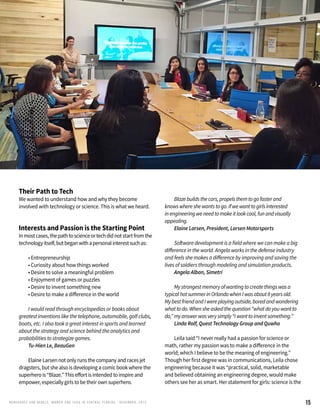
	 Tu-Hien Le, BeauGen
	 Elaine Larsen not only runs the company and races jet
dragsters, but she also is developing a comic book where the
superhero is “Blaze.” This effort is intended to inspire and
empower, especially girls to be their own superhero.
	
	 Blazebuildsthecars,propelsthemtogofasterand
knowswhereshewantstogo.Ifwewanttogirlsinterested
inengineeringweneedtomakeitlookcool,funandvisually
appealing.
	 Elaine Larsen, President, Larsen Motorsports
	 Software development is a field where we can make a big
difference in the world. Angela works in the defense industry
and feels she makes a difference by improving and saving the
lives of soldiers through modeling and simulation products.
	 Angela Alban, Simetri
	 Mystrongestmemoryofwantingtocreatethingswasa
typicalhotsummerinOrlandowhenIwasabout8yearsold.
MybestfriendandIwereplayingoutside,boredandwondering
whattodo.Whensheaskedthequestion“whatdoyouwantto
do,”myanswerwasverysimply“Iwanttoinventsomething.”
	 Linda Rolf, Quest Technology Group and Quwho
	 Leila said “I never really had a passion for science or
math, rather my passion was to make a difference in the
world; which I believe to be the meaning of engineering.”
Though her first degree was in communications, Leila chose
engineering because it was “practical, solid, marketable
and believed obtaining an engineering degree, would make
others see her as smart. Her statement for girls: science is the
RENEGADES AND REBELS, W OMEN AND T ECH IN CENTRAL FL OR ID A • D E CE M BE R , 2 0 1 516
language necessary to make a difference in people’s lives.
Leila Nodarse, Terracon (Nodarse and Associates, Inc. was
acquired by Terracon in 2011).
	 Whenyoucanapplypassiontoanyproblem,you’regoingto
sticktoitlonger.Whenyoucareaboutwhatyou’reworkingon,
itmakesahugedifference.Lettingpeoplehavetheirownvoice,
theirownpassions,andcelebratingthediversityofopinionand
experience,andempoweringtheirsolutionsissoimportant.
	 Shannon Landin, Codecraft Lab
Problem-Solving is the Prize
100% of the women we spoke to express their passion for
problem-solving. They like being able to identify a meaningful
problem, examine it from various angles, acquire the resources
needed to solve the problem and then find a solution. This
was how they defined their day, the core of what they do as
entrepreneurs and executives. For them, their sense of success
at having solved a tough problem increased their sense of
enjoyment and satisfaction.
	 Small or large, you feel like you’re making a difference if
that problem is getting solved.
	 Shalyn Dever, Chatter Buzz
	 Shalyn has grown her company to several million in
revenue with 80% of her workforce being women. She
has her degrees in Electrical Engineering and an MBA. She
defines smart as the ability to understand a situation and
solve the problem.
	
	 It is about taking the time to find the best solution and
using your street smarts to find the right resources. Women are
great problem solvers and that’s what an engineer needs.
	 Shalyn Dever, Chatter Buzz Media
Early and Consistent Exposure is the Key
	 Dad was an entrepreneur. Mom bought me a chemistry set
and told me I could do anything. I believed her.
	 Jennifer McKinley
This has been reflected as a national trend. In a study of 100
women tech founders in Silicon Valley, it was found that over
half of the women had a parent who was an entrepreneur.
Mary Spio, Founder & CEO, Next Galaxy Corp.
	 Mary discovered her passion at five when she had
fun with her dad doing math puzzles. She discovered
her career path in the Air Force when an engineer told
her that she was good at fixing things. The perception
that she would be stuck in a lab for endless hours as an
engineer made this career unappealing. But she found a
passion for satellites and space and went back to college
to study electrical engineering, graduating first in her
class. Mary thought that the ability to send satellites
to space seemed like a radical power to have and calls
her degree her “Jedi Power.” She has multiple patents
in digital cinema technology. Mary would tell young
women that just as you can train the muscles in your
body, you can be good at engineering.
Parents or early
role models were
key to influencing
curiosity or an
interest in science
or technology.
“
”
17RENEG ADES AND REBELS, W OMEN AND T ECH IN CENTRAL FL ORIDA • DECEMBER, 2015
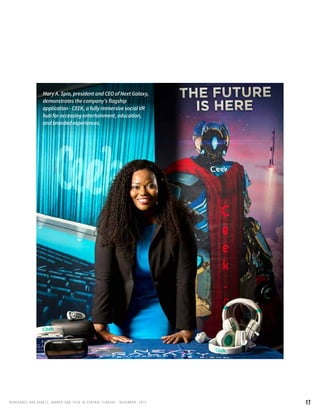
Mary A. Spio, president and CEO of Next Galaxy,
demonstrates the company’s flagship
application - CEEK, a fully immersive social VR
hub for accessing entertainment, education,
and branded experiences.
RENEGADES AND REBELS, W OMEN AND T ECH IN CENTRAL FL OR ID A • D E CE M BE R , 2 0 1 518
Self-Belief Cultivates
Confidence
The women interviewed had strong
awareness of their own intelligence
and capability. They demonstrated
courage and conviction. The ventured
down new and unfamiliar paths,
moved gracefully around obstacles,
derived strength from opposition,
and resourcefully sought knowledge
and know-how. These women are
renegades and rebels.
	 They had a strong belief that
they could accomplish what they set
out to do. There was an underlying
foundation of belief that they were
worthy of success and achievement.
They believed they were part of
something bigger than themselves.
	 Girls assess their mathematical
abilities lower than do boys with
similar mathematical achievements. At
the same time, girls hold themselves
to a higher standard than boys do in
subjects like math, believing that they
have to be exceptional to succeed in
“male” fields. By emphasizing that girls
and boys achieve equally well in math
and science, parents and teachers can
encourage girls to assess their skills
more accurately.
	 Why So Few? Women in Science,
Technology, Engineering and Math,
AAUW, 2010
	 We observed that these women
had a continuous path of progressive
accomplishments that were key to the
development of their self-belief and
self-confidence.
	 I believe confidence comes from a
sense of control over outcomes.
	 Carol Craig, Craig Technologies
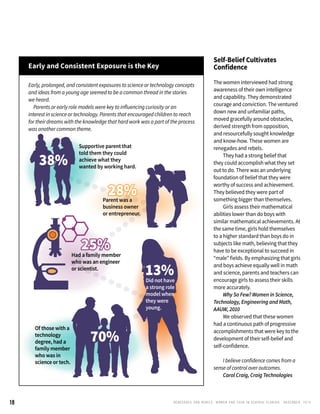
Early and Consistent Exposure is the Key
Early, prolonged, and consistent exposures to science or technology concepts
and ideas from a young age seemed to be a common thread in the stories
we heard.
Parents or early role models were key to influencing curiosity or an
interest in science or technology. Parents that encouraged children to reach
for their dreams with the knowledge that hard work was a part of the process
was another common theme.
Supportive parent that
told them they could
achieve what they
wanted by working hard.
Parent was a
business owner
or entrepreneur.
28%28%
Had a family member
who was an engineer
or scientist.
Had a family member
who was an engineer
or scientist.
25%25%
38%38%
Did not have
a strong role
model when
they were
young.
13%13%
Of those with a
technology
degree, had a
family member
who was in
science or tech.
Of those with a
technology
degree, had a
family member
who was in
science or tech.
70%70%
19RENEG ADES AND REBELS, W OMEN AND T ECH IN CENTRAL FL ORIDA • DECEMBER, 2015
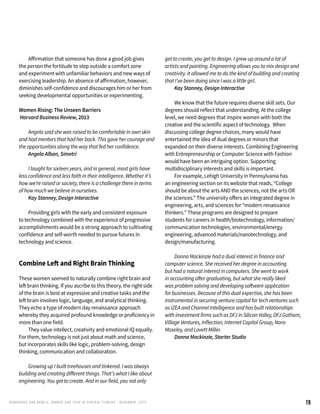
	 Affirmation that someone has done a good job gives
the person the fortitude to step outside a comfort zone
and experiment with unfamiliar behaviors and new ways of
exercising leadership. An absence of affirmation, however,
diminishes self-confidence and discourages him or her from
seeking developmental opportunities or experimenting.
Women Rising: The Unseen Barriers
Harvard Business Review, 2013
	 Angela said she was raised to be comfortable in own skin
and had mentors that had her back. This gave her courage and
the opportunities along the way that fed her confidence.
	 Angela Alban, Simetri
	 I taught for sixteen years, and in general, most girls have
less confidence and less faith in their intelligence. Whether it’s
how we’re raised or society, there is a challenge there in terms
of how much we believe in ourselves.
	 Kay Stanney, Design Interactive
	 Providing girls with the early and consistent exposure
to technology combined with the experience of progressive
accomplishments would be a strong approach to cultivating
confidence and self-worth needed to pursue futures in
technology and science.
Combine Left and Right Brain Thinking
These women seemed to naturally combine right brain and
left brain thinking. If you ascribe to this theory, the right side
of the brain is best at expressive and creative tasks and the
left brain involves logic, language, and analytical thinking.
They echo a type of modern day renaissance approach
whereby they acquired profound knowledge or proficiency in
more than one field.
	 They value intellect, creativity and emotional IQ equally.
For them, technology is not just about math and science,
but incorporates skills like logic, problem-solving, design
thinking, communication and collaboration.
	 Growing up I built treehouses and tinkered. I was always
building and creating different things. That’s what I like about
engineering. You get to create. And in our field, you not only
get to create, you get to design. I grew up around a lot of
artists and painting. Engineering allows you to mix design and
creativity. It allowed me to do the kind of building and creating
that I’ve been doing since I was a little girl.
	 Kay Stanney, Design Interactive
	 We know that the future requires diverse skill sets. Our
degrees should reflect that understanding. At the college
level, we need degrees that inspire women with both the
creative and the scientific aspect of technology. When
discussing college degree choices, many would have
entertained the idea of dual degrees or minors that
expanded on their diverse interests. Combining Engineering
with Entrepreneurship or Computer Science with Fashion
would have been an intriguing option. Supporting
multidisciplinary interests and skills is important.
	 For example, Lehigh University in Pennsylvania has
an engineering section on its website that reads, “College
should be about the arts AND the sciences, not the arts OR
the sciences.” The university offers an integrated degree in
engineering, arts, and sciences for “modern renaissance
thinkers.” These programs are designed to prepare
students for careers in health/biotechnology, information/
communication technologies, environmental/energy
engineering, advanced materials/nanotechnology, and
design/manufacturing.
	 Donna Mackinzie had a dual interest in finance and
computer science. She received her degree in accounting
but had a natural interest in computers. She went to work
in accounting after graduating, but what she really liked
was problem solving and developing software application
for businesses. Because of this dual expertise, she has been
instrumental in securing venture capital for tech ventures such
as IZEA and Channel Intelligence and has built relationships
with investment firms such as DFJ in Silicon Valley, DFJ Gotham,
Village Ventures, Inflection, Internet Capital Group, Noro-
Moseley, and Lovett Miller.
	 Donna Mackinzie, Starter Studio
RENEGADES AND REBELS, W OMEN AND T ECH IN CENTRAL FL OR ID A • D E CE M BE R , 2 0 1 520
6.
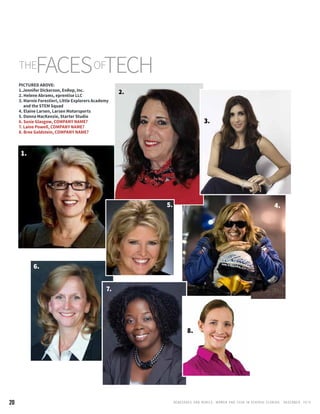
PICTURED ABOVE:
1.Jennifer Dickerson, EnRep, Inc.
2. Helene Abrams, eprentise LLC
3. Marnie Forestieri, Little Explorers Academy
and the STEM Squad
4. Elaine Larsen, Larsen Motorsports
5. Donna MacKenzie, Starter Studio
6. Susie Glasgow, COMPANY NAME?
7. Laine Powell, COMPANY NAME?
8. Bree Goldstein, COMPANY NAME?
theFACESOFTECH
4.
1.
2.
3.
7.
5.
8.
21
communityinsights
andopportunities
Embrace The New Power & The New Economy:
A Fourth Wave of Capitalism Emerging
T
he way we do business is changing. We’re entering a new wave of capitalism
that will be based on a purpose-driven enterprise model emphasizing global
connectedness, authenticity and a more personal business model. This shift
will shake up our business culture and require new skill sets of our business leaders.
This new wave resonates with womenpreneurs, which has resulted in innovative
products and services, unique business models, and empowering workplaces.
	 A recent article in the Harvard Business Review examines the skills sets
required by this new economy: the ability to continually learn, communication
skills, a developed worldview, an entrepreneurial mindset, ethics, initiative,
interpersonal skills, problem-solving ability, teamwork, and vision, among other
skills, will determine who succeeds as businesses grow to meet the demands of
evolving industries.
	 Throughout our study, we noticed strong, inclusive cultures, vibrant
communities of people who were comfortable with each other, supported in their
interests and pursuits, and honored as individuals with their own personalities.
The environment was often casual, comfortable, but clearly professional. Most
importantly, perhaps, was that through all of our conversations, the women
we spoke to often referred back to the contributions of their team members.
They emphasize the importance of giving each person the freedom to express
themselves, to experiment without judgement, to make mistakes, and to learn
from them. They emphasized the ability to listen and learn about each individual,
to let them speak for themselves.
	
	 In business we talk about teamwork, building the right team and chemistry.
Every single person has something special, something they’re going to bring to the
table. When a new employee or intern walks in here, I look at them and I see the
outside covering. But I say “now tell me about you” because I find the little nuances
of what they do or know so interesting. Those are the things that are going to bring
a spark to the project.
	 Elaine Larsen, Larsen Motorsports
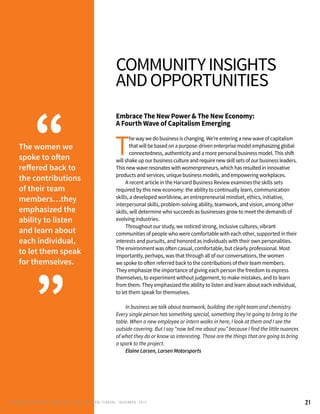
The women we
spoke to often
reffered back to
the contributions
of their team
members…they
emphasized the
ability to listen
and learn about
each individual,
to let them speak
for themselves.
“
”
RENEG ADES AND REBELS, W OMEN AND T ECH IN CENTRAL FL ORIDA • DECEMBER, 2015
• I had experienced a male
with less credentials making
more money than me in the
same job. Unfortunately, 		
my efforts to resolve that
were not met and I ended up
changing companiessinceI
feltIwasnotvalued.
• I had hired 2 executives
who had no respect for any
of my female employees and
of my values of an equal and
diverse workplace. It lead
me to terminate them in
order to firm my
commitment to an equal
and diverse workplace.
• I came in as a partner. I was
one of three. I went to my
first partner meeting, and in
my bag I got a box of cigars
and a necktie.
• I’ve encountered salary
issues and workplace
harassment. It’s still affecting
meandIdon’tthinkweever
reallygetovertoxicwork
environments.
•Manyyearsagoduringa
performancereviewIwas
toldthatIshouldjustget		
marriedandletmyhusband
supportme.WhileIhadmet
orexceededtheexpectations
formyposition,thelarger
raisesneededtogotomen
becausetheyhadfamilies
tosupport.Iwasadivorced
singlemotherworkingfull
timeandattendingcollege
fulltime.
• While my male peers
went to business dinners,
basketball games, I was left
in the basement to continue
with software updates.
• I was told by my male peers
at university, “You won’t last
when it gets too technical.”
• I overheard the statement
“Do we really want to take
something away	from man
and give it to a woman?
• I would make suggestions
about business that were
dismissed. I had to hire men
to say those same words to
be accepted.
“My math teacher
said “let me tell
you in terms you
understand –
shopping.”
”
	 Kay, an engineer, has grown her company to 80 employees
with over $8M in revenue. She believes success begets success
and hires super smart people and gives them free rein to do
what they want. She has employed at least 50 women with tech
and science degrees.
	 Kay Stanney, Design Interactive, Inc.
	 “Throughthisstudy,andourworkwithhundredsof
weVENTUREOrlandoclients,itisclearthattalentedCentralFlorida
womenpreneursarehighlymotivatedtobringcommerciallyviable
productstomarketinwaysthatareenrichingtoteammembers,
foragreatergoodthatsatisfiesadeepsenseofpurposeand/or
positivesocietal,economicorenvironmentalimpact.Embracing
thenewpowerandtheneweconomyispartofwhatcanmakeour
regionthe#1choiceforwomentostartandgrowtheircompanies,
untothebenefitofall.”
	 Danya Shea Glenny
Address Unconscious Gender Bias
There have been some challenges on the path to success.
90% of women surveyed felt that they had experienced
negative gender bias. Gender bias could be defined as unfair
or unequal difference in treatment because of someone’s
sex. Subconscious bias can have a negative effect on a
person’s decision making abilities and self-confidence. It can
limit the effectiveness of business relationships, fund raising,
and team dynamics.
	 Researchers asked people of both sexes to watch pitch
videos. Some of the videos were narrated by a man, others
by a woman. 68 percent of the people who watched the
videos said they’d fund the man, compared with only 32
percent who said they’d fund the woman. Those watching
the videos--men and women alike- considered the pitches
from the men more “persuasive,” “fact-based,” and “logical”
than the pitches from the women. Even though, word for
word, the scripts were exactly the same.
National Academy of Sciences (2014 Study)
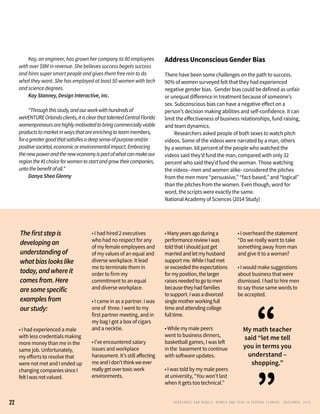
Thefirststepis
developingan
understandingof
whatbiaslookslike
today,andwhereit
comesfrom.Here
aresomespecific
examplesfrom
ourstudy:
RENEGADES AND REBELS, W OMEN AND T ECH IN CENTRAL FL OR ID A • D E CE M BE R , 2 0 1 522
23RENEG ADES AND REBELS, W OMEN AND T ECH IN CENTRAL FL ORIDA • DECEMBER, 2015
	 According to a Silicon Valley study, 33 percent of female
tech entrepreneurs reported facing “dismissive attitudes”
from their colleagues and 15 percent said their abilities
had been questioned. Women in Silicon Valley report overt
biases in hiring and promotion processes in many software
technology and investment companies.
	 Unconscious biases are created and reinforced by our
environments and experiences. Our mind is constantly
processing information, oftentimes without our conscious
awareness. When we are moving fast or lack all the data, our
unconscious biases fill in the gaps, influencing everything from
product decisions to our interactions with coworkers.
	 Google Ventures Research
	 In Harvard Business Review “Women Rising: The Unseen
Barriers” found that CEOs who make gender diversity a
priority, by setting aspirational goals for the proportion of
women in leadership roles, insisting on diverse slates of
candidates for senior positions, and developing mentoring
and training programs, are frustrated. They and their
companies spend time, money, and good intentions on
efforts to build a more robust pipeline of upwardly mobile
women, and then not much happens. Organizations
inadvertently undermine this process when they advise
women to proactively seek leadership roles without also
addressing policies and practices that communicate a
mismatch between how women are seen and the qualities
and experiences people tend to associate with leaders. The
problem with these leaders’ approaches is that they don’t
address the often fragile process of coming to see oneself.
	 Onewaytomitigatesubconsciousbiasistosetwell-defined
metricsforinterviews,hiringprocesses,andperformance
reviews.Somecompanies,includingmajortechnology
companiesthathavehaddifficultyrecruitingandretaining
femaletalent,haveimplementednewinternalsystemsfor
assessingskillsandperformanceusingmetricsinanattempt
toeliminatepersonalbias.Ensuringthatwearedoingthe
necessaryleg-worktoidentifycandidatesforBoardofDirector
positions,speakeropportunities,awardprogramsand
participationincommunityinitiativesisanotherstepforward.
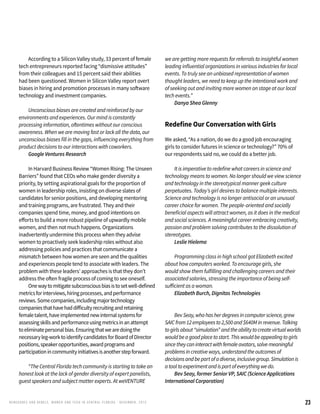
	 “The Central Florida tech community is starting to take an
honest look at the lack of gender diversity of expert panelists,
guest speakers and subject matter experts. At weVENTURE
we are getting more requests for referrals to insightful women
leading influential organizations in various industries for local
events. To truly see an unbiased representation of women
thought leaders, we need to keep up the intentional work and
of seeking out and inviting more women on stage at our local
tech events.”
	 Danya Shea Glenny
Redefine Our Conversation with Girls
We asked, “As a nation, do we do a good job encouraging
girls to consider futures in science or technology?” 70% of
our respondents said no, we could do a better job.
	 It is imperative to redefine what careers in science and
technology means to women. No longer should we view science
and technology in the stereotypical manner geek culture
perpetuates. Today’s girl desires to balance multiple interests.
Science and technology is no longer antisocial or an unusual
career choice for women. The people-oriented and socially
beneficial aspects will attract women, as it does in the medical
and social sciences. A meaningful career embracing creativity,
passion and problem solving contributes to the dissolution of
stereotypes.
	 Leslie Hielema
	 Programming class in high school got Elizabeth excited
about how computers worked. To encourage girls, she
would show them fulfilling and challenging careers and their
associated salaries, stressing the importance of being self-
sufficient as a woman.
	 Elizabeth Burch, Dignitas Technologies
	 BevSeay,whohasherdegreesincomputerscience,grew
SAICfrom12employeesto2,500and$640Minrevenue.Talking
togirlsabout“simulation”andtheabilitytocreatevirtualworlds
wouldbeagoodplacetostart.Thiswouldbeappealingtogirls
sincetheycaninteractwithfemaleavatars,solvemeaningful
problemsincreativeways,understandtheoutcomesof
decisionsandbepartofadiverse,inclusivegroup.Simulationis
atooltoexperimentandispartofeverythingwedo.
	 Bev Seay, former Senior VP, SAIC (Science Applications
International Corporation)
RENEGADES AND REBELS, W OMEN AND T ECH IN CENTRAL FL OR ID A • D E CE M BE R , 2 0 1 5
	 “In high school I thought I would be a linguist. Then I
realized that there are so many languages within the field
of computer science that are beautiful, and even if you go to
another country, they’re going to understand the computer
science languages because they’re in the field. I found
something really magical about that.”
	 Asia Hall, Neon Cowboys
	 CarolCraigdiscoveredherpassionin7thgradeinacomputer
scienceclass. ThatfirstcomputerclasshookedCarolonwriting
codewhilehercuriositywasfosteredbyhermother.Solving
problemsbywritingcodewastangibleandfulfilling.Togetagirl
inscienceortechnology,it’sallaboutnurturingpassion.Shesaid
“Iwasnevershotdown,Iwasalwaysencouraged.It’sallabout
rolemodelsineveryaspectofagirl’slife.”
	 Carol Craig, Craig Technologies
Prepare Women to Pursue Capital
Preparing women to access bank loans, working capital,
angel investments or venture capital funding will open up
new opportunities for business growth.
	 Studies from the National Women’s Business Council
indicate:
• If women-owned or -led companies were able to access
more outside capital, they would be more likely to survive
and grow because firms that use more outside capital have
higher survival rates and revenues.
• Undercapitalization limits enterprise growth by
constraining business investments in key assets such as
equipment, employees, or inventory necessary for growth;
the business does not have the funds it needs to meet
market demands.
• On average, men start their business with nearly twice as
much capital as women.
• Women received only 2% of total funding from outside
equity, compared to 18% for men.
	 “Envisioning a creative, meaningful, passionate and
problem-solving career is compelling to many girls as they
seek to imagine their futures. The horizon of possibilities
expands enormously when a young girl sees a woman she
can relate to solving a compelling problem using technology.
We can model new possibilities for our girls, and we must
change the language used with our girls if we wish to give them
unrestricted access to the economies of the near future.”
	 Leslie Hielema
Women account for only 4.4%
of the total dollar value of
conventional small business
loans. In other words, just $1 of
every $23 in conventional small
business loans goes to women-
owned businesses.
— Committee on Small Business & 		
Entrepreneurship Report, July 2014
“
”24
Helene taught herself to code when computers were
new on the scene. Larry Ellison, founder of Oracle, pursued
and personally recruited Helene because of her expertise
in databases and accounting. She has founded multiple
companies and she had to meet with 77 Venture Capital
firms, before she eventually received $25M in venture
funding. Helene Abrams, eprentise
	 “Adequatefundingatlaunchandgrowthphasesis
importantforspeedtomarket,gainingmarketshare,acquiring
talentorcompetition,andforopeningnewmarkets.Giving
womenpreneursequalaccesstoallthefundingoptionsallows
themtheopportunitytocompetebasedonmeritinthe
marketplace,ultimatelygivingusallbetterchoicesthatalign
withthechangingvaluesetsofconsciousconsumerbehavior.”
	 Danya Shea Glenny
Harness Shared Leadership
and Collective Intelligence
The practice of shared leadership and collective intelligence
was apparent within the companies.
Shared Leadership: The practice of bringing out the greatest
capacity in everyone by empowering each individual to be
responsible for and engaged in the success of the whole.
Collective Intelligence: Group intelligence that emerges
from the collaboration and collective efforts of many
individuals.
	 “If you have come here to help me, you are wasting your
time. But if you have come because your liberation is bound up
with mine, then let us work together.”
	 Australian Aboriginal artist, activist, and educator
	 Inarecentarticle“TheParadigmShifttoShared
Leadership”inConsciousCompanymagazine,itstatedthat
whenwereorientourselvestosharedleadership,wenaturally
risetogetherandopentowardeachother.Asleadershipadapts
tomeettheneedsofthetimes,itsimultaneouslyshapeshow
weseeourproblems,oursolutions,andourselves.Weareat
thebeginningofaparadigmshiftfromtop-down,positional
leadershiptomoresystemicandcollaborativewaysofleading,
generatedfromthewisdomthatourhumanity,equality,
wholeness,andcollectiveintelligencematterfirstandforemost.
	 As individuals and as a community, we inherently know
that if “you do better, we all do better.” By embracing the
philosophy of “a rising tide lifts all boats” in all that we do, we
empower and activate a community to achieve great things.
	 Leslie Hielema
	 Within the companies these women established, there
was the concept of collective intelligence baked into their
culture. Sharing intellectual and relationship capital was
part of their personal and business philosophy. Most were
involved with some form of mentoring or advising, sharing
their knowledge and connections with those inside and
outside their companies.
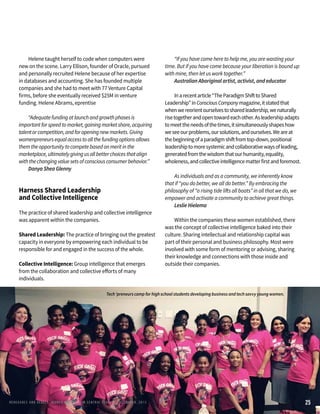
Tech 'preneurs camp for high school students developing business and tech savvy young women.
25RENEG ADES AND REBELS, W OMEN AND T ECH IN CENTRAL FL ORIDA • DECEMBER, 2015
RENEGADES AND REBELS, W OMEN AND T ECH IN CENTRAL FL OR ID A • D E CE M BE R , 2 0 1 526
	 “First hand, I’ve seen weVENTURE clients consistently
prefer to learn in group settings in order to speed their growth
through the collective intelligence of their peers. The learning
environments we facilitate rapidly evolve into problem-solving
situations where the experiential knowledge attendees gain
becomes greater than the course material or exercises could
have intended.”
	 Danya Shea Glenny
Start a New Conversation
Thereisarenewedconversationaboutequalityinthe
workplaceandaboutworkplacesadaptingtothe“whole”
person.Thewayweworkandwhyweworkisshifting.
Cooperativebusinessmodels,crowdsourcingandthe
democratizationofinformationareexamplesofashifttoward
collectiveintelligenceandsharedpower.Inthisnewera,leaders
needtocultivatemutualtrust,compassionandrespect.The
hierarchicalmodelwon’tworkinthiseraofsharedleadership.
	 “Women are building innovative high growth companies,
shaping industries, and impacting our global economy. With
this influence, we are reshaping the conversation about
entrepreneurship, business models and supportive cultures.
Through collaborative leadership, women are able to cultivate
the genius of the group. We are redefining what it means to be
successful as women. We understand that our career paths are
not linear, but multidimensional and circuitous. We embrace
both grace and grit as part of the process.”
	 Leslie Hielema
	 “In 2015 there is already a new conversation underway
across our nation and the globe about what success is for
women and the way women do work. We invite you to an
elevated dialogue around the opportunities and possibilities
before us to build a future for our region that enriches the lives
of ourselves and our neighbors, and that expresses our unique
contribution to the global economy.”
	 Danya Shea Glenny
weVENTURE clients practicing their pitches for judges Diana LaTour and Michael Judith.
27
Newinitiatives
In response to the research findings, community partners,
weVENTURE, and Florida Institute of Technology, together,
are launching three new initiatives.
weLEAD
In order to harness the power of collective intelligence, we launched weLEAD, a
collaborative ecosystem for businesswomen and womenpreneurs. It symbolizes
the characteristics of the new economy and new power and is intended to improve
access to capital and address unconscious gender bias.
	 The weLEAD website provides an easy-to-navigate ecosystem where one can
find the right resource at the right time. It is a place where everyone can contribute
their relational capital to the ecosystem, a “big door” where we can better connect
with one another and a central hub that lists all of the resources we have found to
be beneficial for growth as leaders and entrepreneurs.
	 Resources include:
(1) Associations and Organizations
(2) Advisors and Mentors
(3) Meet-ups and Events
(4) Leadership Development
(5) Global Initiatives
(6) Leveraging Tech
(7) Awards and Recognition
(8) Start-ups and Entrepreneurs
(9) Policy and Politics
	 The ever-changing ecosystem is organic, holistic and dynamic, creating a
collective support system that is continuously evolving.
	 Special thanks to Appleton Creative for creating the weLEAD website.
To access weLEAD, go to weLEADOrlando.com
Contact: Leslie Hielema at lhielema@fit.edu.
RENEG ADES AND REBELS, W OMEN AND T ECH IN CENTRAL FL ORIDA • DECEMBER, 2015
RENEGADES AND REBELS, W OMEN AND T ECH IN CENTRAL FL OR ID A • D E CE M BE R , 2 0 1 528
Girls Who Code
In response to the need to redefine the conversation with
our girls regarding futures in technology and science, we
are launching the national program Girls Who Code. Since
beginning in 2012, Girls Who Code to date has served over
3,860 girls in 29 states. The vision of Girls Who Code is to reach
gender parity in computing fields based on the fact that more
girls exposed to computer science at a young age will lead to
more women in technology and engineering fields.
	 Together with leading educators, engineers, and
entrepreneurs, Girls Who Code has developed a new model
for computer science education, pairing intensive instruction
in robotics, web design, and mobile development with high-
touch mentorship and exposure led by the industry’s top
female engineers and entrepreneurs.
	 The U.S. Department of Labor projects that by 2020,
there will be 1.4 million computer specialist job openings. To
reach gender parity by 2020, women must fill half of these
positions, or 700,000 computing jobs. Anecdotal data tells us
that an average of 30% of those students with exposure to
computer science will continue in the field. This means that
4.6M adolescent girls will require some form of exposure to
computer science education to realize gender parity in 2020.
	 With support from public and private partners and Girls
Who Code, together, we can educate, inspire, and equip
high school girls with the skills and resources to pursue
opportunities in computing field. By equipping girls with
21st century tools for innovation and social change, we can
ensure the economic prosperity for women, families and
communities across the globe.
Information is available at weVENTURE.org
Contact: Leslie Hielema at lhielema@fit.edu.
Women Who Drive Award Series
We want to recognize women who drive elements of the
new conversation around entrepreneurship and technology.
This new award series will showcase women who embody
the new power and the new economy. This may be through
revenue growth, innovative business models, accessing
capital, or harnessing shared leadership and collective
intelligence. The premier award program “Women Who
Drive” will be held in Orlando in 2016.
For more information, go to weVENTURE.org.
Contact: Shea Glenny at dglenny@fit.edu.
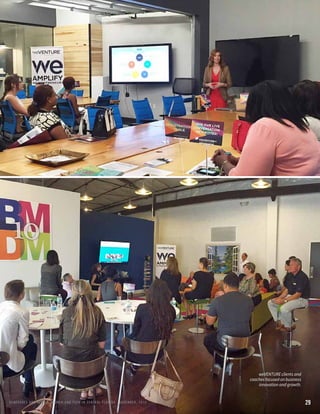
weVENTURE clients and
coaches focused on business
innovation and growth.
RENEG ADES AND REBELS, W OMEN AND T ECH IN CENTRAL FL ORIDA • DECEMBER, 2015 29
RENEGADES AND REBELS, W OMEN AND T ECH IN CENTRAL FL OR ID A • D E CE M BE R , 2 0 1 530
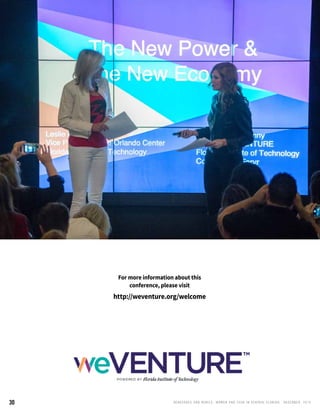
For more information about this
conference, please visit
http://weventure.org/welcome

Women intech

  • 2.
    RENEGADES AND REBELS,W OMEN AND T ECH IN CENTRAL FL OR ID A • D E CE M BE R , 2 0 1 52 Designed and illustrated by Jill Shargaa • Shargaa Illustration & Design • www.shargaa.com • Orlando, Florida This report was prepared by Leslie Hielema Vice President, Orlando Center Florida Institue of Technology @lhielema • lhielema@fit.edu Danya Shea Glenny Director, weVENTURE Florida Institue of Technology Founder, Fervr @danyashea • dglenny@fit.edu Special thanks to… Necole Pynn Landfall Creative @necolepynn STILL NEED SHEA’S PHOTO HERE
  • 3.
    1 1. Setting theStage:.................................................................2 Opening Context Why We Did This Study................................................................... 2 Why Our Study Matters.................................................................. 3 Economic impact New products and services Innovative new business models Cultures that matter to women Realize full potential Scale with digital tech How We Studied............................................................................ 7 Who We Studied............................................................................. 8 2. Key Findings:........................................................................10 Impact........................................................................................ 10 Revenue Employees Degrees Universities Mentors Awards Their Path to Tech........................................................................ 15 Interests & Passions are Starting Point Problem-Solving is The Prize Early and Consistent Exposure is Key Self-belief Cultivates Confidence Combine Left and Right Brain Thinking 3. Community Insights & Opportunities.................................21. Embrace The New Power & The New Economy Address Unconscious Gender Bias Redefine Our Conversation with Girls Prepare Women to Pursue Capital Harness Shared Leadership and Collective Intelligence Start A New Conversation 4. New Initiatives for Central FLorida...................................27 contents RENEGADES AND REBELS, W OMEN AND T ECH IN CENTRAL FL ORIDA • NOVEMBER, 2015
  • 4.
    RENEGADES AND REBELS,W OMEN AND T ECH IN CENTRAL FL OR ID A • D E CE M BE R , 2 0 1 5 Opening Context T o make data meaningful and actionable, context is key. Here we hope to share the purpose behind initiating this study and the framework that guided us through the process. For quick reference, here are the parameters of our research project: Study Timeframe: 4 months, July thru October 2015 Sample Pool: 100 women owners, founders, executives and technologists identified with 40% response rate Region: Orange, Seminole and Brevard Counties Company age: early-stage startup to decades in business Company Size: 1 employee to 500 employees Revenue Range: pre-revenue to over $65mm in annual revenue Industries: advanced manufacturing, aerospace, civil engineering, data analytics, electronics, hardware development, IT, medical, mobile and web development, modeling and simulation, nanotech, sensors, software development, virtual reality Why We Did This Study S ince Florida Institute of Technology launched weVENTURE Orlando in March 2015, we’ve been asked to provide many community partners, policy-makers and media sources insight into the women techpreneurs in our region. To provide the most accurate picture possible, we knew we needed to formally address the collection of this information in a way many of us can leverage as we make Orlando and the surrounding area the #1 choice for women to start and grow companies, and participate fully in the tech boom, unto the economic benefit of all. Additionally, there was a prevailing perception at many levels of our community that “there aren’t a lot of women in tech.” Personally we know many women in tech, but weren’t sure how indicative our perspective really was of the reality of women in tech across Central Florida. We needed to do more research on the demographics of women techpreneurs across Central Florida. We are also often asked “Why does it matter to have more women in tech?” National economic studies confirm that women-owned companies may be the settingthestage It seems clear that the future of American entrepreneurship and growth is in the hands of women. — Kauffman Foundation report, 2014 “ ” 2
  • 5.
    key to economicsecurity in the years to come while local studies confirm that the technology industry is the second most important industry to our local economy. Therefore, we investigated to see if there was a compelling case to justify a community-wide imperative that we support women in tech to have greater business success while also encouraging more girls and young women to pursue futures in tech locally. National Economic Insights Favoring Women Entrepreneurs “Everyone, then, is in search of those future economic tailwinds or “shocks” that will give a boost to twenty-first- century growth in the same way that women’s labor force entry and rising educational attainment did during the twentieth century. One potential boost is a crucial economic area where women continue to be underrepresented: entrepreneurship, especially high-growth entrepreneurship.” - Kauffman, 2014 A study of U.S. Census data found that growth in women- owned businesses with more than $10 million in revenue is 47% higher than among all companies with similar revenue. A seed-stage investment firm recently reviewed its portfolio and found that companies with at least one woman founder performed 63% better, based on increase in company valuation. In another study, the Kauffman foundation found that women-led technology companies have a 35% higher return on investment. With venture funding, those companies have revenues 12% higher. Women are finding success in building high-growth, venture-funded companies. Local Economic Insights Favoring Technology Industry In Central Florida, technology and science is the second- largest industry after tourism, and it is one of the fastest- growing, mirroring national and global trends. The area’s primary industry sectors include modeling and simulation, optics and photonics, interactive entertainment tech and digital media, advanced manufacturing, information technology, aviation and aerospace, and medical technology. Learning about these companies and the entrepreneurs who are building them provides us with a closer look at a cluster of innovative businesses in our community and provides insight into the experience of the entrepreneurs who have built them. Through this information, we can see the deep impact women have on the technology industry in our region and gain a better understanding of future opportunities for our community and the world. Why Our Study Matters W e know that it is important to have more women involved in technology and science. It is part of the national dialog and can be seen in numerous state and local initiatives. But we need to clearly understand the reasons why it is important. By having a common understanding of these reasons, we can leverage untapped potential and implement the most impactful programs, dialogs, and policy. Technology is the thread that runs through a competitive economy, driving multiple and diverse industries and impacting myriad policy issues that are vital to commerce and communication. Technology-based industries and businesses create tremendous growth and opportunity in the U.S. economy and are essential to competing in an interconnected world. U.S.Chamber of Commerce The potential to advance women economically may be the most exciting transformative feature of technology. — Center for the Advancement of Women, 2010 “ 3RENEG ADES AND REBELS, W OMEN AND T ECH IN CENTRAL FL ORIDA • NOVEMBER, 2015 ”
  • 6.
    RENEGADES AND REBELS,W OMEN AND T ECH IN CENTRAL FL OR ID A • D E CE M BE R , 2 0 1 54 Six Reasons Why it is Important to Have Women Engaged in Tech and Science 1) Economic Impact Women-owned businesses already are serious players in this nation’s economy. However, women-owned businesses continue to lag men-owned businesses in the top revenue categories. Only 3% of majority women-owned firms have revenues over $1 million compared to 6% of majority men- owned businesses. The average revenue of women-owned businesses is less than 30% of the average revenue of majority men-owned businesses. National Women’s Business Council This means there is tremendous untapped and unrealized potential for women-owned businesses to make an even greater contribution to the nation’s economic health. One way to realize this potential is to better support women who are building businesses in industries with high revenue potential which can be found in tech and science sectors. 2) New Products and Services We recognize that a diverse set of experiences, perspectives, and backgrounds is crucial to innovation and the development of new ideas. It is crucial that women engage in devising products or services that affect areas such as health, wealth, safety, and wellbeing, to name a few. There is also opportunity to enhance and increase the products and services that address the needs of women as a market segment. 3) Innovative New Business Models There is a growing trend toward transacting business on the basis of authenticity and personal passion, solving meaningful problems and creating sustainable, equitable, and profitable enterprises. Increasingly, people are choosing to do business on the basis of purpose and a vision of a better world. These types of business models are resonating with women and open the door to new types of businesses. 4) Cultures that Matter to Women One of the hottest topics in business now is culture. Companies with strong positive cultures are now the most in- demand. You can feel a company's culture because it is evident in people’s behavior, enthusiasm, and the space itself. Women are creating cultures that are inclusive, respectful of diversity and cultivateshared leadership and most important, they are creating environments that are supportive for women. PICTURED AT RIGHT: 1. Tu-Hien Le, BeauGen 2. Suneera Madhani, Fattmerchant 3. Rachel Baker, Servos & Simulation 4. Shalyn Dever, Chatter Buzz 4. 2. 3. 1. Continued on page 6 We’d like to introduce you to the women who are building and managing tech companies and organizations in Central Florida. They’re solving problems on a global scale, reshaping industries, and changing what we think of as possible. Here’s a snapshot of some of the women and their companies involved in this study. theFACES OFTECH
  • 7.
    Women represent agrowth market more than twice as big as China and India combined. They control $20 trillion in global consumer spending, own or operate between 25-33% of all private businesses, and earn an estimated $13 trillion. — Harvard Business Review, How Women Drive Innovation and Growth, 2013 “ ” 5RENEG ADES AND REBELS, W OMEN AND T ECH IN CENTRAL FL ORIDA • NOVEMBER, 2015 theFACES OFTECH PICTURED AT RIGHT: 1. Shannon Stull Carrus, WHOISCARRUS 2. Coletta Dorado, AZZLY 3. Mary Spio, Next Galaxy Inc. 4. Leslie Hielema, Florida Institute of Technology 5. Kay Stanney, Design Interactive 1. 2. 3. 4. 5.
  • 8.
    5) Realize Full Potential Wehave an opportunity to unlock the full potential of women in this global economy. Significant economic and personal potential can be realized by: • Starting and growing innovative companies in industry sectors with high revenue potential • Addressing the talent shortage of science and tech workers by better supporting women who want to pursue degrees and careers in these fields • Ensuring girls reach their full potential by effectively exposing them to the power of science and technology 6) Scale Through Digital Tech We are in an era where every business needs to become a digital business. Technology is a primary driver of profitability and market differentiation today. Digital technology can be used to improve internal processes and how a company grows. Companies can expand their boundaries by tapping into other digital businesses, digital customers, and digital devices around the globe. By leveraging digital technology, womenpreneurs can effectively scale their businesses like never before. PICTURED ABOVE: 1. Jennifer McKinley, IRRADIANCE GLASS 2. Kirstie Chadwick, International Business Innovation Association 3. Erica Jacobs, Erica Jacobs Design 4. Janet Petro, NASA - Kennedy Space Center 5. Melissa Kuchma, COMPANY NAME??? 1. 2. 1. 3. 4. theFACES OFTECH RENEGADES AND REBELS, W OMEN AND T ECH IN CENTRAL FL OR ID A • D E CE M BE R , 2 0 1 56 Businesses have access to cloud, big data, mobile and social technologies to boost efficiency or cut costs. By leveraging these technologies, businesses can craft new business models, develop new revenue streams, or drive changes that lead to an increase in the top or bottom lines. — Harvard Business Review, The Digital Transformation of Business “ ” 5.
  • 9.
    RENEG ADES ANDREBELS, W OMEN AND T ECH IN CENTRAL FL ORIDA • DECEMBER, 2015 1. Define what we want to achieve and the end goals. 2. Validate goals with stakeholders and subject matters experts. 3. Identify members of the target market. 4. Take time to develop the RIGHT questions. Test questions to ensure that they elicit necessary data points. 5. Listen closely and immerse ourselves in the target market’s environment. 6. Watch carefully to see what bubbles up. Identify trends, commonalities, gaps and opportunities. 7. Develop a common and meaningful vocabulary that describes results. 8. Convene stakeholders around the opportunities and gaps that matter most to the community. 9. Together, define solutions and programs that align with market needs. 10. Ensure synergy among stakeholder’s offerings and cultivate initiatives that span the entire continuum of needs. 11. Nurture on-going collaboration, as a community, to ensure long-term economic development benefits. HOW We Studied W e took an entrepreneurial approach to this study. Our goal was to understand women in tech in the region and then develop the appropriate response to their needs. This response may be in the form of a community initiative, entrepreneurial programs, or even a new area for discussion. The end goal of the study is to identify how we, as a community, could be the most impactful to the success of women in tech and science. WeutilizedastructuredapproachdevelopedbyLeslieHielematoconductthis studywhichincludedprinciplesfromleanstartupandnewproductdevelopment processesandappliedthemtocivicdevelopment.Thestepstothisapproachinclude: It is through this type of “immersive and objective listening” that we are able to clearly identify root issues and most importantly, launch targeted initiatives that will resonate best with the market and propel us all to success. —Leslie Hielema, Florida Institute of Technology “ ” 7
  • 10.
    RENEGADES AND REBELS,W OMEN AND T ECH IN CENTRAL FL OR ID A • D E CE M BE R , 2 0 1 58 To begin our research study, we needed good access to representatives of the population we wished to study. When we began to ask colleagues for referrals to women in tech we were surprised to discover an unconscious bias affecting our region: the mental picture we hold of someone in tech doesn’t connect to the actual women in tech. Society holds and subtly perpetuates an outdated and stereotypical image of a person in tech: male, antisocial, genius IQ, single minded, with low emotional intelligence. No wonder it was difficult for many of us to call to mind a woman in tech who fit this subconscious picture! So first on our list was to redefine the picture of a woman in tech in order to find the representatives we sought. We knew inherently that there is a natural blending of creativity, artistry and entrepreneurship with technology pursuits by women. Art and science are complementary rather than distinct and different. Through our study, we discovered our participants confirmed this knowledge. Their hobbies and interests as children or adults ranged from reading at the top of the list all the way to aquatic snails and Irish whistles. Each individual had their own unique interests and curiosity. There was a balance of the whole person in their daily life. In addition to collecting economic data, we wanted to hear the stories of the women building technology companies in our community. We wanted to learn more about how they approached science and engineering and how their interest grew. We wanted to find the points in their lives when they struggled with their choice of industry, as we hear so many women do, and how they were able to overcome those challenges. We try to partly tell this story in their own voices – we’ve includes quotes from many of the women we spoke to. In interviews and surveys, we asked women about their approach to business, their creative pursuits, and their opinions on how we can reach more girls and women to get them interested in careers in science and technology. We think this information has implications for everyone working in tech, men and women, and gives us great insight into the mind of an entrepreneur. Here’s what we found out about who these women are and how they’ve accomplished so much. PICTURED AT RIGHT: 1. Elizabeth Burch, DIGNITAS Technologies 2. Carol Cox, InterMedia Solutions 3. Beverly Seay, SAIC and UCF 4. Diana LaTour, COMPANY NAME 5. Carol Ann Dykes, COMPANY NAME 1. 2. WHO We Studied W e identified over 100 women who are building or leading tech companies and organizations and our list keeps growing. The types of companies these women are building include aerospace, civil engineering services, data analytics, electronics, hardware development, IT, medical, manufacturing, mobile and web development, modeling & simulation, nanotech, sensors, software development, and virtual reality. We also interviewed women who have run tech companies but are now supporting other entrepreneurs in areas such as funding or business accelerators. theFACESOFTECH 3. 5. 4.
  • 11.
    RENEG ADES ANDREBELS, W OMEN AND T ECH IN CENTRAL FL ORIDA • DECEMBER, 2015 I can honestly say that I was never a conformist. I didn't follow the “norm” and I certainly made sure that I received all the facts before I made any decision. There were many times I refused to do things just because they were the “popular” things to do. — Jennifer Dickerson, EnRep “ ”PICTURED ABOVE: 1. Carol Craig, Craig Technologies 2. Carolyn Capern, CT Social, LLC 3. Elizabeth Caffera, Cloud 3C 4. Amy Jantzer, Echo Interaction Group 5. Dasha Moore, Solodev 6. Asia Hall, Neon Cowboys theFACES OFTECH 1. 2. 3. 5. 9 4. 6.
  • 12.
    10 keyfindings W e wanted tounderstand the impact of these women from both an economic and civic perspective. It was important to create a snapshot of their companies and background. From this picture, we can gain deeper insights into the people making a difference in our community and the world. In this study, we explored: • Revenues • Employees • Funding • Professional, civic and social engagement • Degrees and universities • Mentors and role models • Awards Revenue When we analyzed revenues from the survey respondents, it equated to over $150M in revenue. This does not include a few outliers that were several hundred million in revenue. Revenue ranges were collected across various ranges. It seems clear that the future of American entrepreneurship and growth is in the hands of women. — Kauffman Foundation report, 2014 “ ” Under $250K = 36% $251K to $500K = 4% $501K to $1M = 25% $1 to $5 M = 14% over $5M = 14% over $20 M = 7% weVENTURE clients working on their business model canvas. RENEGADES AND REBELS, W OMEN AND T ECH IN CENTRAL FL OR ID A • D E CE M BE R , 2 0 1 5
  • 13.
    RENEG ADES ANDREBELS, W OMEN AND T ECH IN CENTRAL FL ORIDA • NOVEMBER, 2015 11 Number of Employees When we looked at both full time, part-time and contract employees, these companies employed over 1,500 people. The larger organizations that were outliers were omitted so that they did not skew this total number. Here is the breakdown of employee ranges. 1 employee .....................................13% 2 to 20 employees...........................58% 21 to 50 employees...........................7% 51 to 100 employees.......................13% 101 to 500 employees.......................6% 500+...................................................3% Degrees We looked at the educational background of these women and all had a college degree. It was interesting to see that 50% had technology or science degrees and 50% had degrees in finance, business, economic or arts. 50% Technology or Science Bachelor’s degree 70% of those had Masters degree 50% Finance / Business / Arts 24% Finance / Economics / Business Bachelor degree 26% Arts / Education degree 35% of those have Masters degree Universities We examined the universities and colleges that these women attended. Almost half of the women had advanced degrees. 100% attended college and received a degree 32% attended college in Florida 47% attended college outside of Florida 21% attended colleges both in Florida and outside of Florida 47% had a Masters degree or a PhD Sources of Funding We explored how they funded the start and growth of their companies. Since some of the entrepreneurs surveyed were at pre-revenue or early revenue, they may pursue outside capital at a later time, so these numbers represent a current snapshot at this point in time. ORGANIC GROWTH Revenue and personal savings to fund growth 63%63% FRIENDS AND FAMILY Loans from family and friends 6%6% EXTERNAL SOURCES Funding from banks, angel investors, and venture capital firms EXTERNAL SOURCES Funding from banks, angel investors, and venture capital firms 33%33%
  • 14.
    RENEGADES AND REBELS,W OMEN AND T ECH IN CENTRAL FL OR ID A • D E CE M BE R , 2 0 1 512 Athena NextGen Athena PowerLink Association of US Army Brevard County Schools Business Executives Network Business and Professional Women’s Foundation CANVS CareerSource Central Florida Center for Advanced Entrepreneurship at Rollins Central Florida Navy League Chamber of Commerce, East Orlando & Oviedo Citrus Club Young Executives Committee Member Camaraderie Foundation Mentor Camaraderie PTSD Coalition for the Homeless Compassionate Hearts Crooms Academy of IT BAC The Central Florida Partnership Child Rescue Network Dodge Ball for Charity Early Learning Leaders Executive Association of Greater Orlando FireStarter First United Methodist Church Oviedo Florida Chamber of Commerce Florida Citrus Sports Bowl Scout and Chair of Military Affairs Committee Foundation for OCPS Girl Scouts Habitat for Humanity Heroes Commons (Homes for Vets) History Center Valencia College Human Factors and Ergonomics, CAI IOA Run National Center for Simulation Northland Church MACF Melbourne Chamber of Commerce Melbourne Regional Tech Council Mentor at UCF for WISE program Member of NDIA Metropolitan Business Association of Orlando Member Mills50 Business Association Mission United NAEYC NBIA Orange County Regional Board of Director Orlando Crime Stopper Board Director Orlando, Inc. Board of Directors Orlando Sports Foundation (raising funds to fight breast cancer) Orlando Tech Association (OTA) Orlando Tech Meetup CureBowl Project Management Institute Project Management Professional Rotary Club of Orlando Foundation Board Center for Advanced Entrepreneurship at Rollins Board of Directors Rotary Club of Orlando Rucksack for Wounded Warrior Samaritan Resource Center SBRN of Central Florida Steering Committee Seminole County Democratic Executive Committee Small Business Development Council South East Regional Internet Society Space Coast EDC’s Innovation Council Starter Studio Startup Florida STEM Alliance Summit Church Youth Ministries Society of Women Engineers UCF UCF Incubator UCP of Central Florida University Club Board of Directors and head of Charitable Works Committee weVENTURE Winter Park Tech Women Business Enterprise Council Women in Defense Women’s Chamber of Commerce Women Impacting Public Policy USWCC-U.S. Professional, Civic and Social Engagement All of the survey respondents were involved at a local, state, or national level in multiple professional, civic or social organizations. Here is a listing of more than 70 organizations:
  • 15.
    13 1. 3. It’s time tostart reframing the conversation around women in tech in terms of potential. “ ” 2. PICTURED ABOVE: 1.Alison Wildblood (McKillop), CAMCAD 2. Dr. Isabel Perry, 21st Century Safety 3. Susan Scrupski, Big Mountain Data 4. Lydia Chicles, BOLD! Technologies 5. Shannon Landin, Codecraft Lab Mentors Mentors and role models play an important role in success. We asked women who was most influential in their lives. The results are below. 36% Parent 19% Teacher 26% Employer 6% Role Model 13% None theFACES OFTECH 4. 5. RENEG ADES AND REBELS, W OMEN AND T ECH IN CENTRAL FL ORIDA • NOVEMBER, 2015 STILL NEED SHANNON LANDIN PHOTO
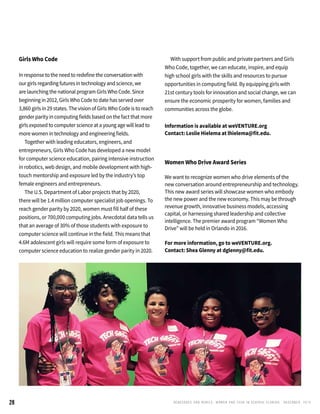
  • 16.
    RENEGADES AND REBELS,W OMEN AND T ECH IN CENTRAL FL OR ID A • D E CE M BE R , 2 0 1 514 Awards Many of the women have received recognition for their hard work and contribution to their communities. These awards have come at the local, state, and national level, and from a wide range of organizations. ADDY Awards Athena PowerLink AUSA Award for Excellence 2014 AUSA Third Region Merit Award 2010 Baggage Screener Award Best Company To Work For Creativity International Awards Don Quijote Award Emmy Awards Fast Company Most Influential Woman in Tech FIPA Florida Citrus Sports Chairperson of the Year 2012 Florida Companies to Watch Florida Trend Magazine 2011 Gartner Selected as Cool Vendor Nominated for Girl Scout Women of Distinction Graphic Design USA Awards (GDUSA) GrowFL IACC Entrepreneur of the Year Inc. 500 Inc. 5000 International Hot Rod Association IT Florida Board Jeb Bush Lake Eola Heights Neighbor of the Year 2013 Maker Award Modeling and SIM Magazine Award NASA’s Small Business of the Year NAWBO Award OBJ Women of Year Public Service Award Rotary Club SBA Women Business of the Year Stevie Award 40 under 40 OBJ TELLY Awards Top M&S Companies for OBJ Top Simulation Company OBJ Venture Forum W3 Awards Women of Distinction Women Who Mean Business OBJ 3. theFACESOFTECH 4. 5. 1. PICTURED AT RIGHT: 1. JoAnn Newman, Orlando Science Center 2. Karen G. Connors, Quality Project Control 3. Linda Rolf, Quest Technology Group and Quwho 4. Angela Alban, SIMETRI, Inc. 5. Kathy Chiu, The FAN Fund 2.
  • 17.
    15RENEG ADES ANDREBELS, W OMEN AND T ECH IN CENTRAL FL ORIDA • DECEMBER, 2015 Their Path to Tech We wanted to understand how and why they become involved with technology or science. This is what we heard. Interests and Passion is the Starting Point Inmostcases,thepathtoscienceortechdidnotstartfromthe technologyitself,butbeganwithapersonalinterestsuchas: • Entrepreneurship • Curiosity about how things worked • Desire to solve a meaningful problem • Enjoyment of games or puzzles • Desire to invent something new • Desire to make a difference in the world I would read through encyclopedias or books about greatest inventions like the telephone, automobile, golf clubs, boats, etc. I also took a great interest in sports and learned about the strategy and science behind the analytics and probabilities to strategize games. Tu-Hien Le, BeauGen Elaine Larsen not only runs the company and races jet dragsters, but she also is developing a comic book where the superhero is “Blaze.” This effort is intended to inspire and empower, especially girls to be their own superhero. Blazebuildsthecars,propelsthemtogofasterand knowswhereshewantstogo.Ifwewanttogirlsinterested inengineeringweneedtomakeitlookcool,funandvisually appealing. Elaine Larsen, President, Larsen Motorsports Software development is a field where we can make a big difference in the world. Angela works in the defense industry and feels she makes a difference by improving and saving the lives of soldiers through modeling and simulation products. Angela Alban, Simetri Mystrongestmemoryofwantingtocreatethingswasa typicalhotsummerinOrlandowhenIwasabout8yearsold. MybestfriendandIwereplayingoutside,boredandwondering whattodo.Whensheaskedthequestion“whatdoyouwantto do,”myanswerwasverysimply“Iwanttoinventsomething.” Linda Rolf, Quest Technology Group and Quwho Leila said “I never really had a passion for science or math, rather my passion was to make a difference in the world; which I believe to be the meaning of engineering.” Though her first degree was in communications, Leila chose engineering because it was “practical, solid, marketable and believed obtaining an engineering degree, would make others see her as smart. Her statement for girls: science is the
  • 18.
    RENEGADES AND REBELS,W OMEN AND T ECH IN CENTRAL FL OR ID A • D E CE M BE R , 2 0 1 516 language necessary to make a difference in people’s lives. Leila Nodarse, Terracon (Nodarse and Associates, Inc. was acquired by Terracon in 2011). Whenyoucanapplypassiontoanyproblem,you’regoingto sticktoitlonger.Whenyoucareaboutwhatyou’reworkingon, itmakesahugedifference.Lettingpeoplehavetheirownvoice, theirownpassions,andcelebratingthediversityofopinionand experience,andempoweringtheirsolutionsissoimportant. Shannon Landin, Codecraft Lab Problem-Solving is the Prize 100% of the women we spoke to express their passion for problem-solving. They like being able to identify a meaningful problem, examine it from various angles, acquire the resources needed to solve the problem and then find a solution. This was how they defined their day, the core of what they do as entrepreneurs and executives. For them, their sense of success at having solved a tough problem increased their sense of enjoyment and satisfaction. Small or large, you feel like you’re making a difference if that problem is getting solved. Shalyn Dever, Chatter Buzz Shalyn has grown her company to several million in revenue with 80% of her workforce being women. She has her degrees in Electrical Engineering and an MBA. She defines smart as the ability to understand a situation and solve the problem. It is about taking the time to find the best solution and using your street smarts to find the right resources. Women are great problem solvers and that’s what an engineer needs. Shalyn Dever, Chatter Buzz Media Early and Consistent Exposure is the Key Dad was an entrepreneur. Mom bought me a chemistry set and told me I could do anything. I believed her. Jennifer McKinley This has been reflected as a national trend. In a study of 100 women tech founders in Silicon Valley, it was found that over half of the women had a parent who was an entrepreneur. Mary Spio, Founder & CEO, Next Galaxy Corp. Mary discovered her passion at five when she had fun with her dad doing math puzzles. She discovered her career path in the Air Force when an engineer told her that she was good at fixing things. The perception that she would be stuck in a lab for endless hours as an engineer made this career unappealing. But she found a passion for satellites and space and went back to college to study electrical engineering, graduating first in her class. Mary thought that the ability to send satellites to space seemed like a radical power to have and calls her degree her “Jedi Power.” She has multiple patents in digital cinema technology. Mary would tell young women that just as you can train the muscles in your body, you can be good at engineering. Parents or early role models were key to influencing curiosity or an interest in science or technology. “ ”
  • 19.
    17RENEG ADES ANDREBELS, W OMEN AND T ECH IN CENTRAL FL ORIDA • DECEMBER, 2015 Mary A. Spio, president and CEO of Next Galaxy, demonstrates the company’s flagship application - CEEK, a fully immersive social VR hub for accessing entertainment, education, and branded experiences.
  • 20.
    RENEGADES AND REBELS,W OMEN AND T ECH IN CENTRAL FL OR ID A • D E CE M BE R , 2 0 1 518 Self-Belief Cultivates Confidence The women interviewed had strong awareness of their own intelligence and capability. They demonstrated courage and conviction. The ventured down new and unfamiliar paths, moved gracefully around obstacles, derived strength from opposition, and resourcefully sought knowledge and know-how. These women are renegades and rebels. They had a strong belief that they could accomplish what they set out to do. There was an underlying foundation of belief that they were worthy of success and achievement. They believed they were part of something bigger than themselves. Girls assess their mathematical abilities lower than do boys with similar mathematical achievements. At the same time, girls hold themselves to a higher standard than boys do in subjects like math, believing that they have to be exceptional to succeed in “male” fields. By emphasizing that girls and boys achieve equally well in math and science, parents and teachers can encourage girls to assess their skills more accurately. Why So Few? Women in Science, Technology, Engineering and Math, AAUW, 2010 We observed that these women had a continuous path of progressive accomplishments that were key to the development of their self-belief and self-confidence. I believe confidence comes from a sense of control over outcomes. Carol Craig, Craig Technologies Early and Consistent Exposure is the Key Early, prolonged, and consistent exposures to science or technology concepts and ideas from a young age seemed to be a common thread in the stories we heard. Parents or early role models were key to influencing curiosity or an interest in science or technology. Parents that encouraged children to reach for their dreams with the knowledge that hard work was a part of the process was another common theme. Supportive parent that told them they could achieve what they wanted by working hard. Parent was a business owner or entrepreneur. 28%28% Had a family member who was an engineer or scientist. Had a family member who was an engineer or scientist. 25%25% 38%38% Did not have a strong role model when they were young. 13%13% Of those with a technology degree, had a family member who was in science or tech. Of those with a technology degree, had a family member who was in science or tech. 70%70%
  • 21.
    19RENEG ADES ANDREBELS, W OMEN AND T ECH IN CENTRAL FL ORIDA • DECEMBER, 2015 Affirmation that someone has done a good job gives the person the fortitude to step outside a comfort zone and experiment with unfamiliar behaviors and new ways of exercising leadership. An absence of affirmation, however, diminishes self-confidence and discourages him or her from seeking developmental opportunities or experimenting. Women Rising: The Unseen Barriers Harvard Business Review, 2013 Angela said she was raised to be comfortable in own skin and had mentors that had her back. This gave her courage and the opportunities along the way that fed her confidence. Angela Alban, Simetri I taught for sixteen years, and in general, most girls have less confidence and less faith in their intelligence. Whether it’s how we’re raised or society, there is a challenge there in terms of how much we believe in ourselves. Kay Stanney, Design Interactive Providing girls with the early and consistent exposure to technology combined with the experience of progressive accomplishments would be a strong approach to cultivating confidence and self-worth needed to pursue futures in technology and science. Combine Left and Right Brain Thinking These women seemed to naturally combine right brain and left brain thinking. If you ascribe to this theory, the right side of the brain is best at expressive and creative tasks and the left brain involves logic, language, and analytical thinking. They echo a type of modern day renaissance approach whereby they acquired profound knowledge or proficiency in more than one field. They value intellect, creativity and emotional IQ equally. For them, technology is not just about math and science, but incorporates skills like logic, problem-solving, design thinking, communication and collaboration. Growing up I built treehouses and tinkered. I was always building and creating different things. That’s what I like about engineering. You get to create. And in our field, you not only get to create, you get to design. I grew up around a lot of artists and painting. Engineering allows you to mix design and creativity. It allowed me to do the kind of building and creating that I’ve been doing since I was a little girl. Kay Stanney, Design Interactive We know that the future requires diverse skill sets. Our degrees should reflect that understanding. At the college level, we need degrees that inspire women with both the creative and the scientific aspect of technology. When discussing college degree choices, many would have entertained the idea of dual degrees or minors that expanded on their diverse interests. Combining Engineering with Entrepreneurship or Computer Science with Fashion would have been an intriguing option. Supporting multidisciplinary interests and skills is important. For example, Lehigh University in Pennsylvania has an engineering section on its website that reads, “College should be about the arts AND the sciences, not the arts OR the sciences.” The university offers an integrated degree in engineering, arts, and sciences for “modern renaissance thinkers.” These programs are designed to prepare students for careers in health/biotechnology, information/ communication technologies, environmental/energy engineering, advanced materials/nanotechnology, and design/manufacturing. Donna Mackinzie had a dual interest in finance and computer science. She received her degree in accounting but had a natural interest in computers. She went to work in accounting after graduating, but what she really liked was problem solving and developing software application for businesses. Because of this dual expertise, she has been instrumental in securing venture capital for tech ventures such as IZEA and Channel Intelligence and has built relationships with investment firms such as DFJ in Silicon Valley, DFJ Gotham, Village Ventures, Inflection, Internet Capital Group, Noro- Moseley, and Lovett Miller. Donna Mackinzie, Starter Studio
  • 22.
    RENEGADES AND REBELS,W OMEN AND T ECH IN CENTRAL FL OR ID A • D E CE M BE R , 2 0 1 520 6. PICTURED ABOVE: 1.Jennifer Dickerson, EnRep, Inc. 2. Helene Abrams, eprentise LLC 3. Marnie Forestieri, Little Explorers Academy and the STEM Squad 4. Elaine Larsen, Larsen Motorsports 5. Donna MacKenzie, Starter Studio 6. Susie Glasgow, COMPANY NAME? 7. Laine Powell, COMPANY NAME? 8. Bree Goldstein, COMPANY NAME? theFACESOFTECH 4. 1. 2. 3. 7. 5. 8.
  • 23.
    21 communityinsights andopportunities Embrace The NewPower & The New Economy: A Fourth Wave of Capitalism Emerging T he way we do business is changing. We’re entering a new wave of capitalism that will be based on a purpose-driven enterprise model emphasizing global connectedness, authenticity and a more personal business model. This shift will shake up our business culture and require new skill sets of our business leaders. This new wave resonates with womenpreneurs, which has resulted in innovative products and services, unique business models, and empowering workplaces. A recent article in the Harvard Business Review examines the skills sets required by this new economy: the ability to continually learn, communication skills, a developed worldview, an entrepreneurial mindset, ethics, initiative, interpersonal skills, problem-solving ability, teamwork, and vision, among other skills, will determine who succeeds as businesses grow to meet the demands of evolving industries. Throughout our study, we noticed strong, inclusive cultures, vibrant communities of people who were comfortable with each other, supported in their interests and pursuits, and honored as individuals with their own personalities. The environment was often casual, comfortable, but clearly professional. Most importantly, perhaps, was that through all of our conversations, the women we spoke to often referred back to the contributions of their team members. They emphasize the importance of giving each person the freedom to express themselves, to experiment without judgement, to make mistakes, and to learn from them. They emphasized the ability to listen and learn about each individual, to let them speak for themselves. In business we talk about teamwork, building the right team and chemistry. Every single person has something special, something they’re going to bring to the table. When a new employee or intern walks in here, I look at them and I see the outside covering. But I say “now tell me about you” because I find the little nuances of what they do or know so interesting. Those are the things that are going to bring a spark to the project. Elaine Larsen, Larsen Motorsports The women we spoke to often reffered back to the contributions of their team members…they emphasized the ability to listen and learn about each individual, to let them speak for themselves. “ ” RENEG ADES AND REBELS, W OMEN AND T ECH IN CENTRAL FL ORIDA • DECEMBER, 2015
  • 24.
    • I hadexperienced a male with less credentials making more money than me in the same job. Unfortunately, my efforts to resolve that were not met and I ended up changing companiessinceI feltIwasnotvalued. • I had hired 2 executives who had no respect for any of my female employees and of my values of an equal and diverse workplace. It lead me to terminate them in order to firm my commitment to an equal and diverse workplace. • I came in as a partner. I was one of three. I went to my first partner meeting, and in my bag I got a box of cigars and a necktie. • I’ve encountered salary issues and workplace harassment. It’s still affecting meandIdon’tthinkweever reallygetovertoxicwork environments. •Manyyearsagoduringa performancereviewIwas toldthatIshouldjustget marriedandletmyhusband supportme.WhileIhadmet orexceededtheexpectations formyposition,thelarger raisesneededtogotomen becausetheyhadfamilies tosupport.Iwasadivorced singlemotherworkingfull timeandattendingcollege fulltime. • While my male peers went to business dinners, basketball games, I was left in the basement to continue with software updates. • I was told by my male peers at university, “You won’t last when it gets too technical.” • I overheard the statement “Do we really want to take something away from man and give it to a woman? • I would make suggestions about business that were dismissed. I had to hire men to say those same words to be accepted. “My math teacher said “let me tell you in terms you understand – shopping.” ” Kay, an engineer, has grown her company to 80 employees with over $8M in revenue. She believes success begets success and hires super smart people and gives them free rein to do what they want. She has employed at least 50 women with tech and science degrees. Kay Stanney, Design Interactive, Inc. “Throughthisstudy,andourworkwithhundredsof weVENTUREOrlandoclients,itisclearthattalentedCentralFlorida womenpreneursarehighlymotivatedtobringcommerciallyviable productstomarketinwaysthatareenrichingtoteammembers, foragreatergoodthatsatisfiesadeepsenseofpurposeand/or positivesocietal,economicorenvironmentalimpact.Embracing thenewpowerandtheneweconomyispartofwhatcanmakeour regionthe#1choiceforwomentostartandgrowtheircompanies, untothebenefitofall.” Danya Shea Glenny Address Unconscious Gender Bias There have been some challenges on the path to success. 90% of women surveyed felt that they had experienced negative gender bias. Gender bias could be defined as unfair or unequal difference in treatment because of someone’s sex. Subconscious bias can have a negative effect on a person’s decision making abilities and self-confidence. It can limit the effectiveness of business relationships, fund raising, and team dynamics. Researchers asked people of both sexes to watch pitch videos. Some of the videos were narrated by a man, others by a woman. 68 percent of the people who watched the videos said they’d fund the man, compared with only 32 percent who said they’d fund the woman. Those watching the videos--men and women alike- considered the pitches from the men more “persuasive,” “fact-based,” and “logical” than the pitches from the women. Even though, word for word, the scripts were exactly the same. National Academy of Sciences (2014 Study) Thefirststepis developingan understandingof whatbiaslookslike today,andwhereit comesfrom.Here aresomespecific examplesfrom ourstudy: RENEGADES AND REBELS, W OMEN AND T ECH IN CENTRAL FL OR ID A • D E CE M BE R , 2 0 1 522
  • 25.
    23RENEG ADES ANDREBELS, W OMEN AND T ECH IN CENTRAL FL ORIDA • DECEMBER, 2015 According to a Silicon Valley study, 33 percent of female tech entrepreneurs reported facing “dismissive attitudes” from their colleagues and 15 percent said their abilities had been questioned. Women in Silicon Valley report overt biases in hiring and promotion processes in many software technology and investment companies. Unconscious biases are created and reinforced by our environments and experiences. Our mind is constantly processing information, oftentimes without our conscious awareness. When we are moving fast or lack all the data, our unconscious biases fill in the gaps, influencing everything from product decisions to our interactions with coworkers. Google Ventures Research In Harvard Business Review “Women Rising: The Unseen Barriers” found that CEOs who make gender diversity a priority, by setting aspirational goals for the proportion of women in leadership roles, insisting on diverse slates of candidates for senior positions, and developing mentoring and training programs, are frustrated. They and their companies spend time, money, and good intentions on efforts to build a more robust pipeline of upwardly mobile women, and then not much happens. Organizations inadvertently undermine this process when they advise women to proactively seek leadership roles without also addressing policies and practices that communicate a mismatch between how women are seen and the qualities and experiences people tend to associate with leaders. The problem with these leaders’ approaches is that they don’t address the often fragile process of coming to see oneself. Onewaytomitigatesubconsciousbiasistosetwell-defined metricsforinterviews,hiringprocesses,andperformance reviews.Somecompanies,includingmajortechnology companiesthathavehaddifficultyrecruitingandretaining femaletalent,haveimplementednewinternalsystemsfor assessingskillsandperformanceusingmetricsinanattempt toeliminatepersonalbias.Ensuringthatwearedoingthe necessaryleg-worktoidentifycandidatesforBoardofDirector positions,speakeropportunities,awardprogramsand participationincommunityinitiativesisanotherstepforward. “The Central Florida tech community is starting to take an honest look at the lack of gender diversity of expert panelists, guest speakers and subject matter experts. At weVENTURE we are getting more requests for referrals to insightful women leading influential organizations in various industries for local events. To truly see an unbiased representation of women thought leaders, we need to keep up the intentional work and of seeking out and inviting more women on stage at our local tech events.” Danya Shea Glenny Redefine Our Conversation with Girls We asked, “As a nation, do we do a good job encouraging girls to consider futures in science or technology?” 70% of our respondents said no, we could do a better job. It is imperative to redefine what careers in science and technology means to women. No longer should we view science and technology in the stereotypical manner geek culture perpetuates. Today’s girl desires to balance multiple interests. Science and technology is no longer antisocial or an unusual career choice for women. The people-oriented and socially beneficial aspects will attract women, as it does in the medical and social sciences. A meaningful career embracing creativity, passion and problem solving contributes to the dissolution of stereotypes. Leslie Hielema Programming class in high school got Elizabeth excited about how computers worked. To encourage girls, she would show them fulfilling and challenging careers and their associated salaries, stressing the importance of being self- sufficient as a woman. Elizabeth Burch, Dignitas Technologies BevSeay,whohasherdegreesincomputerscience,grew SAICfrom12employeesto2,500and$640Minrevenue.Talking togirlsabout“simulation”andtheabilitytocreatevirtualworlds wouldbeagoodplacetostart.Thiswouldbeappealingtogirls sincetheycaninteractwithfemaleavatars,solvemeaningful problemsincreativeways,understandtheoutcomesof decisionsandbepartofadiverse,inclusivegroup.Simulationis atooltoexperimentandispartofeverythingwedo. Bev Seay, former Senior VP, SAIC (Science Applications International Corporation)
  • 26.
    RENEGADES AND REBELS,W OMEN AND T ECH IN CENTRAL FL OR ID A • D E CE M BE R , 2 0 1 5 “In high school I thought I would be a linguist. Then I realized that there are so many languages within the field of computer science that are beautiful, and even if you go to another country, they’re going to understand the computer science languages because they’re in the field. I found something really magical about that.” Asia Hall, Neon Cowboys CarolCraigdiscoveredherpassionin7thgradeinacomputer scienceclass. ThatfirstcomputerclasshookedCarolonwriting codewhilehercuriositywasfosteredbyhermother.Solving problemsbywritingcodewastangibleandfulfilling.Togetagirl inscienceortechnology,it’sallaboutnurturingpassion.Shesaid “Iwasnevershotdown,Iwasalwaysencouraged.It’sallabout rolemodelsineveryaspectofagirl’slife.” Carol Craig, Craig Technologies Prepare Women to Pursue Capital Preparing women to access bank loans, working capital, angel investments or venture capital funding will open up new opportunities for business growth. Studies from the National Women’s Business Council indicate: • If women-owned or -led companies were able to access more outside capital, they would be more likely to survive and grow because firms that use more outside capital have higher survival rates and revenues. • Undercapitalization limits enterprise growth by constraining business investments in key assets such as equipment, employees, or inventory necessary for growth; the business does not have the funds it needs to meet market demands. • On average, men start their business with nearly twice as much capital as women. • Women received only 2% of total funding from outside equity, compared to 18% for men. “Envisioning a creative, meaningful, passionate and problem-solving career is compelling to many girls as they seek to imagine their futures. The horizon of possibilities expands enormously when a young girl sees a woman she can relate to solving a compelling problem using technology. We can model new possibilities for our girls, and we must change the language used with our girls if we wish to give them unrestricted access to the economies of the near future.” Leslie Hielema Women account for only 4.4% of the total dollar value of conventional small business loans. In other words, just $1 of every $23 in conventional small business loans goes to women- owned businesses. — Committee on Small Business & Entrepreneurship Report, July 2014 “ ”24
  • 27.
    Helene taught herselfto code when computers were new on the scene. Larry Ellison, founder of Oracle, pursued and personally recruited Helene because of her expertise in databases and accounting. She has founded multiple companies and she had to meet with 77 Venture Capital firms, before she eventually received $25M in venture funding. Helene Abrams, eprentise “Adequatefundingatlaunchandgrowthphasesis importantforspeedtomarket,gainingmarketshare,acquiring talentorcompetition,andforopeningnewmarkets.Giving womenpreneursequalaccesstoallthefundingoptionsallows themtheopportunitytocompetebasedonmeritinthe marketplace,ultimatelygivingusallbetterchoicesthatalign withthechangingvaluesetsofconsciousconsumerbehavior.” Danya Shea Glenny Harness Shared Leadership and Collective Intelligence The practice of shared leadership and collective intelligence was apparent within the companies. Shared Leadership: The practice of bringing out the greatest capacity in everyone by empowering each individual to be responsible for and engaged in the success of the whole. Collective Intelligence: Group intelligence that emerges from the collaboration and collective efforts of many individuals. “If you have come here to help me, you are wasting your time. But if you have come because your liberation is bound up with mine, then let us work together.” Australian Aboriginal artist, activist, and educator Inarecentarticle“TheParadigmShifttoShared Leadership”inConsciousCompanymagazine,itstatedthat whenwereorientourselvestosharedleadership,wenaturally risetogetherandopentowardeachother.Asleadershipadapts tomeettheneedsofthetimes,itsimultaneouslyshapeshow weseeourproblems,oursolutions,andourselves.Weareat thebeginningofaparadigmshiftfromtop-down,positional leadershiptomoresystemicandcollaborativewaysofleading, generatedfromthewisdomthatourhumanity,equality, wholeness,andcollectiveintelligencematterfirstandforemost. As individuals and as a community, we inherently know that if “you do better, we all do better.” By embracing the philosophy of “a rising tide lifts all boats” in all that we do, we empower and activate a community to achieve great things. Leslie Hielema Within the companies these women established, there was the concept of collective intelligence baked into their culture. Sharing intellectual and relationship capital was part of their personal and business philosophy. Most were involved with some form of mentoring or advising, sharing their knowledge and connections with those inside and outside their companies. Tech 'preneurs camp for high school students developing business and tech savvy young women. 25RENEG ADES AND REBELS, W OMEN AND T ECH IN CENTRAL FL ORIDA • DECEMBER, 2015
  • 28.
    RENEGADES AND REBELS,W OMEN AND T ECH IN CENTRAL FL OR ID A • D E CE M BE R , 2 0 1 526 “First hand, I’ve seen weVENTURE clients consistently prefer to learn in group settings in order to speed their growth through the collective intelligence of their peers. The learning environments we facilitate rapidly evolve into problem-solving situations where the experiential knowledge attendees gain becomes greater than the course material or exercises could have intended.” Danya Shea Glenny Start a New Conversation Thereisarenewedconversationaboutequalityinthe workplaceandaboutworkplacesadaptingtothe“whole” person.Thewayweworkandwhyweworkisshifting. Cooperativebusinessmodels,crowdsourcingandthe democratizationofinformationareexamplesofashifttoward collectiveintelligenceandsharedpower.Inthisnewera,leaders needtocultivatemutualtrust,compassionandrespect.The hierarchicalmodelwon’tworkinthiseraofsharedleadership. “Women are building innovative high growth companies, shaping industries, and impacting our global economy. With this influence, we are reshaping the conversation about entrepreneurship, business models and supportive cultures. Through collaborative leadership, women are able to cultivate the genius of the group. We are redefining what it means to be successful as women. We understand that our career paths are not linear, but multidimensional and circuitous. We embrace both grace and grit as part of the process.” Leslie Hielema “In 2015 there is already a new conversation underway across our nation and the globe about what success is for women and the way women do work. We invite you to an elevated dialogue around the opportunities and possibilities before us to build a future for our region that enriches the lives of ourselves and our neighbors, and that expresses our unique contribution to the global economy.” Danya Shea Glenny weVENTURE clients practicing their pitches for judges Diana LaTour and Michael Judith.
  • 29.
    27 Newinitiatives In response tothe research findings, community partners, weVENTURE, and Florida Institute of Technology, together, are launching three new initiatives. weLEAD In order to harness the power of collective intelligence, we launched weLEAD, a collaborative ecosystem for businesswomen and womenpreneurs. It symbolizes the characteristics of the new economy and new power and is intended to improve access to capital and address unconscious gender bias. The weLEAD website provides an easy-to-navigate ecosystem where one can find the right resource at the right time. It is a place where everyone can contribute their relational capital to the ecosystem, a “big door” where we can better connect with one another and a central hub that lists all of the resources we have found to be beneficial for growth as leaders and entrepreneurs. Resources include: (1) Associations and Organizations (2) Advisors and Mentors (3) Meet-ups and Events (4) Leadership Development (5) Global Initiatives (6) Leveraging Tech (7) Awards and Recognition (8) Start-ups and Entrepreneurs (9) Policy and Politics The ever-changing ecosystem is organic, holistic and dynamic, creating a collective support system that is continuously evolving. Special thanks to Appleton Creative for creating the weLEAD website. To access weLEAD, go to weLEADOrlando.com Contact: Leslie Hielema at lhielema@fit.edu. RENEG ADES AND REBELS, W OMEN AND T ECH IN CENTRAL FL ORIDA • DECEMBER, 2015
  • 30.
    RENEGADES AND REBELS,W OMEN AND T ECH IN CENTRAL FL OR ID A • D E CE M BE R , 2 0 1 528 Girls Who Code In response to the need to redefine the conversation with our girls regarding futures in technology and science, we are launching the national program Girls Who Code. Since beginning in 2012, Girls Who Code to date has served over 3,860 girls in 29 states. The vision of Girls Who Code is to reach gender parity in computing fields based on the fact that more girls exposed to computer science at a young age will lead to more women in technology and engineering fields. Together with leading educators, engineers, and entrepreneurs, Girls Who Code has developed a new model for computer science education, pairing intensive instruction in robotics, web design, and mobile development with high- touch mentorship and exposure led by the industry’s top female engineers and entrepreneurs. The U.S. Department of Labor projects that by 2020, there will be 1.4 million computer specialist job openings. To reach gender parity by 2020, women must fill half of these positions, or 700,000 computing jobs. Anecdotal data tells us that an average of 30% of those students with exposure to computer science will continue in the field. This means that 4.6M adolescent girls will require some form of exposure to computer science education to realize gender parity in 2020. With support from public and private partners and Girls Who Code, together, we can educate, inspire, and equip high school girls with the skills and resources to pursue opportunities in computing field. By equipping girls with 21st century tools for innovation and social change, we can ensure the economic prosperity for women, families and communities across the globe. Information is available at weVENTURE.org Contact: Leslie Hielema at lhielema@fit.edu. Women Who Drive Award Series We want to recognize women who drive elements of the new conversation around entrepreneurship and technology. This new award series will showcase women who embody the new power and the new economy. This may be through revenue growth, innovative business models, accessing capital, or harnessing shared leadership and collective intelligence. The premier award program “Women Who Drive” will be held in Orlando in 2016. For more information, go to weVENTURE.org. Contact: Shea Glenny at dglenny@fit.edu.
  • 31.
    weVENTURE clients and coachesfocused on business innovation and growth. RENEG ADES AND REBELS, W OMEN AND T ECH IN CENTRAL FL ORIDA • DECEMBER, 2015 29
  • 32.
    RENEGADES AND REBELS,W OMEN AND T ECH IN CENTRAL FL OR ID A • D E CE M BE R , 2 0 1 530 For more information about this conference, please visit http://weventure.org/welcome